Week 5: Prandtl Meyer Shock problem
Aim:
- Simulate the supersonic flow through the duct having the sharp corner
- Observe the effect of SGS parameter on the shock loaction and cell used by it
Shock waves:
Shock wave (also spelled shockwave), or shock, is a type of propagating disturbance that moves faster than the local speed of sound in the medium. Like an ordinary wave, a shock wave carries energy and can propagate through a medium but is characterized by an abrupt, nearly discontinuous, change in pressure, temperature, and density of the medium
When a object moves faster than the speed of sound in a fluid medium the particles doesn’t get reflected or diverged from the object(the particles doesn’t get the information) particles directly collides to the object and bounces back then combines with other fluid particle in the medium creating a compressed fluid medium ,then producing a shock
Prandtl Meyer Expansion Fan:
A supersonic expansion fan, technically known as Prandtl–Meyer expansion fan, a two-dimensional simple wave, is a centered expansion process that occurs when a supersonic flow turns around a convex corner. The fan consists of an infinite number of Mach waves, diverging from a sharp corner. When a flow turns around a smooth and circular corner, these waves can be extended backwards to meet at a point.
Each wave in the expansion fan turns the flow gradually (in small steps). It is physically impossible for the flow to turn through a single "shock" wave because this would violate the second law of thermodynamics.
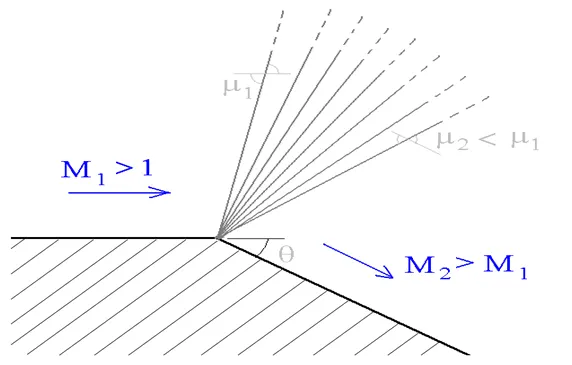
Across the expansion fan, the flow accelerates (velocity increases) and the Mach number increases, while the static pressure, temperature and density decrease. Since the process is isentropic, the stagnation properties (e.g. the total pressure and total temperature) remain constant across the fan.
Boundary Conditions:
- Dirichlet boundary condition
Solving the partial differential equation that takes prescribed value on the boundary of the region
- Neumann boundary condition
It is imposed on a ordinary or partial differential equation it specifies the value that the derivative of a solution is going to take on the boundary of the domain.
- Robin boundary condition
The robin boundary condition is a weighted combination of both dirichlet boundary and Neumann boundary condition in all parts of the boundary
Why Neumann boundary condition used for supersonic outlets?
The inflow values are mentioned that is dirichlet boundary conditions i.e. the inflow velocity of shock wave is mentioned. Whereas in the outflow Neumann boundary conditions are used because the values of the pressure, temperature, velocity, Mach no are not available they are interpolated from the inflow boundary condition so only the normal derivative of the variable are specified to zero
Case Setup:
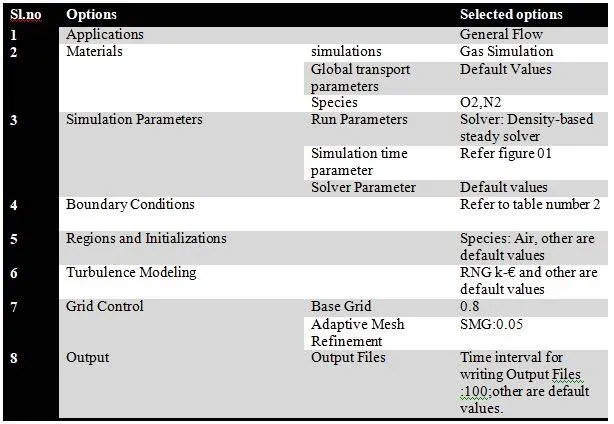
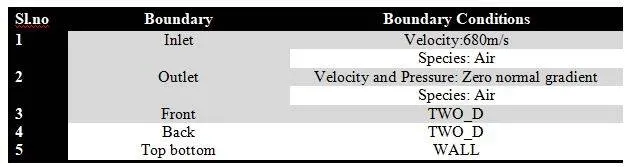
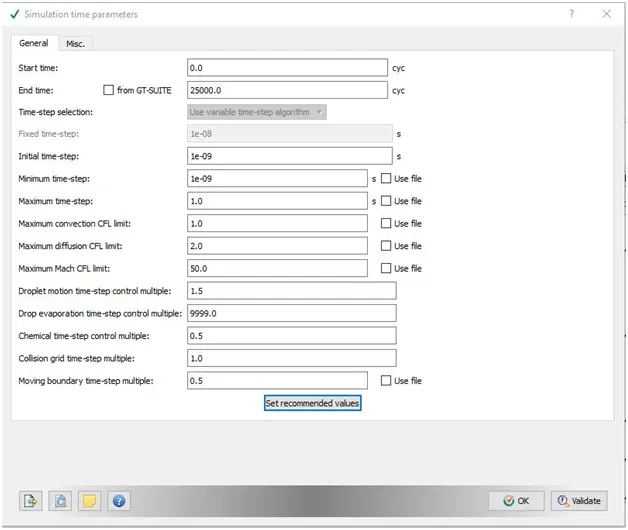
Boundary Conditions
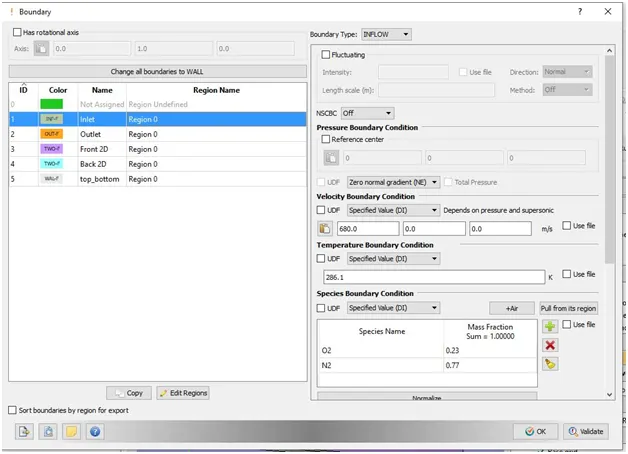
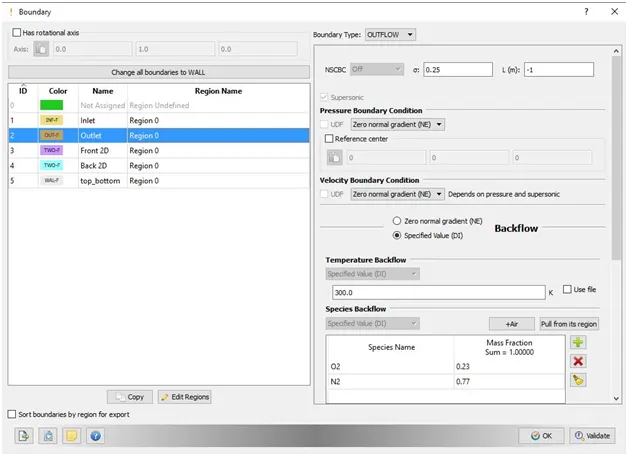
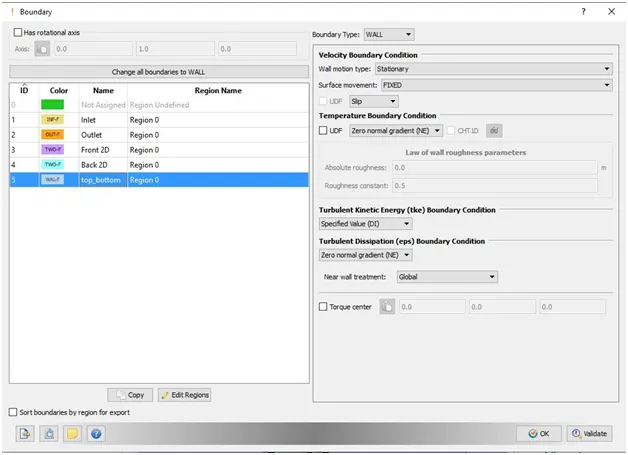
AMR
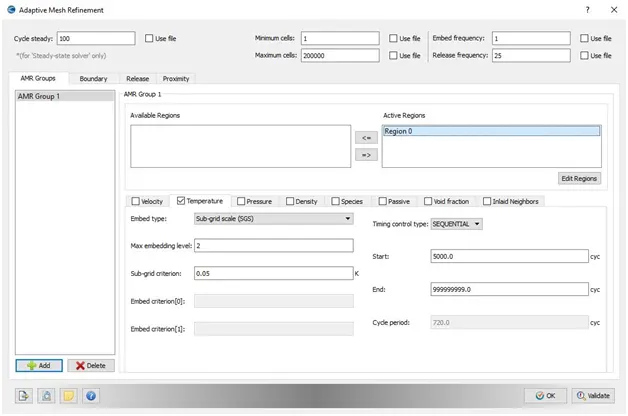
Four cases were setup
Case 1: Velocity =680m/s and SGS parameter=0.05
Case2: Velocity=680m/s and SGS parameter=0.01
CASE 1
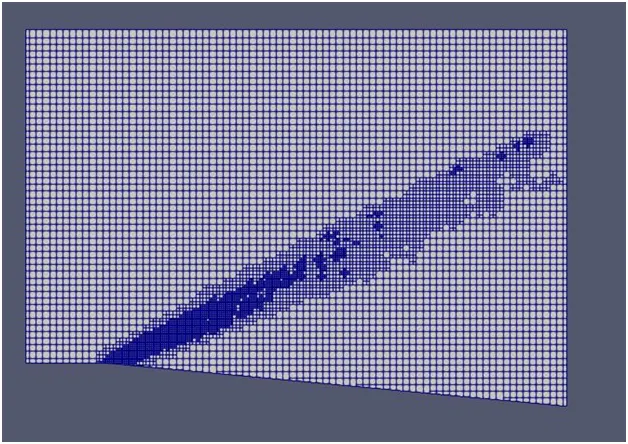
Mesh
Contour Plots
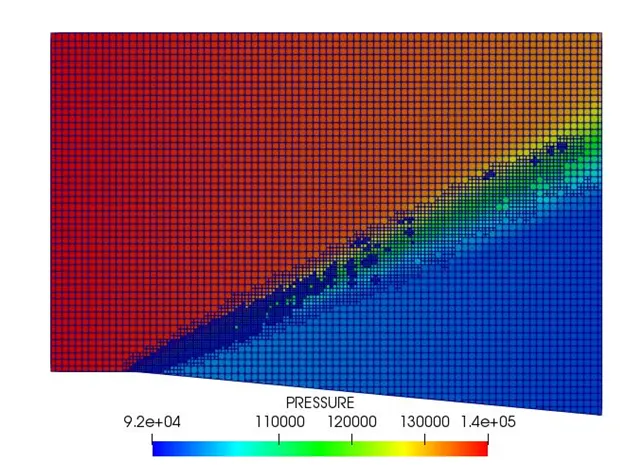
Pressure
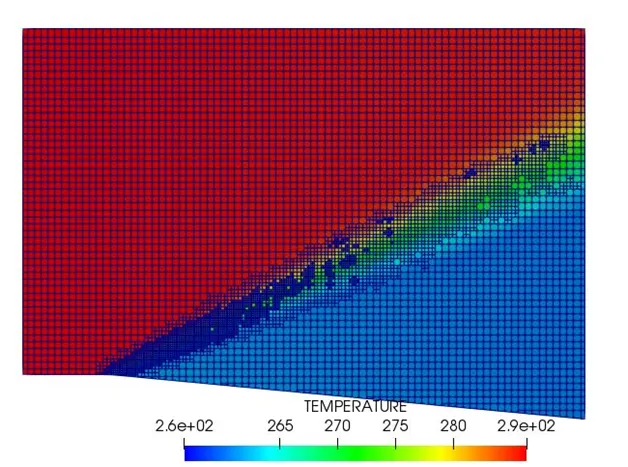
Temperature
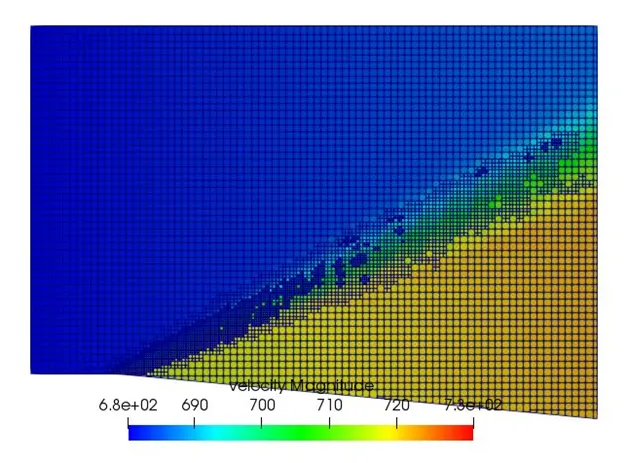
Velocity
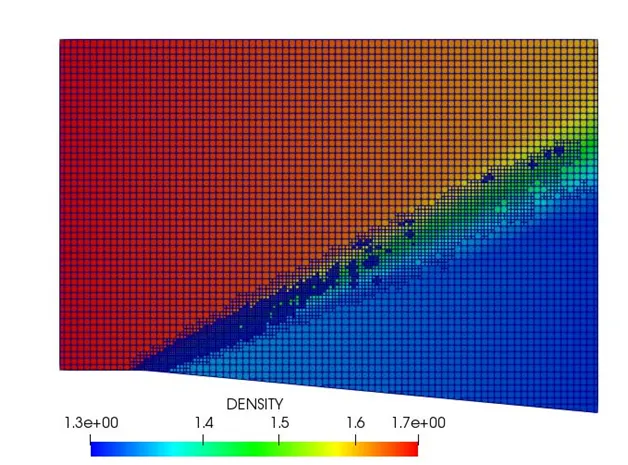
Density
Plots
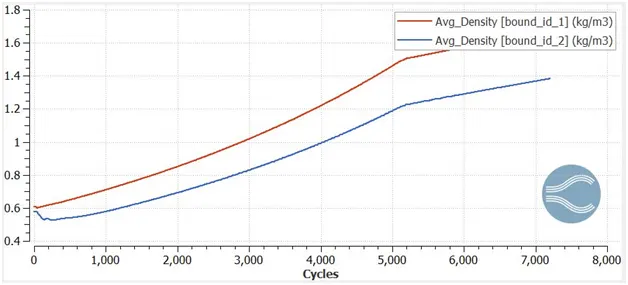
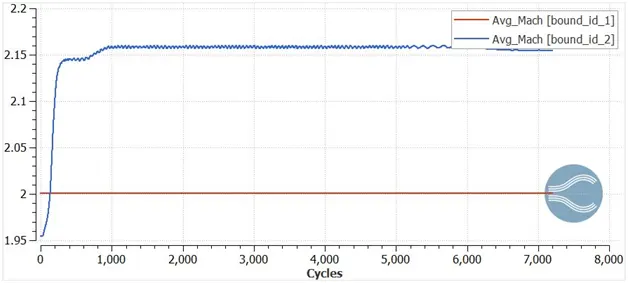
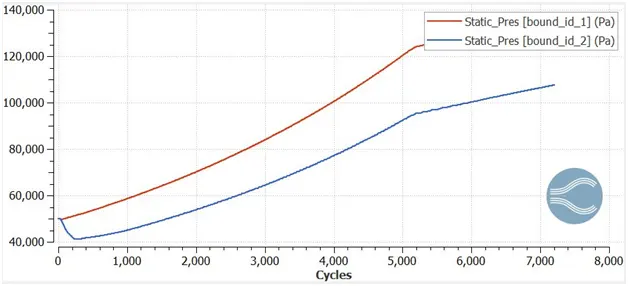
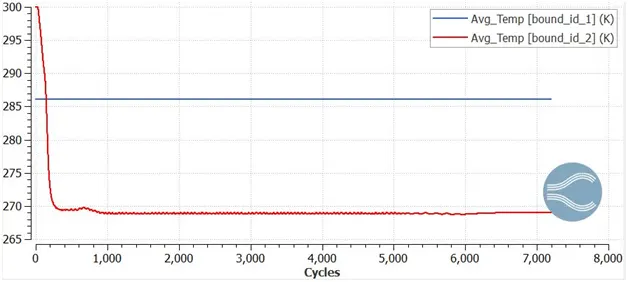
Red line-Inflow,Blue line-Outflow
From the plots we can conclude that static pressure,temperature and density at the outflow decreases,whereas the Mach number increases it is due to supersonic flow over the convex corner forming the shock and abrutly changing pressure,temperature,velocity,etc
Case 2
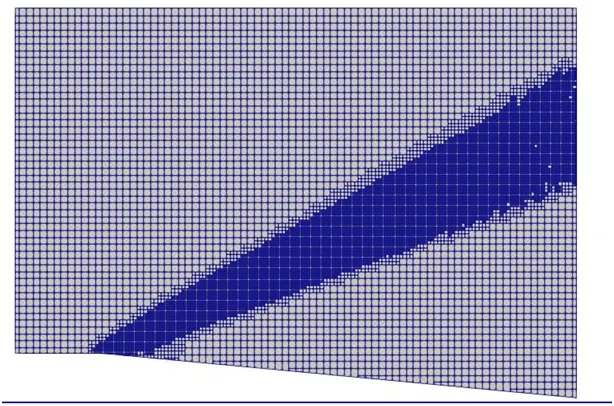
Meshing
Comparision of case 1 and case 2
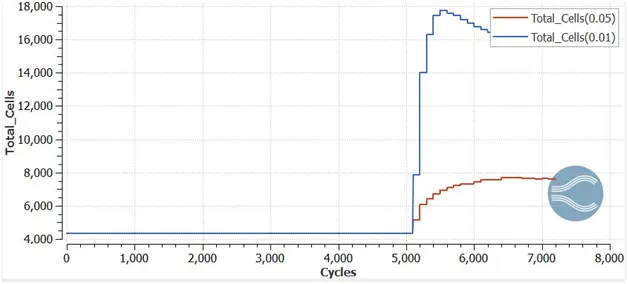
Blue-smg(0.01),Red-smg(0.05)
Lower the value of smg finner will be meshing at the shock location
Animation
Density
Pressure
Temperature
velocity
Conclusion
A simulation of supersonic flow over convex corner was setup and run in converge CFD. Various contourplots of pressure,density, mach no were studied
The formation of shock wave and the effect of SGS parameter on the shock loaction and total cell count used near shock foramtion