Week 5: Prandtl Meyer Shock problem
Introduction
This project involves the simulation of Prandtl-Meyer shock problem in a convex corner .The simulation is performed and results are post processed.
Theory
Shock Waves
Shock waves are pressure disturbances that move at a speed greater than the speed of sound i.e. M>1. There is a discontinuity across the shock wave such that there is a sudden increase in pressure , temperature and density accross the shock and where there is a decrease in speed i.e. M2 <1. Shock waves are aslo called as compression waves where entropy across the shock increases i.e. s2>s1.
2 mathematical solutions of shock waves are possible (i) where M1>1 and M2 <1 (ii) where M1<1 and M2>1 but the latter is physically impossible as there is a decrease in entropy s2<s1 which violates second law of thermodynamics.
There are many different type of shock waves namely
1.Normal Shock Waves
2.Oblique Shock Waves
Prandtl Meyer waves
When a supersonic flow is turned through a sharp corner an oblique shock is produced whereas when the same flow is turned through a smooth corner a prandtl meyer wave is produced . In case of a concave corner we get an prandtl meyer compression wave , in case of a convex corner we get an prandtl meyer expansion wave. Our focus in this project is on the prandtl meyer expansion fan.
Prandtl Meyer Expansion Fan
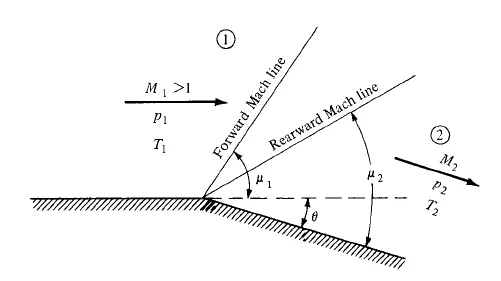
In an expansion fan , the curve produces an infinite number of Mach waves.Each wave turns the incoming flow by an infinitesmal amount `d theta` and increases the velocity by an amount of `dv` .This process is an isentropic one hence prandtl meyer expansion waves are allowed by the second law of thermodynamic.
Across the wave the velocity increases , with decrease in properties such as static pressure , temperature and density. The total pressure before and after the wave is constant as there is no change in entropy.
Each mach wave turns the flow through an angle of `mu`which is the angle made by the mach wave to the direction of flow.
In a prandtl meyer expansion fan
`(delP_2)/(delP_1)<1 ,(delT_2)/(delT_1)<1 ,(delv_2)/(delv_1)<1,M_2>M_1`
Prandtl Meyer Function
It is the angle through which a sonic flow is turned isentropically to reach a supersonic flow speed.
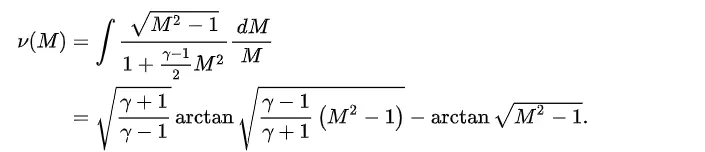
The initial mach number , final mach number and curve angle is related by

Hence if we know the initial conditions and angle of turn . We can obtain the M2 mach number. downstream
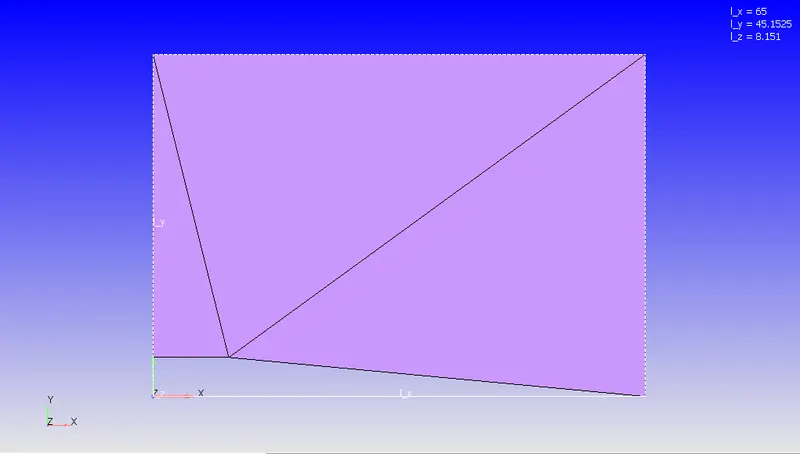
1.Geometry
The geometry is imported as a .stl file.
The required biundaries are flagged.

2.Application Type
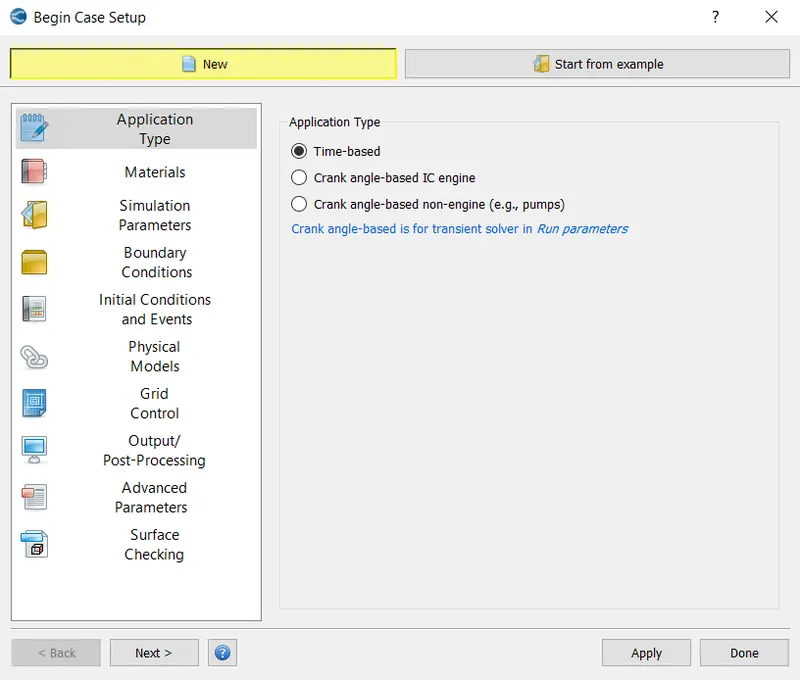
The simulation is a steady state one.Hence Time based is chosen.
3.Materials
Air is chosen as the medium.
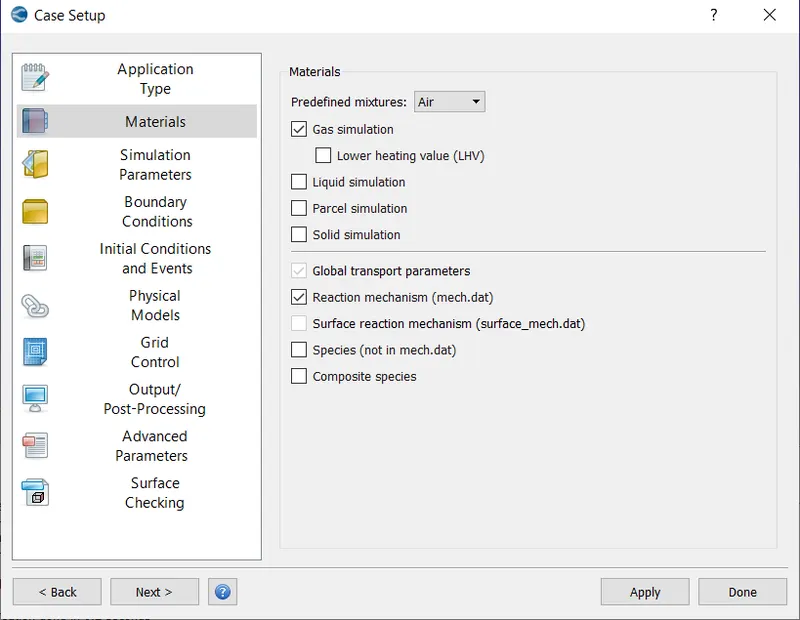
4. Simulation Parameters
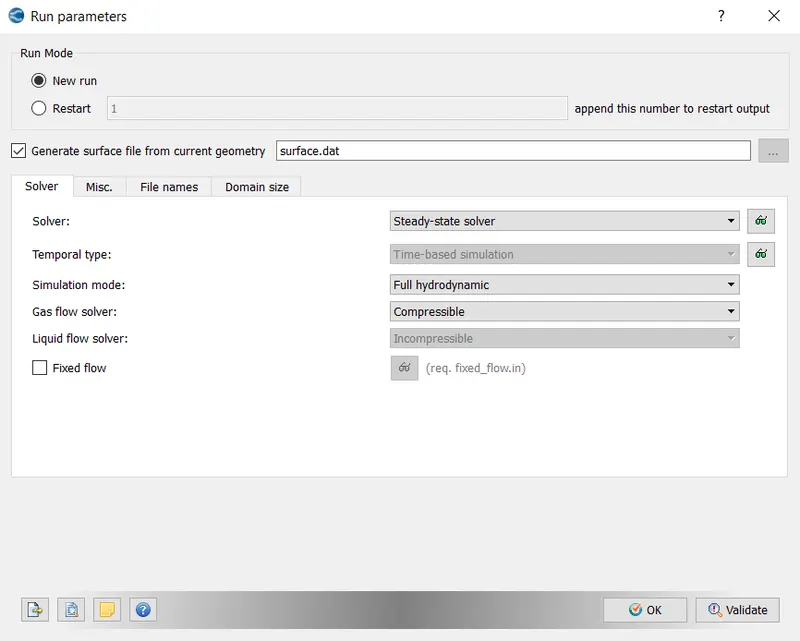
4.1 Run Parameter
The solver is chosen as a steady state solver with simulation mode as full hydrodynamic.
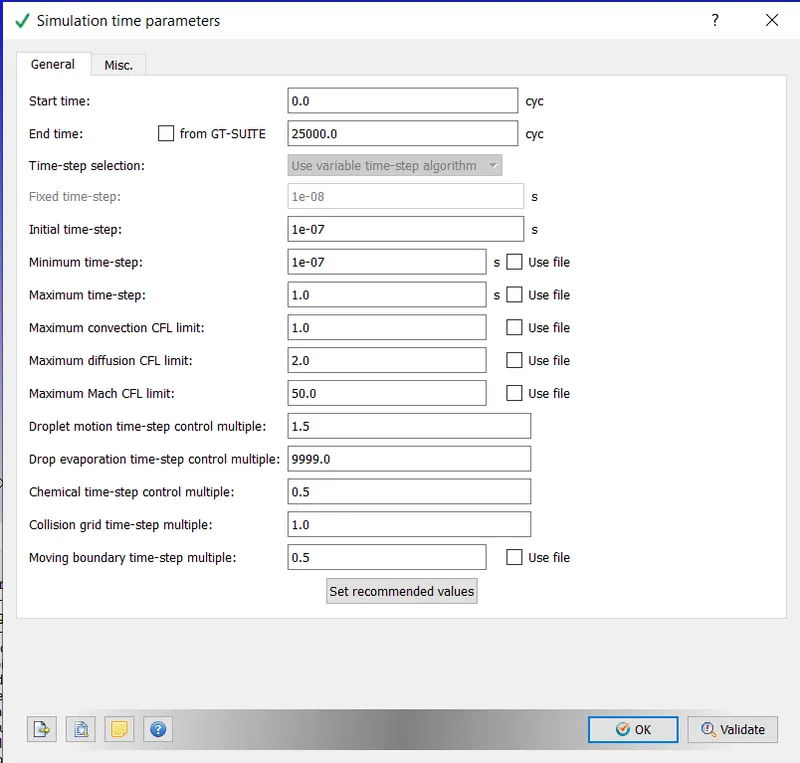
4.2 Simulation time parameters
The total number of cycles = 25000 cycs
Min time step = 1e-7s
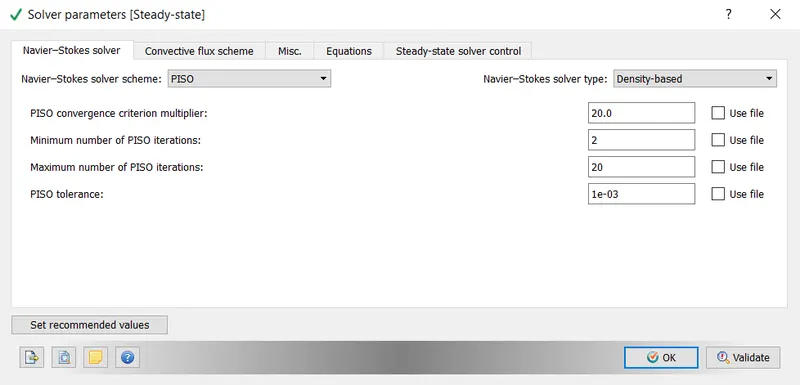
4.3 Solver Parameters
Since this is a supersonic flow , compressibilty effects have to be taken into account . Hence the navier-stokes solver type is choosen as Density based.
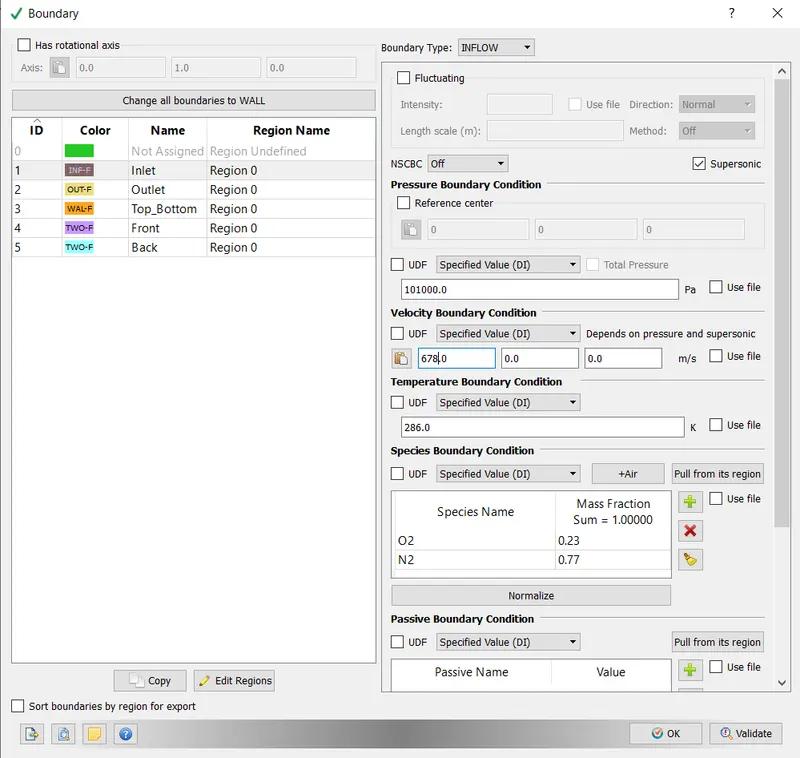
5. Boundary Conditions
The inlet conditions are known hence all the inlet boundary conditions are give as dirichlet boundary conditions.
Inlet Pressure=101000 Pa
Inlet velocity=678 m/s
Inlet Temeprature=286 K
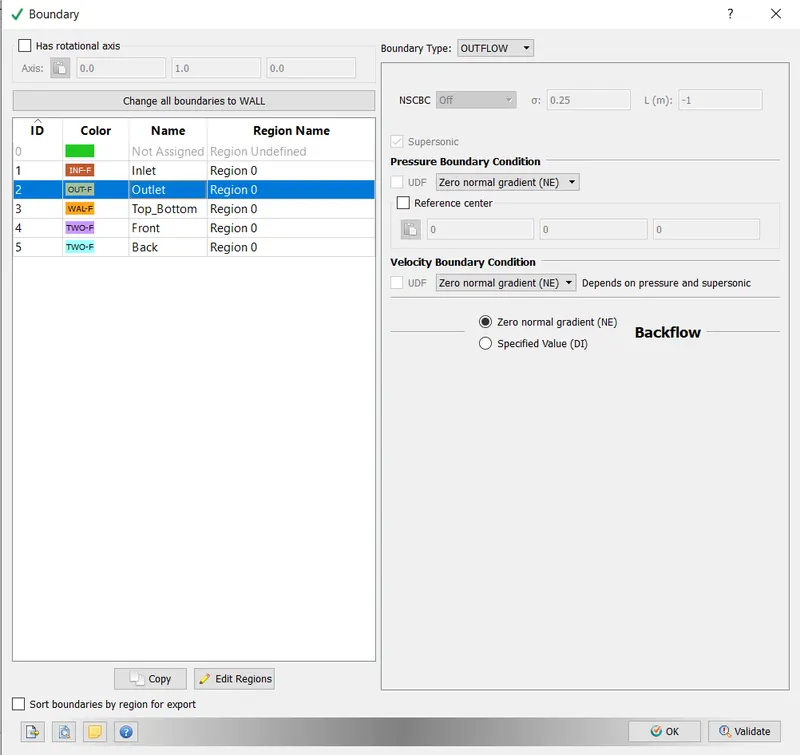
Reason for using neuman boundary condition in outlet
In the outlet for supersonic flows , the boundary conditions are unknown and are derived from the solution hence we use an neuman boundary condition for all variables at the outlet . In the neuman boundary condition the first order derivative of flow variable across the x axis is zero i.e zero normal gradient.
`(delP)/(delx)=0 , (delv)/(delx)=0 , , (delT)/(delx)=0 ,`
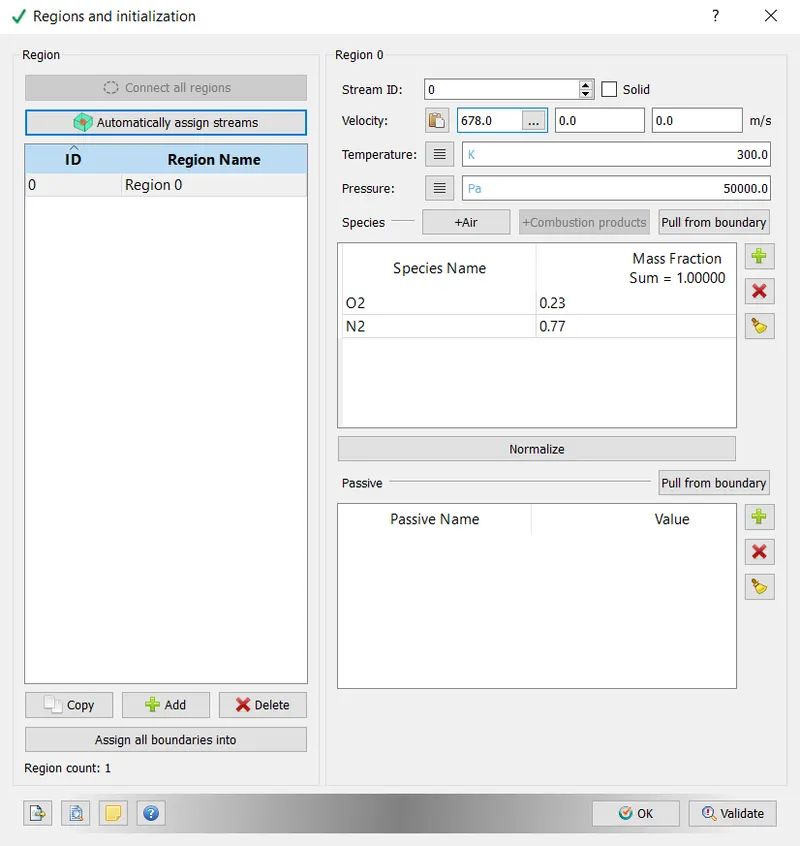
6. Inital Conditions
The initial conditiond for pressure,temperature and velocity are given
7. Grid Control
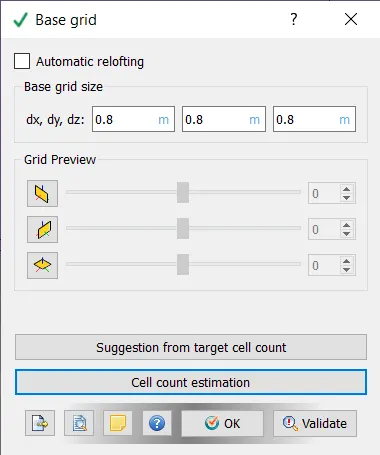
7.1 Base Mesh
A grid size of 0.8m is given in all 3 directions.
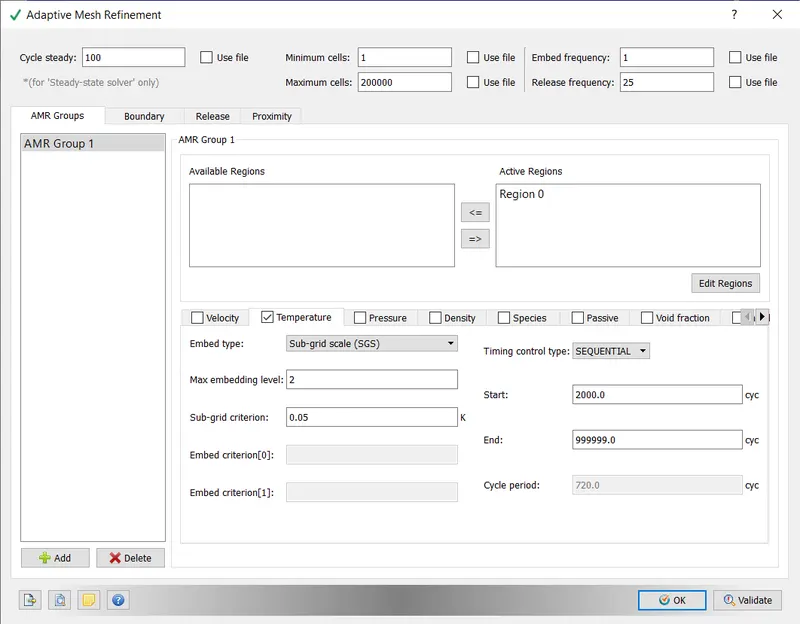
7.2 Adaptive Mesh Refinement
Adaptive Mesh Refinement(AMR) is used to refine the mesh only at places where the flow is complex . This helps to keep the cellcount lower as compared to fine tuning the entire base mesh size which in turns helps to conserve computing power which results in shorter computation time.
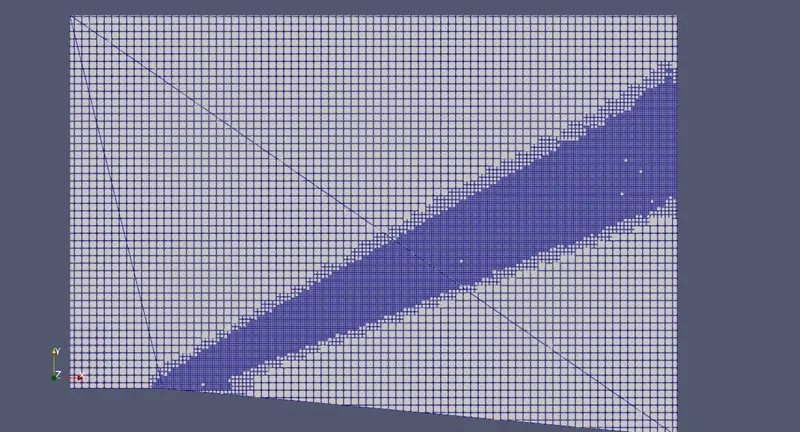
In the sub grid scale embed type the refinement depends on the SGS criterion. The SGS criterion is the second order derivative of the variable selected (curvature) in this case temperature (`(del^2T)/(delx^2)`) . If the differnece is above the user specified value (0.01K) the mesh is refined.
The embedding level defines the size of mesh as compared to the base mesh when the mesh is refined.
`mesh=(base mesh)/(2^n)` where n is the embedding level.
8. Post Processing
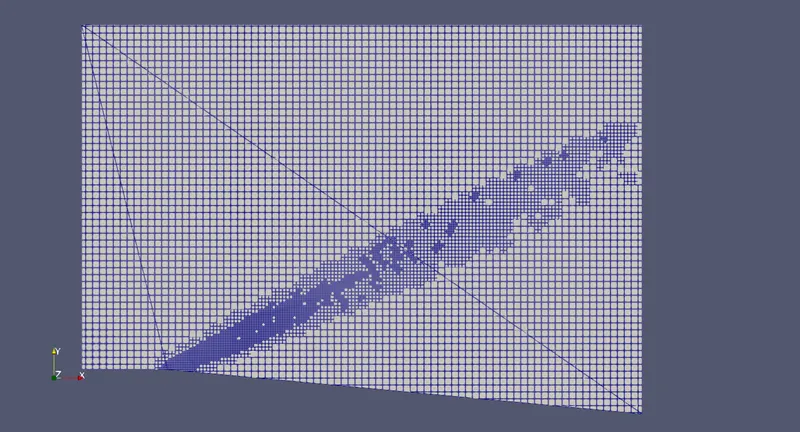
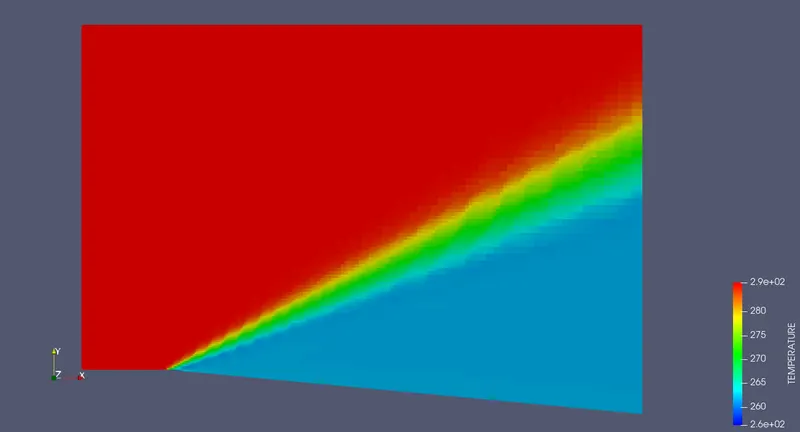
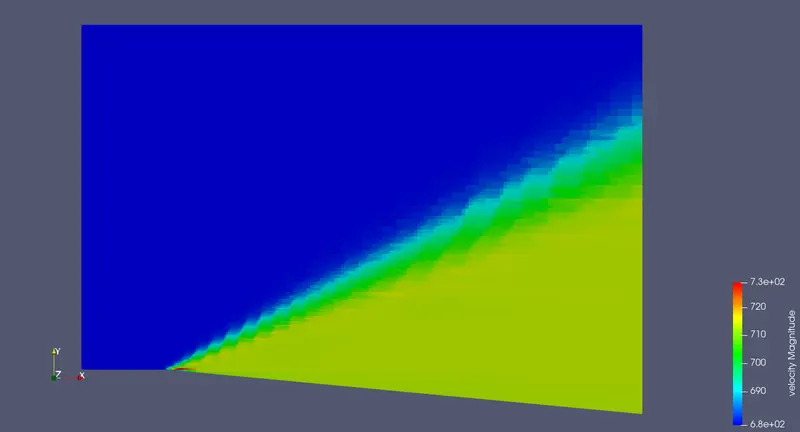
Post processing is done using paraview software.The simulation is done for 2 values of Sub Grid Scale (i)0.05K (ii)0.01K
8.1 Supersonic (M>1)
1. 0.05K
Grid
Temperature Distribution
Velocity Distribution
2.0.01K
Grid
Temperature Distribution
Velocity Distribution
Converge Plots
1.Total cell count
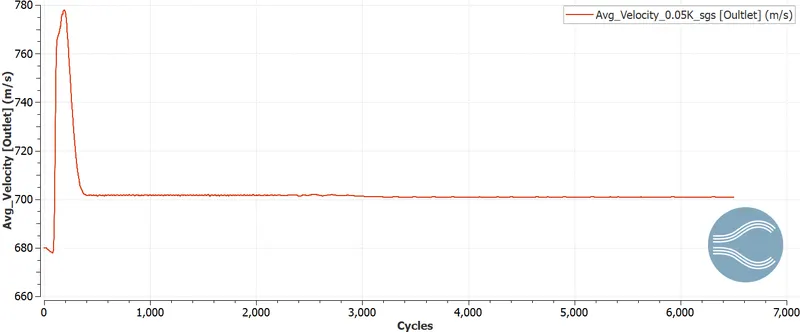
2.Average Velocity
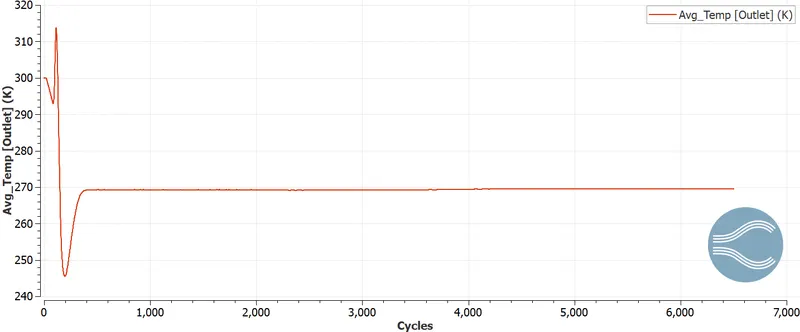
3.Average Temperatue
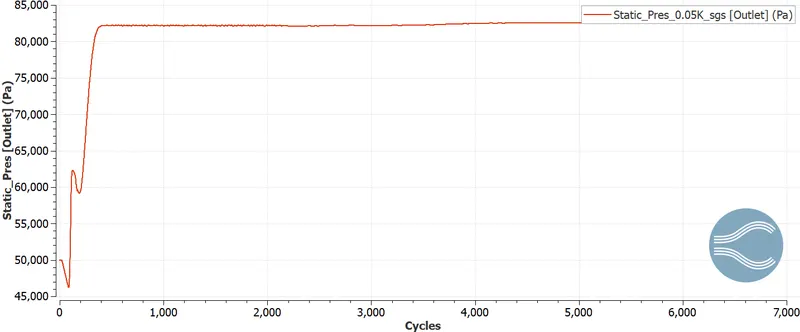
4.Static Pressure
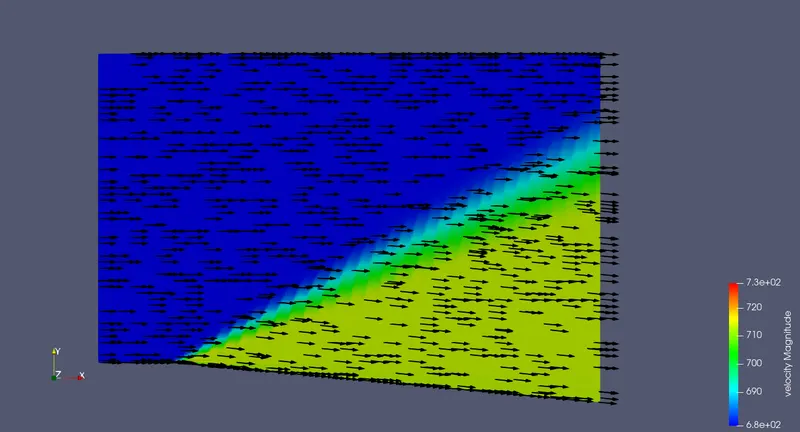
Flow Simulation
Observations
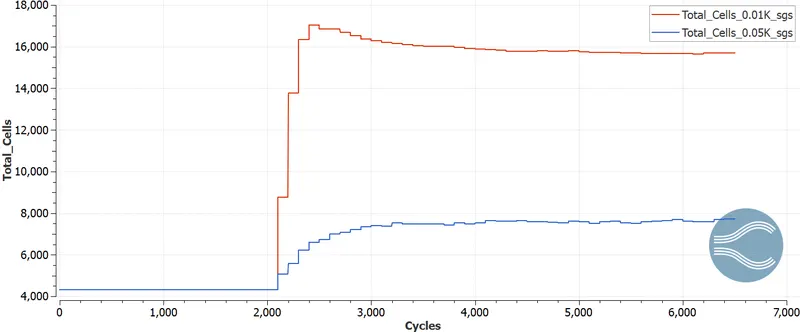
1. The value of sgs has an effect on the number of cell count as shown in the plot. Lower the sgs value higher the number of cell count.
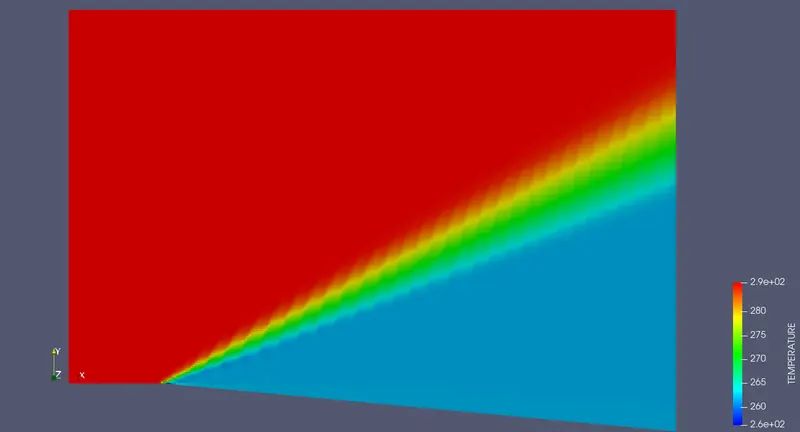
2.The value of sgs has no apparent effect on the shock location.The location of shock is highly dependent on the curve angle `theta`. Upto a maximum value of `theta` the shock is attatched and with angles greater than that of `theta_max` the shock becomes detached from the corner.
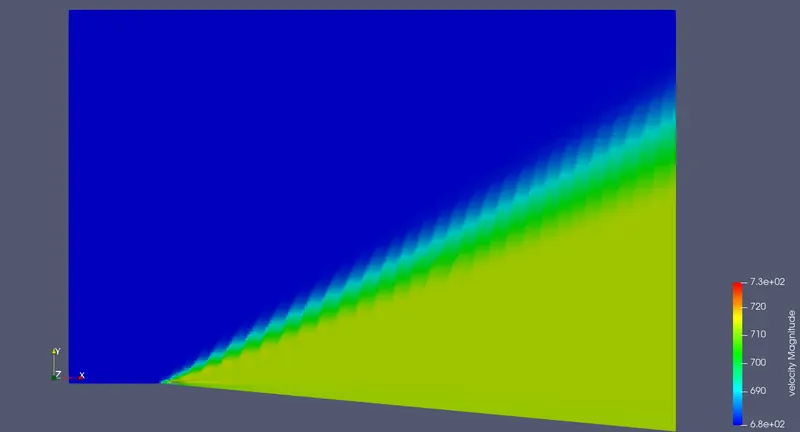
2. The outlet flow variables of pressure , temperature , velocity are greater than that of the inlet which is the characteristic of the prandtl meyer expansion fan.
3.The value of M2 is greater than that of M1.
Local speed of sound a = `root ()(gammaRT)` =`root()(1.4*287*286) = 338`m/s
Inlet mach number (M1) = u1/a = 679/338 = 2
Local speed of sound a = `root()(1.4*287*269)=328`m/s
Outlet mach number (M2) = u2/a = 700/328 = 2.134
Hence M2>M1 . Characteristic of an expansion wave.
4.The prandtl meyer expansion fan is clearly visible from the simulation.