Week 5: Prandtl Meyer Shock problem
AIM: run a Simulation on Sub_Sonic waves as well as Super_Sonic Waves.
INTRODUCTION: MACH Number(M)
it is the the ratio of the seed of the body to the speed of sound in the surrounding meadium.
M=u/c
M---->Mach Number
u----->limit of the flow of Velocity
c------->speed of Sound.
if M>1------>Super Sonic Speed
if M<=0.75----->Sub Sonic Speed.
THEORY:
As there are many types of Shock Waves but since we are simulating the Adibatic Shock waves in a Convergence Software hence it will discuss the Physics of Shock Adiabatics.
1>Shock Waves
it is a strong Pressure Waves in an Elastic Meadium such as air, Water or any Solid Material Ejected from Explosion or Lightening or other Phenomena that creates Variation in Pressure.
SHOCK ADIABATIC
we know that the tangential component of Gas Velocity is of Continous.
We can therefore take a coordinate system in which the surface element considered is at rest, and the tangential component of the gas velocity is zero on both sides.
D1v1=D2v2=j (1)
P1+D1(v1)^2=P2+D2(v2)^2 (2)
w1+0.5(v1)^2=w2+0.5(v2)^2 (3)
j-------->Mass Flux Density at surface if Disconitnuity
D1----->Mass Density Inlet
D2------->Mass Density Outlet
P1------>Inlet Pressure
P2-------->Outlet Pressure
w1--------->Angular Velocity at Inlet
w2------------>Angular Velocity at Outlet
v1------------>Inlet Average Velocity
v2------------->Outlet Average Velocity
We Shall Take j as Positive of a Gas going from Inlet to Outlet..
this is what we called the Gas moving at Inlet onto which the Shock waves moves, and the Gas at Outlet remains Behind Shock Waves.
using specific Volume ie (V1=1/D1), (V2=1/D2)
From Eq (1)
v1=jV1, v2=jV2; (4)
V1------>Specific Volume at Inlet
V2-------->Specific Volume at Outlet
Substitute Eq1 from Eq2
P1+(j)^2V1=P2+(j)^2V2 (5)
hence
(j)^2=(P2-P1)/(V1-V2) (6)
this Formula Together relates the Propogation of the Shock Waves to the Pressure and Density of the Gas on Inlet and Outlet Boundary.
Hence by Solving
(v1-v2)= Sqr Root of [(P2-P1)(V1-V2)] (7)
w1+0.5(j)^2V1=w2+0.5(j)^2V2 (8)
Now Subsitute From Eq 6
w1-w2+0.5(V1+V2)(P1+P2)=0 (9).
EXPERIMENT
1> COMMON THINGS FOR BOTH
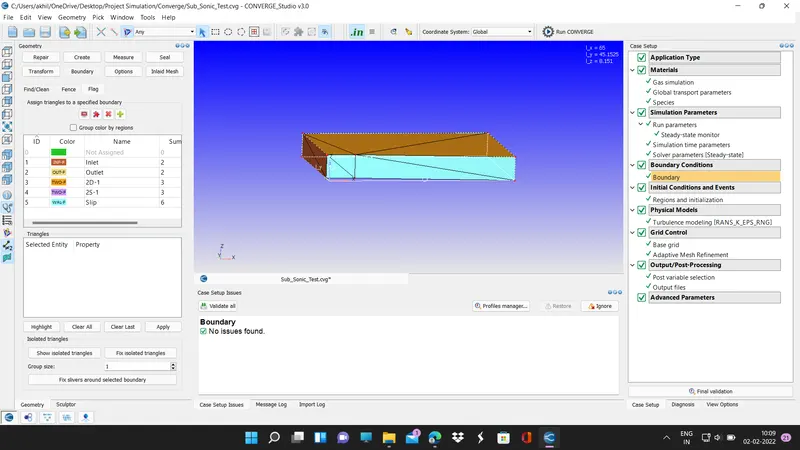
1.1> BOUNDARY CONDITION
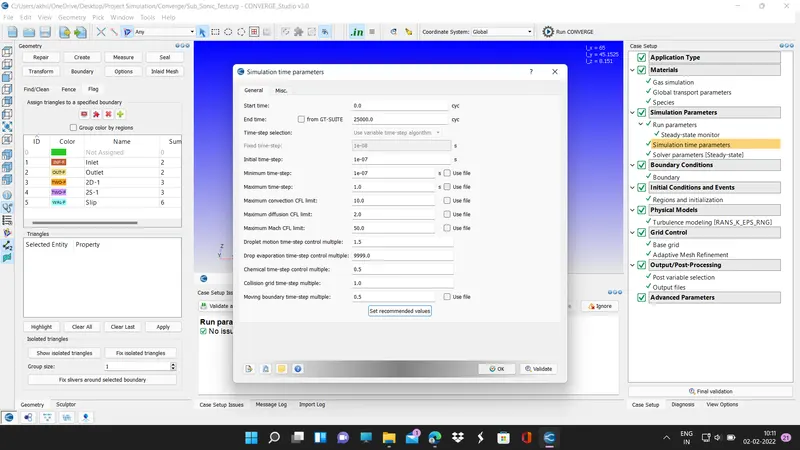
1.2> Simulation Time Parameters
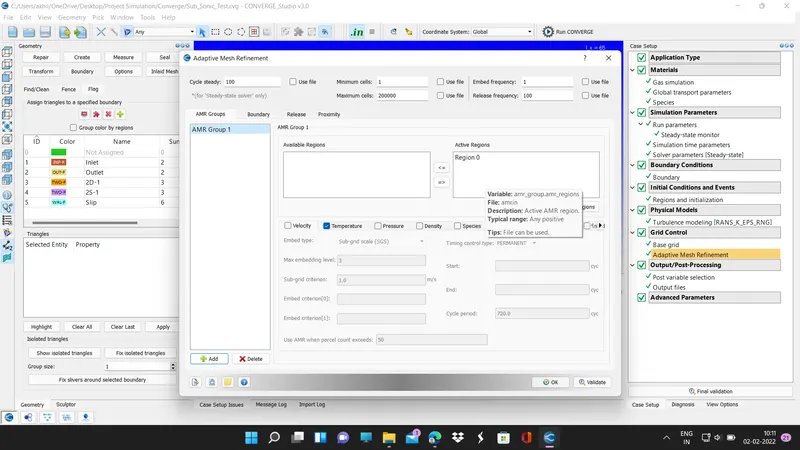
1.3> Adaptive Mesh Refinements
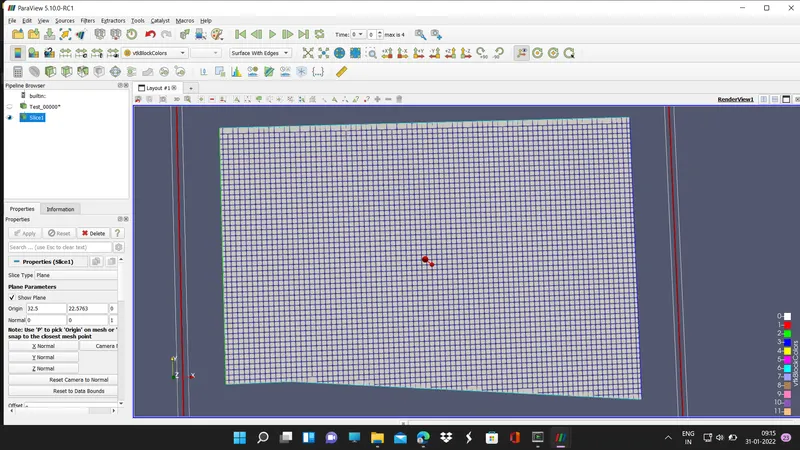
1.4> SURFACE WITH EDGES
2> SUB SONIC WAVES.
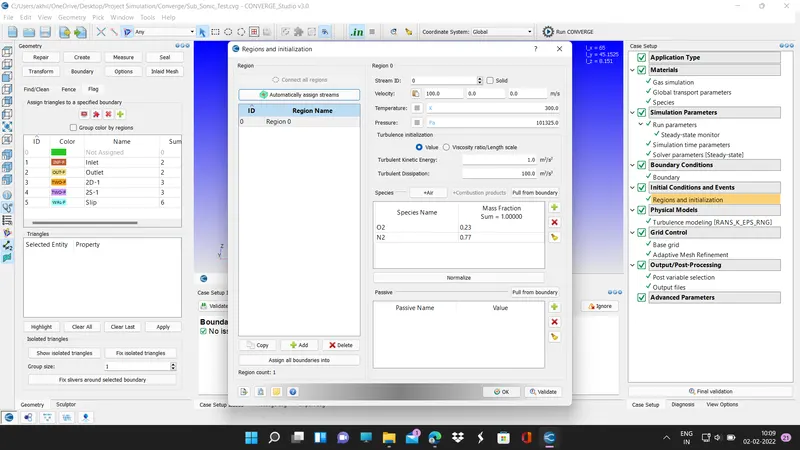
2.1> INITIALISATION
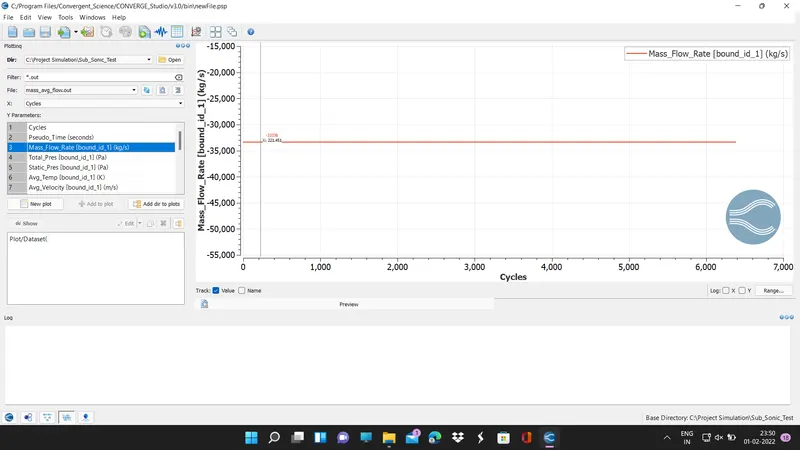
2.2> INLET MASS FLOW RATE
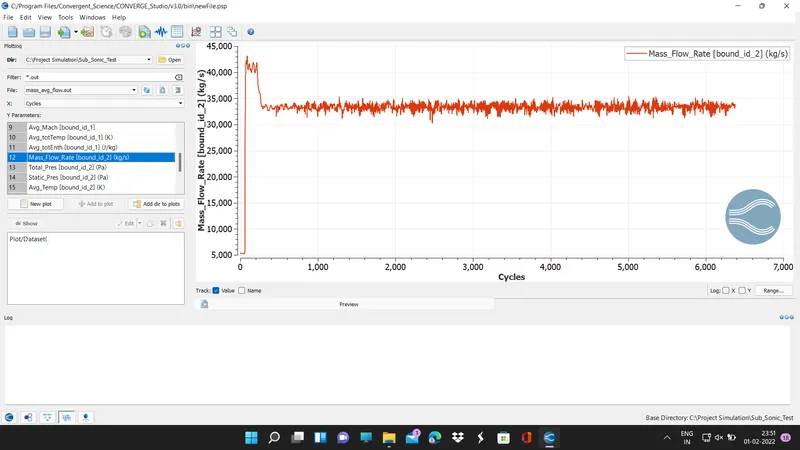
2.3 OUTLET MASS FLOW RATE
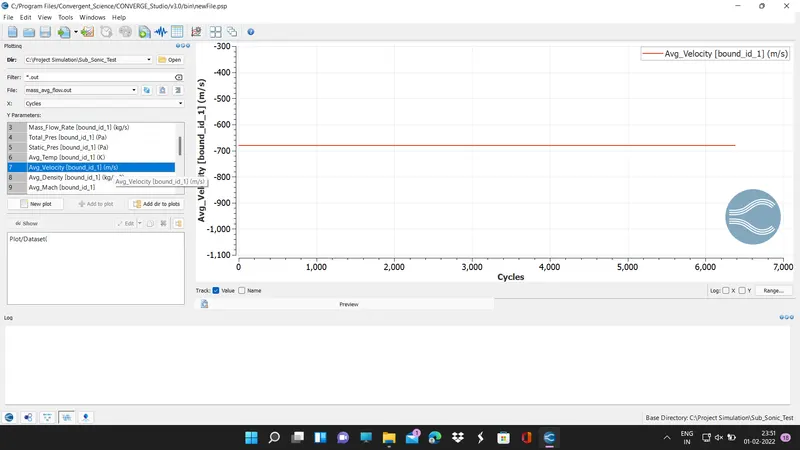
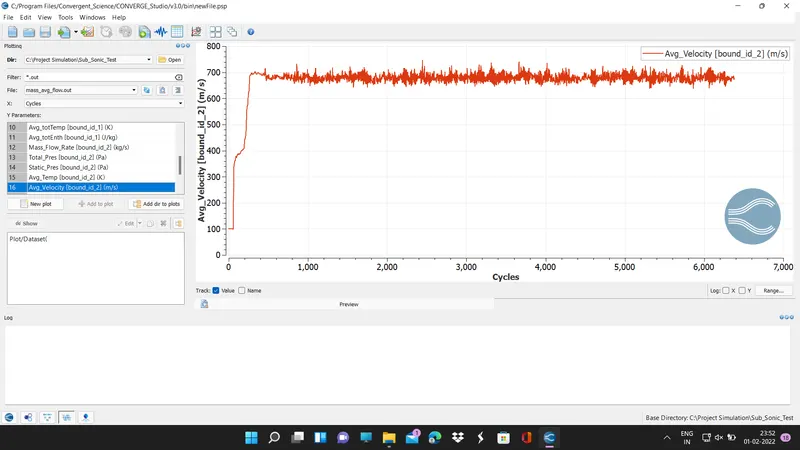
2.4> Inlet Average Velocity
2.5> Outlet Average Velocity
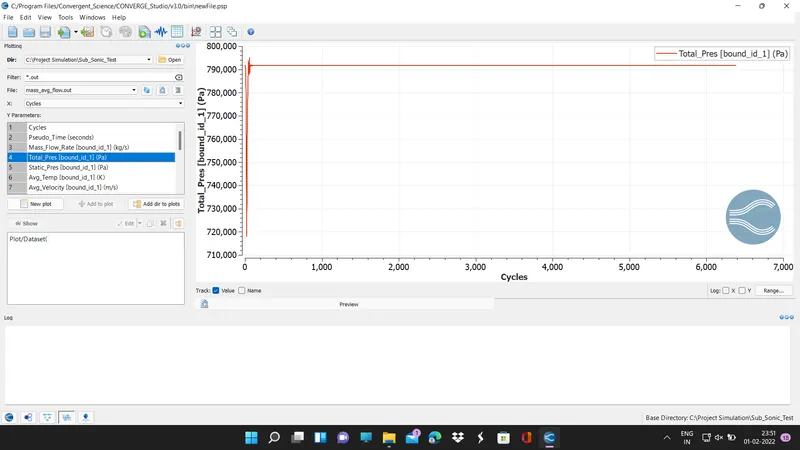
2.6> Inlet Total Pressure
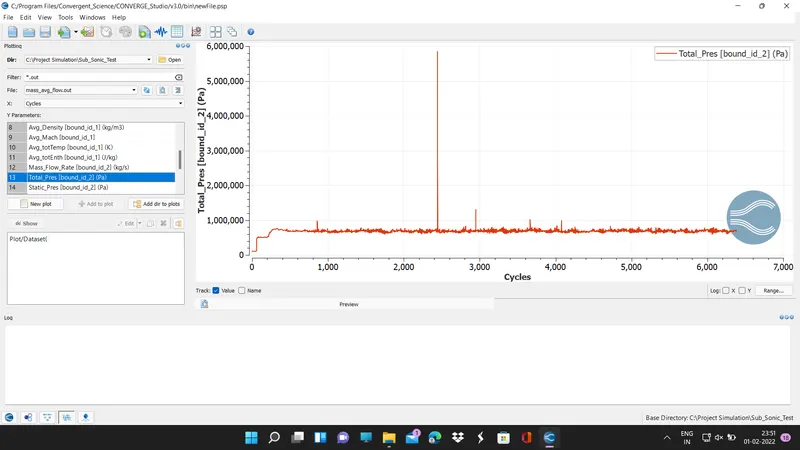
2.7> Outlet Total Pressure
3> SUPER SONIC WAVES
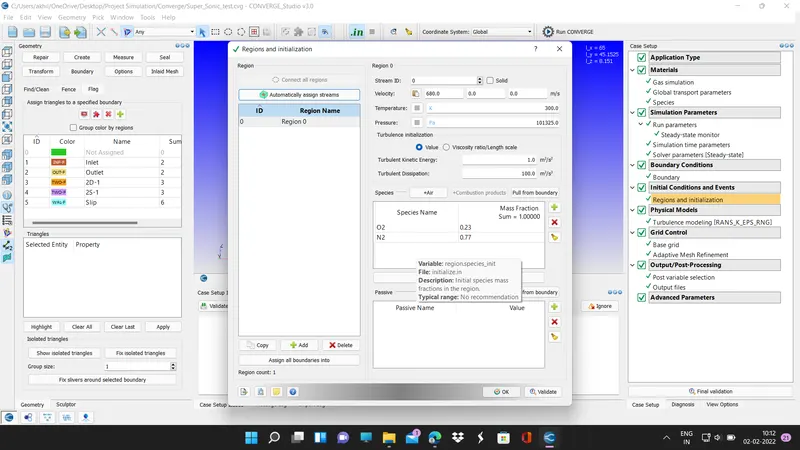
3.1> INITIALISATION
3.2> INLET MASS FLOW RATE
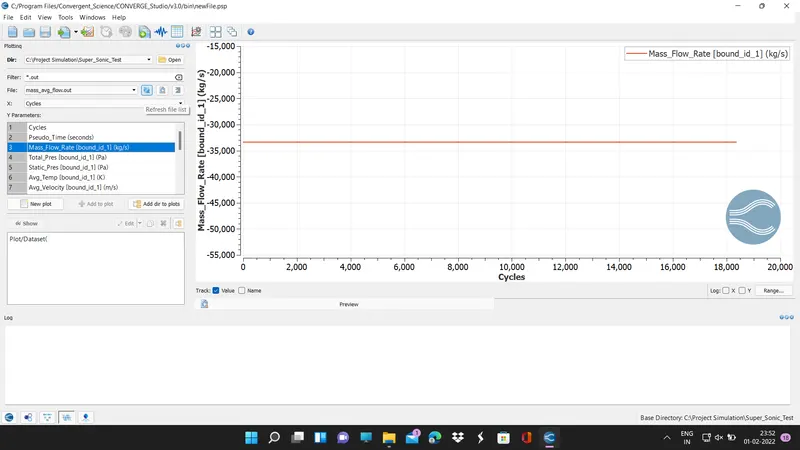
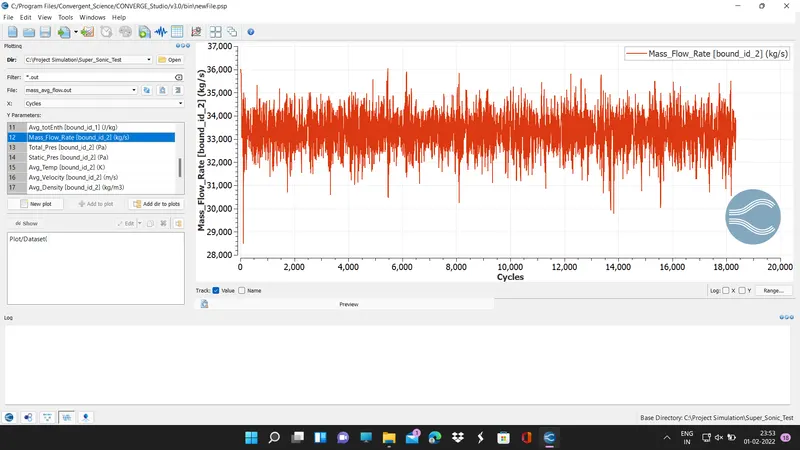
3.3> OUTLET MASS FLOW RATE
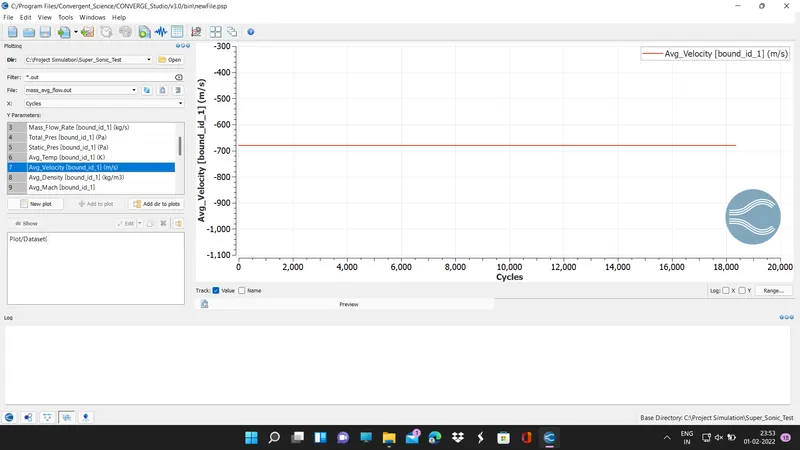
3.4> Inlet Average Velocity
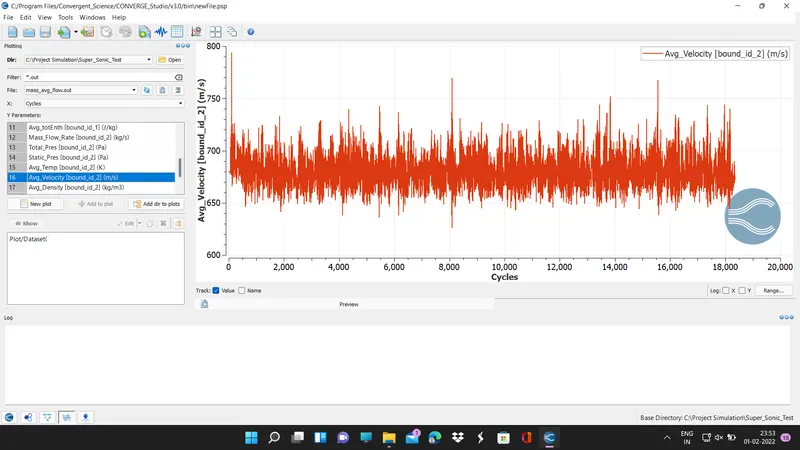
3.5> Outlet Average Velocity
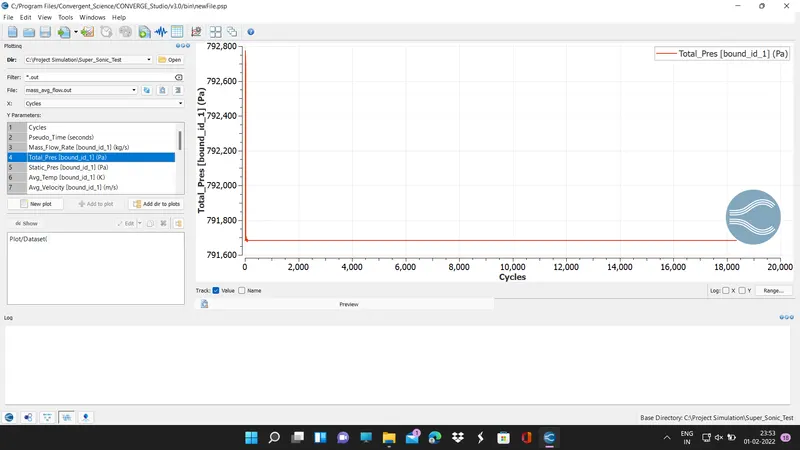
3.6> Inlet Total Pressure
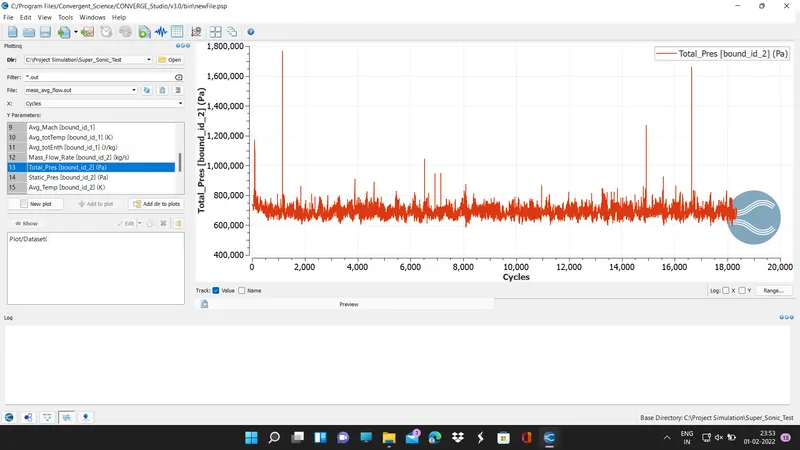
3.7> Outlet Total Pressure
4> LINKS
4.1> PARAVIEWS
4.2> FILES
https://drive.google.com/drive/folders/1XIaKinty11bXQtLuOv9Dija08_6hovkb?usp=sharing
https://drive.google.com/drive/folders/1eGk23dcpT-ocXgtfJuizNwgpJW-HqvY9?usp=sharing
5>CONCLUSION: the Sub Sonic and Super Sonic Shock waves have been Succesfully Simulated.