Week 5 - Literature review: ODE Stability
AIM: To write the literature review for ODE and to write the computer program to subtantiate the solution.
Introduction:
Ordinary differential equation (ODE) is a differential equation containing one or more functions of one independent variable and the derivatives of those functions.
The term ordinary is used in contrast with the term partial differential equation which may be with respect to more than one independent variable.
Stability:
condition in which a slight disturbance in a system does not produce too disrupting an effect on that system.
In terms of the solution of a differential equation, a function f(x) is said to be stable if any other solution of the equation that starts out sufficiently close to it when x = 0 remains close to it for succeeding values of x.
If the difference between the solutions approaches zero as x increases, the solution is called asymptotically stable. If a solution does not have either of these properties, it is called unstable.
Consider,
dy/dt = -1000*y- (e^-t)

(y^(n+1) - y^(n))/delta(t) = -1000*(y^n) - (e^-t)

y^(n+1) = y^n - 1000*y^n*delta(t) - (e^-t)


Implicit Backward differencing:

(y^n - y^(n-1))/delta(t) = -1000*(y^n) - (e^-t)

y^n = (-1000*(y^n) - (e^-t))*delta(t) + y^(n-1)

y^n - ((-1000*(y^n) - (e^-t))*delta(t)) = y^(n-1)

y^N = y^(n-1) - (e^-t)*delta(t) /(1+1000*delta(t))
Results:
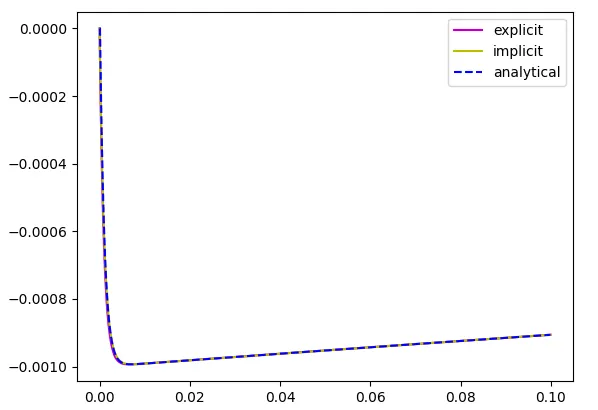
de = 1e-4:
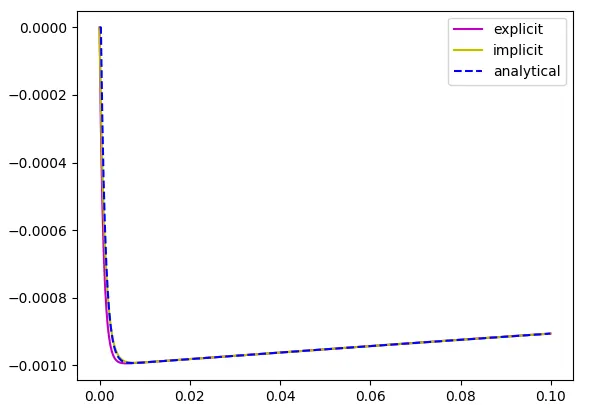
de = 3e-4:
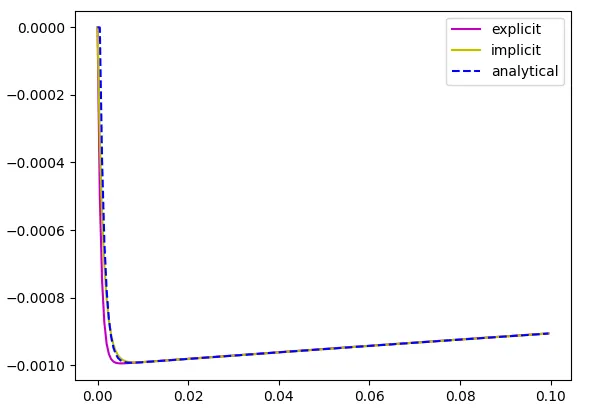
de = 5e-4:
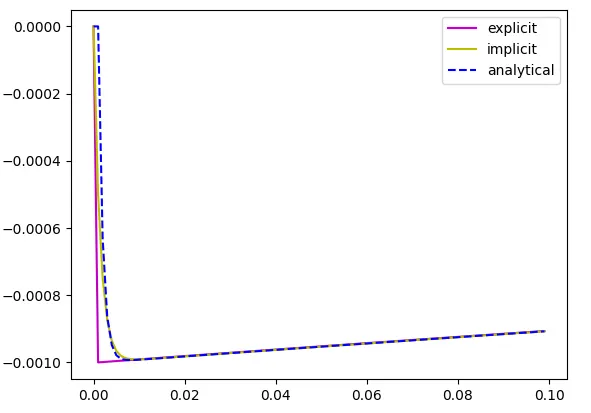
de = 10e-4:
de = 15e-4:
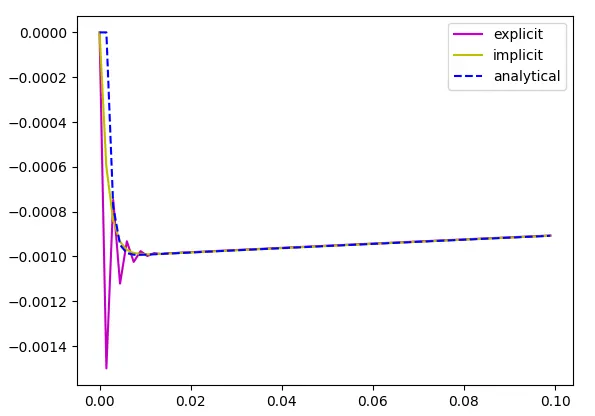
de = 20e-4:
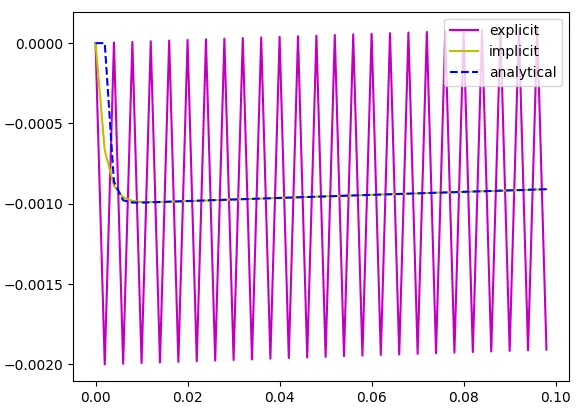
When does a ODE become unstable?
In Explicit case the ODE is unstable if the number of sub intervals are less or the size of the time step is more, therefore grid size is more.
For Implicit, for all the sub interval values the system is stable.
How does stability affect engineering simulations?
In engineering simulations, we get number of errors when we solve the problems. In order to get the perfect results we need to stabilize the solution or should decrease the errors as per the problem so that we get stable results to proceed the work.
Can stability condition be derived for all types of problems?
- If the problem is well-conditioned then there is a stable way to solve it.
- If the problem is ill-conditioned then there is no reliable way to solve it in a stable
way.