Week 5 - Genetic Algorithm
Aim
Write a code in MATLAB to optimize the stalagmite function and find the global maxima of the function.
Genetic algorithm:
In computer science and operations research, a genetic algorithm (GA) is a metaheuristic inspired by the process of natural selection that belongs to the larger class of evolutionary algorithms (EA). Genetic algorithms are commonly used to generate high-quality solutions to optimization and search problems by relying on biologically inspired operators such as mutation, crossover and selection. Some examples of GA applications include optimizing decision trees for better performance, solving sudoku puzzles hyperparameter optimization, etc.
‘’Syntax for GA’’
x = ga(fun,nvars)
x = ga(fun,nvars,A,b)
x = ga(fun,nvars,A,b,Aeq,beq)
x = ga(fun,nvars,A,b,Aeq,beq,lb,ub)
x = ga(fun,nvars,A,b,Aeq,beq,lb,ub,nonlcon)
x = ga(fun,nvars,A,b,Aeq,beq,lb,ub,nonlcon,options)
x = ga(fun,nvars,A,b,[],[],lb,ub,nonlcon,IntCon)
x = ga(fun,nvars,A,b,[],[],lb,ub,nonlcon,IntCon,options)
x = ga(problem)
|
fitnessfcn |
Fitness functions |
|
|
nvars |
Number of design variables |
|
|
Aineq |
A matrix for linear inequality constraints |
|
|
Bineq |
b vector for linear inequality constraints |
|
|
Aeq |
Aeq matrix for linear equality constraints |
|
|
Beq |
beq vector for linear equality constraints |
|
|
lb |
Lower bound on x |
|
|
ub |
Upper bound on x |
|
|
nonlcon |
Nonlinear constraint function |
|
|
rngstate |
Optional field to reset the state of the random number generator |
|
|
solver |
'ga' |
|
|
options |
Options created using optimoptions or exported from the Optimization app |
Ga syntex explaination:
x = ga(fun,nvars) finds a local unconstrained minimum, x, to the objective function, fun. nvars is the dimension (number of design variables) of fun.
x = ga(fun,nvars,A,b) finds a local minimum x to fun, subject to the linear inequalities A*x ≤ b. ga evaluates the matrix product A*x as if x is transposed (A*x').
x = ga(fun,nvars,A,b,Aeq,beq) finds a local minimum x to fun, subject to the linear equalities Aeq*x = beq and A*x ≤ b. (Set A=[] and b=[] if no linear inequalities exist.) ga evaluates the matrix product Aeq*x as if x is transposed (Aeq*x').
x = ga(fun,nvars,A,b,Aeq,beq,lb,ub) defines a set of lower and upper bounds on the design variables, x, so that a solution is found in the range lb ≤ x ≤ ub. (Set Aeq=[] and beq=[] if no linear equalities exist.)
x = ga(fun,nvars,A,b,Aeq,beq,lb,ub,nonlcon) subjects the minimization to the constraints defined in nonlcon. The function nonlcon accepts x and returns vectors C and Ceq, representing the nonlinear inequalities and equalities respectively. ga minimizes the fun such that C(x) ≤ 0 and Ceq(x) = 0. (Set lb=[] and ub=[] if no bounds exist.)
x = ga(fun,nvars,A,b,Aeq,beq,lb,ub,nonlcon,options) minimizes with the default optimization parameters replaced by values in options. (Set nonlcon=[] if no nonlinear constraints exist.) Create options using optimoptions.
x = ga(fun,nvars,A,b,[],[],lb,ub,nonlcon,IntCon) or x = ga(fun,nvars,A,b,[],[],lb,ub,nonlcon,IntCon,options) requires that the variables listed in IntCon take integer values.
x = ga(problem) finds the minimum for problem, where problem is a structure.
[x,fval] = ga(___), for any previous input arguments, also returns fval, the value of the fitness function at x.
What is stalagamite function:
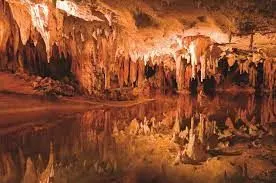
A stalagmite is an upward-growing mound of mineral deposits that have precipitated from water dripping onto the floor of a cave. Most stalagmites have rounded or flattened tips. There are many other types of mineral formations found in caves.
;%challange for genectic algorithem
clear all
close all
clc

x=linspace(0,0.6,150);
y=linspace(0,0.6,150);
num_cases=50;
%to create a two dimensional mesh
[xx yy]=meshgrid(x,y);
%evaluate the stalagmite function
for i=1:length(xx);

    for j=1:length(yy);
        input_vector(1)=xx(i,j);
        input_vector(2)=yy(i,j);
        f(i,j)=stalagmite(input_vector);
    end
end
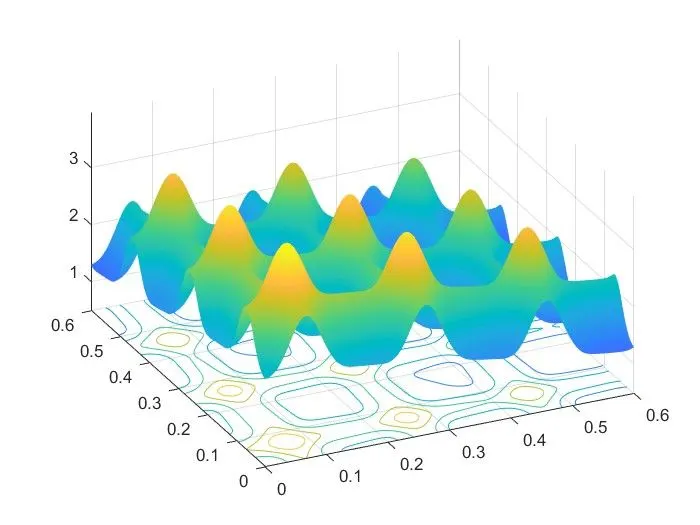
surfc(xx,yy,f)
shading interp
tic
%study stalagmite functions
for i=1:num_cases
[input,fopt(i)]=ga(@stalagmite,2);
xopt(i)=input(1)
yopt(i)=input(2)
end
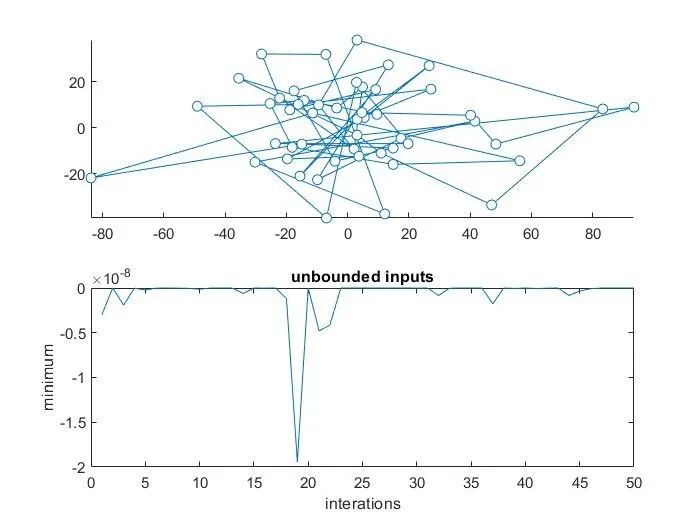
figure(2)
subplot(2,1,1)
hold on
surfc(x,y,-f)
shading interp
plot3(xopt,yopt,fopt,Marker="o",MarkerFaceColor="auto")
subplot(2,1,2)
plot(-fopt)
title('unbounded inputs')
xlabel('interations')
ylabel('minimum')
studytime=toc

%STUDY2

% study 2 - statistical behaviuor - with upper and lower bounds
tic
for i = 1:num_cases
     [inputs, fopt(i)] =  ga(@stalagmite,2,[],[],[],[],[0:0],[1:1]);
     xopt(i) = inputs(1);
     yopt(i) = inputs(2);
end

fopt = -fopt
f = -f

figure(3)
subplot(2,1,1)
hold on
surfc(x,y,f)
shading interp
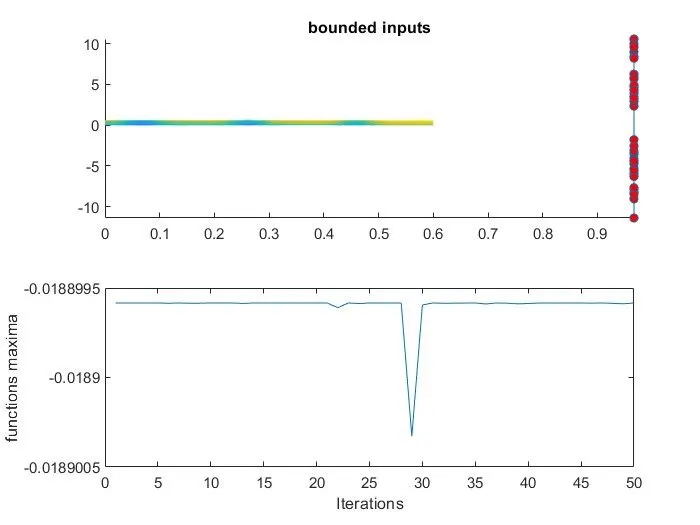
plot3(xopt, yopt, fopt, 'marker', 'o', 'markersize', 5, 'markerfacecolor', 'r')
title('bounded inputs')
subplot(2,1,2)
plot(fopt)
xlabel('Iterations')
ylabel('functions maxima')
resuts are below :
errors faced:
during program i faced lot of erros related to ga function i forget to screen shot it but i over come the erros with continbservation.
conclusion:
finelly we conclude with we study the stalagmite function with the help of ga function in m matlab