Week 5 Challenge
SOLUTION 1)
Solution: "FALSE"
Battery is not a better choice in the given driving scenario.
Battery:
- A battery converts chemical energy to electrical energy and it is reversible in chemical reactions.
- They have low power density
- less life and the battery charge/ Discharge process is relatively slower.
Ultra-Capacitor:
- Ultracapacitors are also known as supercapacitors.
- The source of energy is electrical energy.
- They are a very high energy density.
- As the Ultra capacitors are bigger capacitors, they store a large amount of electrical charge than the chemical batteries.
- They are having high power density.
- Ultra capacitors undergo a quick charge and discharge rate.
Result:
As per the above comparison between battery and ultra capacitor, it is understood that Ultra capacitors are more suitable for vehicles that accelerate and decelerate very frequently.
SOLUTION 2)
Energy Density: It is the measure of how much energy a battery contains in proportion to its weight. This measurement is typically presented in watt-hours/kilogram. The higher the energy density, the longer the runtime.
Lead Acid batteries:
Lead-acid batteries have relatively low energy density.
Nickel-Cadmium Battery:
Nickel Cadmium has a much higher energy density compared to lead-acid batteries.
Nickel-Metal Hydride Battery:
Ni-MH batteries can have two to three times the capacity of NiCd batteries of the same size, with high significance and also much less than lithium-ion batteries.
Lithium-ion battery:
Lithium-ion batteries have a high energy density.
Ultracapacitor:
Energy density is more in ultracapacitors compared to capacitors.
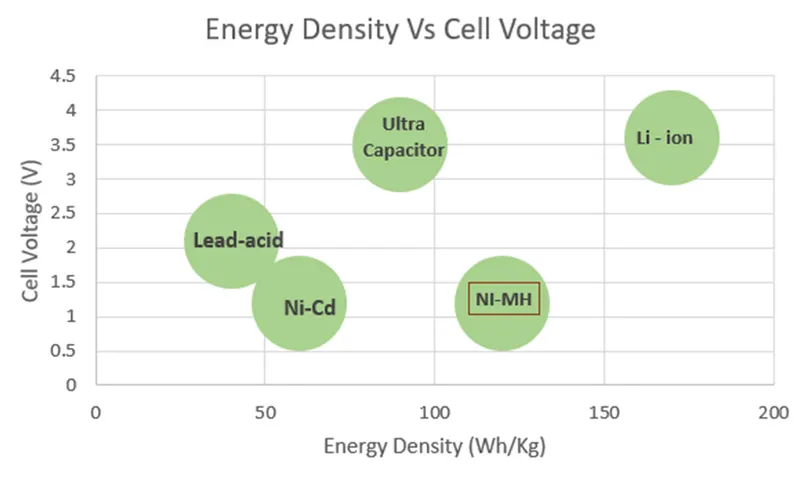
The values of energy densities of different batteries and cell voltage are shown in the below table and also the same is represented in the X-Y plot shown below.
|
Battery name |
Energy density |
Cell voltage |
|
Lead-acid battery |
35-40 |
2.1 |
|
Nickel Cadmium |
40-60 |
1.2 |
|
Nickel Metal Hydride |
60-120 |
1.2 |
|
Lithium-ion |
100-265 |
3.6/ 3.7/ 3.8/ 3.85 |
|
Ultracapacitor |
89.6 |
3.5 |
SOLUTION 3)
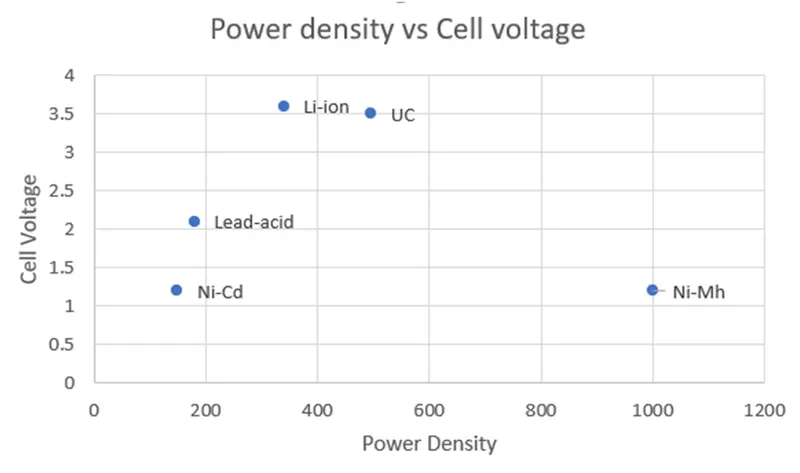
The power density of the above set of batteries is as shown below.
|
Battery name |
Power density (W/Kg) |
Cell voltage (V) |
|
Lead-acid battery |
180 |
2.1 |
|
Nickel Cadmium |
150 |
1.2 |
|
Nickel Metal Hydride |
1000 |
1.2 |
|
Lithium-ion |
340 |
3.6 |
|
Ultracapacitor |
496 |
3.5 |
The power density plot of the batteries is shown below in the plot.
SOLUTION 4)
"True"
The number indicated as 1 is a -ve electrode.