Week 5 Challenge
1)
False, the explanation can be seen below.
As mentioned in the query, we are considering the situation where a driver is rapidly accelerating and braking on city roads.
Usually, an EV vehicle consists of a Cell and an Ultra Capacitor(UC) to meet the drive cycle.
In order to answer we need to know the working and load meeting capacity of a battery.
Battery:
- A battery converts chemical energy to electrical energy and it is reversible in chemical reactions.
- They have low power density
- The battery charge/ Discharge process is relatively slower.
W.r.t the characteristics of the battery, it is not at all recommended to charge or discharge a battery instantaneously as it may lead to:
- Breakdown of cell
- Due to rapid change heat generates which in result may lead to a blast of cell[due to internal chemical reactions]
- Cell stack may deteriorate and can cause short-circuit which results in a fire to the stack.
- Puncture of a cell may lead to a release of poisonous gas.
Ultra Capacitor:
- These are also known as Super Capacitors
- The source of energy is electrical energy.
- They are a very high energy density.
- As the Ultracapacitors are bigger capacitors, they store a large amount of electrical charge than the chemical batteries. They are having high power density.
- Ultracapacitors undergo a quick charge and discharge rate.
As per the above comparison between battery and ultracapacitor, it is understood that Ultracapacitors are more suitable for vehicles that accelerate and decelerate very frequently.
Result: Here we can conclude that UCs are more suitable for vehicles rather than batteries for rapid accelerating and braking very frequently.
2)
Energy density is the measure of energy w.r.t weight of a battery. It's represented in Wh/kg. Energy density is directly proportional to battery runtime.
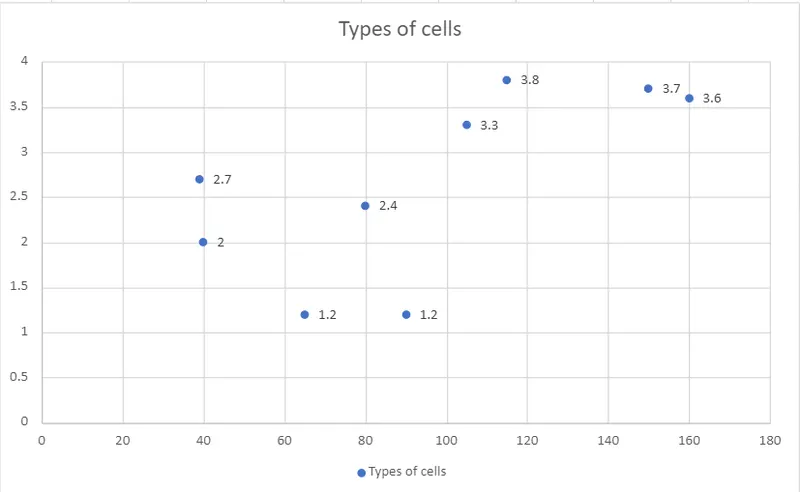
- Lead acid batteries can be used in IC engine vehicles to supply the auxiliary 12V system load and in emergency lighting because of their low energy density, simple construction, and stable operation.
- Nickel-cadmium batteries have less cell voltage and a little higher energy density than lead acid hence it is can be used in toy cars, and calculators.
- Nickel Metal Hydride batteries can be used in wide electronic devices because of their high energy density. Voltage is less hence it is sufficient to power electronic devices such as computers, and cellular phones.
- Lithium-ion batteries have high energy density and high cell voltage.
- Lithium is also light in weight and hence it can be used in Battery Electric vehicles, Smartphones, and Laptops. Y-axis values are cell voltage and X axis values are Energy density and the column shows the type of battery.
- NMC has the highest energy density among all hence it is used in most BEV vehicles. Leading automakers Toyota, and Tata use this chemistry for their BEVs.
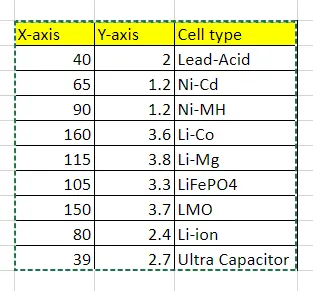
These are the various cell parameters that are been taken and plotted accordingly.
3)
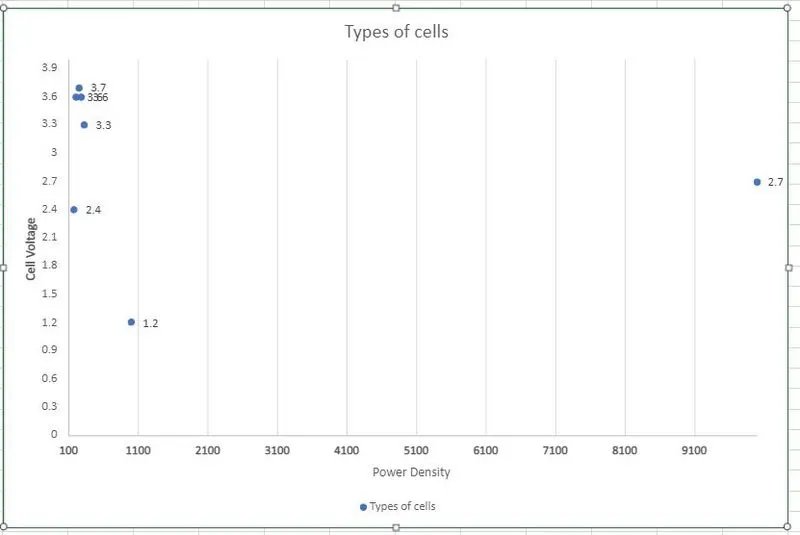
Explanation:
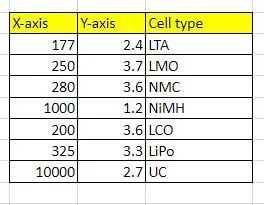
- Lead acid, Nickel Cadmium, Lithium titanate, Lithium manganese oxide, and lithium cobalt oxide have low power density. Hence these can be operated for low-power applications.
- Lithium Nickel Manganese Cobalt battery has comparatively high power density than other batteries except for NIMH. Hence it is used for high power and high energy requiring systems.
- Nickel metal Hydride has high power density than other batteries hence it can be used in HEVs and portable power tools where high power is required.
- Ultracapacitors have far high power density than any other source of energy-storing elements.
- Ultracapacitors have ten times higher power density than lithium-ion batteries.
4)
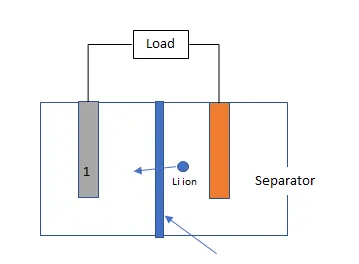
Here the electrode which is named "1" is the Li-ion battery's negative electrode.
This battery will generate the DC power through the chemical reactions that are happened inside the battery.
Inside the Li-ion battery:
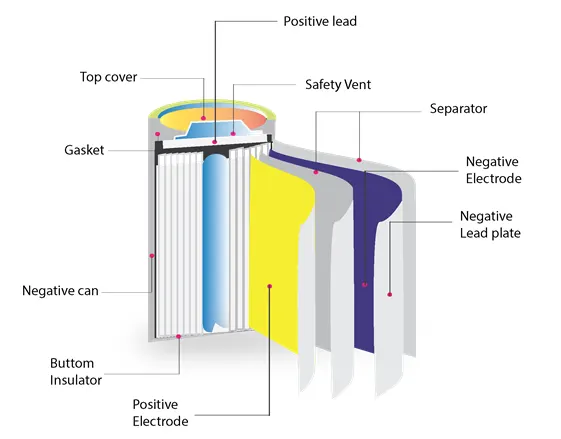
As per the universal behavior[i.e., ions discharge from negative electrode and travel to positive electrode which in turn current travels from positive to electrode] Li-ion battery also behaves the same, ions from
-ve anode travel through the electrolyte to reach the positive electrode.
During the charge cycle e- moves from the anode to cathode in the ckt.
Here anode acts as -ve electrode and cathode acts as +ve electrode
A SEI is formed at anode.Anode decomposes if it contact with electrolyte, in result SEi protects the anode.
Here we conclude that electrode marked as "1" is negative electrode.This is TRUE.