Week 5 Challenge
#AIM
1) Consider a scenario where an aggressive driver is accelerating very rapidly and braking harshly in a city driving. Is battery better a choice to supply power than UC in this scenario?
- True
- False
Why?
2) Consider the following components.
1) Lead acid battery 2) Nickel-cadmium battery 3) Nickel Metal hydride battery 4) Lithium-ion (specify chemistry) battery 5) Ultra Capacitor
Note: In the case of a range of energy density, take the average value for the plot.
Create a plot with energy density on the X-Axis and cell voltage on the Y axis.
Comment on the capabilities of these batteries based on the plot created.
3) For the above-mentioned components on the same plot (retain the previous plot) created in the previous
Create a plot with power density on the X axis and cell voltage on the Y axis.
4) Consider the following scenario:
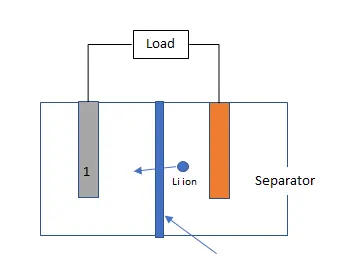
A battery has just been manufactured in the industry and has been connected to a charger for the first time. The electrode marked as (1) in the picture below is the negative electrode.
- True
- False
# EXPLANATION
1) Consider a scenario where an aggressive driver is accelerating very rapidly and braking harshly in a city driving. Is battery better a choice to supply power than UC in this scenario?
- True
- False
Why?
False, Battery is not a better choice in the given driving scenario.
Condition: The driver is driving aggressively. Very rapid accelerating and braking (deceleration) take place in the driving.
Battery:
- A battery converts chemical energy to electrical energy and it is reversible in chemical reactions.
- They have low power density
- Power density refers to how quickly a device can discharge its energy,
- The battery charge/ Discharge process is relatively slower.
- Batteries have low power density but high energy density, meaning they have a lot of energy that gets discharged slowly.
Ultra-Capacitor:
- Ultracapacitors are also known as supercapacitors.
- The source of energy is electrical energy.
- They are a very high energy density.
- energy density refers to how much energy a device contains
- As the Ultracapacitors are bigger capacitors, they store a large amount of electrical charge than the chemical batteries.
- They are having high power density.
- Ultracapacitors undergo a quick charge and discharge rate.
As per the above comparison between battery and ultracapacitor, it is understood that Ultracapacitors are more suitable for vehicles that accelerate and decelerate very frequently.
2) Consider the following components.
1) Lead acid battery 2) Nickel-cadmium battery 3) Nickel Metal hydride battery 4) Lithium-ion (specify chemistry) battery 5) Ultra Capacitor
Note: In the case of a range of energy density, take the average value for the plot.
Create a plot with energy density on the X-Axis and cell voltage on the Y axis.
Comment on the capabilities of these batteries based on the plot created.
Energy Density: It is the measure of how much energy a battery contains in proportion to its weight. This measurement is typically presented in watt-hours/kilogram. The higher the energy density, the longer the runtime.
Lead Acid batteries:
Lead-acid batteries have relatively low energy density.
Nickel-Cadmium Battery:
Nickel Cadmium has a much higher energy density compared to lead-acid batteries.
Nickel-Metal Hydride Battery:
Ni-MH batteries can have two to three times the capacity of NiCd batteries of the same size, with high significance and also much less than lithium-ion batteries.
Lithium-ion battery:
Lithium-ion batteries have a high energy density.
Ultracapacitor:
Energy density is more in ultracapacitors compared to capacitors.
Here we are going to compare the cell voltage and energy density for the battery types,
- Lead acid battery-Cell voltage:2V, Energy density:30-50Wh/Kg.
- Nickel Cadmium battery-Cell voltage:1.2V, Energy density:45-80Wh/Kg.
- Nickel Metal Hydride battery-Cell voltage:1.2V, Energy density:60-120Wh/Kg.
- Li-ion (LMO -Lithium manganese oxide) battery-Cell voltage:3.8V, Energy density:100-135Wh/Kg.
- Ultracapacitors- Average Voltage:3V, Energy density 1-10Wh/Kg
Now we have to create a plot for these battery types and compare them.
| Cell Type | Cell Voltage(V) | Average Energy density(Wh/Kg) |
| Lead acid | 2 | 40 |
| Ni-Cd | 1.2 | 62.5 |
| Ni-MH | 1.2 | 90 |
| Li-ion(LMO) | 3.8 | 117.5 |
| Ultracapacitor | 3 | 10 |
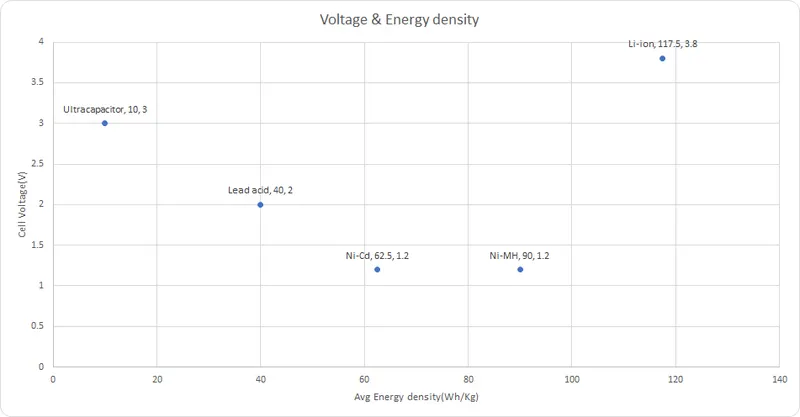
Here in the plot, the values above the blue dots represent the energy density and cell voltages of corresponding cell types shown in the table.
From the plot, we understand that,
- The Li-ion battery type has a higher voltage level and higher energy density.
- Nickel-cadmium and Nickel metal hydride have nearly equal cell voltages but the energy density is different.
- Nickel metal hydride has a higher energy density than the Ni-Cd battery type.
- Lead acid battery type has a medium voltage higher than Ni-cd and Ni-MH and its energy density is lesser than other types of batteries except for ultracapacitors.
- Ultracapacitors have a high voltage range but their energy density is lesser than all types of batteries.
- Thus ultracapacitors are used only in conditions where high power requirements at a small amount of duration.
3)For the above-mentioned components on the same plot (retain the previous plot) created in the previous
Create a plot with power density on the X axis and cell voltage on the Y axis.
For the above-mentioned same battery types now we have to compare by their voltage and power density values.
The voltage and power density values are mentioned below as,
- Lead acid battery-Cell voltage:2V, Power density: Less than 300 W/Kg.
- Nickel Cadmium battery-Cell voltage:1.2V, Power density:150-300W/Kg.
- Nickel Metal Hydride battery-Cell voltage:1.2V, Power density: Less than 200W/Kg.
- Li-ion (LMO -Lithium manganese oxide) battery-Cell voltage:3.8V, Power density:100-1000W/Kg.
- Ultracapacitors- Average Voltage:3V, Power density 600W/Kg.
For the above values, we need to plot a chart,
| Cell Type | Average Power density (W/Kg) | Cell Voltage(V) |
| Lead acid | 155 | 2 |
| Ni-Cd | 225 | 1.2 |
| Ni-MH | 105 | 1.2 |
| Li-ion(LMO) | 550 | 3.8 |
| Ultracapacitor | 600 | 3 |
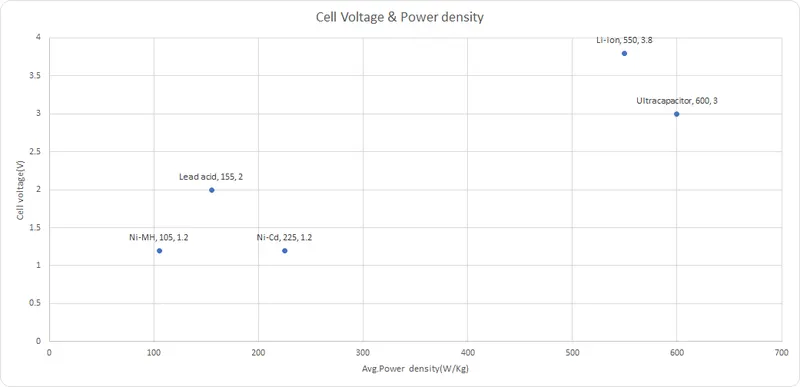
From the above plot, we can see that,
- Ultracapacitors are having high power density and their voltage level is also above the medium level voltage of 3V.
- The power density of Lead acid battery types is in between Ni-metal hydride and Ni-cadmium battery types.
- All Ni-metal hydride battery types are having lesser power density on average.
By comparing plots from questions 2 and 3 we can come to know that,
- Li-ion battery types are almost in the higher preference range for better energy density, power density, and voltage ranges.
- However, Ultracapacitors are also suitable for conditions were high power requirements in shorter duration.
- Other types excluding the above are also used for applications corresponding to their specification matching of loads.
4) Consider the following scenario:
A battery has just been manufactured in the industry and has been connected to a charger for the first time. The electrode marked as (1) in the picture below is the negative electrode.
- True
- False
True. The number indicated as 1 is a -ve electrode.
Lithium-ion batteries generate DC power by utilizing chemical reactions.
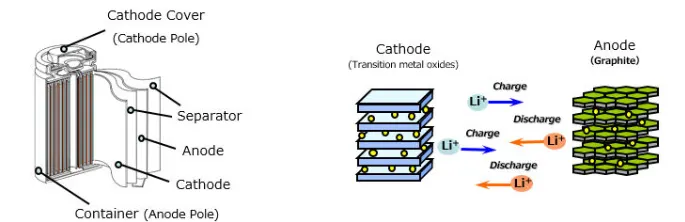
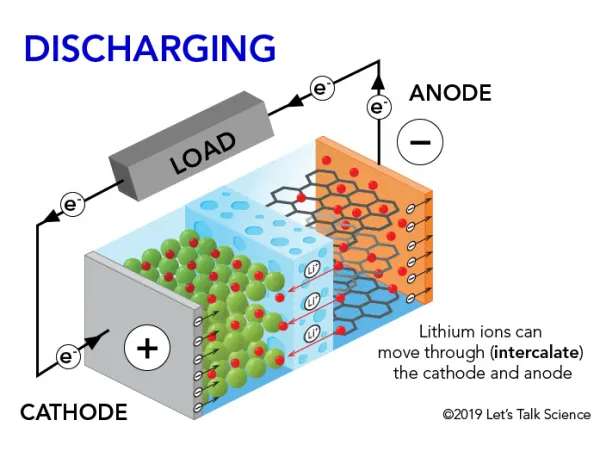
- During discharge, lithium ions from the -ve anode move through the electrolyte to gets intercalate the +ve cathode.
- During charging, electrons move from anode to cathode in the external circuit.
- Electrons flow to balance the cell voltage.
- During the electrochemical process, the anode is -ve and the cathode is +ve.
- At the first time charging, the lithium-ion from the cathode gets attached to anode and it forms the inseparable layer on the anode.
- A solid Electrolyte Interface (SEI) is formed at the anode. Anode gets decomposed if it comes in contact with the electrolyte. SEI protects the anode.
Components of lithium-ion battery:
A battery is made up of several individual cells that are connected to one another. Each cell contains three main parts:
- positive electrode (a cathode),
- negative electrode (an anode) and
- liquid electrolyte.
- Separator.
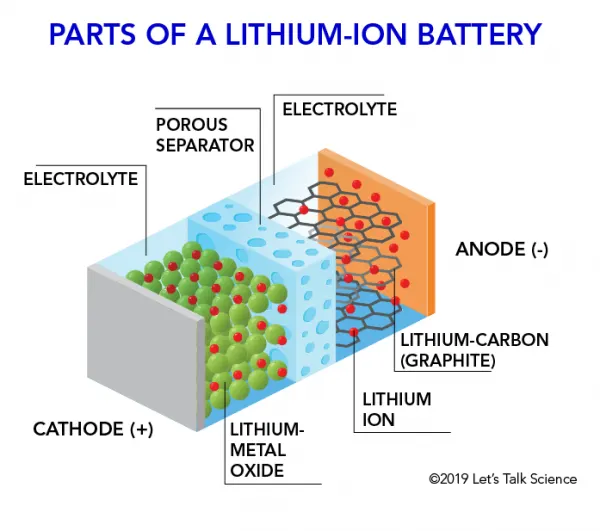
Reactions involved in lithium-ion batteries
Inside a lithium-ion battery, oxidation-reduction (Redox) reactions take place.
Reduction takes place at the cathode. There, cobalt oxide combines with lithium ions to form lithium-cobalt oxide (LiCoO2). The half-reaction is:
CoO2 + Li+ + e- → LiCoO2
Oxidation takes place at the anode. There, the graphite intercalation compound LiC6 forms graphite (C6) and lithium ions. The half-reaction is:
LiC6 → C6 + Li+ + e-
Here is the full reaction (left to right = discharging, right to left = charging):
LiC6 + CoO2 ⇄ C6 + LiCoO2
How does recharging a lithium-ion battery work?
When the lithium-ion battery in your mobile phone is powering it, positively charged lithium ions (Li+) move from the negative anode to the positive cathode. They do this by moving through the electrolyte until they reach the positive electrode. There, they are deposited. The electrons, on the other hand, move from the anode to the cathode.
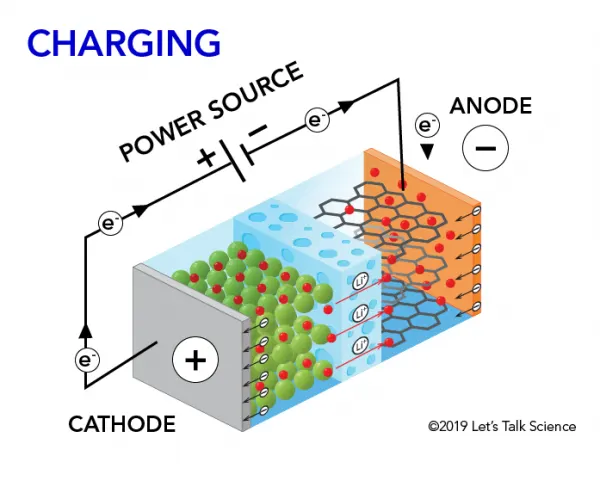
When you charge a lithium-ion battery, the exact opposite process happens. The lithium ions move back from the cathode to the anode. The electrons move from the anode to the cathode.
A battery has just been manufactured in the industry and has been connected to a charger for the first time. The electrode marked as (1) in the picture below is the negative electrode. this is true
# CONCLUSION
Studied about Lead-acid batteries, Nickel-cadmium batteries, Nickel Metal hydride batteries, Lithium-ion (specify chemistry) batteries, Ultracapacitors and about their power and energy densities