Week 5 Challenge
1.
ANS: False
Rapid accelereation requires high power demand and sudden breaking causes sudden decceleration which can be utilised for regeneration and charging. Fast charging and discharging is possible in ultracapacitors. So the power demand can be solved using ultracapacitors. sudden breaking also used to recharge the ultracapacitor. Ultracapacitor can deliver large amount of power for short duration. Therefore its ideal for rapid acceleration.
2.
Energy Density: It is the measure of how much energy a battery contains in proportion to its weight. This measurement is typically presented in watt-hours/kilogram. The higher the energy density, the longer the runtime.
Lead Acid batteries: Lead-acid batteries have relatively low energy density.
Nickel-Cadmium Battery: Nickel Cadmium has a much higher energy density compared to lead-acid batteries.
Nickel-Metal Hydride Battery: Ni-MH batteries can have two to three times the capacity of NiCd batteries of the same size, with high significance and also much less than lithium-ion batteries.
Lithium-ion battery: Lithium-ion batteries have a high energy density.
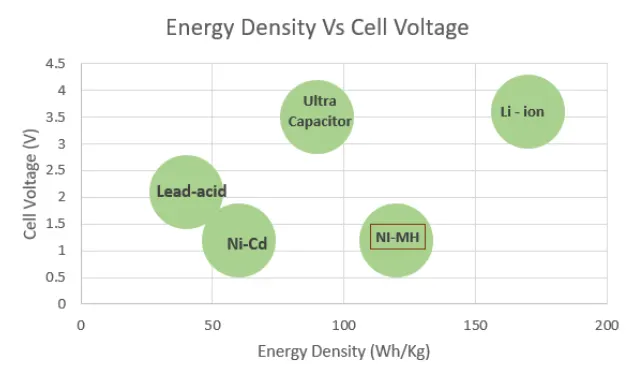
Ultracapacitor: Energy density is more in ultracapacitors compared to capacitors. The values of energy densities of different batteries and cell voltage are shown in the below table and also the same is represented in the X-Y plot shown below.
Battery name Energy density Cell voltage
Lead-acid battery 35-40 2.1
Nickel Cadmium 40-60 1.2
Nickel Metal Hydride 60-120 1.2
Lithium-ion 100-265 3.6/ 3.7/ 3.8/ 3.5
Ultracapacitor 89.6 3.85
3.
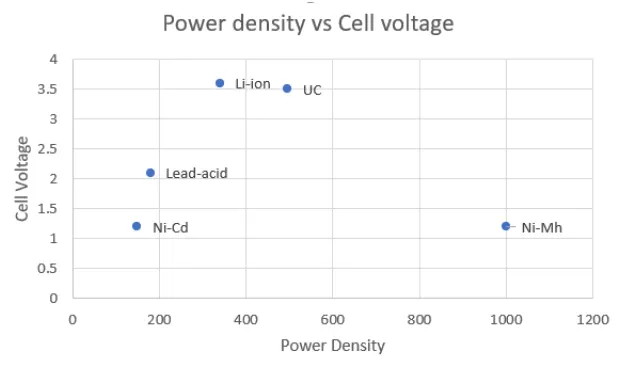
Battery name Power density (W/Kg) Cell voltage (V) Lead-acid battery 180 2.1
Nickel Cadmium 150 1.2
Nickel Metal Hydride 1000 1.2
Lithium-ion 340 3.6
Ultracapacitor 496 3.5
4.
Ans:True
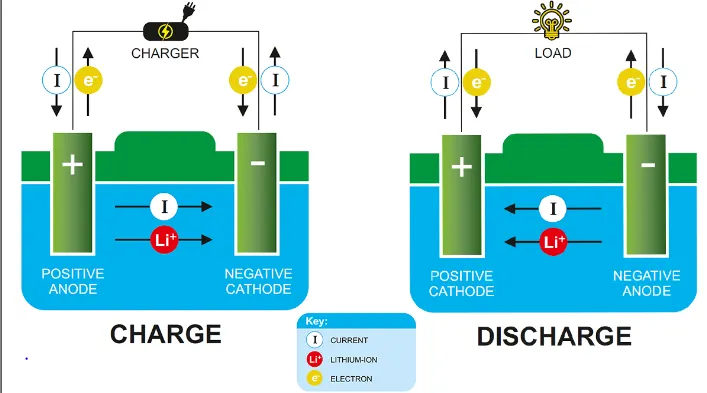
A lithium ion battery working in charging and discharging is given below. Lithium ions will move from +ve electrode to negative electrode on charging.