Week 5 Challenge
1. Consider a scenario where an aggressive driver is accelerating very rapidly and braking harshly in a city driving. Is battery better a choice to supply power than UC in this scenario?
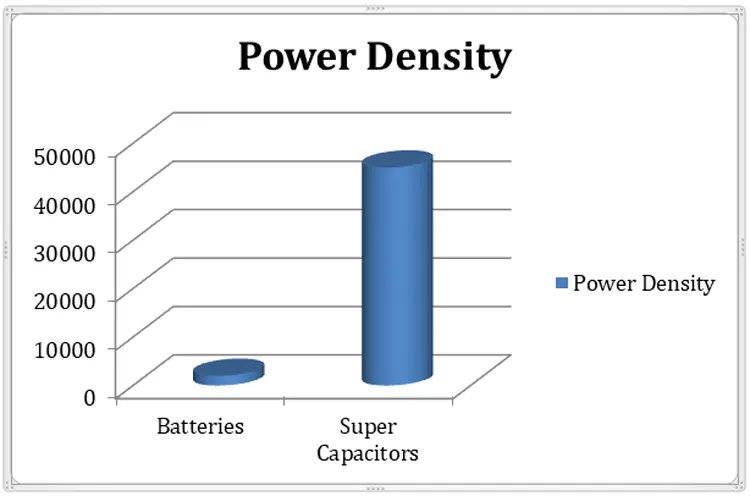
Ans: False, in the scenario where an aggressive driver is accelerating very rapidly and braking harshly, the instantaneous power which should be provided by the source need to be high. The ability of the source to provide instantaneous power is determined by the power density (or specific power) parameter of the source. The battery has low power density compared to the UC (ultracapacitor). The power density of capacitor can be more than 10times that of battery, so during these types of scenario powering the drivetrain by UC is recommended.
The power density comparison of battery and UC is given below
2. Energy density vs Cell voltage of different sources
The energy density is the amount of energy stored in a given system or region of space per unit volume (Wh/L). It may also be used for energy per unit mass (Wh/kg).
In this 5 different common DC power sources are selected for comparison
- Lead acid battery
- Nickel cadmium battery
- Nickel Metal hydride battery
- Lithium ion (NMC) battery (INR18650 25R)
- Ultra Capacitor (2.7V 3400F Maxwell UC)
The table consist of cell voltage and energy density of above sources
| Source | Voltage | Energy density | Energy density |
| Lead-Acid | 2 V | 25–35 Wh/kg | 80-90 Wh/L |
| NiCad | 1.2 V | 45-80 Wh/kg | 50-150 Wh/L |
| NiMH | 1.2 V | 60-120 Wh/kg | 170-420 Wh/L |
| Li-ion (NMC) | 3.3 V | 210 Wh/kg | 548 Wh/L |
| UC (3400F) | 2.7 V | 7.1 Wh/kg |
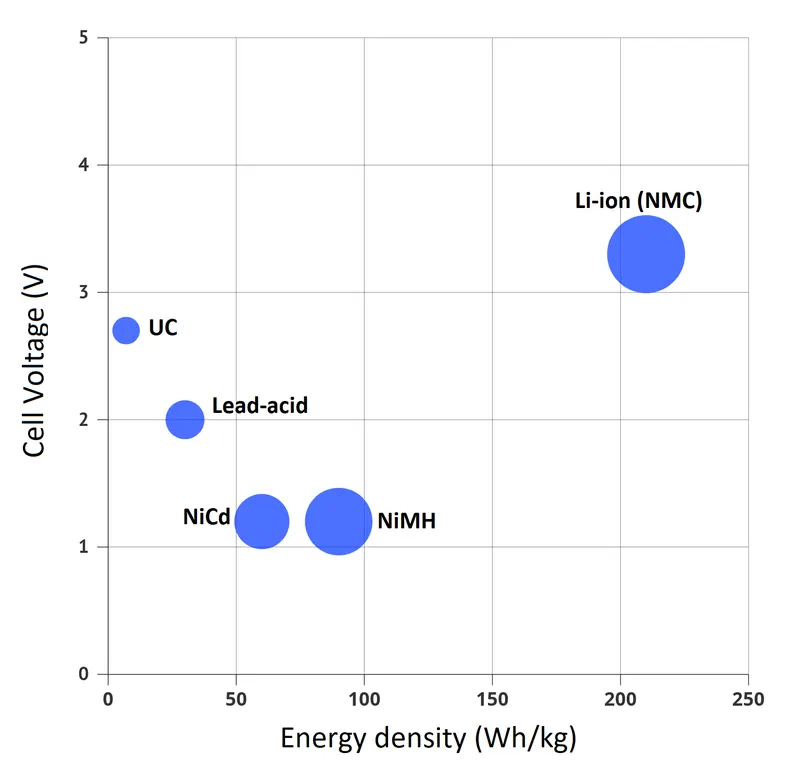
With the above data a bubble graph has plotted for the energy density vs cell voltage
Observation:
- Li-ion has the highest energy density among all.
- The Li-ion can be used where more energy is required per kg, like in automobile where weight also determines the performance of the system.
- UC has the lowest energy density among all.
- The energy density in increasing order is as given below
- UC < Lead-acid < NiCd < NiMH < Li-ion
3. Power density vs Cell voltage of different sources
Power density is a measure of power output per unit volume or unit mass (W/L or W/kg).
In this 5 different common DC power sources are selected for comparison
- Lead acid battery
- Nickel cadmium battery
- Nickel Metal hydride battery
- Lithium ion (NMC) battery (INR18650 25R)
- Ultra Capacitor (2.7V 3400F Maxwell UC)
The table consist of cell voltage and energy density of above sources
| Source | Voltage | Power density |
| Lead-Acid | 2 V | 150 W/kg |
| NiCad | 1.2 V | 150 W/kg |
| NiMH | 1.2 V | 250-1000 W/kg |
| Li-ion (NMC) | 3.3 V | 1.5kW/kg |
| UC (3400F) | 2.7 V | 8.5 kW/kg |
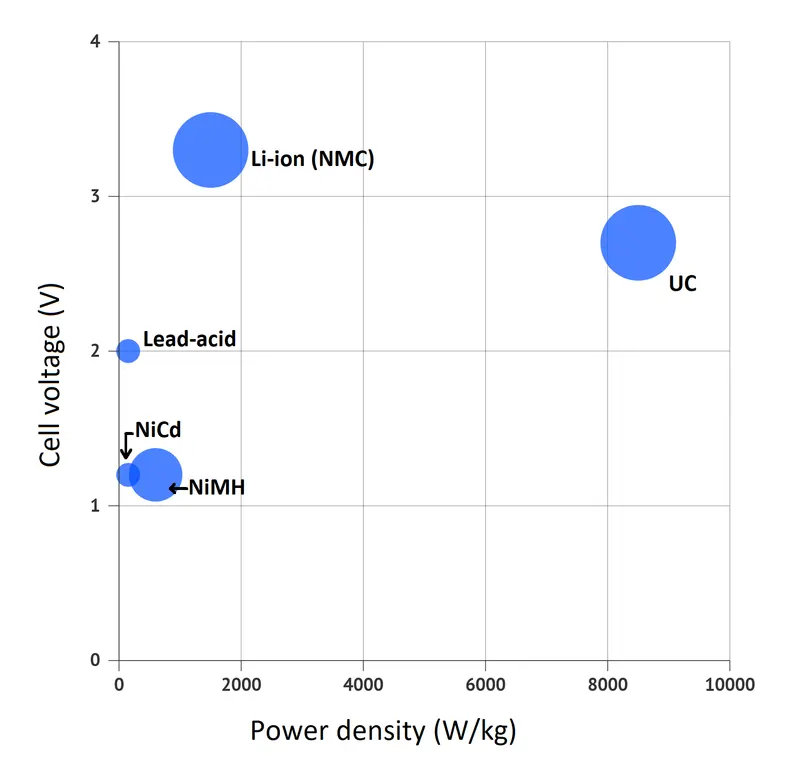
With the above data a bubble graph has plotted for the energy density vs cell voltage
Observation:
- UC has the highest power density among all, it means for a given kg the amount of power the UC can give instantaneously is high.
- UC can use in application where sudden discharge and charge is required.
- Lead-acid has the lowest energy density among all.
- The power density in increasing order is as given below
- Lead-acid < NiCd < NiMH < Li-ion < UC
4. A battery has just been manufactured in the industry and has been connected to a charger for the first time. The electrode marked as (1) in the picture below is the negative electrode. True/False?
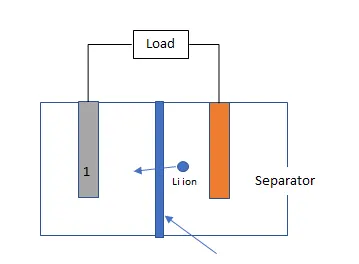
Ans: True, during charging the Li-ions moves from Cathode (positive electrode) to Anode (negative electrode) through seperator which is an ionic conductor.
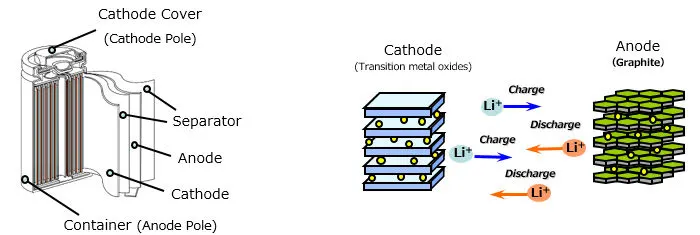
During charging the DC source is connected such that a positive potential is created between the cathode (positive electrode) and source, this will attract the e- from the cathode and causes the Lithium metal oxide to split into Metal oxide, Li+ ions and e-, the electrons flows through the external DC source and reach to the Anode (negative electrode) and creates a negative charge in the Anode, this attracts the positive charge Li+ ions and Li+ ions moves through electrolyte or seperator to reach Anode, where both Li+ ions and e- are intercalated in the graphite. This causes the Li cell to reach unstable state, as it progress the potential difference between the anode and cathode increases.
During discharge Li+ ions moves from Anode to Cathode, as the potential difference is high, when the external load is connected it creates a path such that the e- flows through external and Li+ ions through seperator and combine with Metal oxide to form Lithium metal oxide.
During charging following reaction occurs
The positive electrode (cathode) half-reaction in the lithium-doped cobalt oxide substrate is
- `LiCoO_2 rarr CoO_2 + Li^+ + e^(-)`
The negative electrode (anode) half-reaction for the graphite is
- `C_6 + Li^+ + e^(-) rarr LiC_6`
The full reaction
- `C_6 + LiCoO_2 rarr LiC_6 + CoO_2`
During discharging following reaction occurs
The positive electrode (cathode) half-reaction in the lithium-doped cobalt oxide substrate is
- `CoO_2 + Li^+ + e^(-) -> LiCoO_2`
The negative electrode (anode) half-reaction for the graphite is
- `LiC_6 -> C_6 + Li^+ + e^-`
The full reaction
- `LiC_6 + CoO_2 -> C_6 + LiCoO_2`