Week 5 Challenge
Question 1:
Consider a scenario where an aggressive driver is accelerating very rapidly and braking harshly in a city driving. Is battery better a choice to supply power than UC in this scenario?
- True
- False
Why?
False.
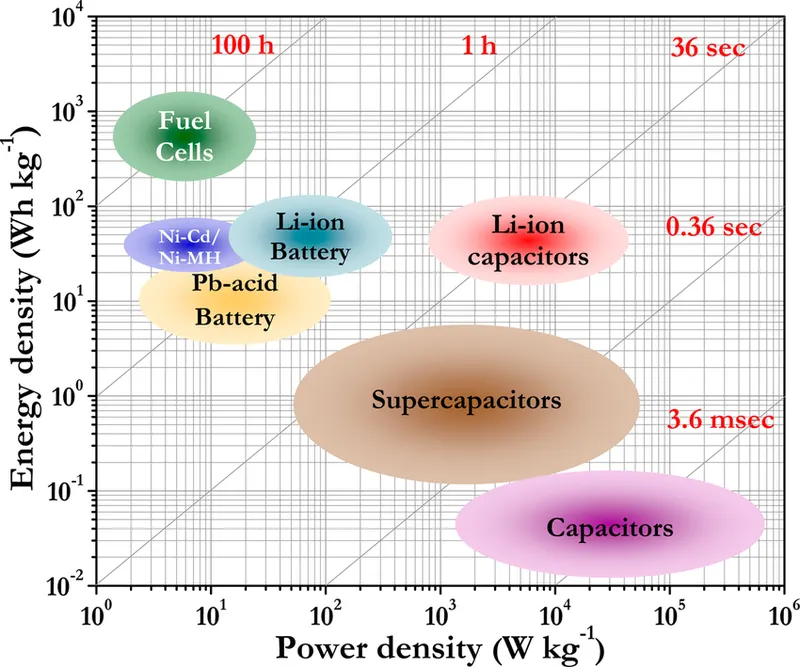
In the above scenario in which an aggressive driver is accelerating very rapidly, more power(peak power) is needed by the motor in a very short span of time. Battery is not suitable for supplying more power in a short period which a main drawback of batteries, since batteries have high energy density and low power density, it can deliver the small enery for long period of time, that's why batteries cannot meet the peak power requirement.
For the above scenario, Ultracapacitors are the suitable option because it have high power density so that it can meet the peak power demand of the vehicle. Since the driver is braking harshly, regenerative braking occurs, so the motor will act as generator and the battery gets charged.
Question 2:
Consider the following components.
1) Lead acid battery 2) Nickel cadmium battery 3) Nickel Metal hydride battery 4) Lithium ion (specify chemistry) battery 5) Ultra Capacitor
Note: In case of a range of energy density, take the average value for the plot.
Create a plot with energy density on the X Axis and cell voltage on the Y axis.
Comment on the capabilities of these batteries based on the plot created.
The specifications of different energy storage system is attached below
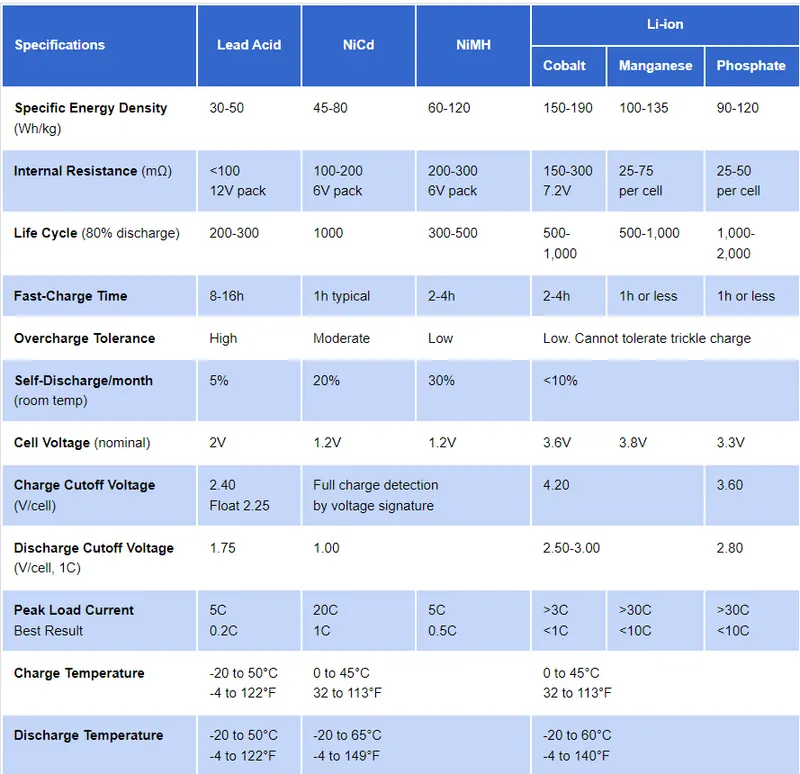
From the above data of Energy density, the plot of Energy density Vs cell voltage for different energy storage systems is attached below
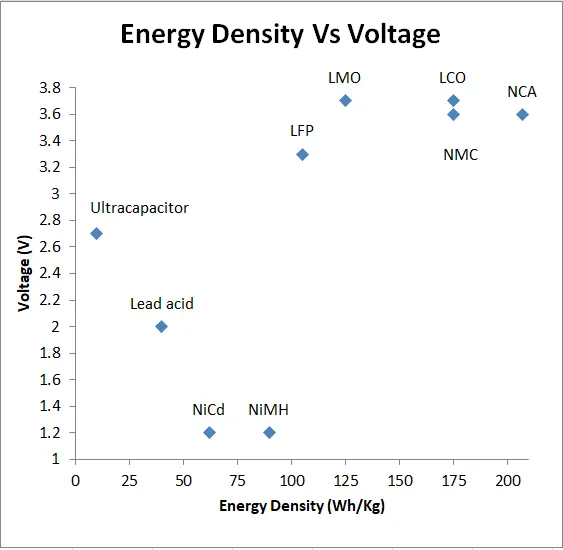
From the plot, it is observed that
- Lithium ion battery chemistries posses high voltage as well as the energy density, This makes lithium ion batteries more suitable for automotive applications.
- Among different chemistry of lithium ion batteries, Lithium manganese Oxide(LMO) and Lithium Cobalt Oxide (LCO) posses high voltage of about 3.7V, but Nickel Cobalt Aluminium(NCA) posses more energy density that others. Over all LCO has high voltage and Energy density.
- Incase of Nickel metal Hydride and Nickel Cadmium batteries, both have same voltage of 1.2V but the energy density of NiMH is more that NiCd batteries. NiMH batteries are used in some automotive applications like Hybrid electric vehicle. one such example is Toyota hybrid vehicles typically utilize either a Nickel-Metal Hydride (NiMH) or Lithium-ion (Li-ion) battery. One or the other. A 2021 Prius uses both.
- Lead acid battery individual cell has 2V, still which is half of single lithium ion battery and the energy density is also very much low when compared to lithium ion battery which is a maindrawback of lead acid batteries for automotive applications.
- Ultracapacitors comes in low ED and at optimum voltage region of about 2.7V.
Question 3:
For the above-mentioned components on the same plot (retain the previous plot) created in the previous
Create a plot with power density on the X axis and cell voltage on the Y axis.
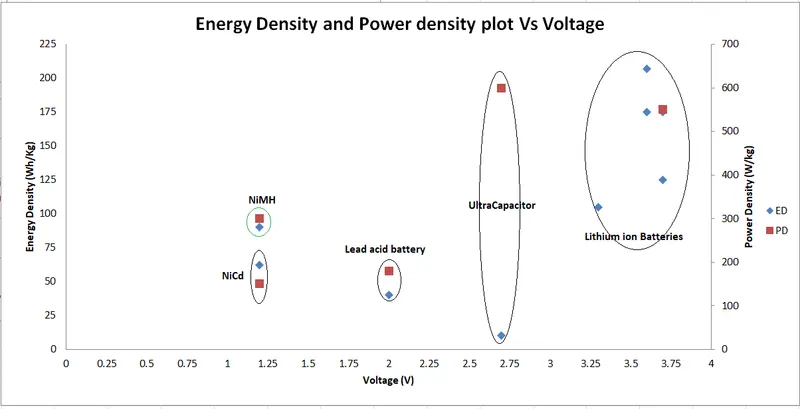
In the above plot,
- Ultracapacitors having high power density and its voltage is also optimum (2.7V)
- Power density of lead acid battery is in same range of NiCd battery but lower that NiMh batteries.
- Based on the power density, all the energy sources are arranged in below order
Ultracapacitors>Lithium ion batteries>NiMH>Lead acid battery>NiCd.
Question 4:
Consider the following scenario:
A battery has just been manufactured in the battery and has been connected to a charger for the first time. The electrode marked as (1) in the picture below is the negative electrode.
- True
- False
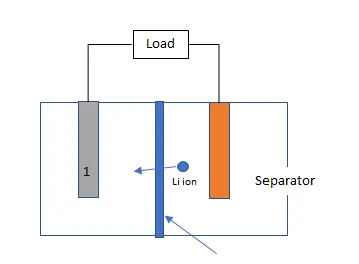
True.
The main chemistry invloved in lithium ion batteries is intercalation and deintercalation of lithium ions between anode and cathode. Since the battery is connected to the charger for the first time, all the lithium ions are present in the cathode (positive electrode). During charging Li+ ions are deintercalated from cathode and intercalated into the anode layer(mostly graphite).
In the above picture, the Li+ ions are transfering from positive electrode to negative electrode during charging, Thus the (1) marked electrode is negative electrode.
Components of lithium ion battery:
A battery is made up of several individual cells that are connected to one another. Each cell contains three main parts:
- positive electrode (a cathode),
- negative electrode (an anode) and
- liquid electrolyte.
- Separator.
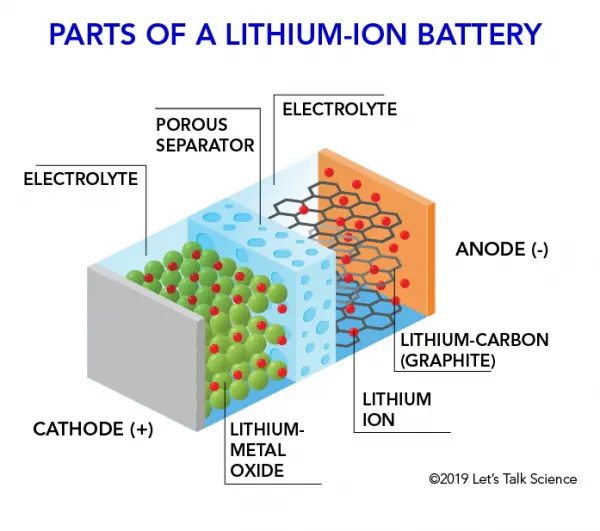
Reactions involved in lithium-ion batteries
Inside a lithium-ion battery, oxidation-reduction (Redox) reactions take place.
Reduction takes place at the cathode. There, cobalt oxide combines with lithium ions to form lithium-cobalt oxide (LiCoO2). The half-reaction is:
CoO2 + Li+ + e- → LiCoO2
Oxidation takes place at the anode. There, the graphite intercalation compound LiC6 forms graphite (C6) and lithium ions. The half-reaction is:
LiC6 → C6 + Li+ + e-
Here is the full reaction (left to right = discharging, right to left = charging):
LiC6 + CoO2 ⇄ C6 + LiCoO2
How does recharging a lithium-ion battery work?
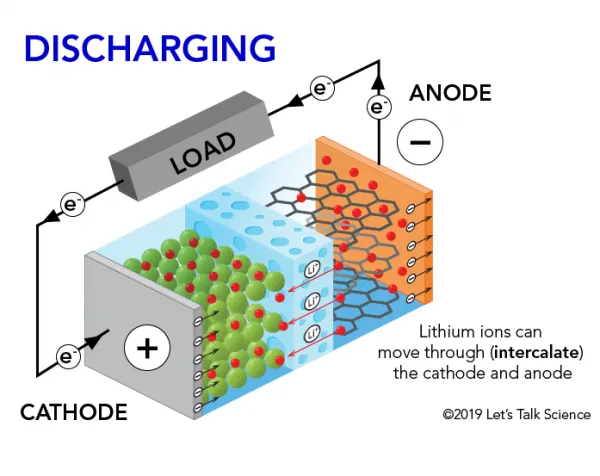
When the lithium-ion battery in your mobile phone is powering it, positively charged lithium ions (Li+) move from the negative anode to the positive cathode. They do this by moving through the electrolyte until they reach the positive electrode. There, they are deposited. The electrons, on the other hand, move from the anode to the cathode.
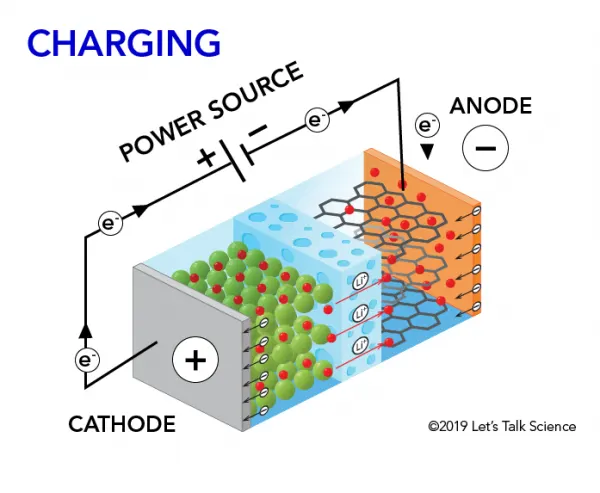
When you charge a lithium-ion battery, the exact opposite process happens. The lithium ions move back from the cathode to the anode. The electrons move from the anode to the cathode.