#2 Specifications of Lithium Ion Cell
1) What is the difference between nominal voltage and maximum voltage?
Nominal voltage: what the voltage of any particular battery is called (not necessarily exactly what it is). In otherterms the
Voltage of a fully charged cell or battery when delivering rated capacity at a specific discharge rate.
For example: Nominal voltage of lead acid battery - 2V per cell/12V per battery
Maximum voltage: The voltage upto which the voltage increase upon charging the cell/battery.
For example: Maximum voltage of a lead acid battery - 2.2V per cell/ 13.2V per battery
2) Under which situation we observe the changes in dimensions and weight of a cell.
- Overcharging the battery beyond the maximum voltage specified in the data sheet, e.g. to increase the range of an electric car. Depending on the degree of overcharging, the battery may be damaged permanently and the service life of the battery decreases.
- Excessive currents when charging or discharging the battery, e.g. when rapid charging.
- Internal short circuit: Due to an accident or similar mechanical impact, e.g. if a tool falls down from a great height, the battery is deformed, material penetrates the battery cell and triggers an internal short circuit.
- External short circuit: Deformation of the battery cell causes an external short circuit.
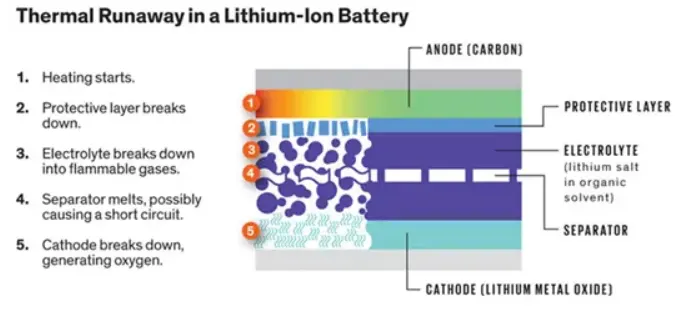
whenever a change in dimensions of the battery is observed, its a main symptom of possibilty of thermal
runaway
3) List out various mechanical testing and standards.
Mechanical Testing methods:
Drop test(Freefall Test): In this test, a fully charged battery/cell as of shipment condition is dropped on concrete or wooden floor from a certain height(as per testing standards) from 3 sides. The leakage and decrease in voltage(ocv drop) is observed.
Vibration test: In this method, a fully charged battery/cell is place in a vibration testing chamber, the vibrations of definite frequency(as per testing standard) is applied for period of time. Any leakages, damages and decrease in voltage(ocv drop) is observed.
Crush Test: The fully charged battery/cell is crushed between two flat surfaces. The force for the crushing is applied by a hydraulic ram exerting a force of 13 kN ± 1 kN. The crushing is performed in a manner that will cause the most adverse result. Once the maximum force has been applied, or an abrupt voltage drop of one-third of the original voltage has been obtained, the force is released. A cylindrical or prismatic cell is crushed with its longitudinal axis parallel to the flat surfaces of the crushing apparatus. To test both wide and narrow sides of prismatic cells, a second set of cells is tested, rotated 90° around their longitude in a axes compared to the first set. Force can also be stopped when 10 % of deformation of initial dimension of cell has occurred (or when 13 kN ± 1 kN force is reached or abrupt drop of 1/3 original OCV, whichever is reached first)
• Crush only wide side of prismatic cells
Testing Standards:
IEC62133 - Safety Test Standard of Li-Ion Cell and Battery
4)What is the discard procedure suggested generally for used Li ion+ batteries?
Most of the manufacturers of lithium ion battery suggesting to dispose the used batteries to the authorized angencies who are involved in the recycling process.
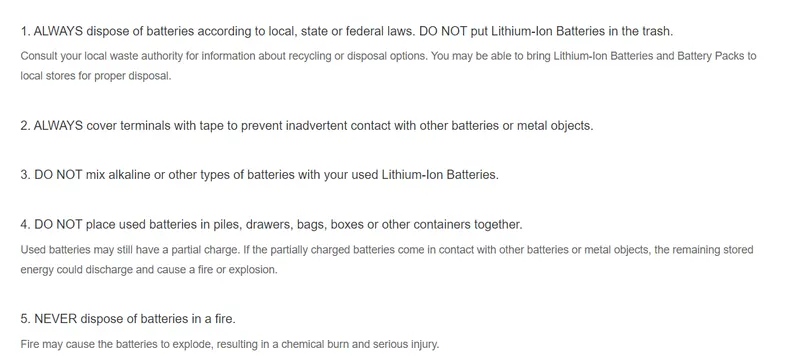
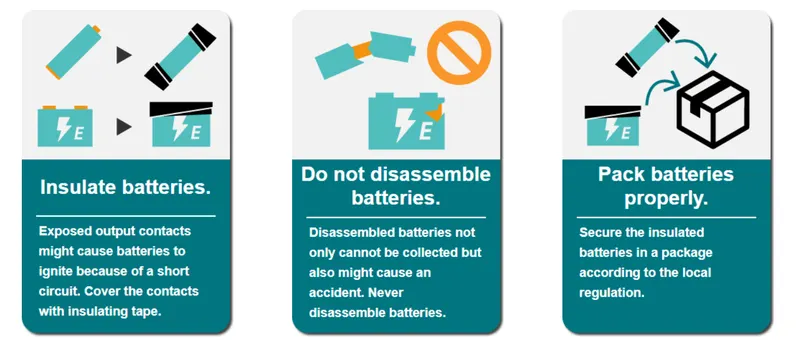
you can’t throw away lithium-ion batteries with your regular trash or even in your blue recycling bin.
And there are three specific reasons why.
- Some Metals They Contain Are Toxic To The Environment
There is some confusion out there when it comes to lithium-ion batteries and their environmental impact.
You’ll often hear huge electronic manufacturers refer to studies about how lithium is one of the least toxic metals utilized in batteries, and there's a certain amount of truth to that.
But, as always, you have to take a closer look.
Some types of li-ion batteries contain metals like cobalt that are highly damaging even in relatively small quantities when these batteries are broken down.
Thankfully, some lithium-ion battery technology is forgoing cobalt for safer, non-toxic, relatively common materials such as manganese oxide or phosphate.
- They're Toxic To Humans When Broken Down or Damaged
First things first: The important thing to understand with these batteries is that even though they may contain materials that could be considered toxic or hazardous, the batteries are not exactly dangerous when they’re contained inside an electronic product (like when they’re inside a laptop, for example).
However, once you break down the electronics, the batteries that are now in the open can potentially be toxic to humans.
On average, about 50% of a lithium-ion battery can be recycled in an effective way.
This is especially true if they get exposed to dampness, heat, or accidental damage.
Every cell within a battery is a separate unit, but even if one of them gets damaged, this could cause a chain reaction. This would then lead to harmful metals leaking out.
Inhaling or otherwise coming into contact with metals like cobalt can cause very serious health problems.
That’s why battery recycling should be your first option for keeping your family safe.
- They're a Potential Fire Hazard
One of the underrated reasons why proper lithium ion battery disposal is important is because there is a certain level of fire hazard associated with them.
At GreenCitizen over 95% of the exploded or bulging batteries that Apple products that use the Lithium Polymer (LiPo) style.
References:
IEC62133 - Safety Test Standard of Li-Ion Cell and Battery.
https://www.samsungsdi.com/lithium-ion-battery/safe-information.html