Volume Mesh for Rearview mirror using ANSA
Aim: To generate a volume mesh for the rearview mirror using ANSA. (Unstructured mesh)
|
S.No |
Quality Criteria |
Value |
|
1 |
Target/Average length |
1 |
|
2 |
Minimum Length |
0.5 |
|
3 |
Maximum Length |
2 |
|
4 |
Tetcolapse |
0.2 |
A rear-view mirror (or rearview mirror) is a flat mirror in automobiles and other vehicles, designed to allow the driver to see rearward through the vehicle's rear window.
In cars, the rear-view mirror is usually affixed to the top of the windshield on a double-swivel mount allowing it to be adjusted to suit the height and viewing angle of any driver and to swing harmlessly out of the way if impacted by a vehicle occupant in a collision
The rear-view mirror is augmented by one or more side-view mirrors, which serve as the only rear-vision mirrors on trucks, motorbikes, and bicycles.
Methodology:
- Import the cad geometry of the intake manifold.
- Clean up the geometry and look for any topological errors.
- Generate a volume mesh from the 2D mesh.
- In order to 3D mesh the component, the volume of the model should be defined. Tet collapses should also be removed after generating a mesh.
Step 1:
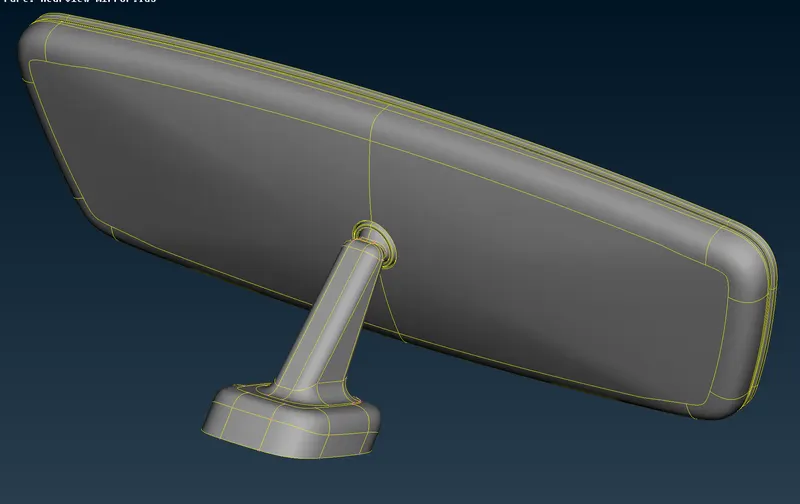
After importing the geometry into ANSA, the length of the perimeter and macros is set to 1 mm to check the quality of the model. Then, a geometry check is run and required clean-up is performed.
Also, a topo function is performed to fix free edges in the model.
The errors are mostly fixed automatically using the 'fix' option in the checks menu.
Step 2:
After all the errors are fixed, a quality criterion for the model is set using the required mesh parameters. Meshing is done at curved and smaller regions in the area using 'ortho trias' as they enable better feature-capturing.
For uncurved features, tria mesh is used as it gives almost the same result as an ortho tria mesh while needing lesser computational time.
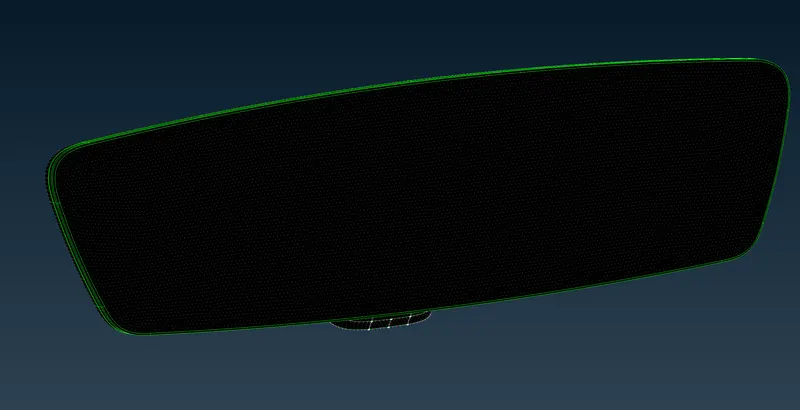
The quality errors in mesh are then corrected using 'smooth', 'reconstruct' and other options. Also, certain construction lines inside the holes were removed so as to avoid any quality failure.
Step 3:
For 3D meshing of the components, the volume has to be defined. Next step is to go to the list option which to ensure that the volume has been defined.
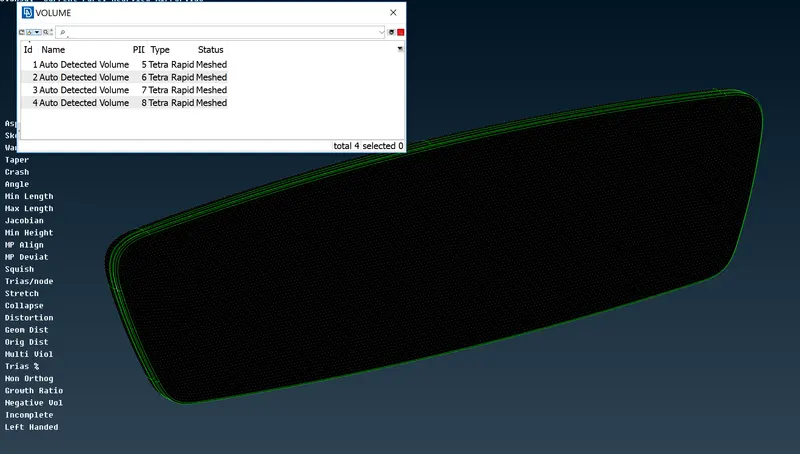
Now, the unmeshed volume can be meshed using Tetra Rapid or Tetra FEM.
Tetra - FEM/ Rapid are just different algorithms for unstructured meshing.
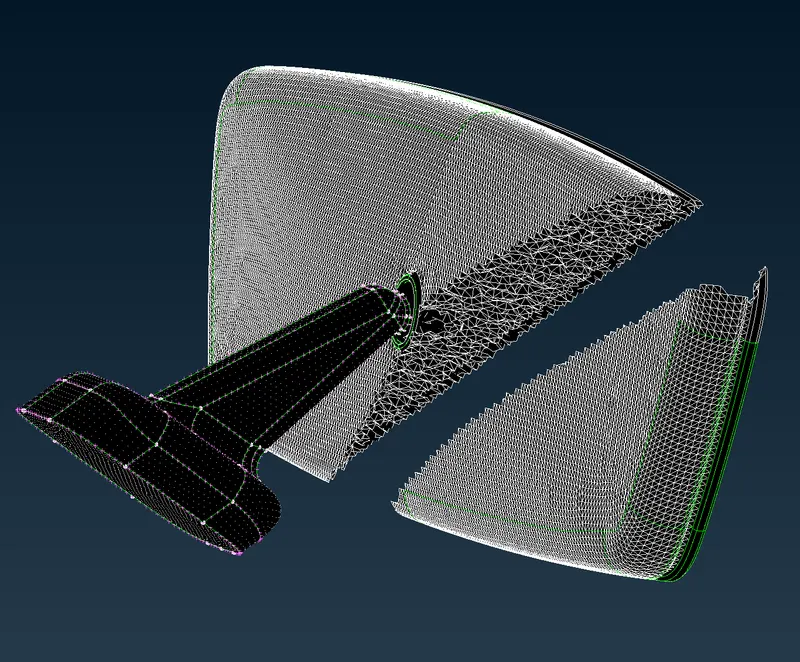
Any elements which do not abide by the quality criteria are taken care of using 'align', 'smooth' or 're-construct' method.
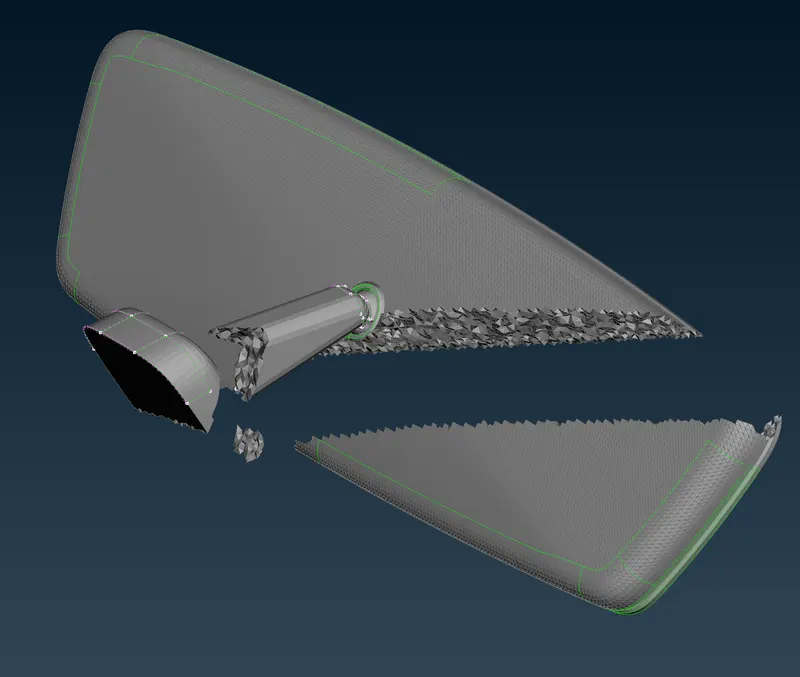
The final picture of the mesh is shown below
Conclusion:
The given model is imported to the ANSA software and the geometrical errors are fixed.
The surface of the component is meshed with the combination of ortho tria and normal trial elements.
The volume of the component is defined and meshed using tetra FEM elements.
The kinks and dips are eliminated.