Week 5.1 - Mid term project - Solving the steady and unsteady 2D heat conduction problem
AIM
To solve the 2D heat conduction equation using point iterative techniques (Jacobi, Gauss-Seidel and Successive Over-Relaxation).
First discretize the equation and then implement the iterative methods and also compare the convergence rates of these methods for steady state and transient analysis.
1. Steady State Analysis
The 2D heat conduction equation in steady state is given by:
`((del^2T)/(delx^2))+((del^2T)/(delu^2))=0`
Discretize this equation using finate differencing and solve it using the Jacobi, Gauss-Seidel and SOR Methods using MATLAB.
Result
Jacobi Method
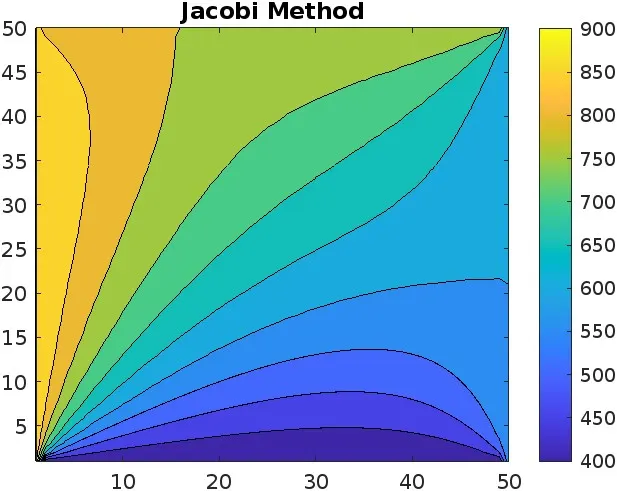
The contour plot shows the temperature distribution with smooth gradients and converges to the steady state.
The convergence is slow, requiring a large number of iterations to meet the error tolerence `(1e-4)`.
Gauss-Seidel Method
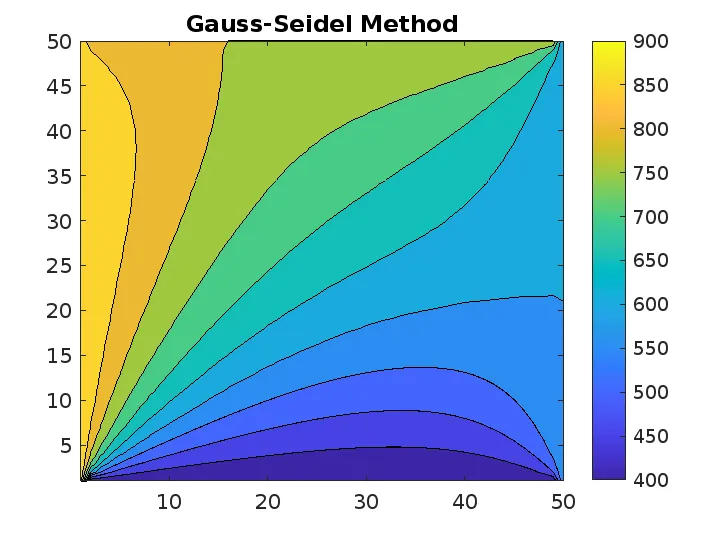
The temperature distribution is similar to the Jacob method but converges faster.
It uses updated values during iteration, which accelerates convergence.
SOR Method
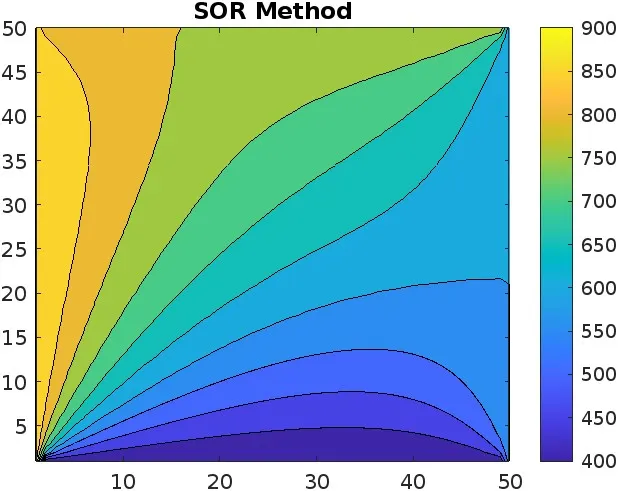
The temperature distribution is identical to the other methods, but converges significantly faster.
The relaxation factor `(omega = 1.5)` optimizes the convergence rate.
2. Transient Analysis
For transient analysis, we will solve the time dependent heat conduction equation:
`(delT)/(delt)= alpha ((del^2T)/(delx^2))+((del^2T)/(dely^2))`
I have used both explict and implict scheme for this analysis.
Results
Explicit Scheme
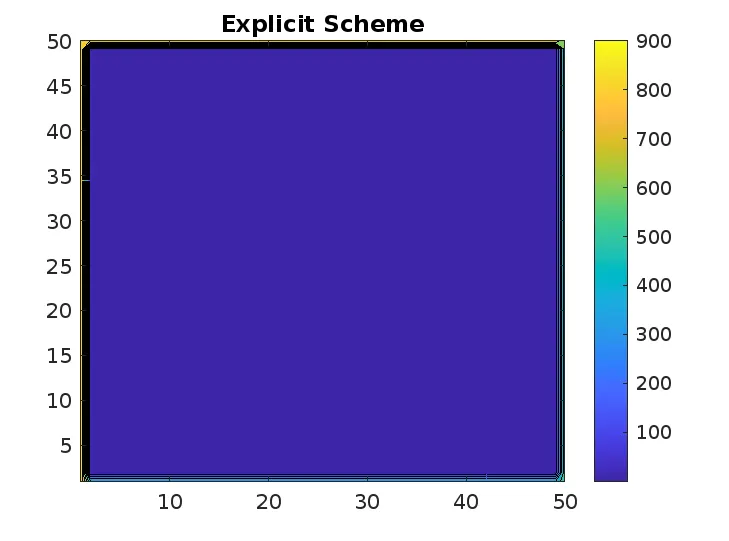
The temperature distribution evolves over time, starting from the initial condition and approaching the steady state solution.
The method is simple but requires small time steps for stability.
Implicit Scheme
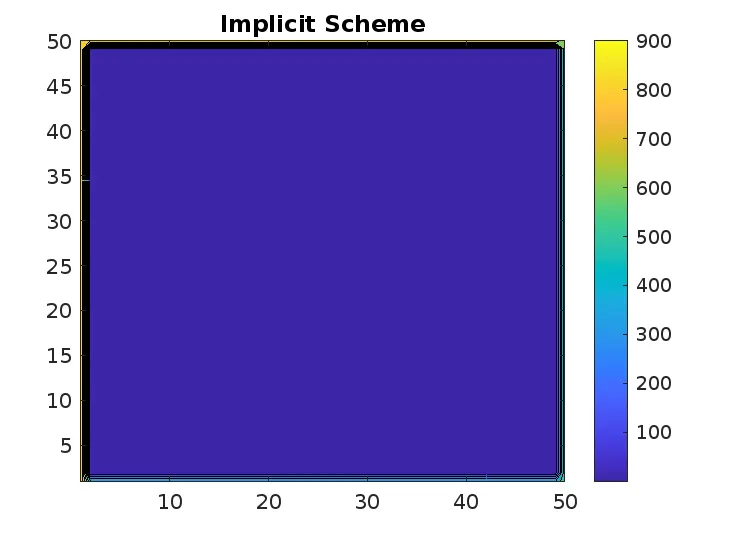
The temperature distribution also evolves over time but is more stable than the explicit scheme.
It allows larger time steps and converges faster to the steady state solution.
Conclusion
Steady State Analysis
The SOR Method is the most efficient for solving the steady state heat conduction equation as it converges significantly faster than the Jacobi and Gauss Seidel Methods.
The Gauss Seidel method is a good compromise between simplicity and efficiency.
The Jacobi method is the simplest to implement but is computationally expensive for large grids.
Transient Analysis
The implicit schene is more stable and efficient than the explicit scheme, expecially for larger time steps.
The explicit scheme is easy to implement but requires very small time steps to maintain stability, making it less efficient for long simulations.
Overall
For steady state problems, the SOR method is recommended due to its fast convergence.
For transient problems, the implicit scheme is preferred dur to its stability and ability to handle larger time steps.