Week 4.1: Project Steady state simulation of flow over a throttle body
Advanced Aerodynamic Simulations using Converge Studio
Week 4.1 Project :- Steady state simulation of flow over a throttle body
Geometry setup and Pre-processing:
For the given project, a geometry of '.stl' file is loaded in Converge Studio. Since the imported geometry is not suitably captured by the CAD environment, few modifications are performed.
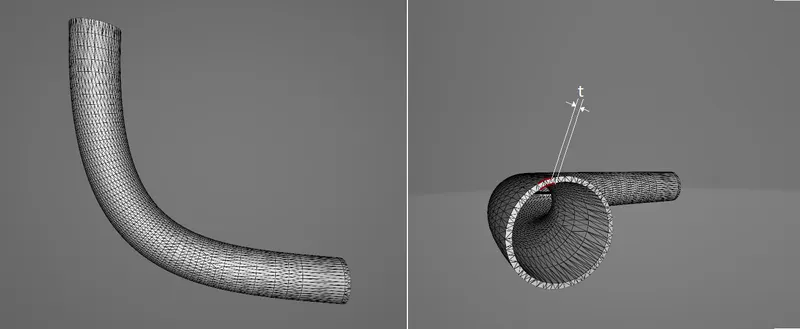
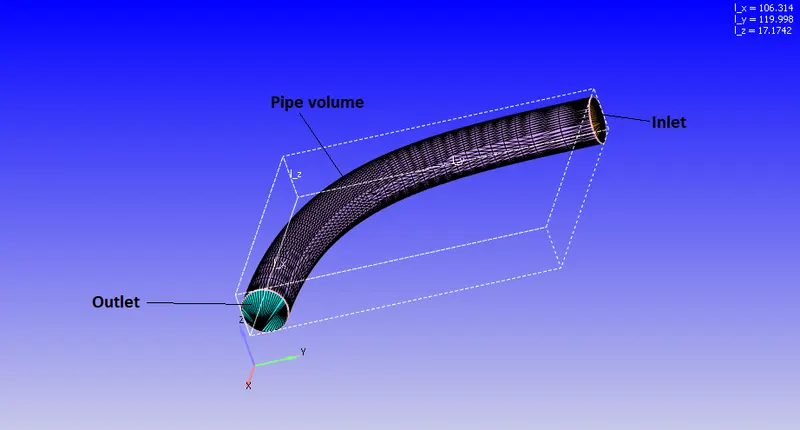
The aim here is to make internal flow analysis of the pipe. Here, the pipe has a wall thickness, which is not required and the internal flow volume is of importance. With that, the outer faces (width) of the geometry are removed and just a 2D surface is kept.
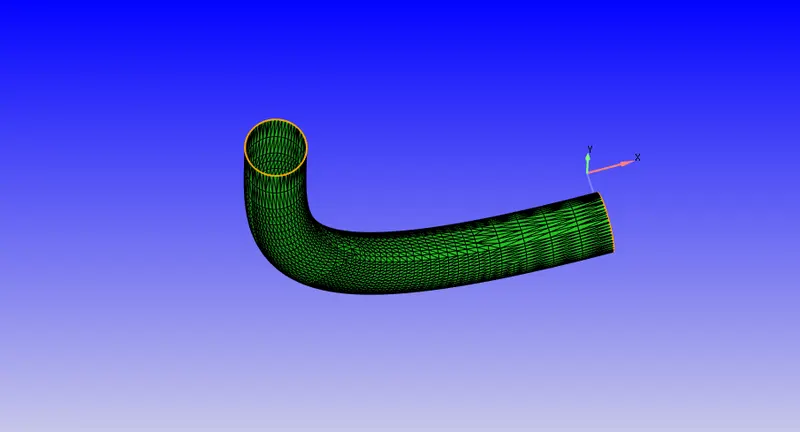
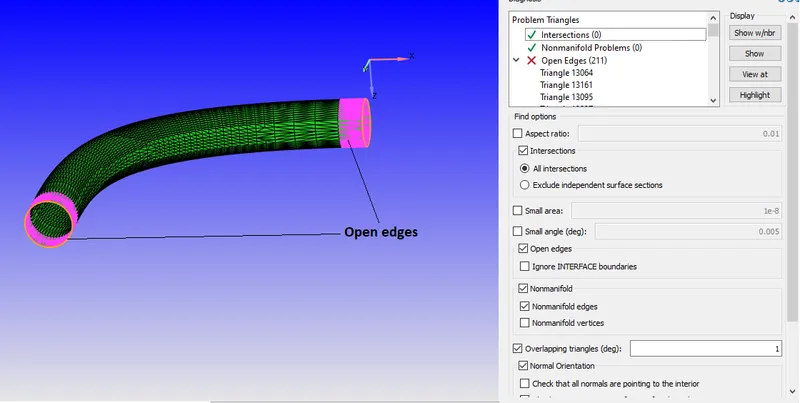
After removing the thickness, in order to make the geometry free of incomplete surfaces, the few open edges are removed and the open surfaces are sealed by providing patches at the circular openings, putting it simply, the open surface is covered by boundary fences at both ends.
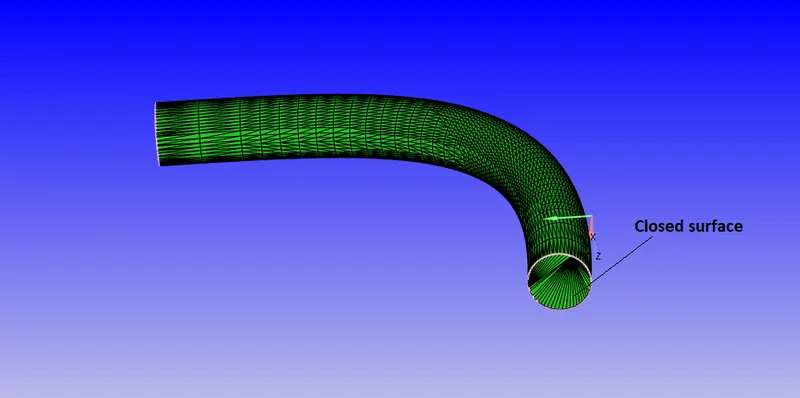
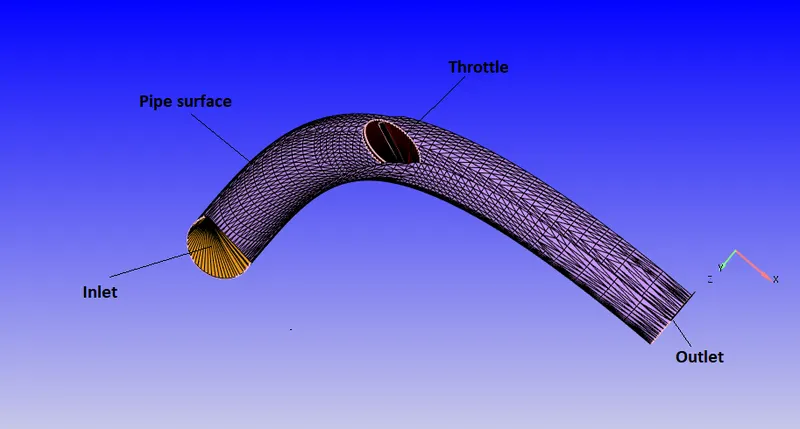
The image shown above represents the "Extracted Fluid Volume". In the next stage, the entire geometry consisting of triangles is categorized into inlet, outlet, pipe surface and the throttle body by creating different boundaries.
Nextly, the entire model is scaled down to a factor of 0.001. Here, the geometric dimensions will be reduced to an extent, however, the flow analysis will not be impacted.
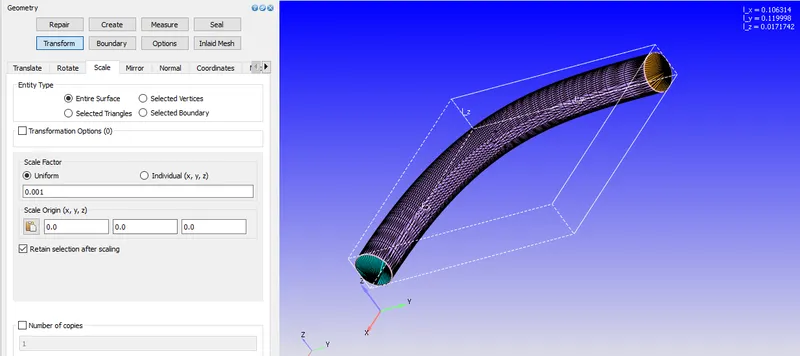
The geometry is free of any extra edges and is now ready for case setup.
Solver Settings:
In the Time-Based type of steady state simulation, the fluid is chosen as 'Air', as mixture of N2 and O2 of 0.77 and 0.23 percent.
The Turbulent Prandtl number is a non-dimensional term defined as ratio between momentem eddy diffusivity and heat transfer eddy diffusivity. It is useful to solve heat transfer problem boundary layer flows. The summation of molecular and turbulent conductivity and diffusivity is taken into consideration when solving transport equations. With that, the turbulent Schmidt (Sc) and Prandtl number (Pr) are partially varying as presence of walls affect these values hence the default values taken near to 0.78 and 0.9 respectively.
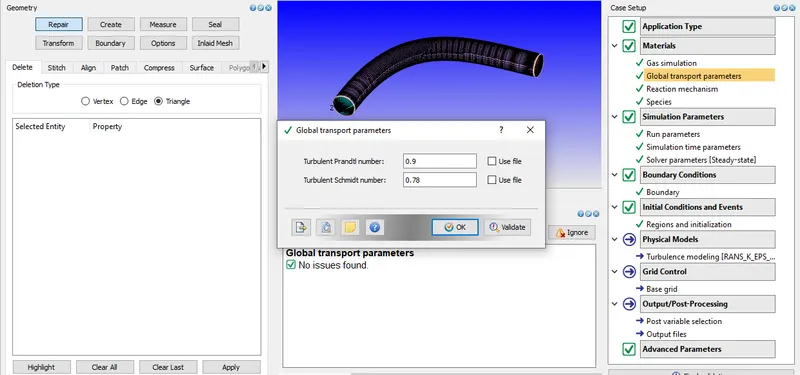
This default values is proved to be satisfactory for many reacting and non-reacting turbulent flows hence they can be used as some default approximations.
The case is set for full hydrodynamic and compressible flow and solver is preferred steady state solver. The end time for case is set to 15000 Cycles with initial minimum time step of 1e-9 and maximum time step of 1 with maximum convection CFL limit of 0.5. The lesser the CFL number's value is, the slow will be the simulation and more accurate will it be. In addition the convective flux scheme is set as FVM and the Density based solver is used. These particular values of Convection CFL, Diffusion and Mach CFL number is related to the stabilty of the solution which Converge uses as default.
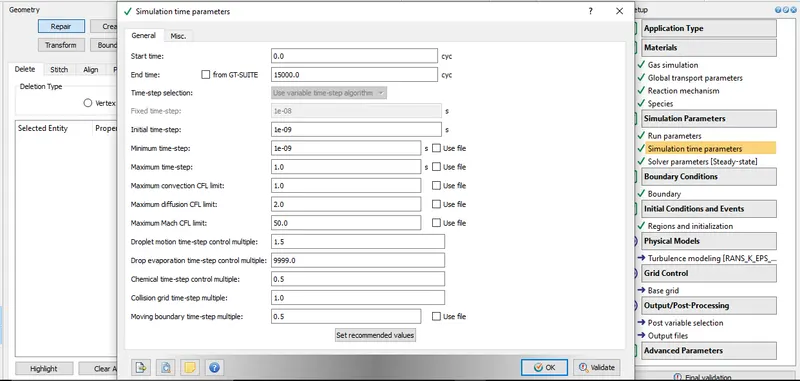
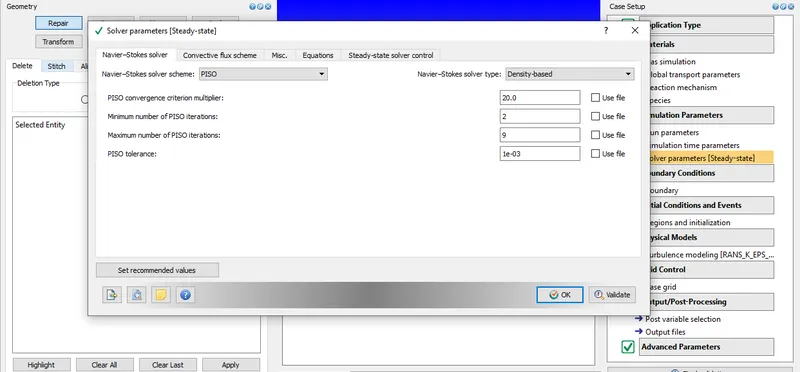
The solution scheme is set to PISO which is "Pressure Implicit with Splitting of Operator". The PISO algorithm with multiple time steps provides more stable solution, with lower time steps.
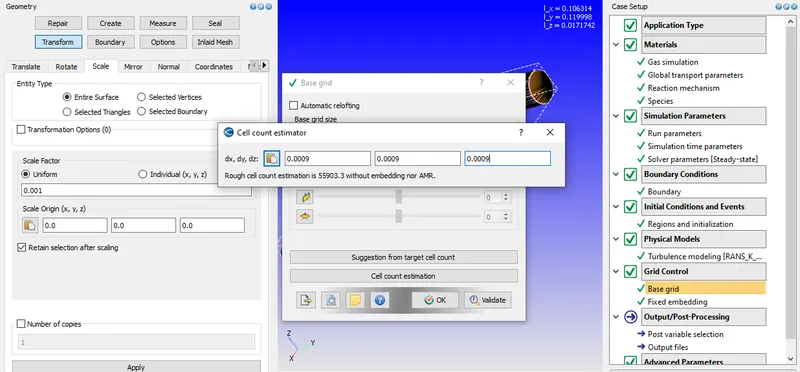
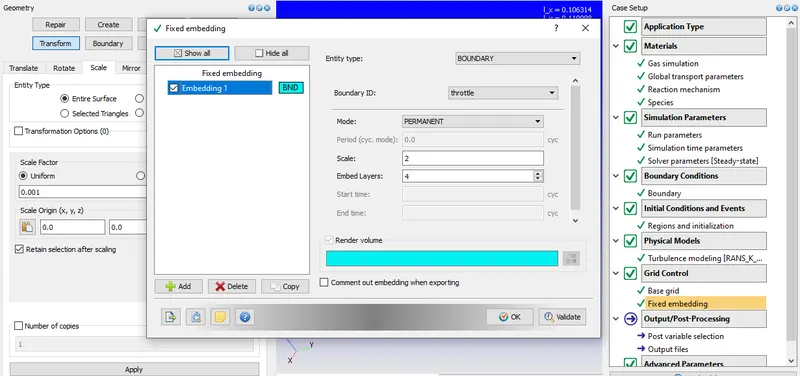
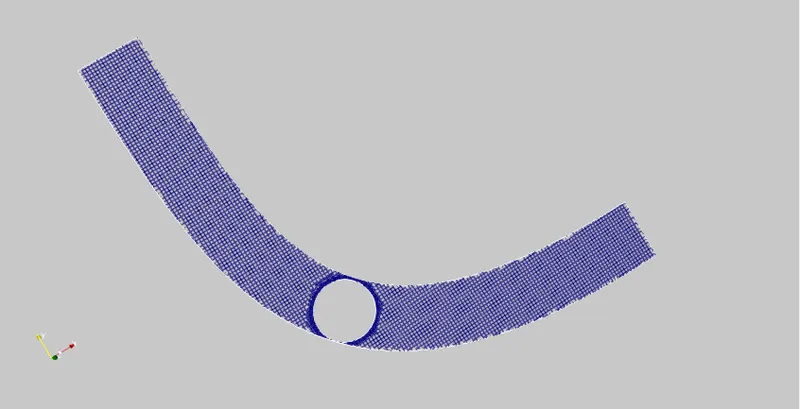
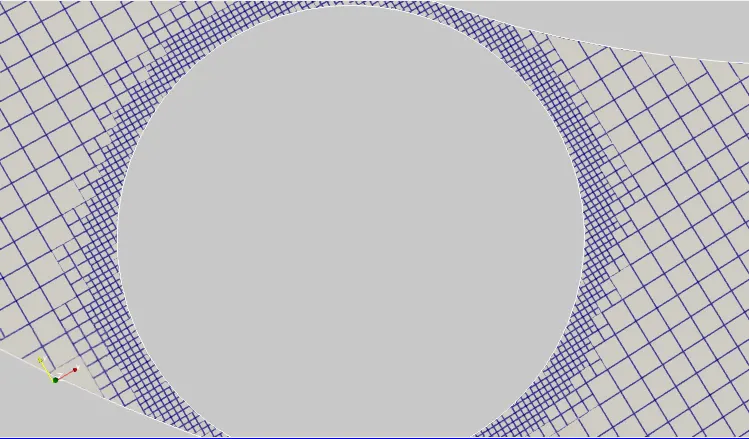
With regards to the grid size, the cell size is kept 0.0009 metres with total cell count of ~55000 cells. In addition to refine the regions at the internal boundaries, the Boundary type Permanant Fixed Embedding is employed at throttle surface, with scale of 2 and of total 4 layers
For Boundary conditions, the Inlet boundary is set to Total pressure inlet of 150000 Pa, with Zero Normal Gradient for Velocity Boundary condition, which means that all variables are set to a fixed value, and considering a variable `phi`is fully developed at the inflow region of the circular opening, so its variation with respect to space (say `vecn`) is zero, i.e. `(dphi)/(dvecn) = 0`.
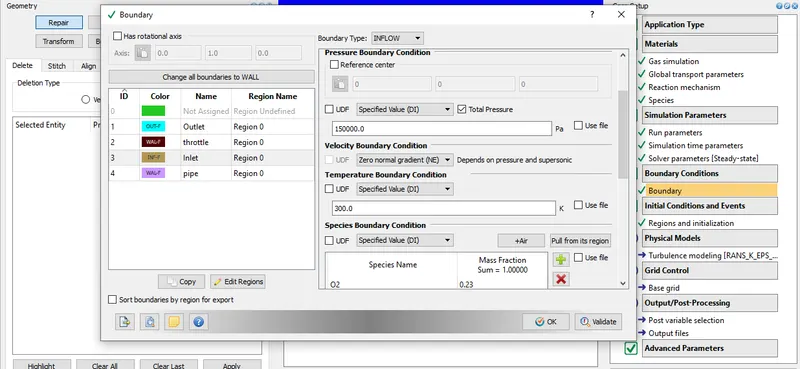
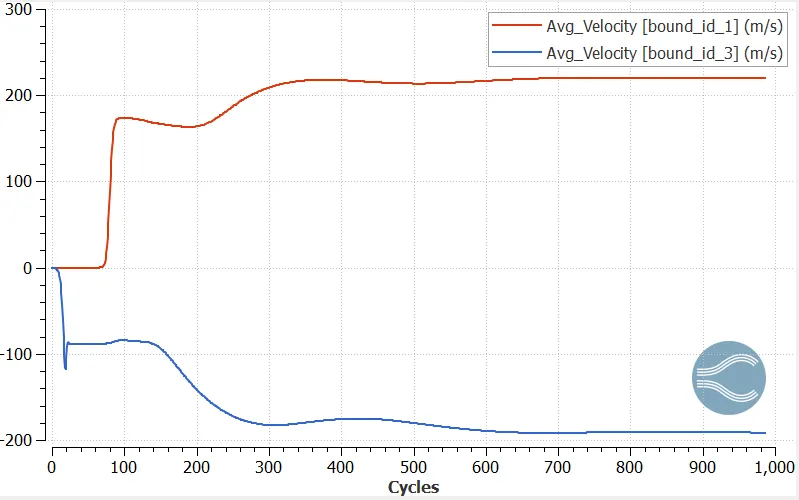
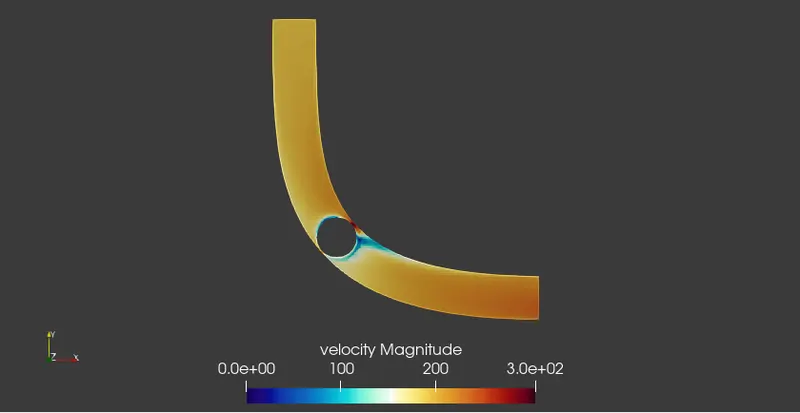
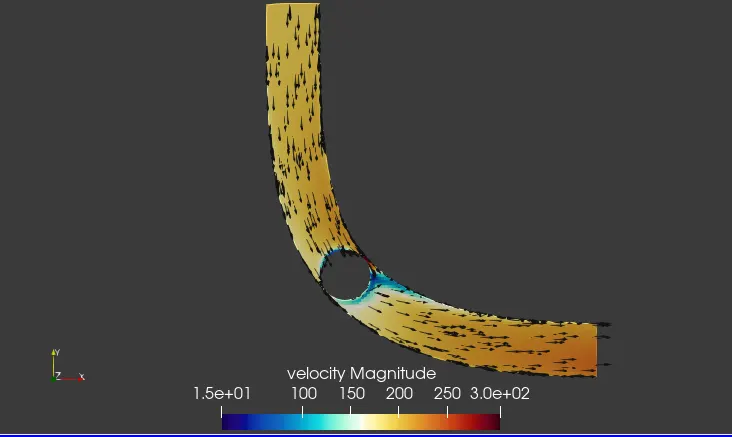
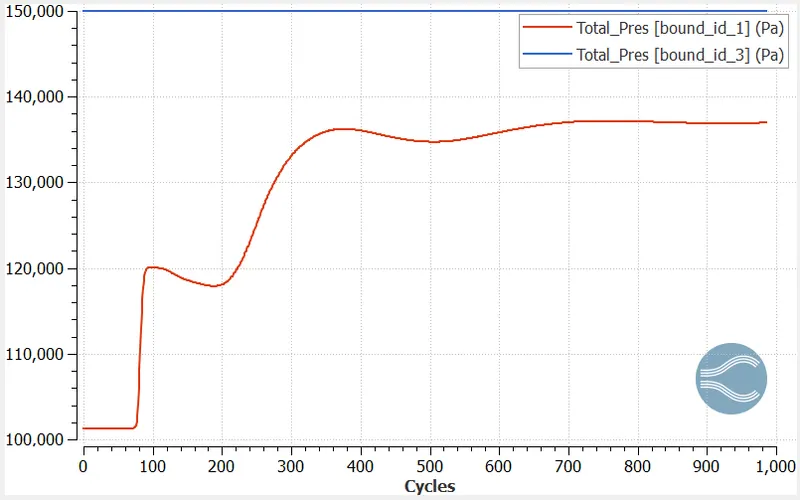
For outlet, the Pressure outlet is kept at 1 atm, i.e. 101325 Pa, at sea-level condition. By the pressure difference of ~48000 Pa, the value of velocity is around 280 m/s, setting up a compressible flow.
For the Throttle's boundary condition, the limitation is given as "Wall", with Fixed surface movement.
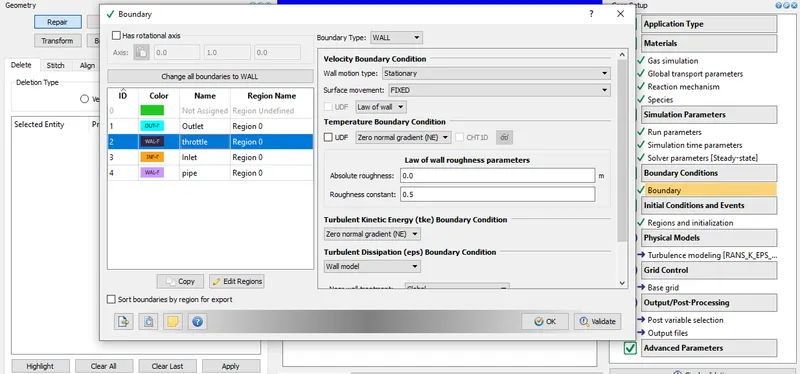
The flow being viscous, the model is selected to RNG k-epsilon. In the standard k-Epsilon model, the eddy viscosity is determined by single turbulent length scale, however in reality all scales of motion contribute to turbulent diffusion so is this modified equation of Renormalised Group, (RNG k-epsilon) it accounts for different scales through changes in the production term.
After this the input files are exported to the case's setup folder and required executables along with license file are copied, and the case is ran with 4 parallel processor in Cygwin. As the post processing of output files is done, the contours are viewed in Paraview and variation of parameters in Converge's line plot.
Post-Processing:
The below picture illustrates the generated grid with given embedding parameters;
Variation in Mass flow rate:
Variation in Velocity:
Variation in Total Pressure:
Variation in Turbulent kinetic energy:
Conclusion:
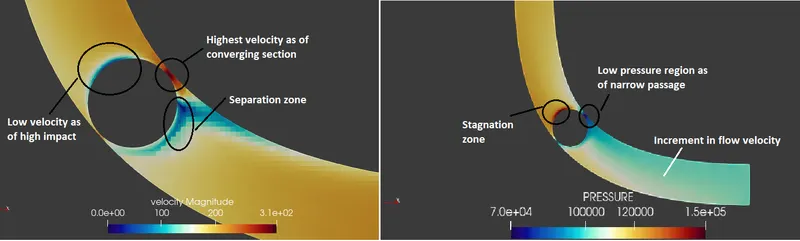
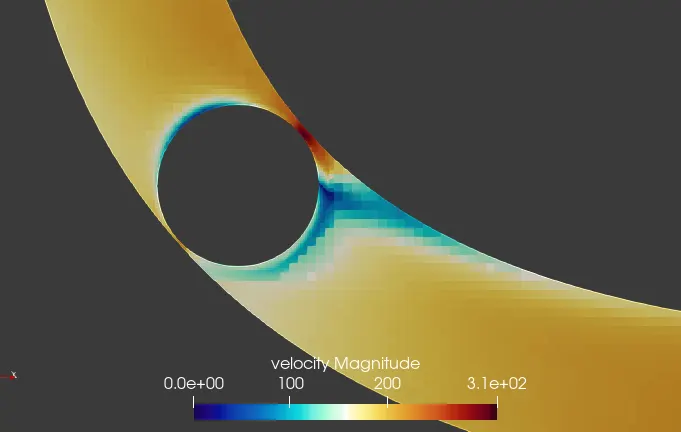
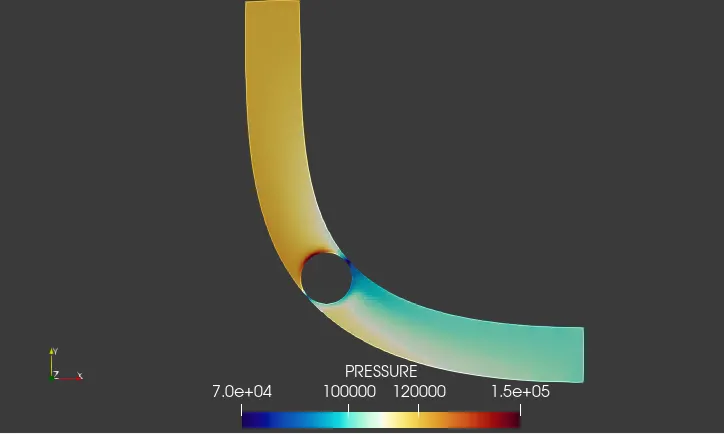
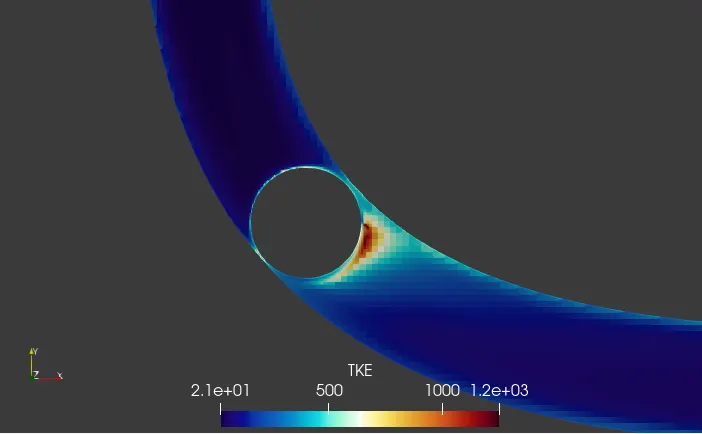
As seen from the above image, the inflow velocity is less at the throttle's surface as that region consist of high pressure zone. Consequently, as the flow passes thru the narrow channel, i.e. the gap between the throttle's surface and the pipe wall, the flow velocity increases as the phenomena validates the continuity equation of "Area x Velocity = constant". Right after that passage, the space is diverging, and as the reaches there it starts to separate and eddies are formed as seen in the above picture of turbulent kinetic energy, where the red coloured region indicates high intensity of eddies.
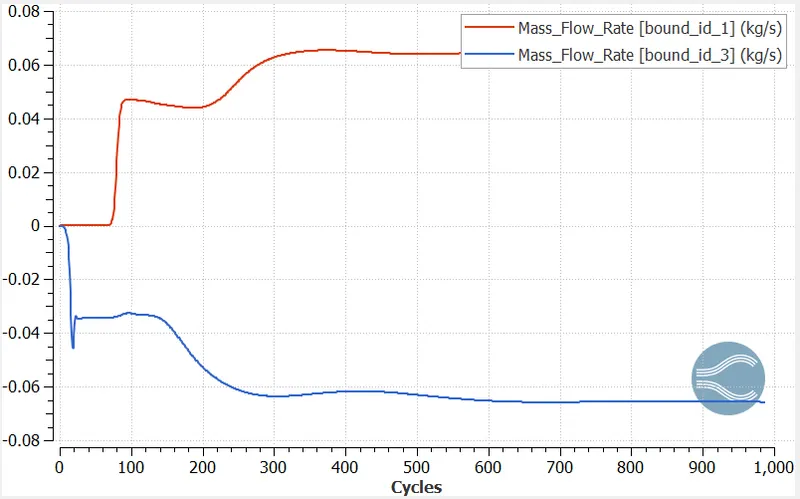
From the grapical values it is clear that the pressure at the outlet is lower, about 136963 Pa, as the most of the flow propagates with more velocity to the exit section with around 219 m/s. Secondly, the mass flow rate is 0.065 kg/s at inlet and outlet, indicates that the "Continuity Equation" is conserved locally.
Furthermore, in order to capture the near accurate values of velocity and pressure at certain zones, the mesh needs to be refined and the embedding has to be kept smooth with certain number of layer.