Week 4 -Wire Bending Challenge
Objective:
In this challenge we have to simulate the bending of a wire using deifferent materials which are Copper alloy, Aluminium Alloy and Magnesium alloy for the wire material. The equivalent stress and equivalent strain of the wire alone is found out on each case and results are compared.
Setup:
For the first step we need to load the materials into engineering materials. The materials that needs to be added are Copper Alloy, Aluminium Alloy and Magnesium Alloy. All these materials are available in the general materials non linear section. Once that is done we import the geometry and open it in Spaceclaim. After checking for any abnormalaties in spaceclaim we updates the model. Once the updation is done we open the mechanical module and rename the componenets as Wheel. Wire and Lever. During this renaming we also assign the wire the suitable material, the Wheel and Lever material is assigned Structural Steel. We add a new co-ordinate system at the surface where the wire comes in contact with wheel initially. Once the coordinate system is established we offset the coordinate to move towards the wire by offsetting X by 3mm and offsetting Z by -3mm. Moving on to the mesh we select all bodies for patch conforming method and change the method to tetrahedrons. Then we select the surface of the wire and the contact surface with the wheel and lever to give it a mesh size of 2.1mm. After that we select the contact surface of wire and wheel where we established a new co-ordinate system and cahnge the type to sphere of influenece. Selecting the new coordinate system, giving the radius 7mm and a mesh size of 0.8mm.Change normal stiffness factor to factor and give it a value of 0.1 andchange update stiffness to after each iteration thisconcludes the final step . After that we move on to Analysis settings where we give 8 steps. For the first step we switch on Auto times stepping and change the define by to time. Initial time step is 0.1s, Minimum Time step is 1e-2 s and maximum time step is 0.2s. Also for the first step switch all the no to yes in output controls. For steps 2 to 8 switch on aut time stepping and carry over time step as well. Minimum time step is 1e-2 and Maximum time step is 1s. For all steps change solver type to direct, switch on large deflection and change weak springs to Program Controlled. FInally change the interface treatment to add offset, ramped effects. Now we can give a fixed support at the inner surface area of the wheel and another fixed support to the wire head surface which is inside the wheel. We need to give a ground to bodt joint by selectin the inner circular surface of the lever (Revolute joint). We give the joint a rotation value along its z axis such that it bends the wire. The values are given in a tabular column whihc are -20,-40,-60,-80,-120,-140 and -140. After that goin to solution and selceting Equivalnet strain and Equivalent Stress just for the wire as geometry. Now we can run the simulation.
Copper Alloy:
Equivalent Strain:
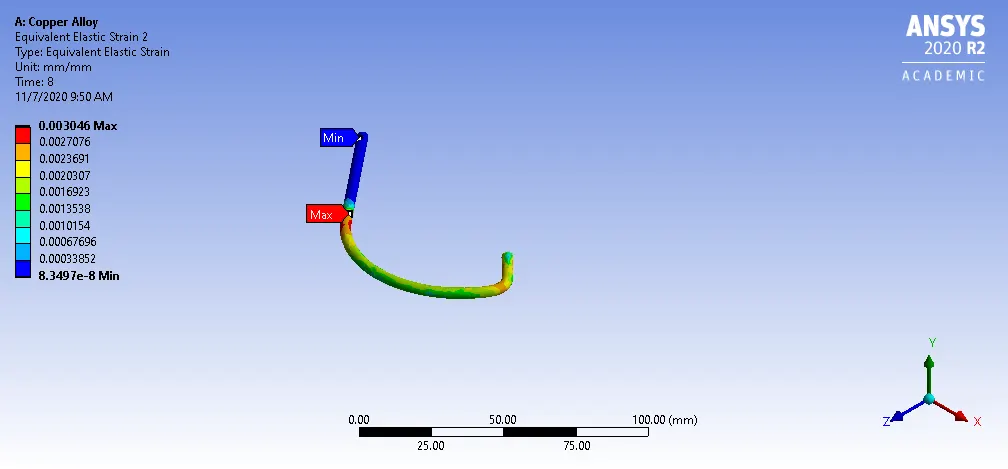
The maimum strain occured was 0.003046 mm/mm which occured at the point of bending as shown above.
Equivalent Stress:
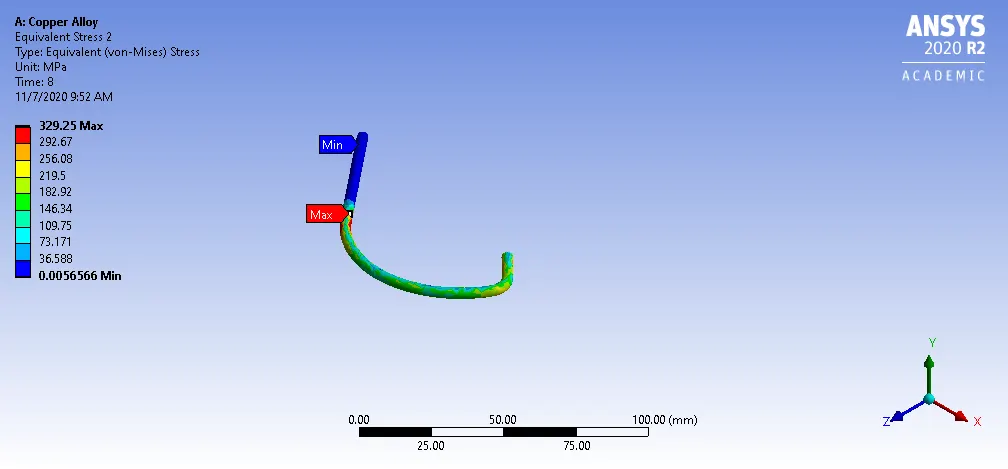
The maximum stress occured at the same place of maximum strain and its value is 329.25 MPa
Aluminium Alloy:
Equivalent Strain:
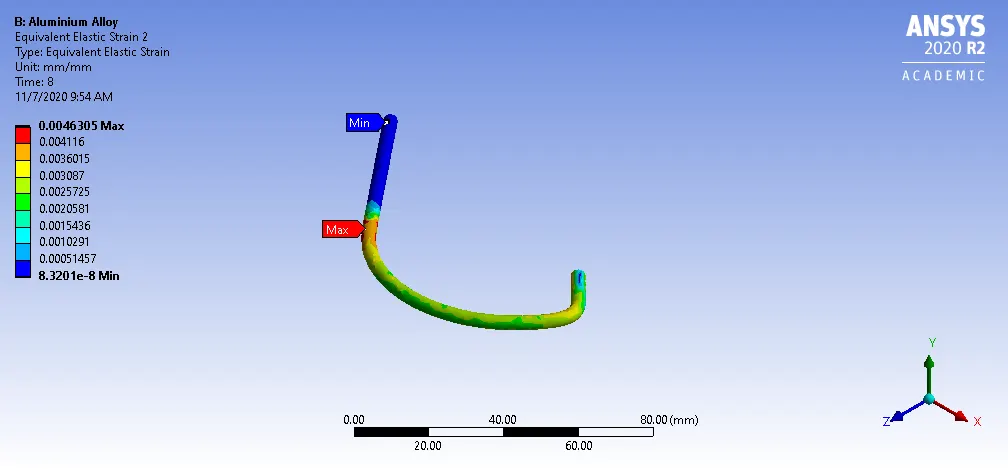
The maximum strain in aluminium occured at the point of bedning as well it is 0.0046305 mm/mm.
Equivalent Stress:
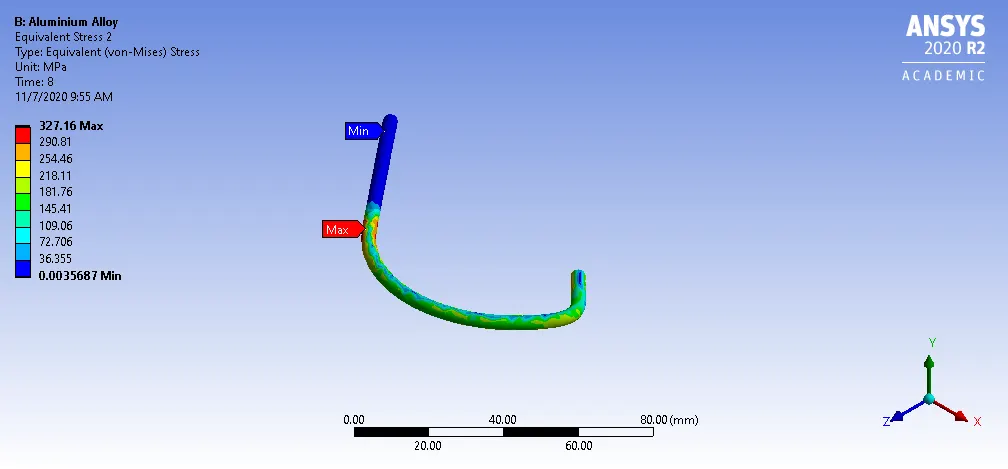
The Maximum stress coincided with maximum strain and its value is 327.16 MPa.
Magensium Alloy:
Equivalent Strain:
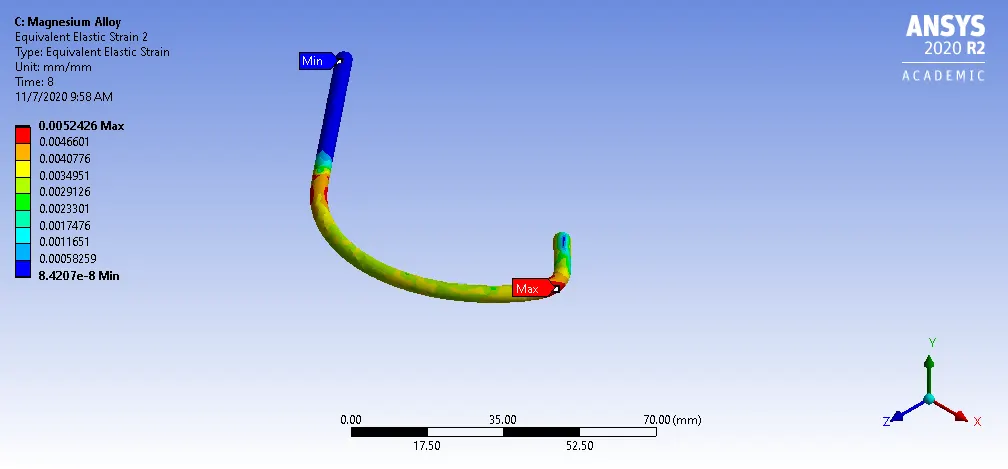
The maximum strain that occured is 0.0052426 mm/mm. It is at the first bending point although similar values are seen at the last bending point as well.
Equivalent Stress:
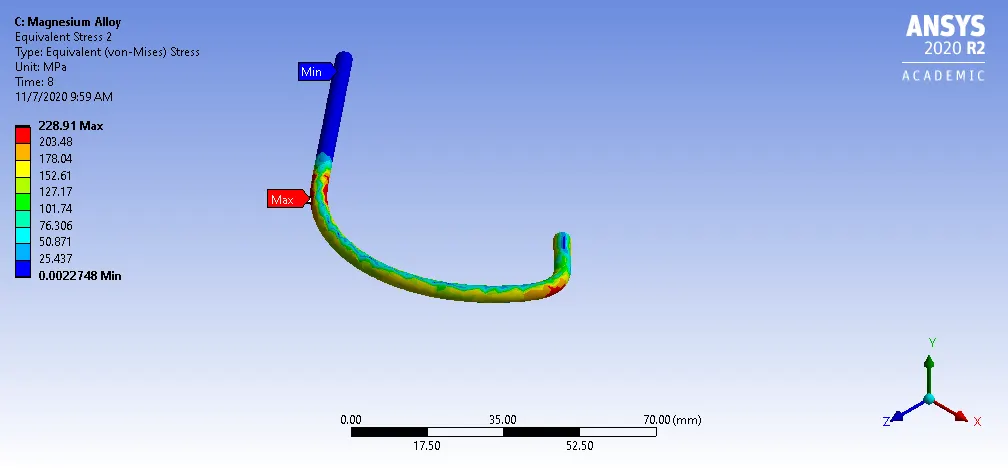
The maximum stress is 228.91 Mpa.
Comparison:
| Material | Equivalent Strain (mm/mm) | Equivalent Stress (MPa) |
| Copper alloy | 0.003046 | 329.25 |
| Aluminium Alloy | 0.0046305 | 327.16 |
| Magnesium Alloy | 0.0052426 | 228.91 |
All the materials except magnesium had maximum stress and strain at the same point. The maximum stress is developed in Copper followed by Aluminium and the least is developed by Magnesium. While the maximum strain is dveloped by magnesium followed by aluminium and the least is developed by copper. The maximum stress is always developed at the bending point and so is strain except in the case of magnesium although similar value was obtained at the point of bending.