Week 4 -Wire Bending Challenge
Wire Bending
OBJECTIVE
To perform analysis for finding equivalent stress and equivalent strain on a wire by simulating the bending of a wire using copper alloy (Non Linear), aluminium alloy (Non Linear) and magnesium alloy (Non Linear) as wire materials.
METHODOLOGY
The geometry consisting of wire, wheel and lever was imported and checked in Spaceclaim for any uncertainties. The bodies were rechecked for any abnormalities in spaceclaim and verified that the geometries were free of abnormalities. Fig. 1 shows the imported geometry. The materials of wire such as copper alloy NL (Fig. 2), aluminium alloy NL(Fig. 3) and magnesium alloy NL (Fig. 4) are added from the engineering data sources available in the ANSYS. The structural steel was assigned to both wheels and lever (Fig. 5). The analysis has been performed by specifying two contacts. In the first contact, the wire was the contact body whereas the lever was the target body. In the second contact between the wheel and wire, the contact and target bodies were wheel and wire. These two contacts were defined as frictional with frictional coefficient of 0.2. The formulation was augmented lagrange, normal stiffnes defined by a factor of 0.1 and update stiffness by each iteration and interface treatment as add offset, ramped effects. A revolute joint (body to ground) was set by selecting the inner circular face of the lever that could rotate on the Z axis. For three cases, two faces of the wire have meshed with 2.2 mm face sizing. A sphere of influence was placed on the wire where bending is severe by placing a new coordinate system by offsetting x and offsetting Z by 6 mm and -3 mm respectively. The refined mesh was developed on the maximum bent region with a sphere radius of 7 mm and element size of 0.8 mm Fig. 6). The entire bodies were meshed using tetrahedrons. The inner hollow face of the wheel was fixed in all degrees of freedom. The end face of the wire extended to the wheel was also fixed in X, Y and Z for restricting the slipping of the wire. The analysis settings consist of 8 steps with auto time stepping as ON, defined by time, initial time step as 0.1s, minimum time step as 0.01s and maximum time step as 0.2s. Solver type was ‘DIRECT’, large deflection was turned ON. The joint rotation was given as tabular for 8 steps (Table 1). The equivalent stress and equivalent strain on the wire are evaluated and compared.
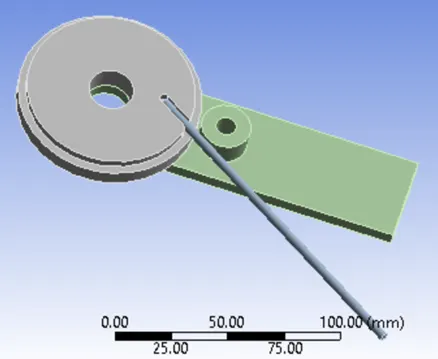
Fig. 1 Geometry consisting of wheel, wire and lever
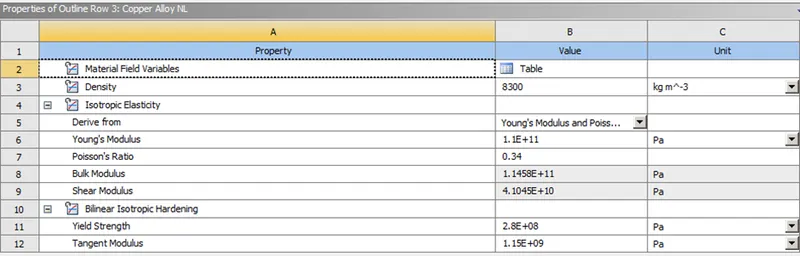
Fig. 2 Material properties of Copper alloy
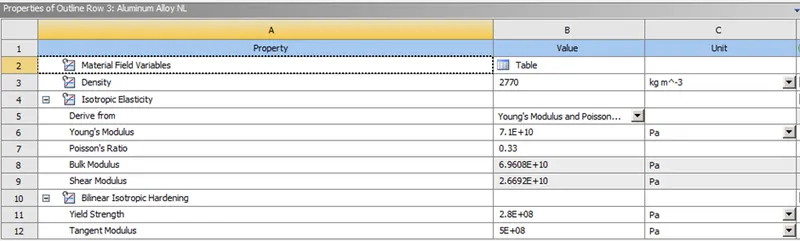
Fig. 3 Material properties of Aluminium alloy
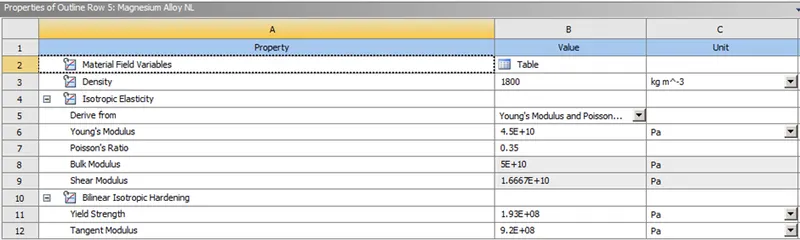
Fig. 4 Material properties of Magnesium alloy
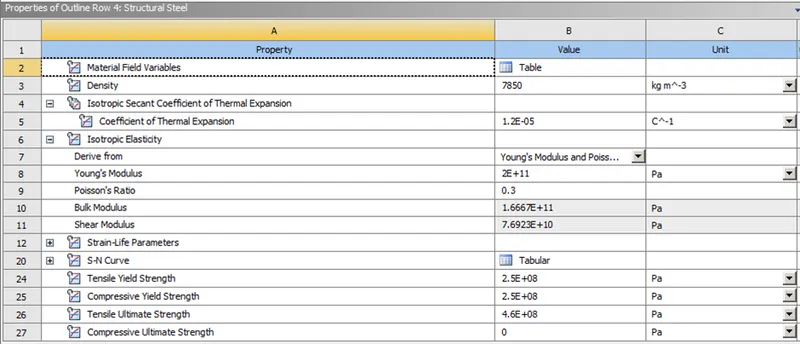
Fig. 5 Material properties of Structural steel
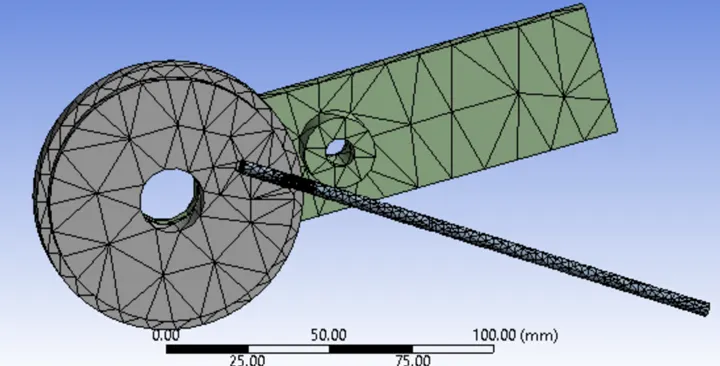
Fig. 6 Meshed model
RESULTS AND DISCUSSION
Three cases of bending were investigated by assigning different non linear materials such as copper, aluminum and magnesium to the wire. Table 1 compares the equivalent stress and equivalent strain for the three cases. Fig. 7 and Fig. 8 show the von mises stress and equivalent strain on the copper wire at the end time. At the end of the time steps, the equivalent stress and equivalent strain of the wire were highest in copper alloy wire with 322.79 MPa and 0.00295, respectively. Fig.9 and Fig.10 show the von mises stress and equivalent strain on the aluminium wire whereas Fig. 11 and Fig. 12 illustrate the von mises stress and equivalent strain on the magnesium wire at the end time. The von mises stress of magnesium alloy and aluminium alloy wire were 232.22 MPa and 313.5 MPa respectively. The magnesium has undergone an equivalent strain of 0.005183 whereas the aluminium alloy has undergone an equivalent strain of 0.00442. Least the equivalent strain, highest is the von mises stress. However, during the process of plastic deformation, the maximum von mises stress is observed on copper alloy (657.25 MPa) and second on the magnesium alloy (496.32 MPa) and the least on the aluminium alloy with 454.58 Mpa. It was found that the stress was relieved after the bending process. The trend of maximum equivalent strain followed the same as that of equivalent strain at the end of the process. The maximum equivalent strain on copper, aluminium and magnesium wires are 0.006044, 0.00645 and 0.011123 respectively.
|
Table 1 Von mises stress and equivalent strain on a bent wire |
|||
|
CASE 1 |
CASE 2 |
CASE 3 |
|
|
Wheel: Structural steel Wire: Copper NL Lever: Structural steel |
Wheel: Structural steel Wire: Aluminium NL Lever: Structural steel |
Wheel: Structural steel Wire: Magnesium NL Lever: Structural steel |
|
|
Maximum Von Mises on wire |
657.25 MPa |
454.58 MPa |
496.32 MPa |
|
Von Mises on wire at end time |
322.79 MPa |
313.5 MPa |
232.22 MPa |
|
Maximum Equivalent strain on wire |
6.0445e-003 |
6.4503e-003 |
11.123e-003 |
|
Equivalent strain on wire at end time |
2.9506e-003 |
4.4221e-003 |
5.1831e-003 |
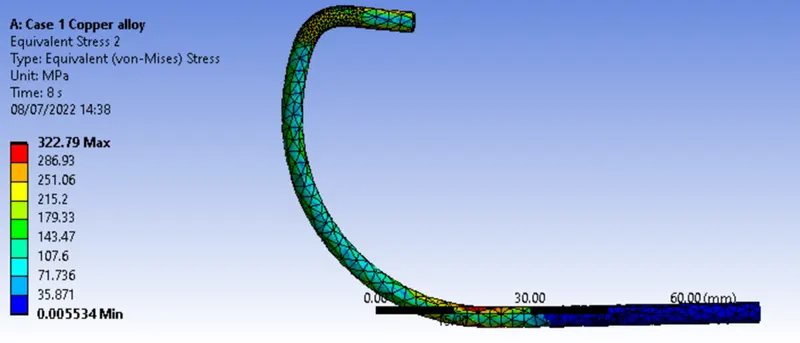
Fig. 7 Von mises stress on copper wire (case 1)
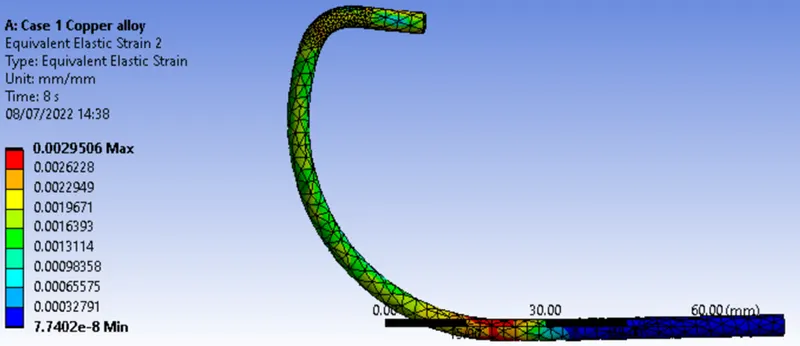
Fig. 8 Equivalent strain on copper wire (Case 1)
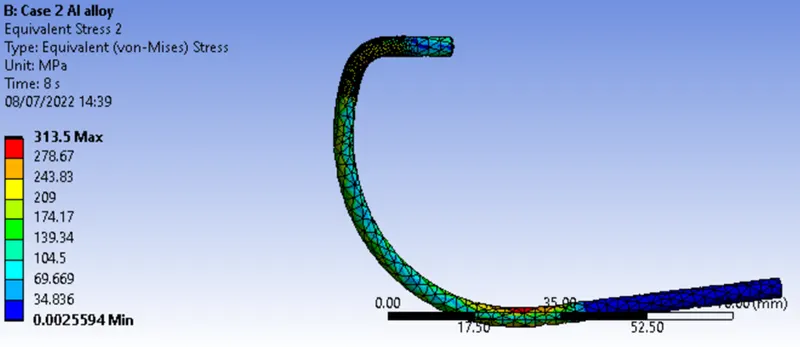
Fig. 9 Von mises stress on aluminium wire (Case 2)
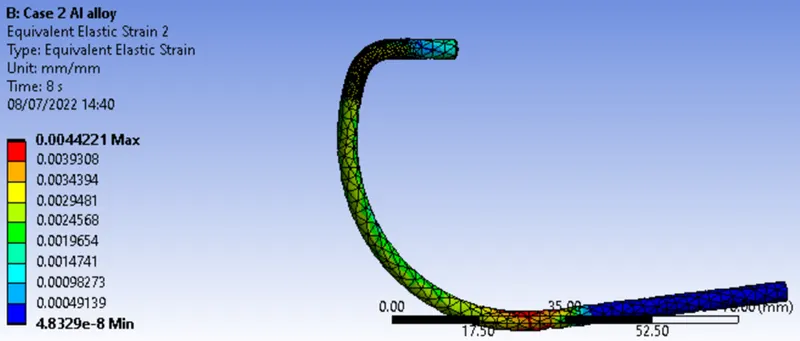
Fig. 10 Equivalent strain on aluminium wire (Case 2)
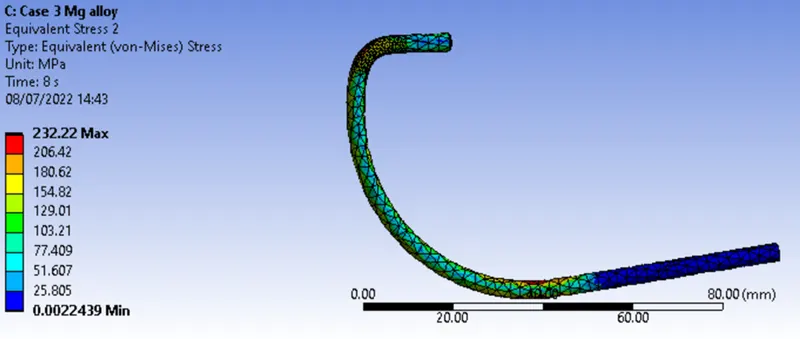
Fig. 11 Von mises stress on magnesium wire (Case 3)
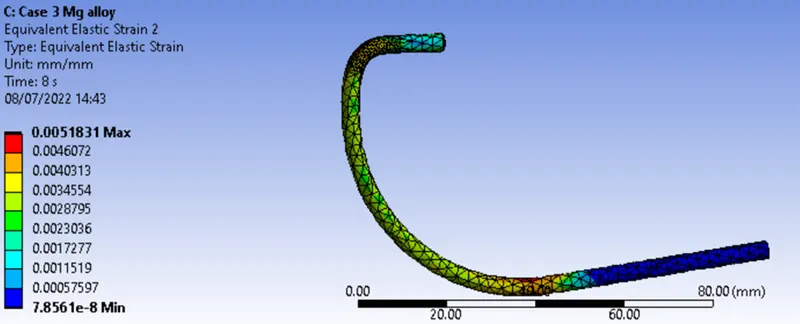
Fig. 12 Equivalent strain on magnesium wire (Case 3)
CONCLUSION
Numerical analysis was conducted for investigating the von mises stress and equivalent strain on the bent wire subjected to the bending process. Three cases with different non-linear materials such as copper alloy, aluminium alloy and magnesium alloy are investigated and compared. The major findings are listed below.
- The wire was plastically deformed after the bending process using the wheel and lever.
- At the end of the time steps, copper Nl has exhibited the highest von-mises stress of 322.79 MPa and minimum equivalent strain of 0.00295.
- The von mises stress on copper NL, Aluminium NL and magnesium NL were 322.70 MPa, 313.5 MPa and 232.22 MPa respectively whereas the maximum von mises stresses were 657.25 MPa, 454.58 MPa and 496.32 MPa respectively.
- The equivalent strain at the end time step on copper NL, Aluminium NL and magnesium NL were 0.00295, 0.00442 and 0.00518 respectively whereas the maximum equivalent strain were 0.006044, 0.00645 and 0.011123 respectively.
- Highest the stress, least was the equivalent strain on all the compared wire materials.