Week 11 Car Crash simulation
CAR CRASH SIMULATION
OBJECTIVE
Evaluate total deformation and equivalent stress by conducting a parametric study using 3 different values of thickness for the car body.
METHODOLOGY
The car crash simulation is carried out using ASNYS 2021 R2 workbench (Student version). Explicit dynamics analysis is used since the car crash occurs in a very short time. The time of simulation is set to 0.001s. The car body and wall are imported for running the analysis after verification using Spaceclaim. The material of the car body is stainless steel NL and the stiffness of wall was set to RIGID. A default meshing was carried out without refining due to limitation in Student version. Total elements and nodes were 20479 and 20805 respectively. The simulation is carried out in such a way that wall hits the car instead of opposite. The wall has given a 500 mm displacement towards the car and rear parts of car body which was expected will not be having in contact were set fixed displacement. The thickness of the car was parametrized. Various thickness of 0.1 mm, 0.3 mm and 0.5 mm were investigated. For each cases, total deformation and equivalent von mises stress were evaluated and summarized.
RESULTS AND DISCUSSION
In the car crash, it is desired for the car body material to easily undergo plastic deformation so that the body will absorb most of the energy from the car collision. For this reason, the shock to the passengers will be less. From the comparative analysis with respect to the car body thickness, 0.1 mm thick stainless steel has undergone maximum deformation of 894.4 mm deformation whereas it is only 265.05 mm deformation for 0.3 mm thick car body. Since 0.1 mm thick car body is not practical but investigated based on the curiosity, the best choice would be 0.5 mm thick car body. However, the total deformation of 0.5 mm thick car body is 891.95 mm which is close to the result of 0.1 mm thick car body. The maximum equivalent stress decreased when the thickness was increased. However, at the end, the von mises stress is low for 0.5 mm thick (2327.887), and the highest von mises stress is 2467.811 for 0.3 mm thick car body. The total deformation and von mises stress are shown below case wise.
CASE 1 (0.1 mm)
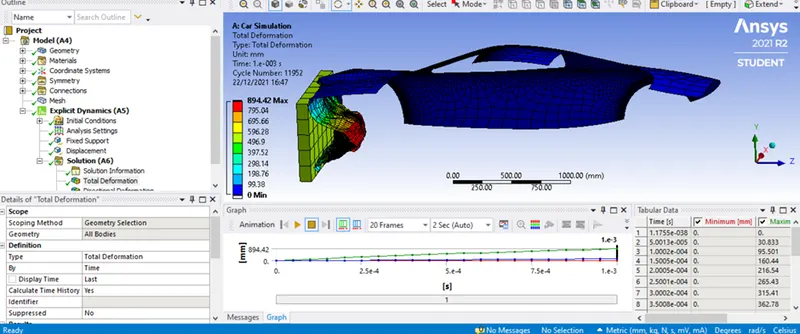
Fig.1 Total deformation in mm for 0.1 mm car body thickness
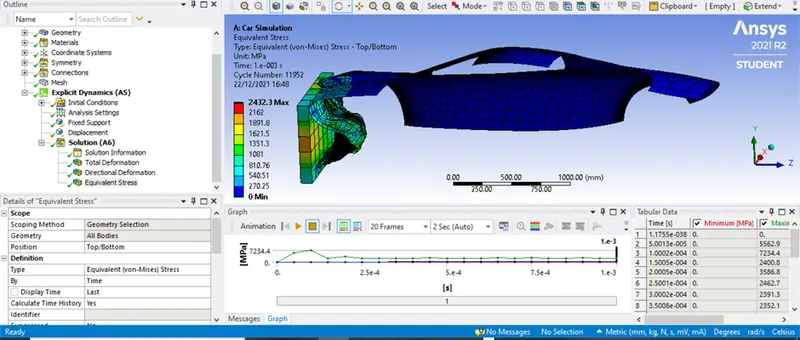
Fig. 2 Von Mises equivalent stress in MPa for 0.1 mm car body thickness
CASE 2 (0.3 mm)
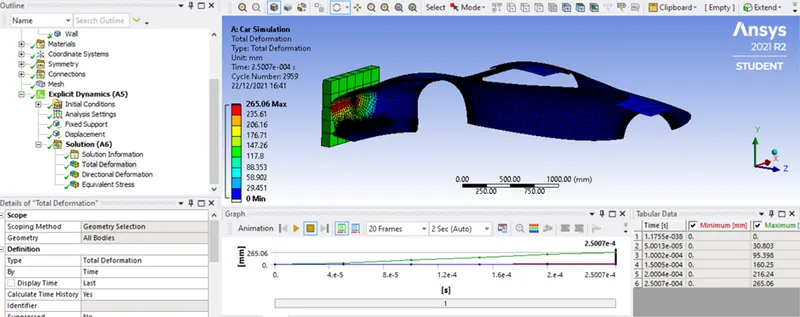
Fig. 3 Total Deformation in mm for 0.3 mm car body thickness
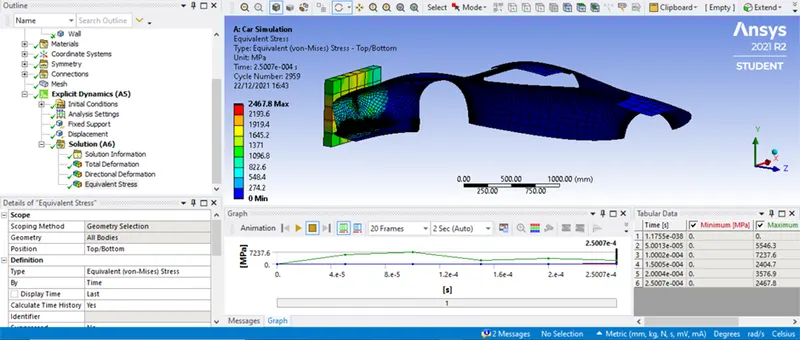
Fig. 4 Von Mises equivalent stress in MPa for 0.3 mm car body thickness
CASE 3 (0.5 mm)
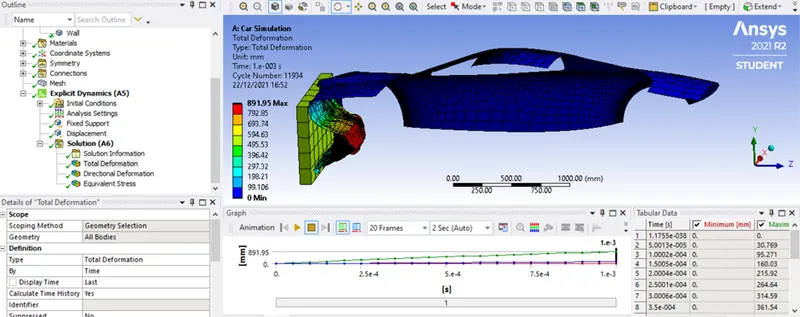
Fig. 5 Total Deformation in mm for 0.5 mm car body thickness
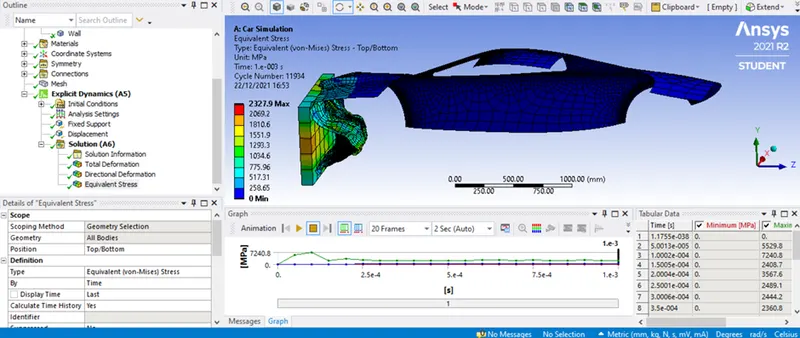
Fig. 6 Von Mises equivalent stress in MPa for 0.5 mm car body thickness
|
Table 1 Comparisons of total deformation and von mises stress at various thickness |
||||
|
Car Body thickness |
Total deformation at end of time |
Equivalent stress at end of time |
Maximum Equivalent stress over time |
Maximum total deformation over time |
|
Mm |
MPa |
MPa |
mm |
|
|
0.1 |
894.419 |
2432.290 |
7234.425 |
894.419 |
|
0.3 |
265.059 |
2467.811 |
7237.600 |
265.059 |
|
0.5 |
891.950 |
2327.887 |
7240.790 |
891.950 |
CONCLUSION
Numerical analysis was conducted for investigating the total deformation and von mises stress during a car crash for various stainless steel car body thicknesses. 0.5 mm car body thickness was found to be effective with regard to the total deformation. However, the results are not accurate since fine meshing has not been performed due to limitations in student version.