Week 4 -Wire Bending Challenge
Wire Bending Challenge
OBJECTIVE:-
To perform an analysis to simulate the bending of a wire in ANSYS.
Use Copper Alloy (Non Linear), Aluminium Alloy (Non-Linear), and Magnesium Alloy (Non-Linear) for the wire alone.
Find out the Equivalent stress and Equivalent strain on the wire alone.
Compare the results.
INTRODUCTION:-
Wire bending operation is a process included in metal-working, in which a wire piece is plastically deformed into desired shape. Wire bending operation is widely used in various domains for example – construction industry for providing reinforcement to structures, in automotive industry for additional strength to wheels & other chassis components, used in various household products etc. In order to be efficient in its application quality of wire generated from the wire-bending machine must be well good enough. Moreover, its production must not causes significant damage to machine otherwise machine will require frequent maintenance.
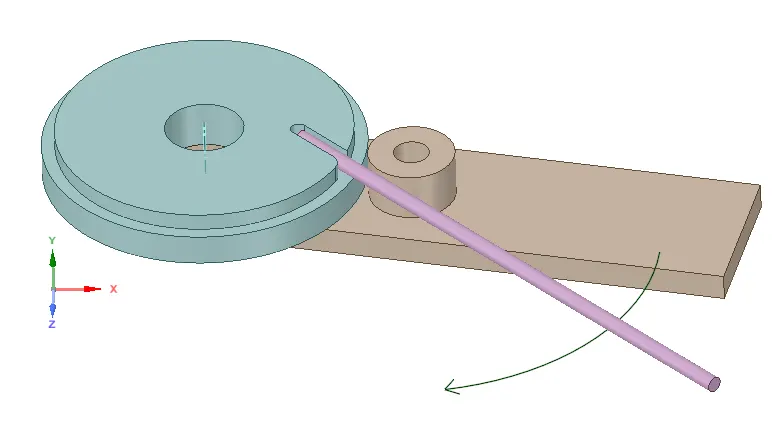
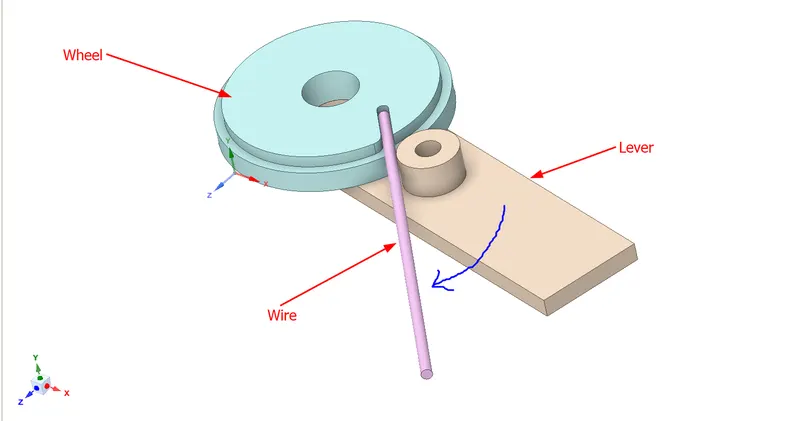
An assembly of Wheel & lever is used to perform bending operation. In wheel, wire is placed & held in a grooved inclusion. While lever revolves around the wheel & bend the wire such that wire takes the shape of the wheel geometry
PROCEDURE:-
1) Material Properties:-
In order to perform comparative analysis, wire is assigned with three different materials. While other parts which perform bending operation are assigned with structural steel.
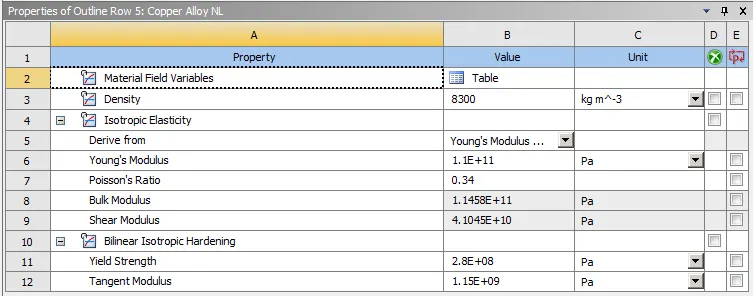
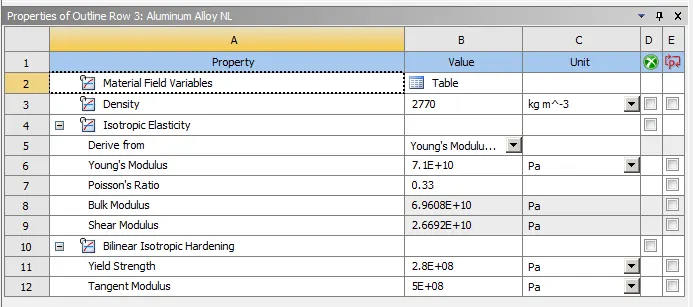
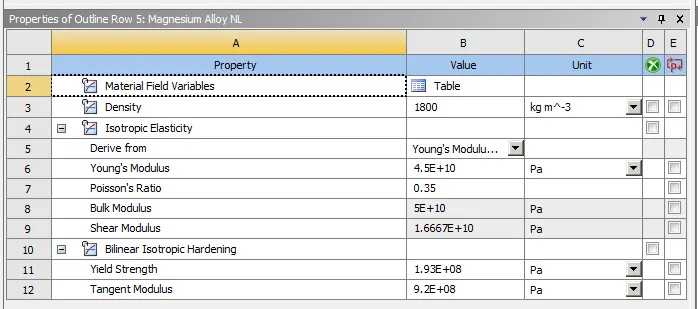
Following are the properties of materials, which are assigned to the wire.
Copper Alloy NL
Aluminium Alloy NL
Magnesium Alloy NL
2) Geometry:-
An assembly of Wire bending apparatus consisting of Wheel & lever with wire piece is directly imported in the workbench from the available resources.
3) Contacts:-
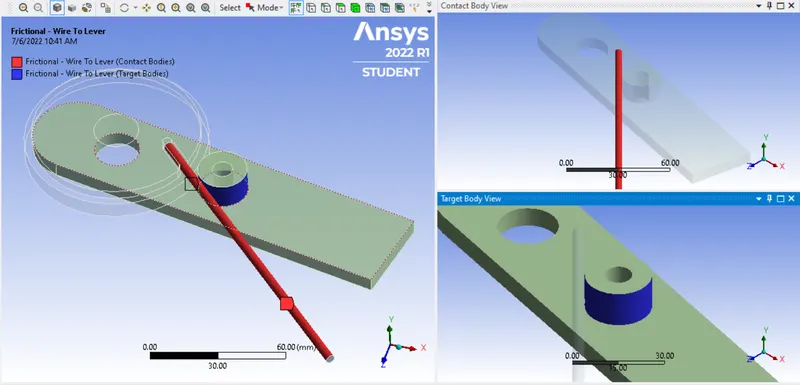
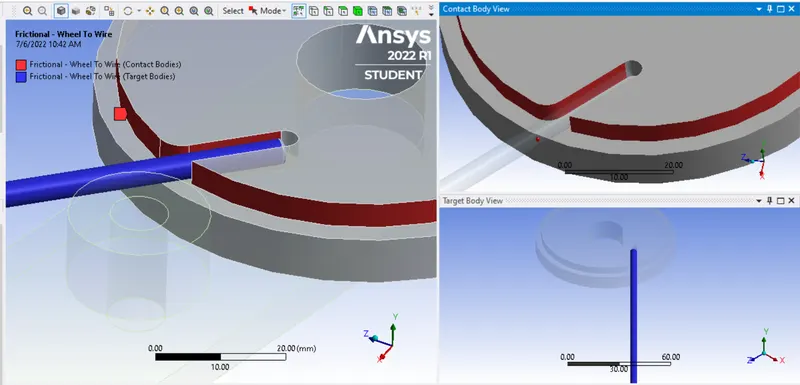
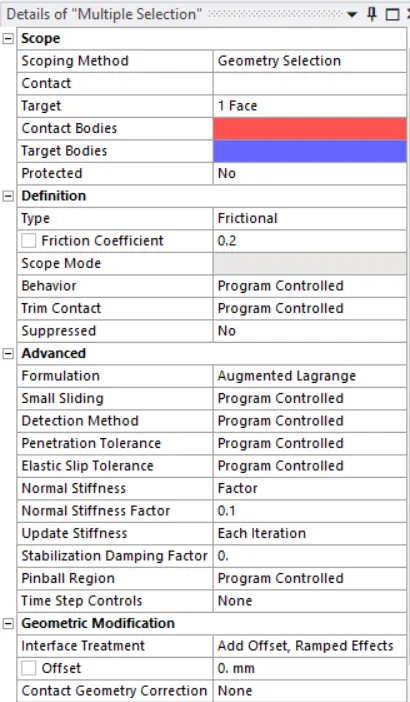
Frictional contact is established between interfaces of Wire piece and lever with frictional coefficient of 0.2. Similar contact is also made between contact regions of wire piece & wheel. Below are the details of the contacts, which are applied.
Contact wire to lever -
Contact wheel to wire -
Contact details -
4) Joint Revolute:-
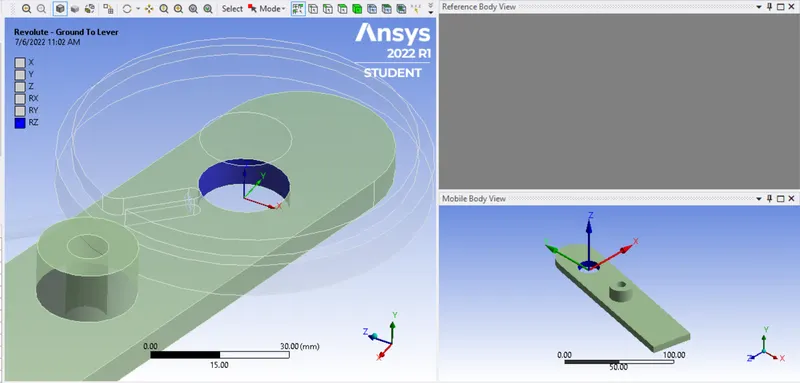
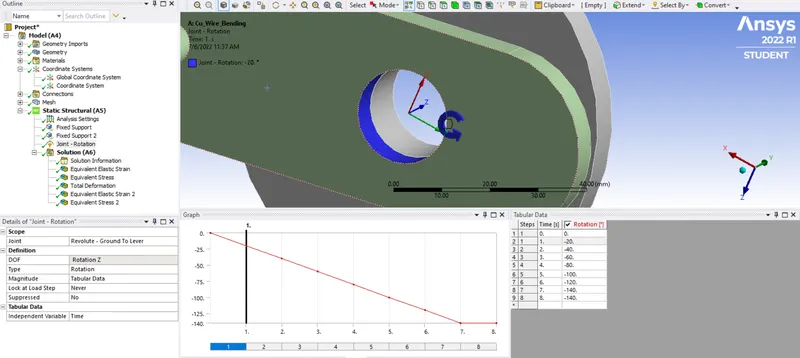
In joints, in order to perform bending action a revolute joint is applied to the lever hence able to rotate in its position & perform bending operation.
5) Meshing:-
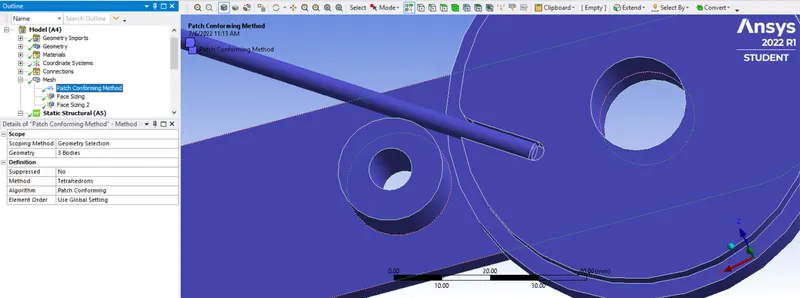
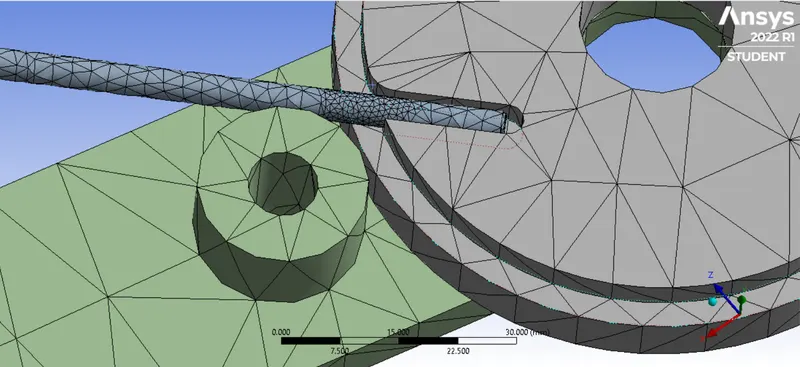
- All the parts of the geometry are meshed with tetrahedrons elements using patch conforming method.
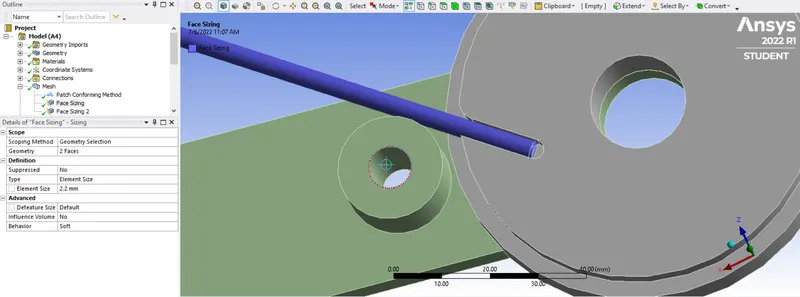
- Face sizing is established at critical contact regions (i.e. areas that are subjected to excessive loading and deformation).
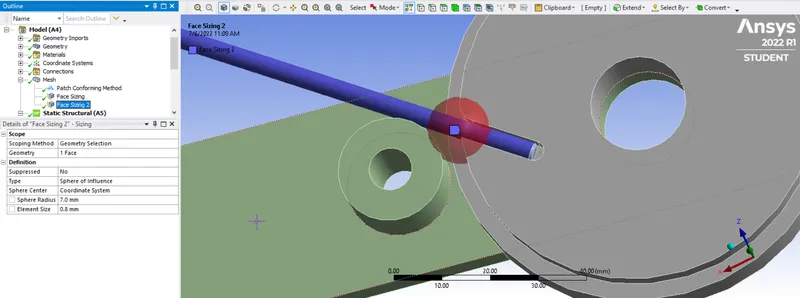
- Another Face sizing is applied on wire piece at the region of maximum distortion using sphere of influence.
6) Analysis Settings:-
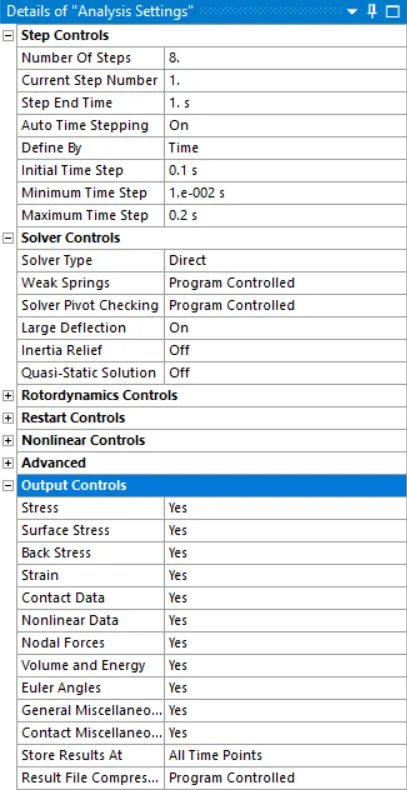
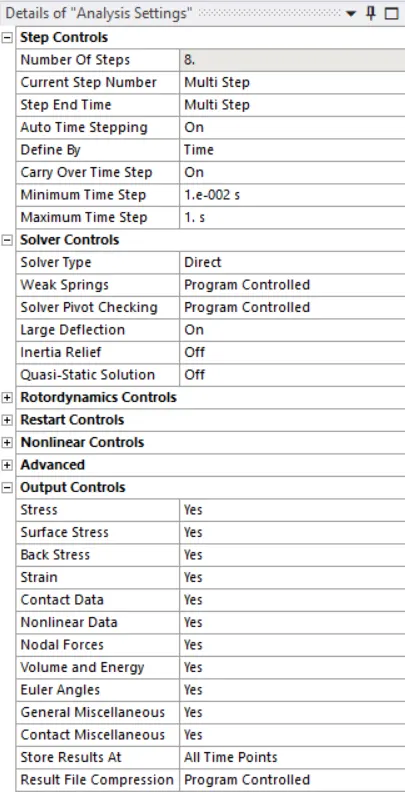
- Eight time steps are used to simulate the bending action.
- Solver type is changed to Direct rather than iterative.
- Large deformation setting is enabled to counter unconstrained motion and deformations.
- Automatic time setting is also enabled to help in easy convergence by progressing the simulation in a small sub-time steps increments inside each steps.
For Step-1
For Step-2 to 8
7) Fixed Supports:-
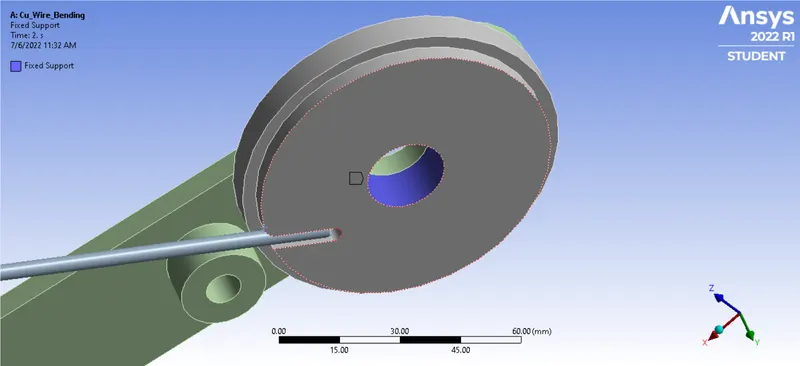
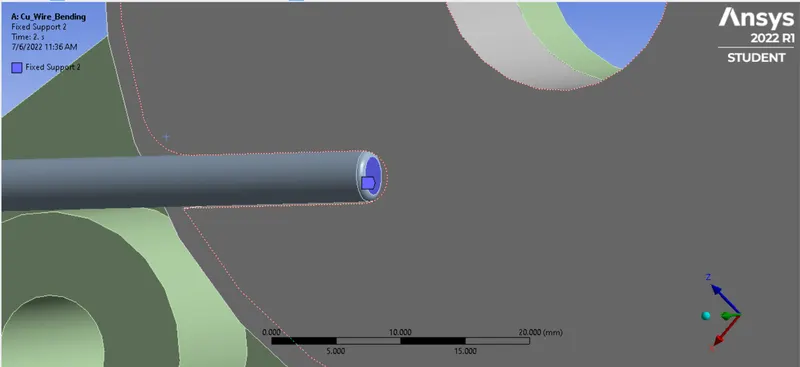
Fixed supports are given to the wheel face and one face of wire so that wire does not slip off out of the wheel groove.
8) Joint Load:-
Rotation of 140 degree is given to the lever in 8 steps with respect to z axis.
Results and Discussion:-
Simulation:-
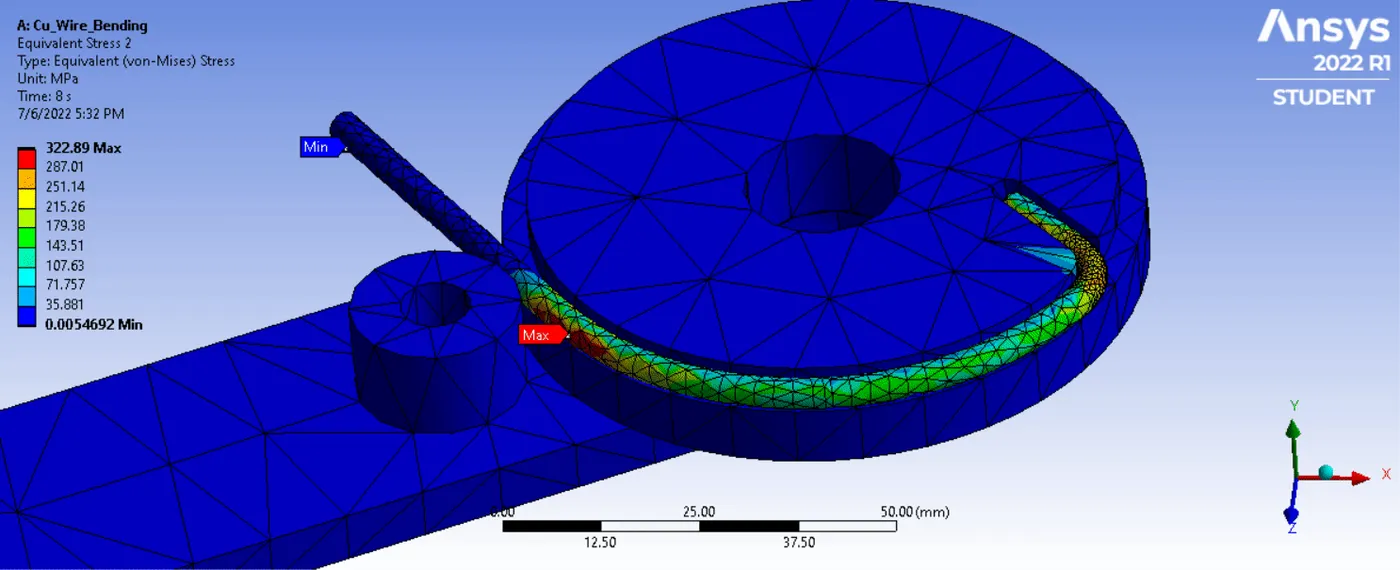
EQUIVALENT STRESS-
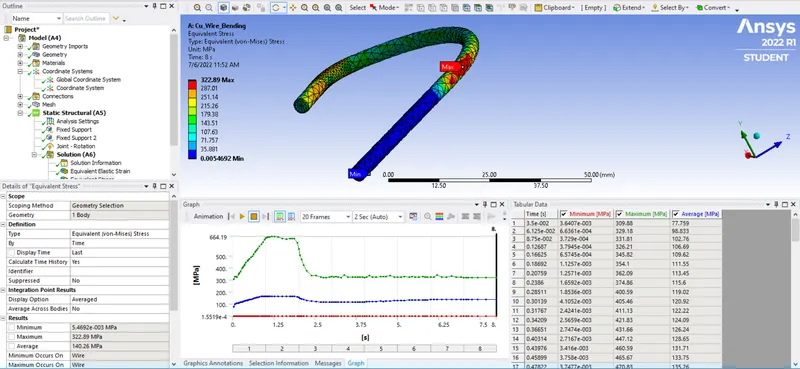
- When Copper alloy NL is used as wire material
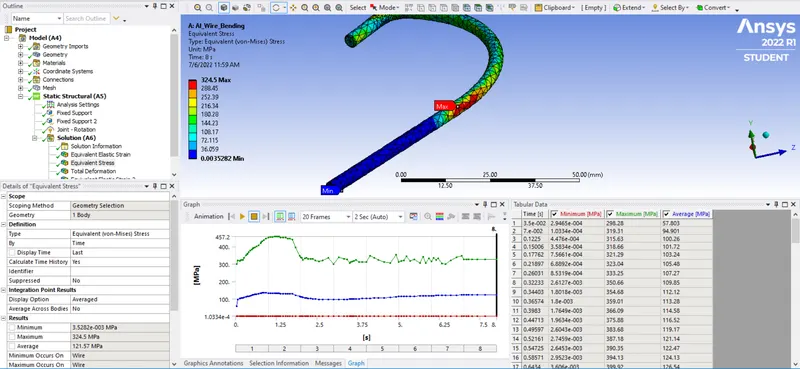
- When Aluminum alloy NL is used as wire material
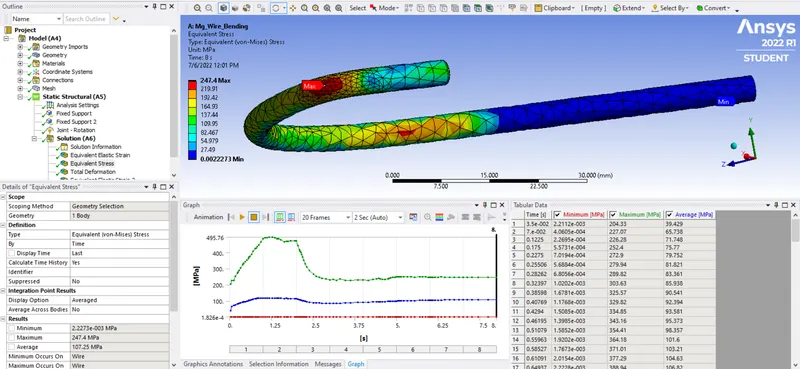
- When magnesium alloy NL is used as wire material
Conclusion:-
From the above results, it is clear that for all cases peak region of stress development take place in between 1st-2nd time step, after that an almost constant level of stress is maintained. Because in the beginning, high force is needed to bend the wire around the region which close to grooved portion of wheel, as at this point very sharp bending is taking place. But as bending continues comparatively lesser force is needed because now wire is only required to bend around the wheel’s outer circumferential surface.
| Wire Material | Equivalent Stress |
| Copper Alloy NL | 322.89Mpa |
| Aluminium Alloy NL | 324.5Mpa |
| Magnesium Alloy NL | 247.4Mpa |
For the bending operation, it is required that material must be less stiff and is flexible to undergo bending. Therefore, such material must have lower young modulus of elasticity & have lower yield strength so that they can be easily deformed plastically and have stable geometry with minimum residual stresses. From the comparison, it is clear that, when Aluminum alloy NL is applied as a wire material it offered least resistance to bending in the beginning while copper alloy NL offered highest resistance. And at the end of process, magnesium alloy NL has minimum stress value to resist deformation, which indicate it is more stable with its new deformed sturcture, while both copper & aluminum alloy ended up with higher stresses. So from the above comparison, Magnesium alloy NL must be prefered as wire material for bending operation.
EQUIVALENT ELASTIC STRAIN-
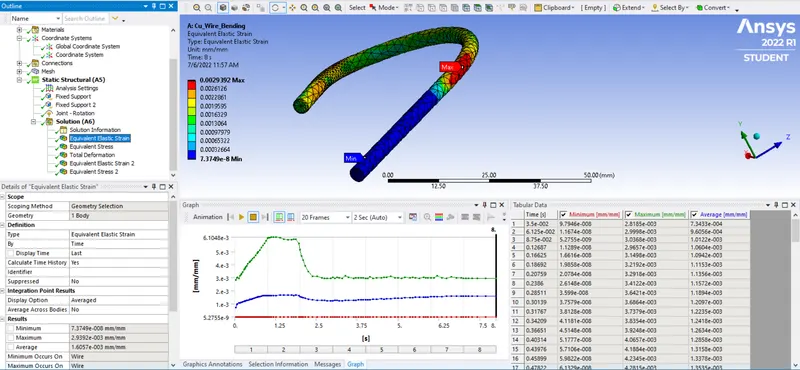
- When Copper alloy NL is used as wire material
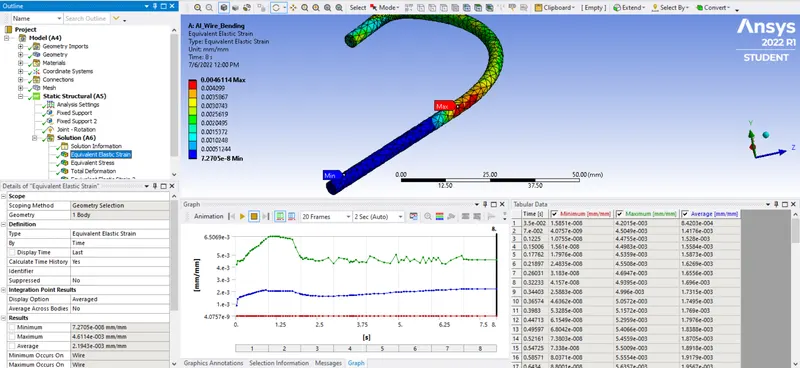
- When Aluminum alloy NL is used as wire material
- When magnesium alloy NL is used as wire material
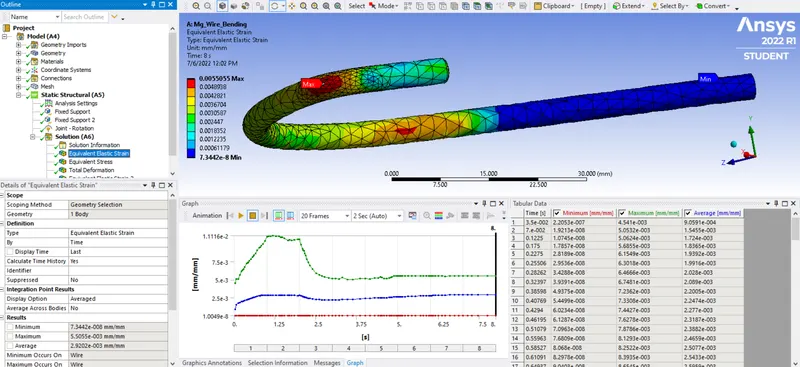
Conclusion:-
A similar trend is also observed in the results of Elastic Strain having high strain development during start and then constancy until end. However, by comparison it is noted that because of high young modulus of Copper alloy NL comparatively lesser strain is developed in the wire. Moreover, because of lower young modulus magnesium seemed to have max. strain development while copper places itself in between. So from results of strain also it is recommend to select magnesium alloy NL as wire material.