Week 4- Meshing of Backdoor Challenge
Goals:
- To examine the CAD model's geometrical faults.
- To verify the CAD Clean Up and Topology.
- To assign thickness to the mid surface and extract the mid surface for each component in the CAD model.
- The model's features and quality standards must be accurately represented with a good mesh flow in order to be mentioned.
- To improve the mesh flow by meshing each mid surface.
- To compile a thorough report on the meshing of the hood task.
- To highlight the outcome that provides the CAD model's optimal mesh flow.
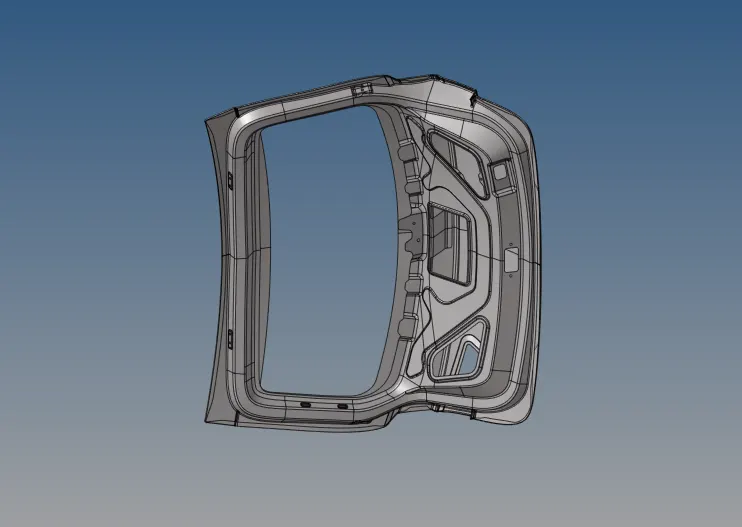
Import Geometry :- The backdoor's geometry has been loaded into the Hypermesh window.There are three parts to geometry. Following that, topoloy visualization was completed in order to look for any errors that required geometry removal.
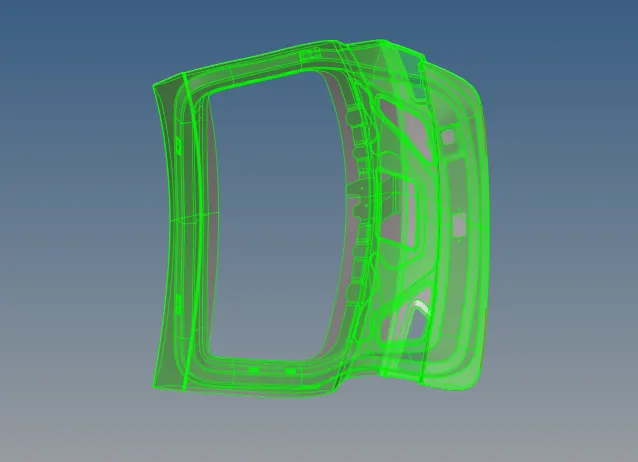
Cleanup of Geometry :- We must undertake geometric cleanup in order to eliminate any open edges before proceeding with midsurfacing and meshing. Failure to do so may result in issues during analysis. We utilized the replace tool and the equivalency surface edges option to solve this problem.
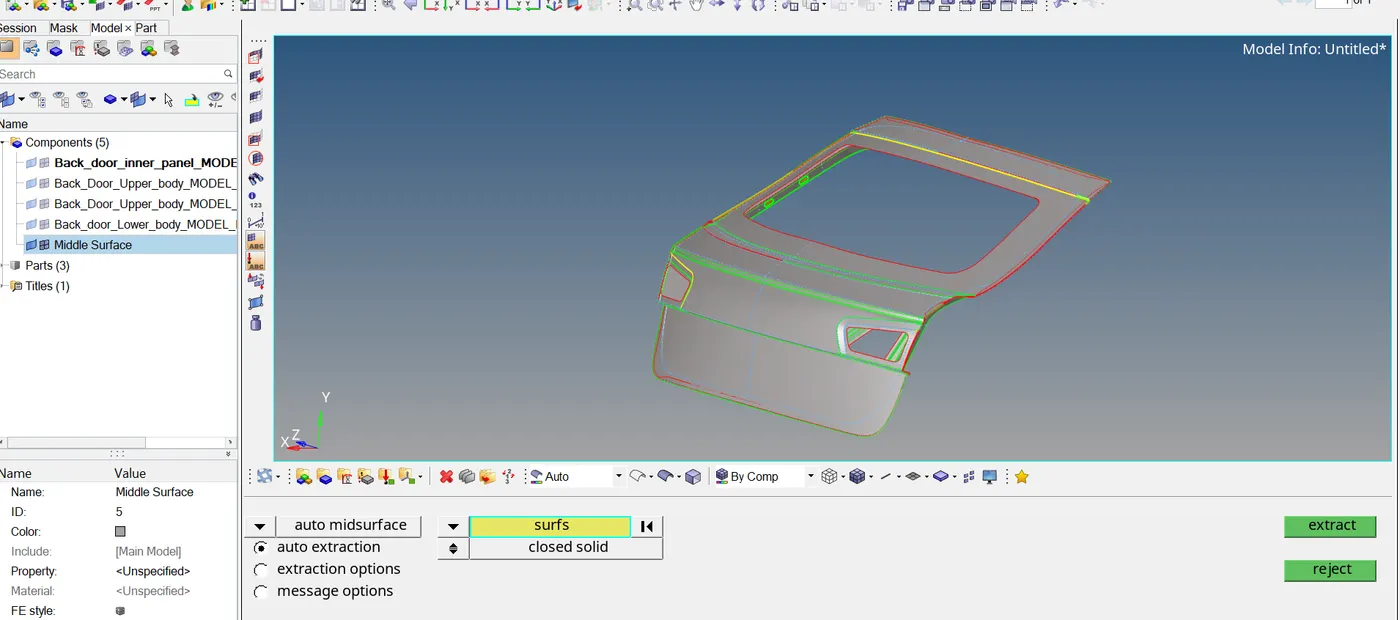
Midsurface :-A midsurface tool that makes it possible to locate and retrieve surfaces from thin solid geometries with a single thickness.
The new geometry that represents the midsurface is placed in a component called Middle Surface, or in the current component, depending on your option. The original geometry that we chose to extract the midsurface from stays untouched. The autosurfce option with skin offset has been chosen extracted mid surface.The extracted midsurface is divided into three distinct parts.
Split Surace :- Given that the surface is symmetrical by nature. To save computing time, we can divide the surface into two sections and conduct meshing on half of those sections before refining the other half.
Meshing :- Performing calculations at a finite number of points and then interpolating the results for the entire domain (surface or volume) is the fundamental concept behind Finite Element Analysis (FEA). There are limitless degrees of freedom for each continuous object, hence the problem cannot be solved in this style. Using discretization or meshing (nodes and elements), the Finite Element Method reduces the degrees of freedom from infinite to finite.
On surfaces that already exist, the automesh panel generates shell mesh.
Mesh on correctly connected geometry ensures proper mesh connection. Automeshing enables all surfaces of a part to be meshed at the same time. Most parts from CAD software come in as surfaces.
Desnsity_variation :- We adjusted the mesh's density after meshing in order to obtain as many structured elements as feasible and improve the outcome.
Remeshing :-Remeshing is need to be done to remove the rotating tria elemnts of the components surface.
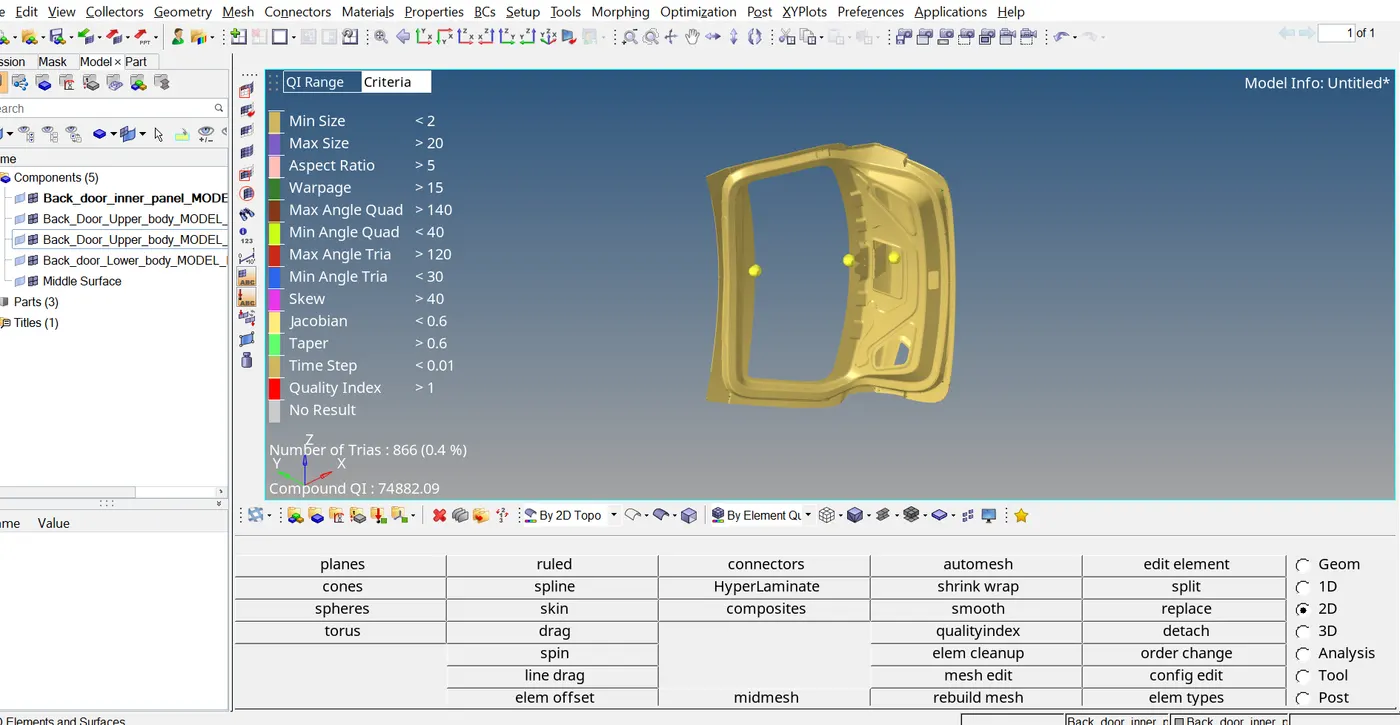
Meshing cleanup :- Mesh cleanup is the following step after meshing in order to satisfy our mesh criterion need.
Reflect :- After meshing, the elements must be reflected in order to obtain all of the elements in the z direction according to the component direction.
In summary :-
The supplied task has been completed successfully for the specified mesh requirements.
We have successfully cleaned the automobile backdoor model's mesh.
Link for Backdoor_Seperated : https://drive.google.com/file/d/1TaspdGDGiAgxlt17MNeKce1rC1kKlzQH/view?usp=drive_link
All the Images are listed below