Week - 4 - Crash Box Simulation
Objective:
To perform impact analysis on the Crush Box to the rigid wall and check the changes in the result when there is a change in the thickness of Crush Box.
Crash Box:
Crash Box is an important part in determining crashworthiness, This is placed between Bumper and Side rail of automotive vehicle.
It helps in understanding the ability of the vehicle structure to absord the Kinetic Energy and minimize the injury to the passenger during collision and it is considered as an important criteria in determining the vehicle design with regards to passenger safety.
Generally aluminium and steel is used for making crash box in the car but in the new generation vehicles they are moving towards composite material because of thier lightweight, hight stiffness anf strength.
Setup:
- For this analysis the crash box is made to impact the rigid wall at a 50kmph velocity and understand how it deforms.
- The crush box used in this analysis is a hollow rectangular tube with a thickness of 1.2mm and then changed to 1.5mm and the material used for this analysis is steel.
- In this analysis first the crush box is tested with elastic material properties to make sure the analysis works fine, and then the desired material properties is added to finalize the analysis.
- gm-mm-ms unit system is used for this analysis with the termination time of 20ms with all the usual output cards to get the necessary data.
Procedure:
- Section,Material,part definition:
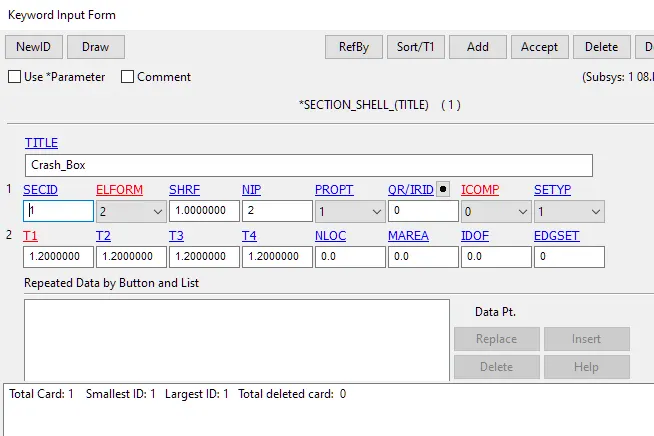
In this analysis there is only one part present which is crash box as wall is considered as different keyword, 'Shell' section is used with an 'ELFORM 2' formulation.
Here we are comparing the Crash box with with different thickness of 1.2mm and 1.5mm .
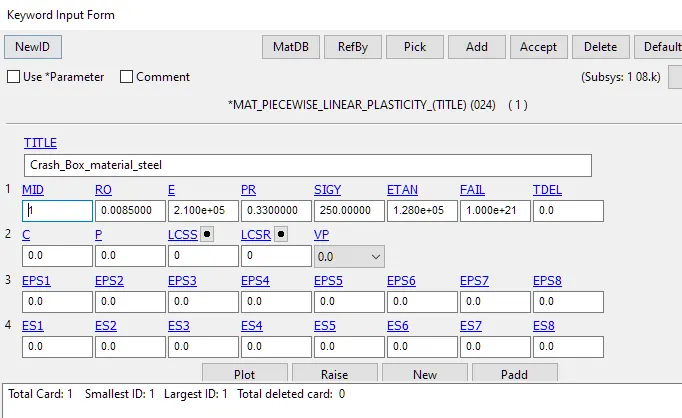
Here the material card that we have used is 'Piecewise_Linear_plastic' for elastic formulation, And material property of steel is defined with [gm-mm-ms] unit consistency.
And finally section and material are assigned to CrashBox part as shown below.
- Boundary condition and Rigid wall Definition:
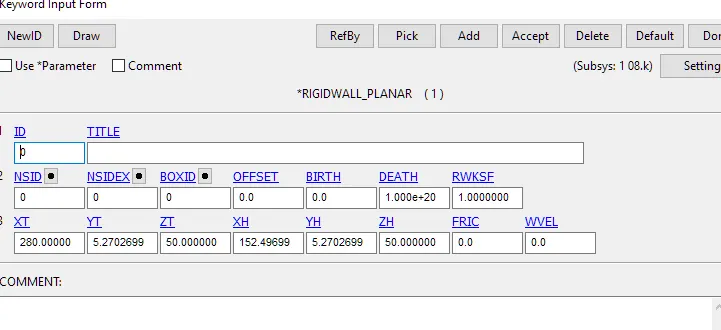
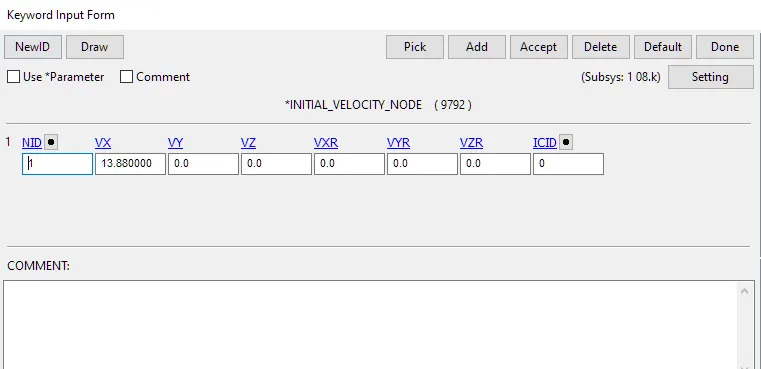
Here we have placed the rigid wall normal to X axis and it is fixed, the Crash box is moving at a initial velocity of 13.88mm/ms in X direction.
- Contact Definition:
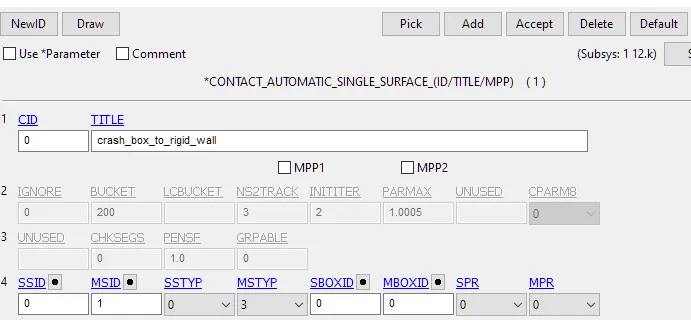
A self contact is established in this modelas there is only one surface, it is done by 'AUTOMATIC_SINGLE_SURFACE' control card.
Single surface contact is the most general type of contact used in Ls-Dyna which automatically searches allof the external surfaces with ina model to determine if penetration has occured.
- Control Setup :
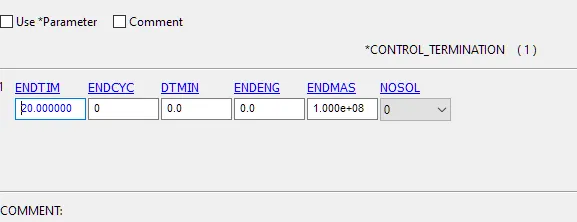
'Control_Termination' is used to define the simulation time, In this model it is set to run for 20ms.
- Output_Definition:
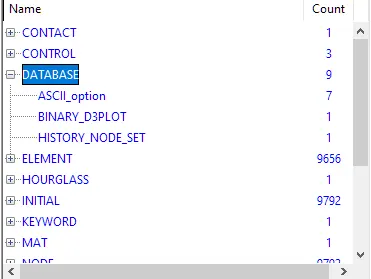
In 'Database' keyword we request a plot data of various result parameters such as stress and strain using 'Binary d3plot' option.
Similarly using the 'ASCII' option the nodal and elemental energy data, Hourglassing and sliding energy data etc are requested .
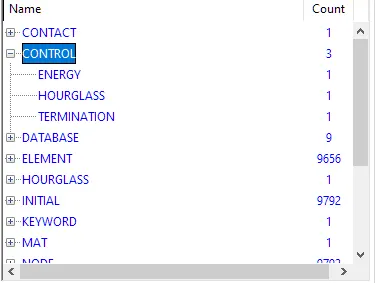
We should toggle 'Energy' card from control keyword to add hourglass and sliding energy results.
- Results:
- Energy plot for crash box of shell thickness 1.2mm:
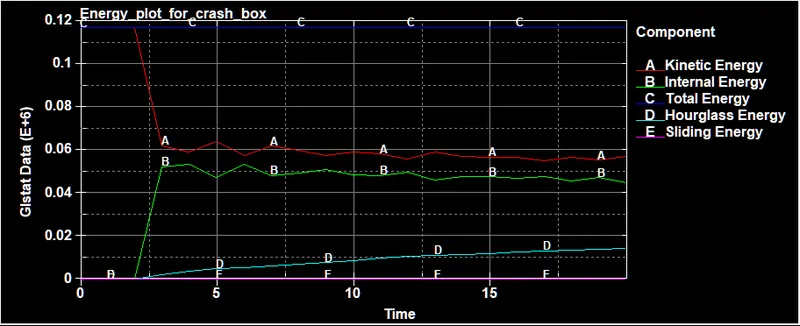
the above shown graph gives information about the energy distribution of the crash box impacting a rigid wall.
It can be seen that at time 2ms, the crash box hits the rigidwall from which the internal energy starts to increase and reaches max at 5.23e4 N-mm at 3ms.
Kinetic energy tends to behave opp of internal energy,thus decreasing with respect to time.
There is a slight increase in the hourglass energy due to small strain.
Sliding energy remains Zero since there is no sliding type contact.
Total energy tends to decrease.
- Cross Sectional force in the middle of the box:
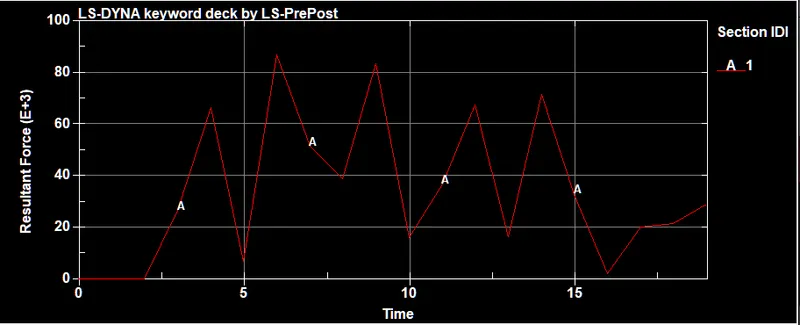
Above shown graph is for cross esctional force in the midlle of the bar.
It is ploted by creating planar cross section plane by using keyword 'CROSS_SECTION_PLANE' from Database.
The output request for cross sectional force is created from 'Secforc' ASCII option.
The max section force in the middle is 8.69e4 N at 6ms.
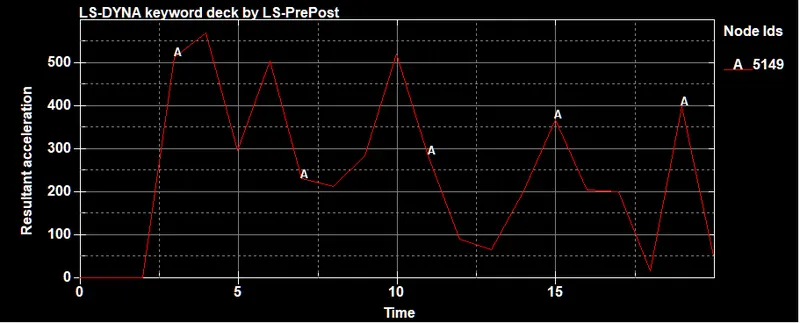
- Comparison of acceleration plots between crashbox at midnode of shell thickness 1.2mm and 1.5mm.
for 1.2mm thickness:
for 1.5mm thickness:
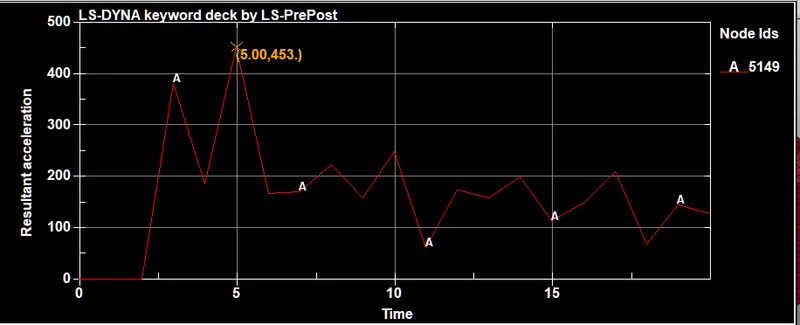
The above two plots depict the resultant acceleration vs time variation of crash box at midnode of shell thickness 1.2mm and 1.5mm.
For 1.2mm thickness, The max resultant acceleration found is `0.572(mm)/(ms)^2` at time 4ms.
For 1.5mm thickness, The max resultant acceleration found is `0.453 (mm)/(ms)^2`at time 5ms.
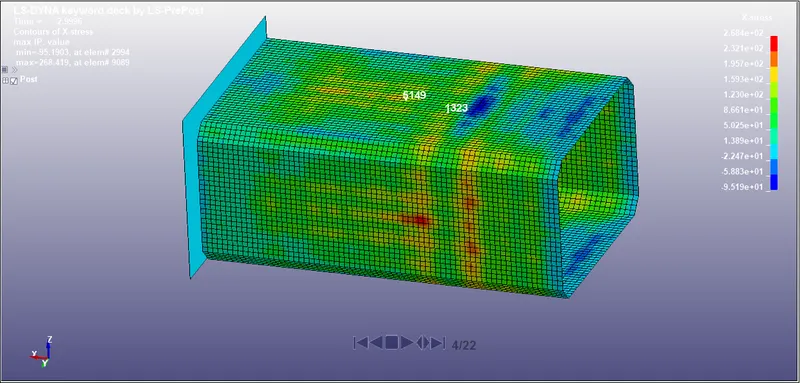
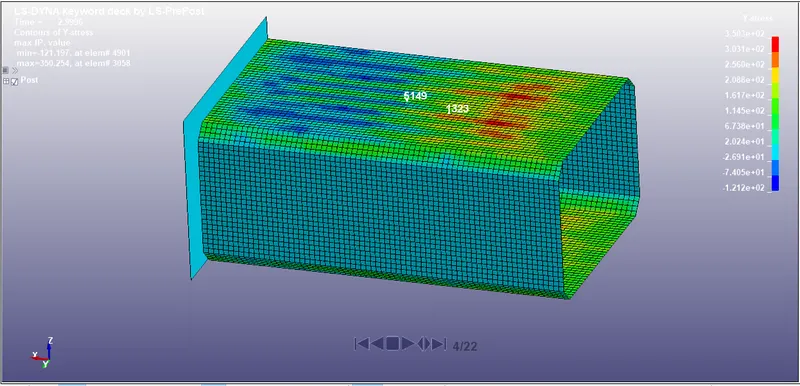
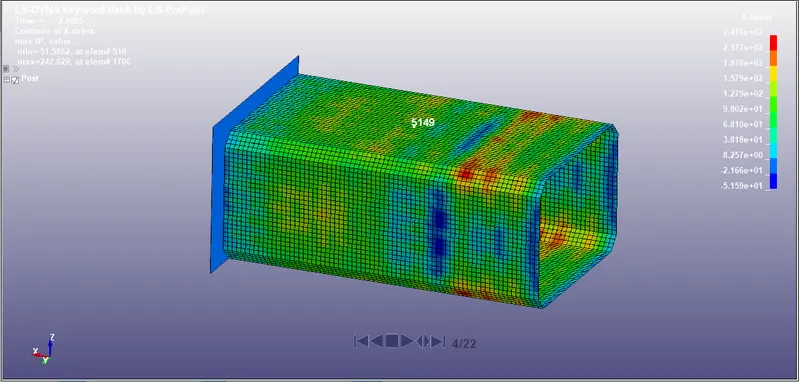
- Comparison of diredctional stress in crash box of shell thickness 1.2mm and 1.5mm :
for 1.2mm thickness:
X stress:
Y stress:
For 1.5mm thickness:
X stress:
Y Stress:
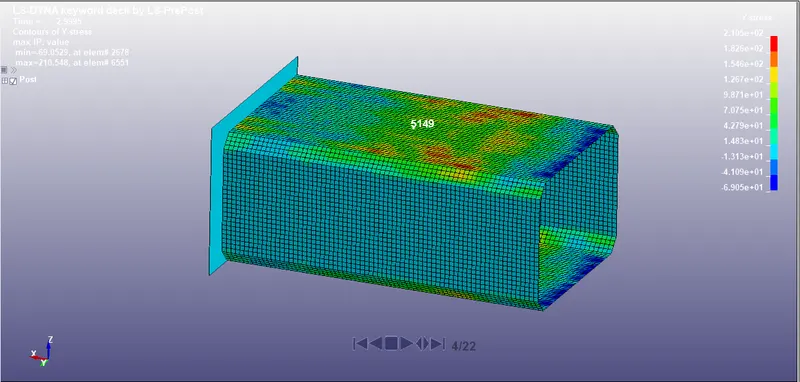
The following table summerizes the directional stress in the crash box simulation:
| Crash Box Shell Thickness | Maxmium Directional stress | |
| X-stress | Y-stress | |
| 1.2mm | 268.4Mpa | 350.3Mpa |
| 1.5mm | 247.6Mpa | 210.5Mpa |
From the above table we can say that X directional stress in more in 1.2mm thickness shell compared to 1.5mm thickness shell.
Also, The max Y directional stress is more in 1.2mm shell compared to 1.5mm shell.
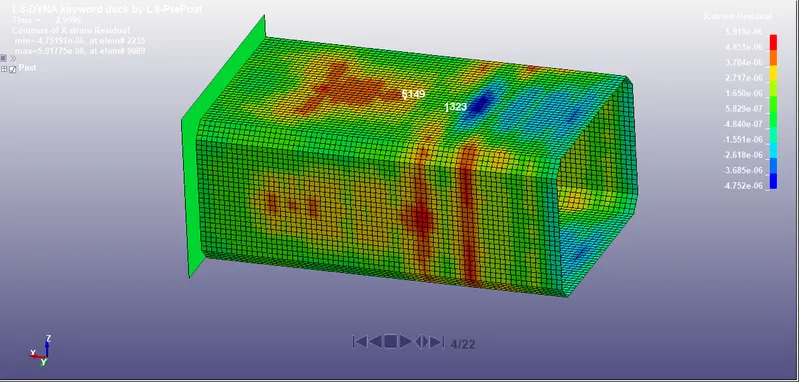
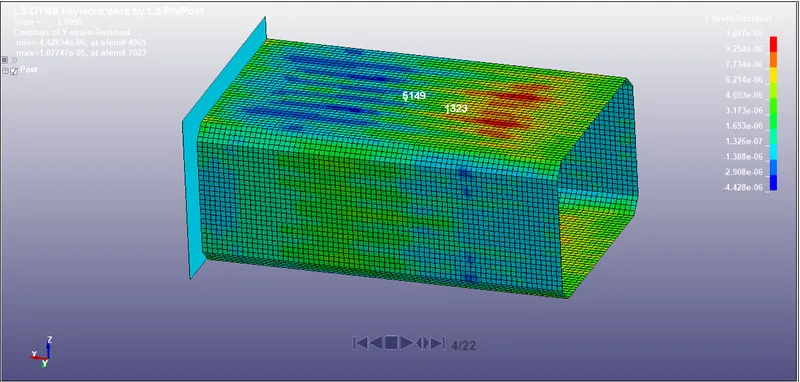
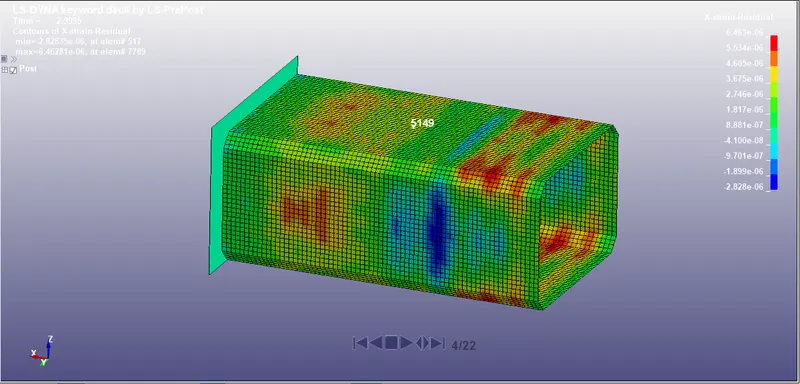
- Comparing Directional strain for crash box of 1.2mm and 1.5mm thickness shell.
For 1.2mm Thickness shell:
X-strain:
Y-Strain:
For 1.5mm thickness:
X-Strain:
Y-Strain:
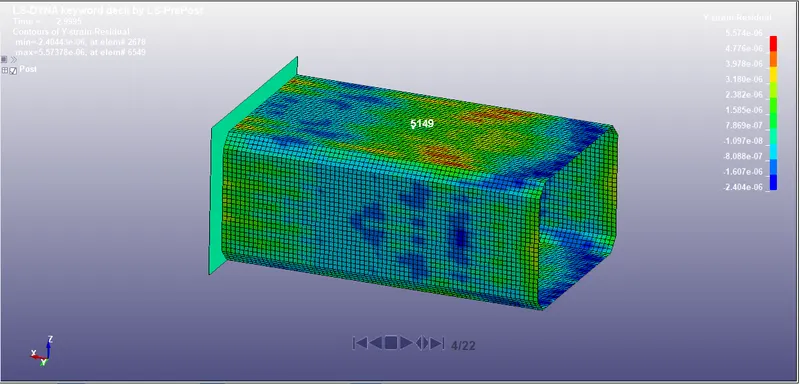
The following table summarizes the max directional strainof the crash box simulation:
| Crash Box Shell Thickness | Maxmium Directional straain | |
| X-strain | Y-strain | |
| 1.2mm | 5.92E-06 | 1.08E-05 |
| 1.5mm | 6.46E-06 | 5.57E-06 |
From the above table it is evident that Max X-directional strain is more for the crash box of 1.5mm thickness compared to 1.2mm thickness.
Also, The Max Y-directional strain is more for crash box of 1.20mm thickness compared to 1.50mm thickness.
Conclusion:
Crash Box Absorbers are important structural part which plays an important role during accidents in automotive.
Simulation on crashBox impaccting the rigid wall with 50kmph ie(13.88mm/ms).
The simulation is carried out for crash box of thickness 1.20mm and 1.50mm and results are tabulated and analyzed.
From the above results we can say that crash box with thickness 1.50mm has better stiffness and energy absorption rate compared to 1.20mm thickness crash box.