Week 4 - Combustion Efficiency Calculation after Preheating
AIM:
1)Effect of preheating on the adiabatic flame temperature.
2)Effect of pre-heat temeprature on combustion efficiency.
Introduction:
The adiabatic flame temperature is one that occurs when the combustion chamber is well insulated with no heat losses (adiabatic conditions). The peak adiabatic flame temperature occurs at around Φ = 1 in an ideally insulated combustion chamber.
The AFT depends on the heating value of the fuel, the temperature and amount of oxidizer, and final combustion product composition. To equate the sum of the heating value of fuel and sensible heat of oxidizers to the sensible heat of the combustion product, AFT can be calculated.
Recuperator:
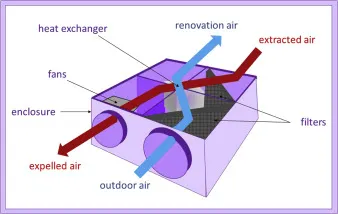
A recuperator is a special purpose counter-flow energy recovery heat exchanger positioned within the supply and exhaust air streams of an air handling system, or in the exhaust gases of an industrial process, in order to recover the waste heat.
Generally, they are used to extract heat from the exhaust and use it to preheat air entering the combustion system. In this way they use waste energy to heat the air, offsetting some of the fuel, and thereby improves the energy efficiency of the system as a whole.
In many types of processes, combustion is used to generate heat, and the recuperator serves to recuperate, or reclaim this heat, in order to reuse or recycle it. The term recuperator refers as well to liquid-liquid counterflow heat exchangers used for heat recovery in the chemical and refinery industries and in closed processes such as ammonia-water or LiBr-water absorption refrigeration cycle.
Case-1:
Effect of preheating on the adiabatic flame temperature.
Preheat lowers the degree of H2O concentration and accelerates a rich CH4/air flame to approach equilibrium.
Cantera code for effect of preheating on AFT:
"""
Code for the Effect of Pre-Heating on AFT for Methane
"""
import cantera as ct
import matplotlib.pyplot as plt
import numpy as np

gas = ct.Solution('gri30.cti')

# CH4 + 2(O2 + 3.76N2) = CO2 + 2H20 + 7.52N2

# Fuel
B = ct.Quantity(gas)
B.TPX = 298.15, ct.one_atm,'CH4:1'
B.moles = 1

# Air
A = ct.Quantity(gas)
Temperature = np.linspace(298, 600, num=21)

for T_pre in Temperature:
	A.TPX = T_pre, ct.one_atm,'O2:0.21, N2:0.79'
	A.moles = 9.52

	# The following step is used to apply the right molar balance
	M = A+B
	M.equilibrate('HP')

	print('Value of AFT=',M.T)
	plt.plot(T_pre, M.T, 'o', color = 'blue')

plt.grid()
plt.xlabel('PreHeating Air Temperature')
plt.ylabel('Adiabatic Flame Temperature')
plt.title('Effect of Pre-Heating on AFT')
plt.show()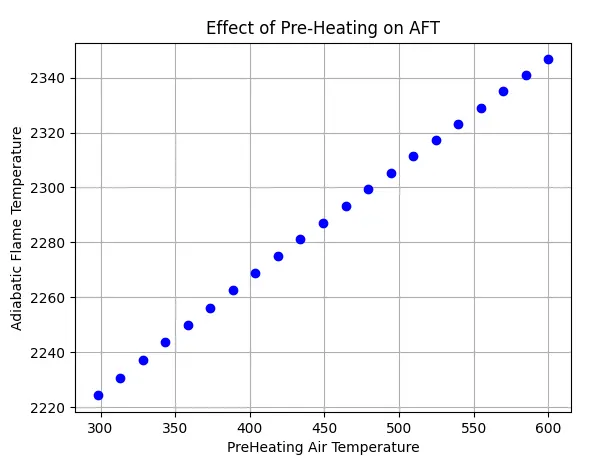
AFT increases with increase in preheating air temperature. The amount of heat available decides how effectively the fuel burns and heat availability to get high temperature.
Case-2:
Effect of pre-heating on Combustion Efficiency:
Combustion efficiency is a measure of how effectively the heat content of a fuel is transferred into usable heat. The stack temperature and flue gas oxygen (or carbon dioxide) concentrations are primary indicators of combustion efficiency.
available heat at outlet = outlet heat/mass of fuel
Combustion Efficiency = available heat generated/maximum possible heat generation
= Q/mf*LHV
CH4+2(O2 + 3.76N2) = CO2 + 2H2O+7.52N2
mole fraction of:
CH4 = 1/(1+2+7.56) = 0.094
O2 = 2/(1+2+7.56) = 0.189
N2 = 7.56/(1+2+7.56) = 0.715
No. of moles = 1 + 2 + 7.56 = 10.56
Cantera Code:
"""
Code for the Effect of Pre-Heating on Combustion Efficiency.
"""
import cantera as ct
import matplotlib.pyplot as plt
import numpy as np

gas = ct.Solution('gri30.cti')

# CH4 + 2(O2 + 3.76N2) = CO2 + 2H20 + 7.52N2

# Fuel
B = ct.Quantity(gas)
B.TPX = 298.15, ct.one_atm,'CH4:1'
B.moles = 1

# Air
A = ct.Quantity(gas)
Temperature = np.linspace(298, 600, num=21)
LHV = 50*pow(10,6)

products = ct.Quantity(gas)
products.TPX = 1700, ct.one_atm,'CO2:0.094, H2O:0.189, N2:0.79'
products.moles = 10.56

for T_pre in Temperature:
	A.TPX = T_pre, ct.one_atm,'O2:0.21, N2:0.79'
	A.moles = 2/0.21

	Q = ((A.mass*A.h) + ((B.mass)*B.h - (products.mass)*products.h))/B.mass

	Efficiency = Q/LHV

	print(Efficiency)
	plt.plot(T_pre, Efficiency, 'o', color = 'k')

plt.grid()
plt.xlabel('PreHeating Air Temperature')
plt.ylabel('Efficiency')
plt.title('Effect of Pre-Heating on Combustion Efficiency')
plt.show()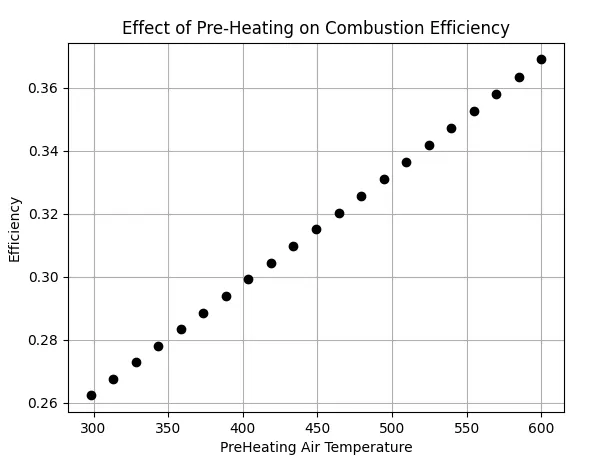
Increasing preheat temperature increases Efficiency.