Week 4 - CHT Analysis on Exhaust port
- Give a brief description of why and where a CHT analysis is used.
- Maintain the y+ value according to the turbulence model and justify the results.
- Calculate the wall/surface heat transfer coefficient on the internal solid surface & show the velocity & temperature contours in appropriate areas.
- How would you verify if the HTC predictions from the simulations are right? On what factors does the accuracy of the prediction depend on?
EXHAUST PORT SIMULATION(BASELINE MESH)
Geometry :
Exhaust port model have to import in the Spaceclaim for the simulation.
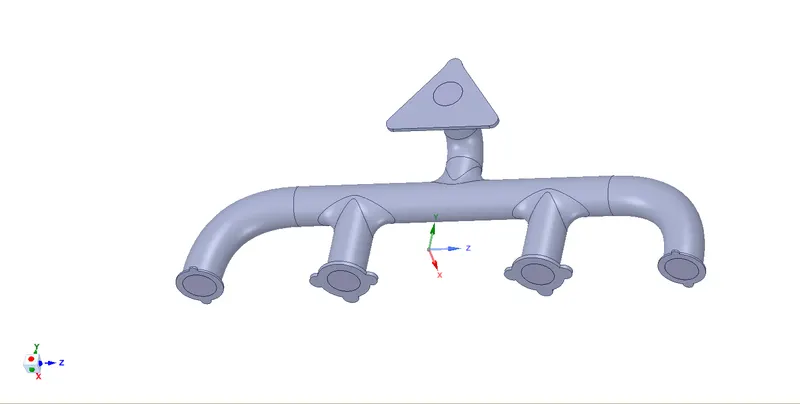
The fluid domain and the solid domain are separated by using the voulme extraction tool of SpaceClaim.
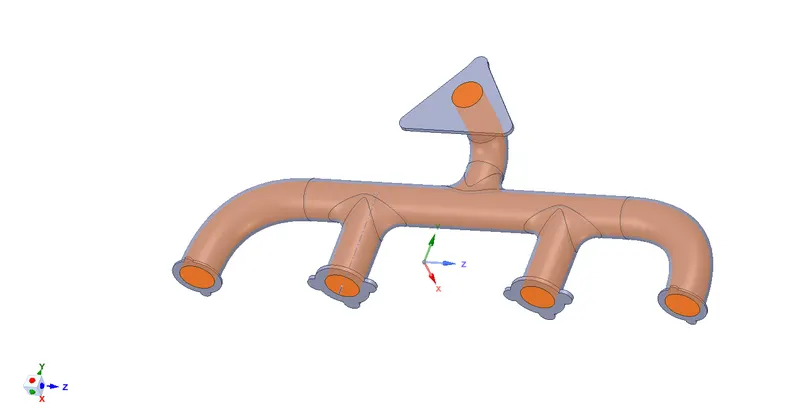
The share topology option is to be enabled which is important for the ANSYS Mesher to identify the components and generate a conformal mesh.
(A confromal mesh is one where the elements of two meshes intersect only at point or an edge. This means there should be no intersection area)
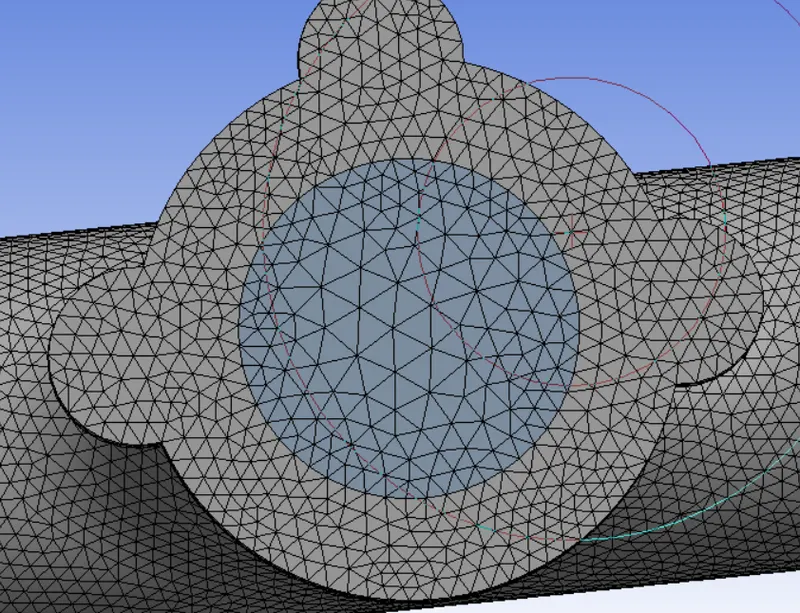
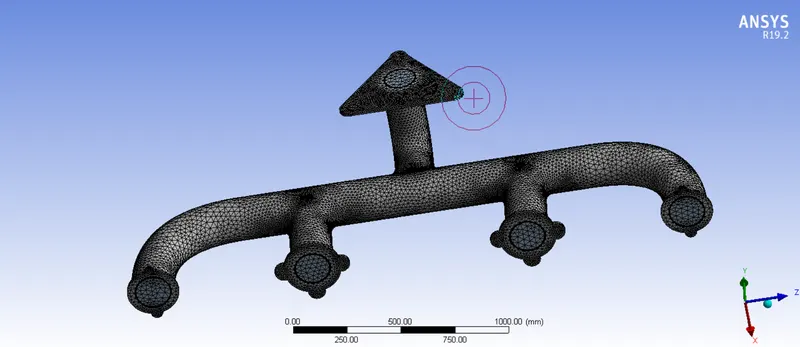
The inflation layers has been created by mainting the y+ values.
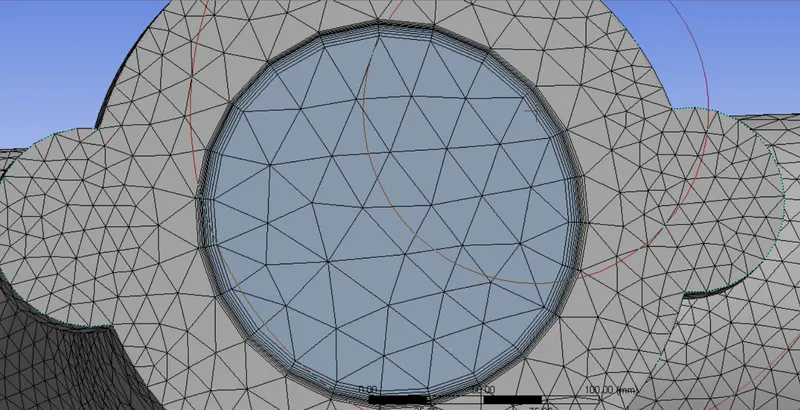
Final Meshing :
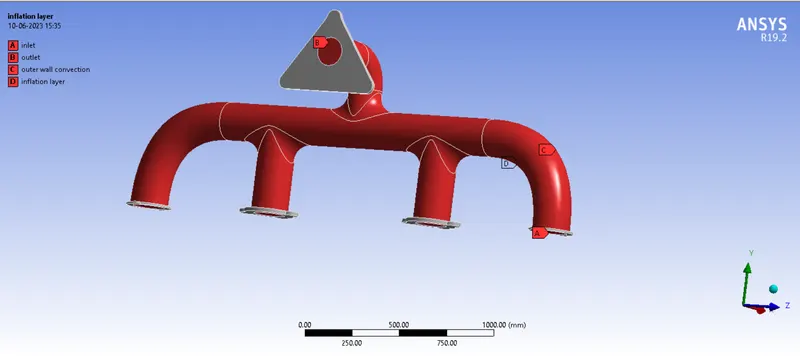
Named selections:
Setup :
The setup involves the following changes to the solver.
- Solver - pressure-based solver
- solver state - steady state
- Turbulence Model - K-epsilon
- Boundary conditions
- Inlet velocity = 5 m/s
- Heat transfer coefficient = 20 W/m^2K
- pressure outlet = 0 pascals
- Give a brief description of why and where a CHT analysis is used.
The Conjugate Heat Teansfer (CHT) analysis has been performed when the heat transfers from the solid domain to fluid domain or Fluid to solid through the interface between two states.
The applications of CHT analysis are heat transfers, cooling of electronic products and general heating & cooling systems.
2. Maintain the y+ value according to the turbulence model and justify the results.
In current simulation, the total height of the inflation layer has been set as 5 mm.
Now, following is the cross-checking of inflation layer thickness by calculating y+ which is dimensionlesss number.
In turbulent flows, the flow nearer to the wall is laminar for very small region if the wall has no-slip condition has been given.
y+ value will help the designer to understand how coarse or fine the generated mesh is for particular method. As per boudary later theory, the y+ value for the viscous sublayer would be less than 10 and if were modeling for the turbulent region, than the y+ value would be greater than 30.
So for this problem, the value of y+ will be taken as 10.
The equation of y+ is :
`y + = (y.u^**)/v`
where, y = distance from the wall in mm
`u ^** `=friction velocity in m/s
`v` = kinematic viscocity in kg/ms
The friction velocity can be defined as the velocity of the flow in the region near to a wall. It can be calculated using following formula:
`( u^∗ ) ^2 = tau rho`
`u^** = sqrt (tau/ rho)`
`tau`=wall shear stress in`Pa = 0.5 ⋅ ( C_f ⋅ rho ⋅ u^2 )`
where, u = free stream velocity in m/s
`c_f`= skin friction coefficient
`C _f = 0.0576 ⋅ R e ^(− 1 /5)`
where Re = Reynolds Number
`Re = (rho ⋅mu ⋅ L)/ mu`
where = rho = fluid density in kg/m^3
u = free stream velocity in m/s
L = characteristic linear length in meter
`mu` = dynamic viscocity of fluid in kg/ms
So, for this problem,
u = 5 m/s
L = 0.166 m (Inlet port dia has been considered)
`mu` = 1.7894e-5 kg/ms
`rho=1.225 (kg)/m^ 3`
Now, calculating Re first.
Re = (1.225 * 5 * 0.166)/1.7894e-5 = 56820
`C_f = 0.0576 * 56820^(-1/5) = 0.00645`
Wall Shear Stress = `tau` = 0.5*0.00645*1.225*5^2) = 0.0988 Pa
frinction velocity, `u^**`= sqrt(0.0988/1.225) = 0.28 m/s
Wall distance, y = (10*1.7894e-5)/0.28 = 0.00063 m = 0.63mm
3. Calculate the wall/surface heat transfer coefficient on the internal solid surface & show the velocity & temperature contours in appropriate areas.
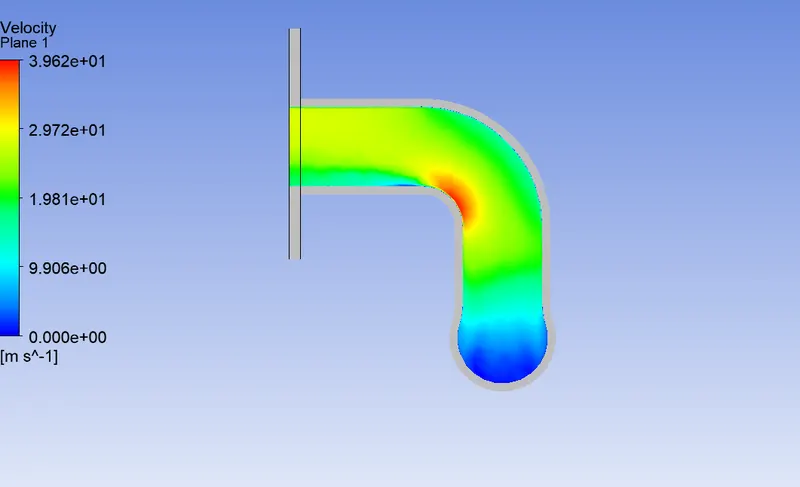
Velocity Counter :
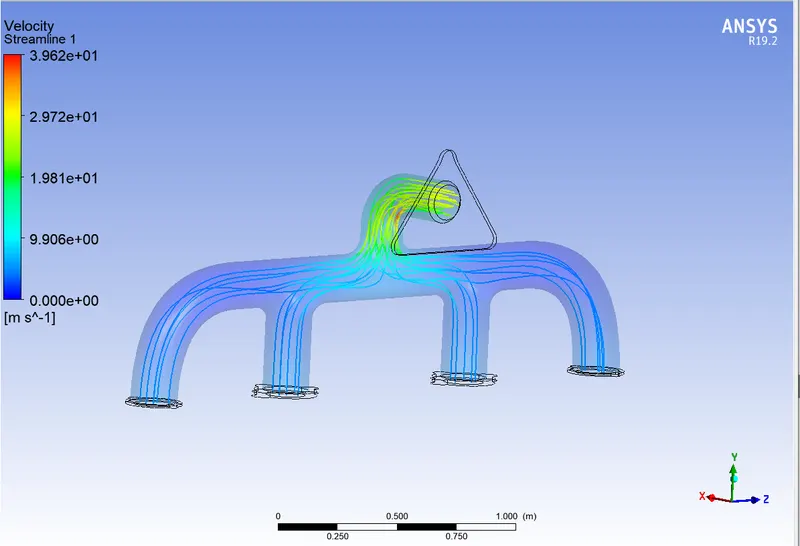
Stream Lines :
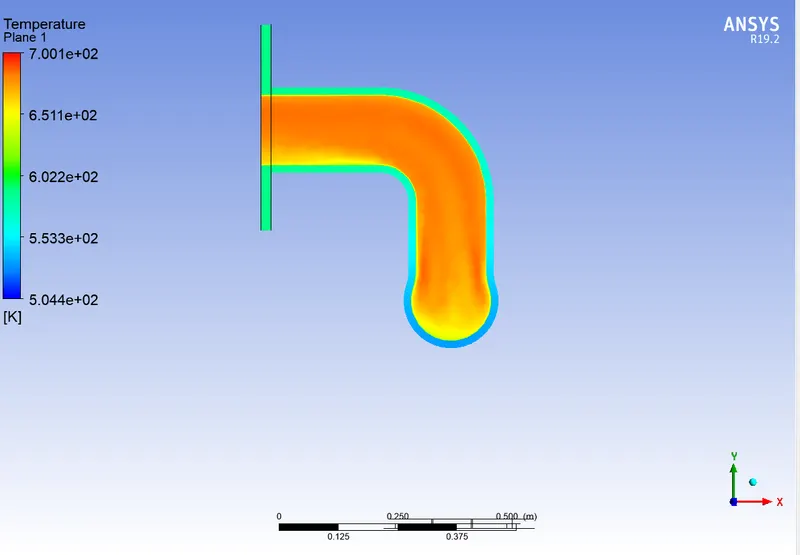
Temperature Counter :
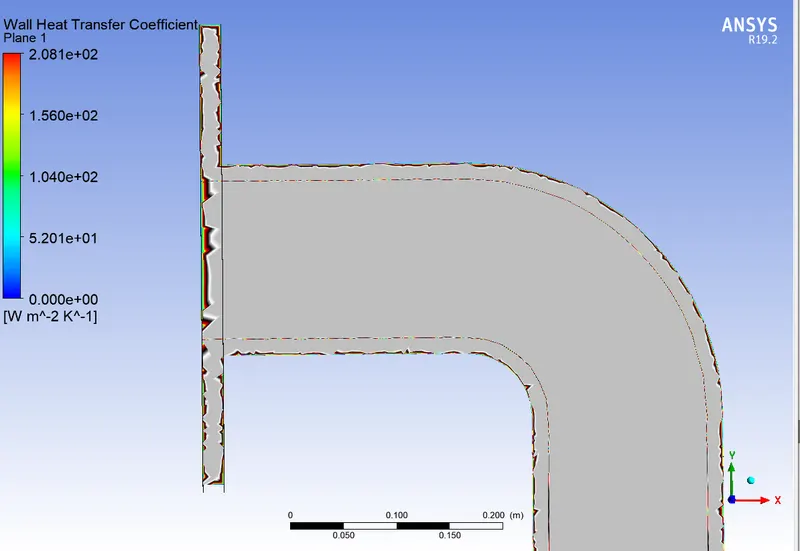
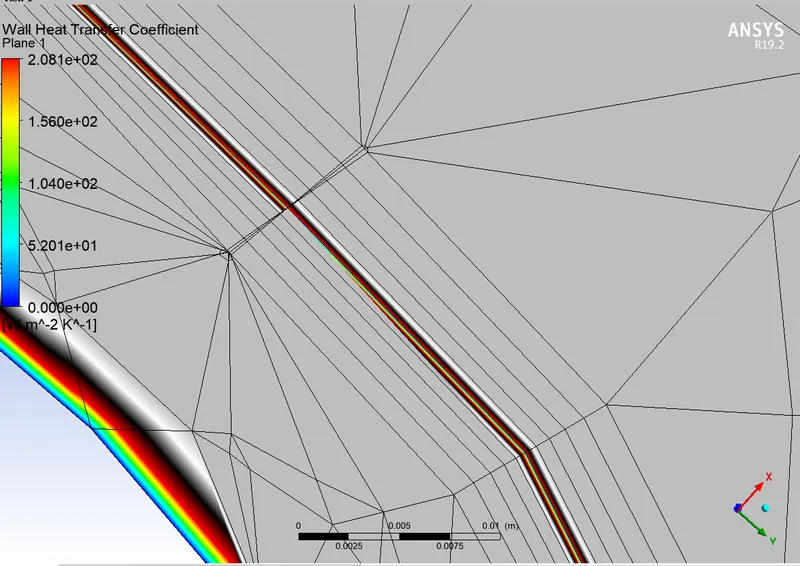
Heat transfer coefficient :
4. How would you verify if the HTC predictions from the simulations are right? On what factors does the accuracy
of the prediction depend on?
Heat transfer coefficient can be determined using the Nusselt Number (Nu) equation, which is
Nu = convective Heat Transfer / conductive Heat Transfer = `(h.L)/k`
where, h = convective heat transfer coefficient in W/m^2.K
L = characteristic diamerer in meter = 0.166m
k = thermal conductivity in W/m.K = 0.0242 W/m.K
To determine Nusselt Number, the Dittus-Boeltr equation for internal turbulent flow condition will be used
`N u = 0.023 ⋅ Re_ (Dh)^0.8 ⋅ P r ^0.4`
where, Pr = Prandtl Number for the air with 700 K temperature = 0.71
Re = 56820
`Nu = 0.023 * (56820)^0.8 * 0.71^0.4 = 127. 59`
From first equation of Nusselt Number
`h = (Nu*k)/L = (127.59*0.0242)/0.166 = 18.6 W/m^2.K`
The heat transfer coefficient consider for the simulation, which is 20 W/m^2.K, is very near by the calculated heat transfer coefficient.
The calculated Nusselt Number's value depends on the Prandtle number & Reynolds number also,the Dittus-Boeltlr equation is accurate for the smooth circular pipe with small to moderate temperature differences and it is less accurate for rough pipes & large temperature variations.
Because of these factors, the difference in the calculated heat transfer coefficient & coefficient consider for simulation is acceptable.
Results :
The maximum velocity can be seen in the red color near the turining where pressure has been dropped due to sudden turn in profile & following to the maximum velocity area, low pressure area has been build up.
The temperature starts dropping towards reaching the outlet of exhaust port because of the heat is transferring from the exhaust port walls & also the air from the low pressure areas in the exhaust port where air with less temperature mixed up with the hot air.
The heat transfer coefficient only visible in the first layer of the inflation layers as shown in the image