Week 4 - CHT Analysis on Exhaust port
CHT ANALYSIS
A Conjugate Heat Transfer (CHT) analysis is used to study the combined heat transfer phenomena involving both fluid flow and heat conduction within solid structures. It is typically applied in situations where there is a strong coupling between the fluid and solid domains, and heat transfer occurs through convection, conduction, and possibly radiation.
The purpose of conducting a CHT analysis is to understand and predict the distribution of temperature, heat flux, and thermal gradients in systems where fluid flow and heat transfer interact with solid components.
APPLICATIONS
-
Combustion Systems: CHT analysis plays a vital role in the design and optimization of combustion systems, such as gas turbines or internal combustion engines. It helps predict the temperature distribution, heat transfer, and thermal stresses in components exposed to high-temperature gases.
-
Electronics Cooling: CHT analysis is used to study the thermal management of electronic components and systems. It helps evaluate heat dissipation, identify hotspots, and optimize cooling strategies such as heat sinks, fans, or liquid cooling solutions.
-
Thermal Comfort in Buildings: CHT analysis is employed to evaluate and optimize the thermal performance of buildings and HVAC (heating, ventilation, and air conditioning) systems. It helps assess temperature distribution, energy consumption, and indoor comfort levels.
-
Aerospace and Automotive Applications: CHT analysis is extensively used in the aerospace and automotive industries to study thermal management, such as engine cooling, aerodynamic heating, and heat transfer in components like heat exchangers or radiators.
-
Renewable Energy Systems: CHT analysis is applied to assess and improve the performance of renewable energy systems, such as solar collectors, wind turbine cooling, or geothermal systems.
Maintaining The Y+ Value
Maintaining the y+ value in a CFD simulation is important for accurate turbulence modeling and capturing the flow behavior near the wall. The y+ value represents the distance of the first cell centroid from the wall.
To maintain the desired y+ value, the mesh near the wall needs to be appropriately refined. A fine mesh is required in the near wall region, where the velocity gradients are high. Gradually increasing the mesh density towards the wall ensures that there are enough cells to resolve the boundary layer and capture the turbulence effects accurately.
PROJECT
GEOMETRY SETUP
The model is opened in ANSYS Spaceclaim.
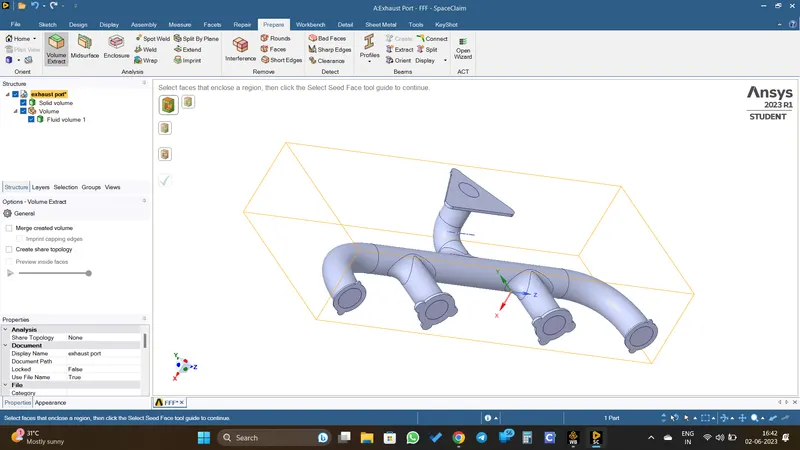
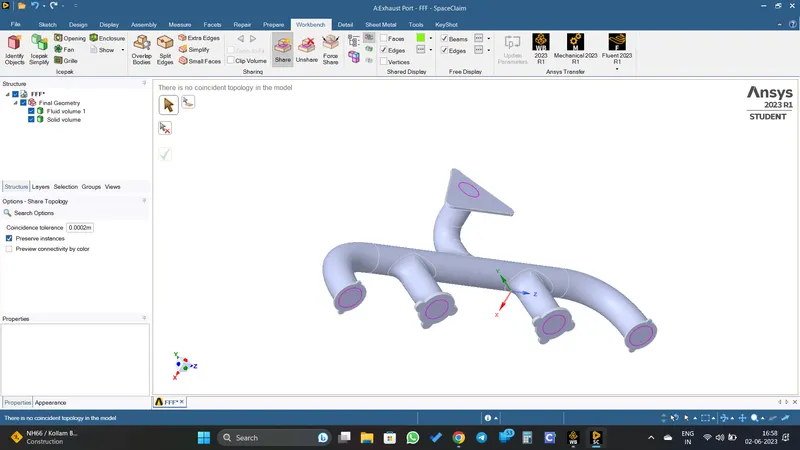
Extracted the fluid volume and enabled share topology to share data from fluid volume to solid volume.
MESHING
The model is opened in Meshing Window.
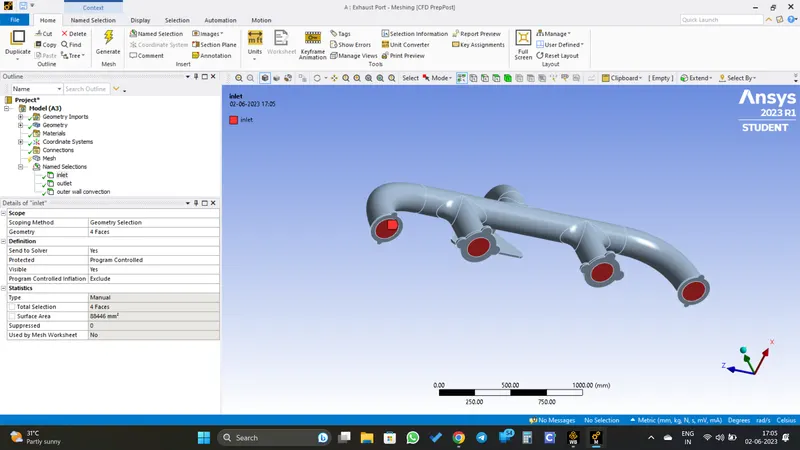
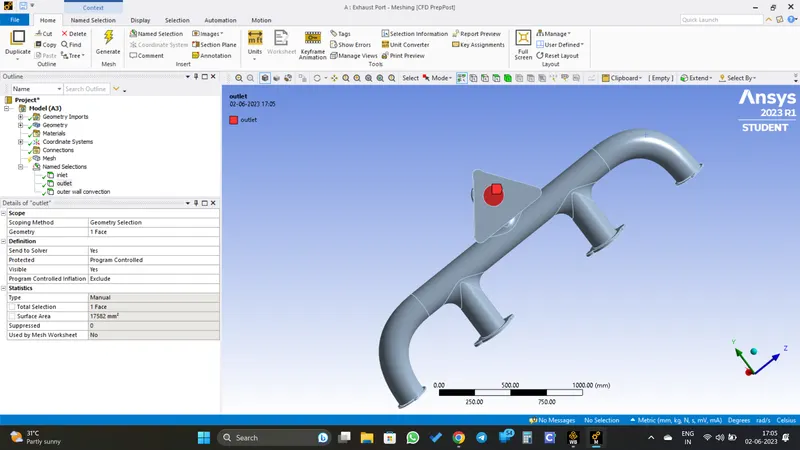
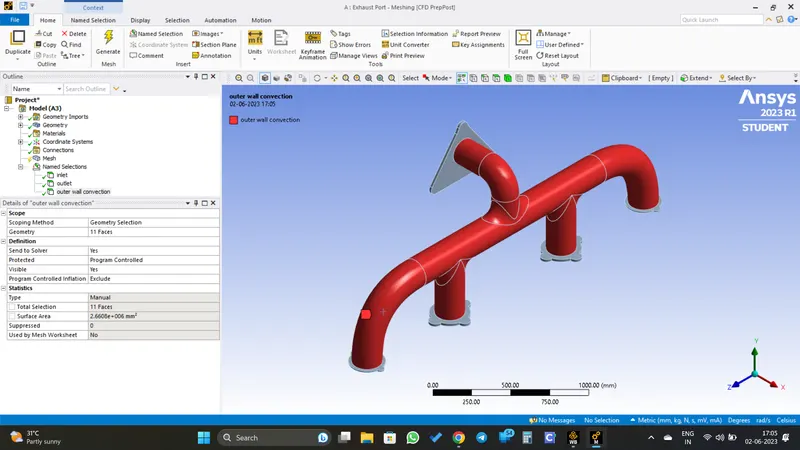
Given the name for each parts.
Inlets Outlet
Outer Wall
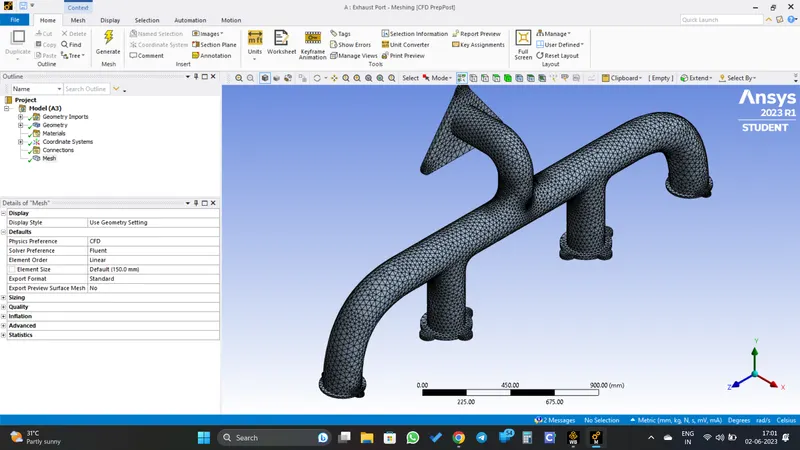
Generated a base line mesh
SETUP
The meshed model is opened in ANSYS FLUENT.
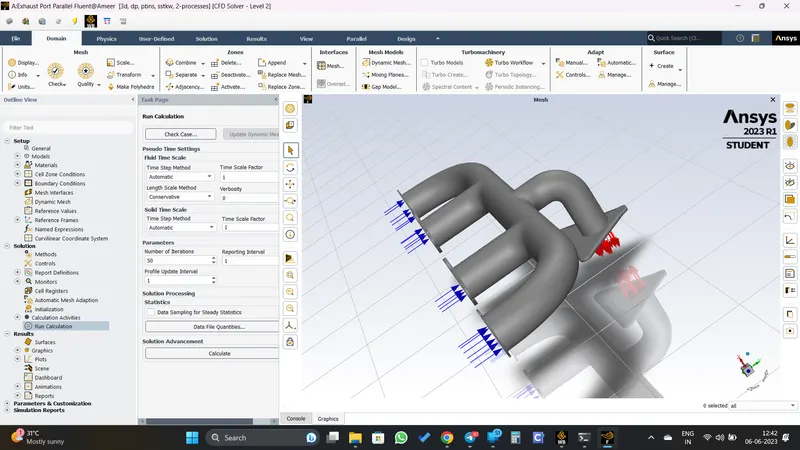
Solver Type: Pressure Based
Energy equation is enabled
Viscous Model: k-omega SST (It provides improved predictions in regions with strong streamline curvature or swirling flows.
Materials: Fluid as air
Solid as aluminium
Boundary Conditions;
- Inlet velocity: 5 m/s
- Inlet temperature: 700 k
- Outer wall thermal condition: Convection
- Outer wall heat transfer coefficient: 20 `W/(m^2k)`
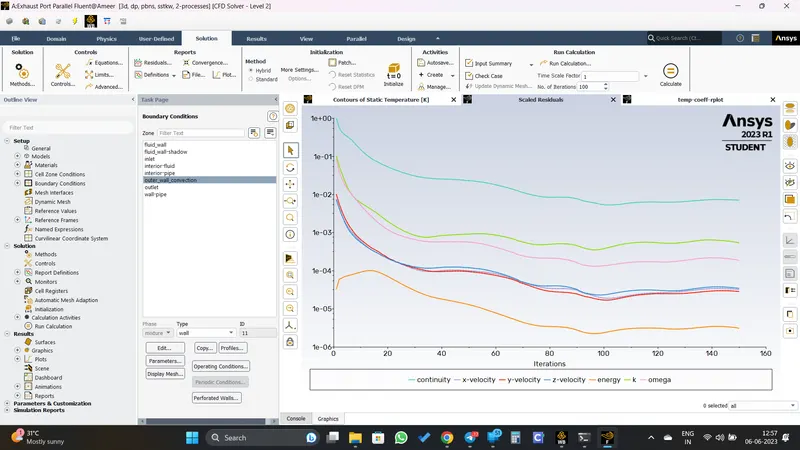
Then the model is rum for 150 iteration.
Results
Residual Plot
Heat Transfer Coefficient
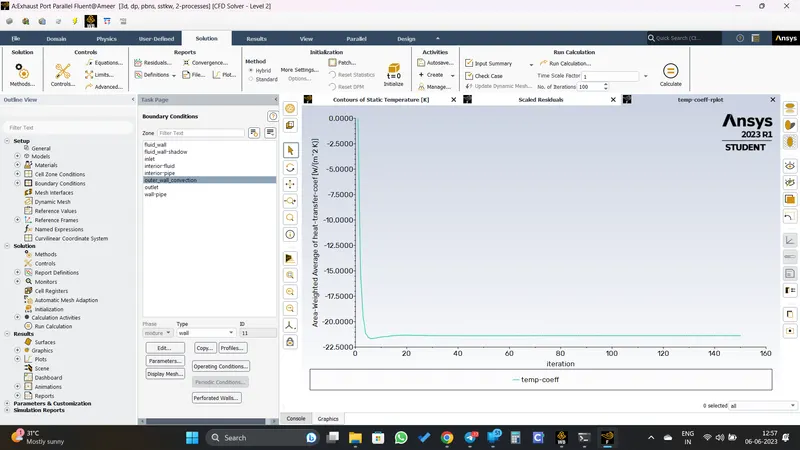
The value of Heat Transfer Coefficient is -21.37 `W/(m^2k)`
Temperature Contour
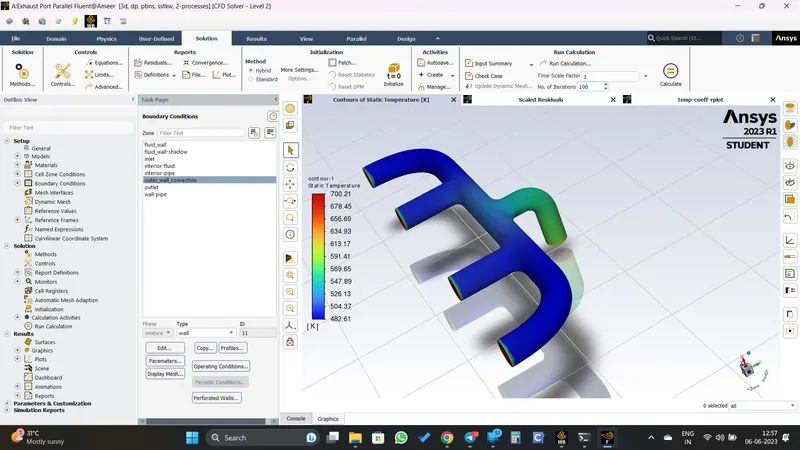
Going For A Refined Mesh
To do the mesh refinment and comparison, a duplicate of the model is created having all the same parameters.
To obtain a proper refinment an inflation layer is created.
The parameters of the inflation later is obtained using Y+ calculator.
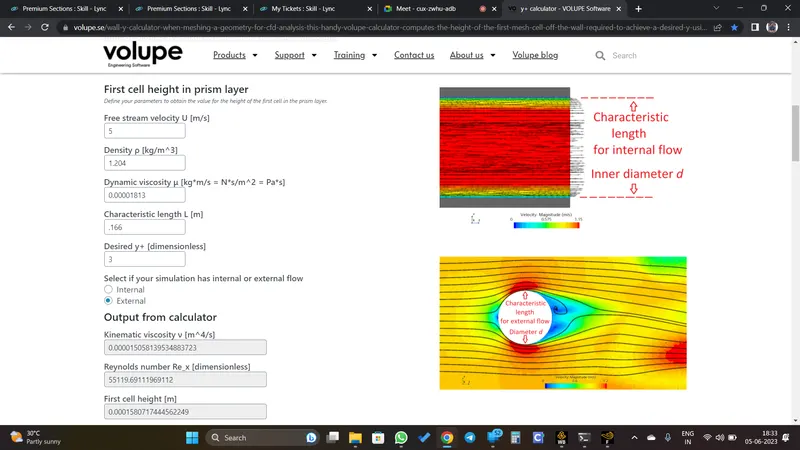
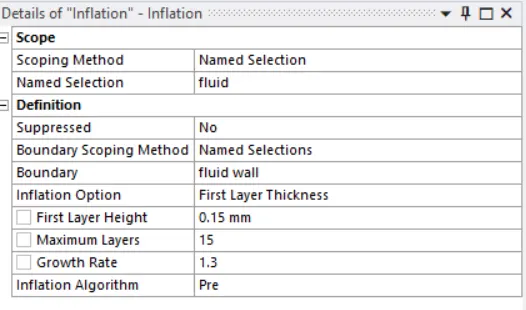
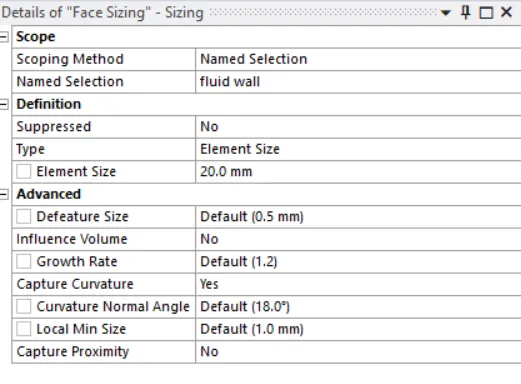
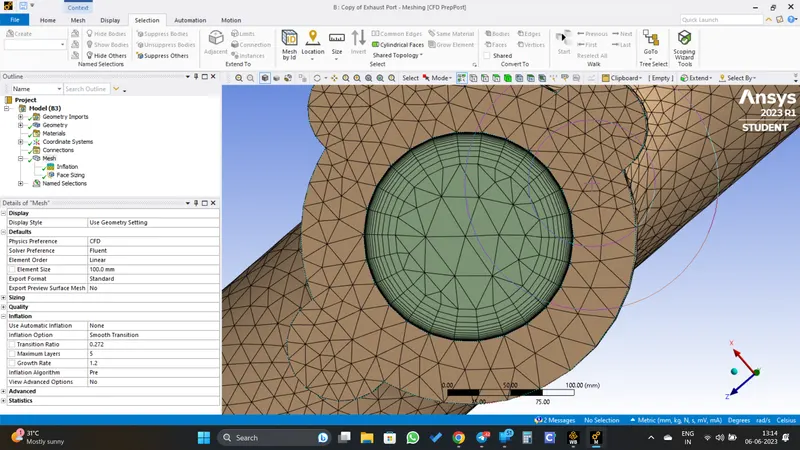
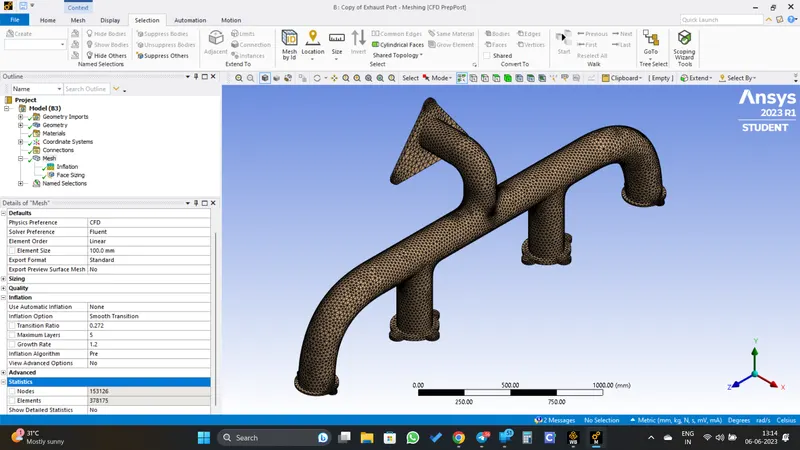
Then the model is again opened in ANSYS FLUENT and run for 150 iteration
Results
Residual Plot
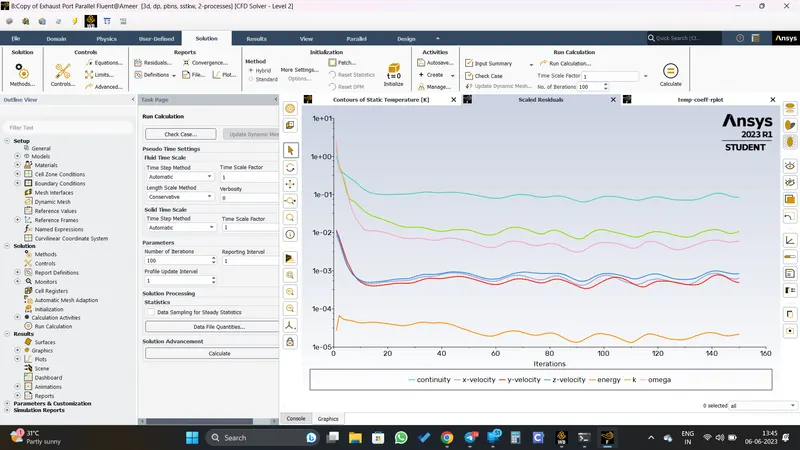
Heat Transfer Coefficient
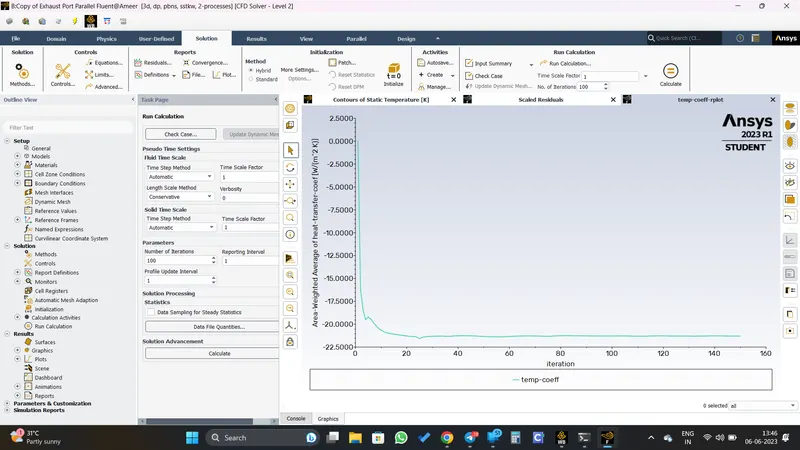
The value of Heat Transfer Coefficient is -21.28 `W/(m^2k)`
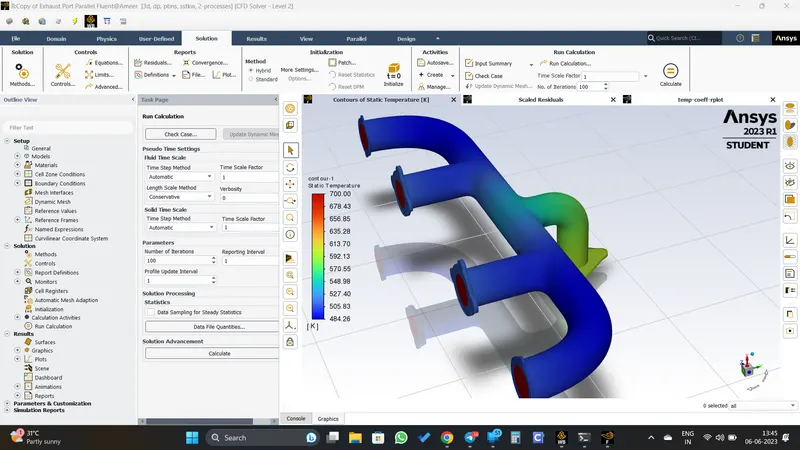
Temperature Contour
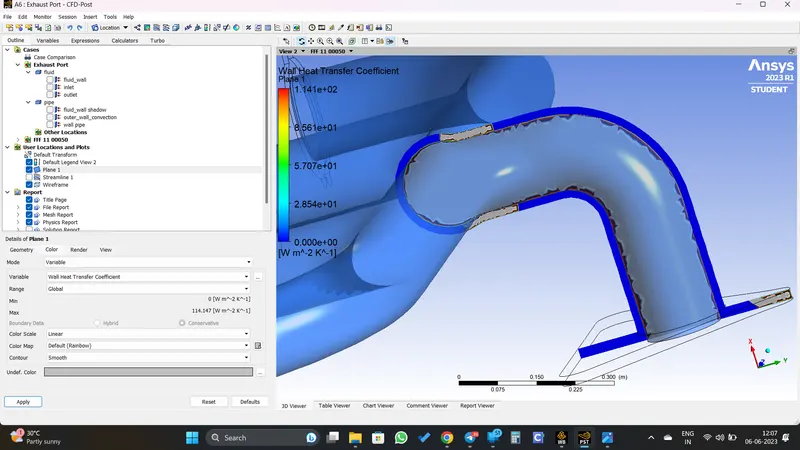
Heat Transfer Coefficient Of The Pipe Wall
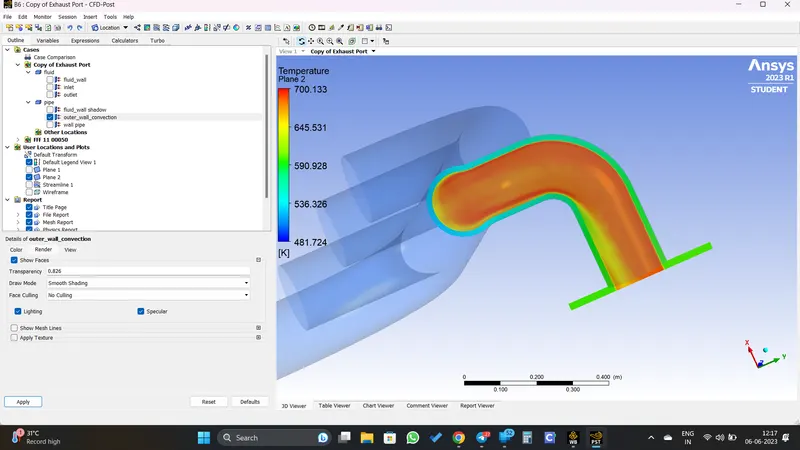
Temperature Contour (Plane)
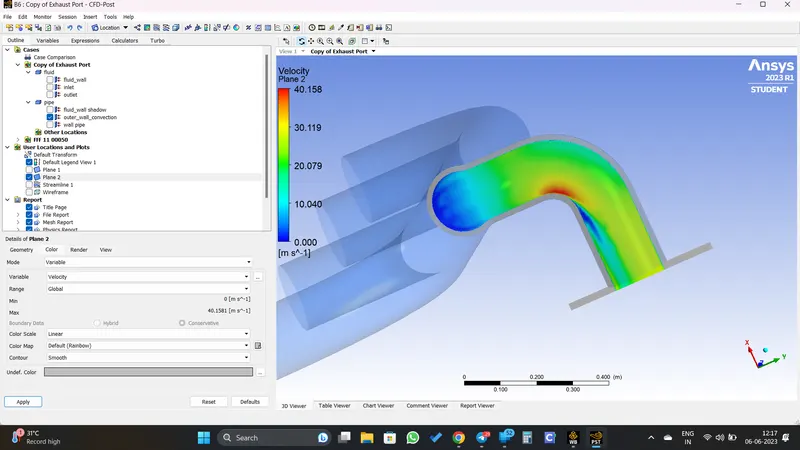
Velocity Contour (Plane)
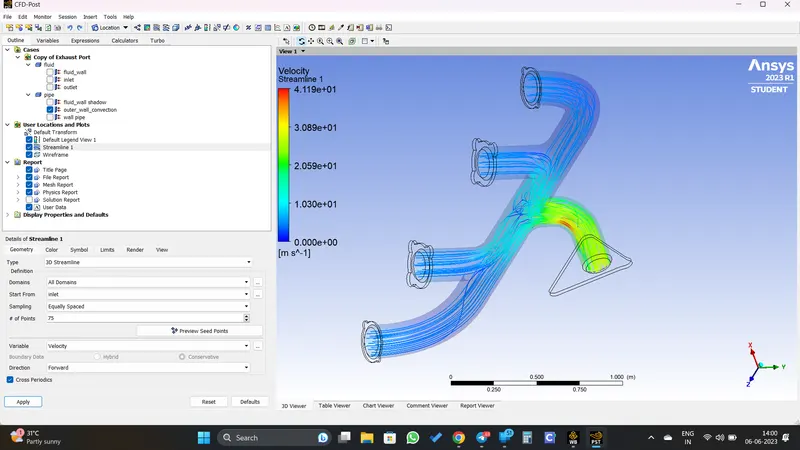
Velocity Stream Line
OBSERVATION
- In the temperature contour, we can see that the temperature of the pipe at the inlet side is quit low where as the outlet side is high.
- This is because the velocity at the inlet is low where as the outlet mass momentum will be high beacuse it is sum of all inlet as we can see in the velocity stream line.
- Also we can obeserve a high velocity region near the bend of the outlet side.
- Due to the high velocity at the outlet region, the Reynolds number is high at that region which means the heat transfer coefficient is also high at the outlet.
| CASE | NO: OF ELEMENT | NO: OF NODES | HEAT TRANSFER COEFFICIENT |
| BASE LINE MESH | 138223 | 27539 | -21.37 W/m^2k |
| REFINED MESH | 378175 | 153126 | -21.28 W/m^2k |
The negative value of heat transfer coefficient indicates that the surface is gaining heat from the surrounding fluid.
SIMULATION OF HTC AND IT'S ACCURACY
Verifying the accuracy of heat transfer coefficient (HTC) predictions from simulations involves comparing the simulation results with experimental data or validated numerical solutions. Here are some factors affecting the accuracy of HTC predictions;
- Experimental Data: Comparing the simulation results with reliable experimental data is crucial for verification.
- Grid Resolution: The accuracy of HTC predictions depends on the grid resolution or mesh quality. Coarser meshes may not adequately capture the boundary layer or fluid flow features, leading to inaccuracies.
- Turbulence Modeling: The choice of turbulence model can impact the accuracy of HTC predictions. Different turbulence models have different levels of complexity and assumptions, and their performance may vary depending on the flow conditions.
- Material Properties: Accurate material properties, such as thermal conductivity and heat capacity, are essential for precise HTC predictions.
- Simulation Setup: The accuracy of HTC predictions can also depend on other simulation setup parameters, such as the inlet boundary conditions, turbulence intensity, boundary conditions for radiation or conduction, and convergence criteria.
Besides this there are some other factors which also have impact on the accuracy of HTC.
For project file, click here