Week 4 - CHT Analysis on Exhaust port
CHT ANALYSIS ON HEAT EXHAUST PORT
Introduction:
Conjugate Heat Transfer is process of heat exchanging at interface and transporting via conduction within solid and /or transporting via within fluid domain.
In others word the heat transfer allows to exchange of thermal energy at the interface between the solid and fluid domain. In that case it is more stable and provides faster convergence as the energy equation is strongly coupled between the solid and fluid regions.
The application for CHT are like simulation of heat exchanger, cooling of electronic equipment, general purpose of cooling and heating of system.
Conjugate Heat transfer analysis is beneficial in engineering applications because it shows the heat exchanging capabilities between the two surfaces in the engineering device and various optimization can be done to improve the thermal characteristics of the devices. Thus, this can be used to improve the heat transfer rate wherever required. It also helps us to identify the key parameters that enhance the fluid flow and heat transfer within the system.
Procedure for Simulation:
- Creating Geometry:
Solid volume Geometry:
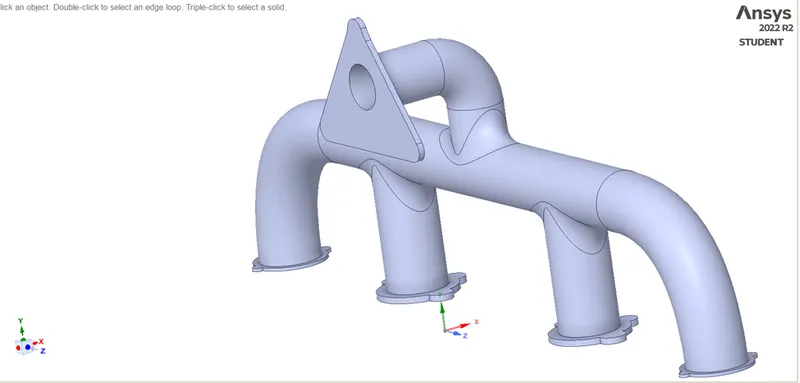
Fluid volume extracted geometry:
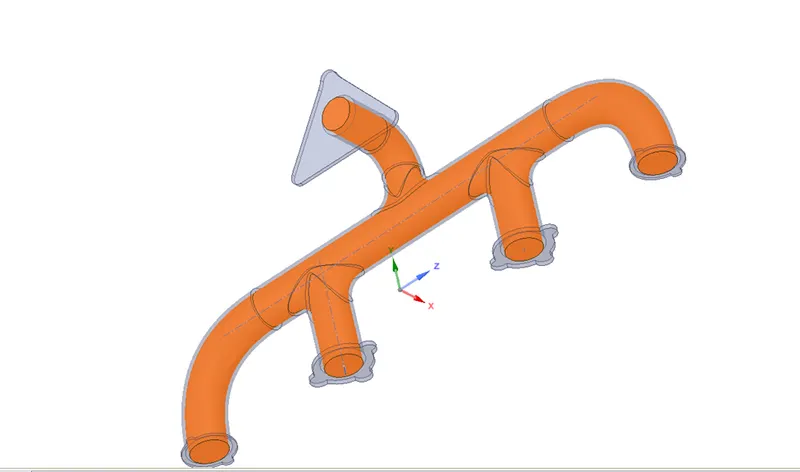
Final Geometry:
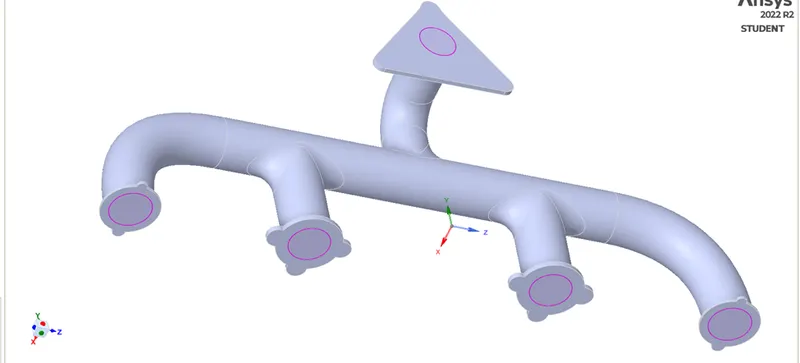
2. Meshing the model:
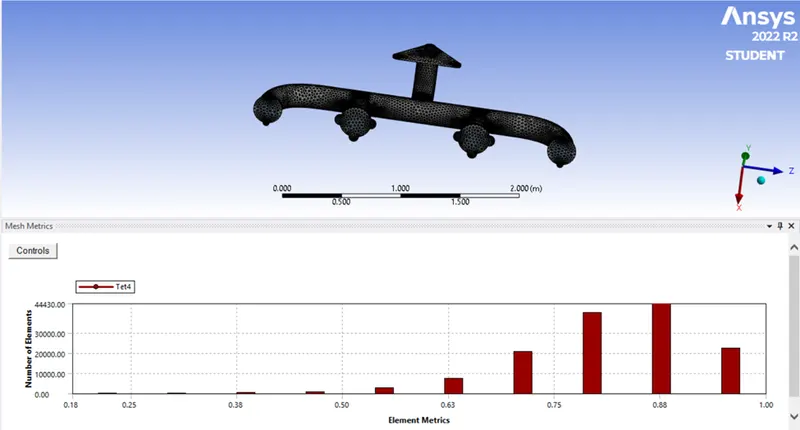
Meshing the model by baseline value without inflation
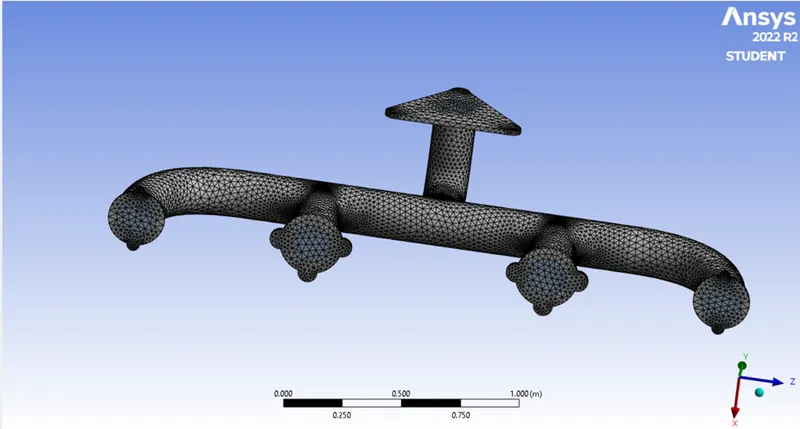
Element Quality with 137975 elements:
3. Setup:
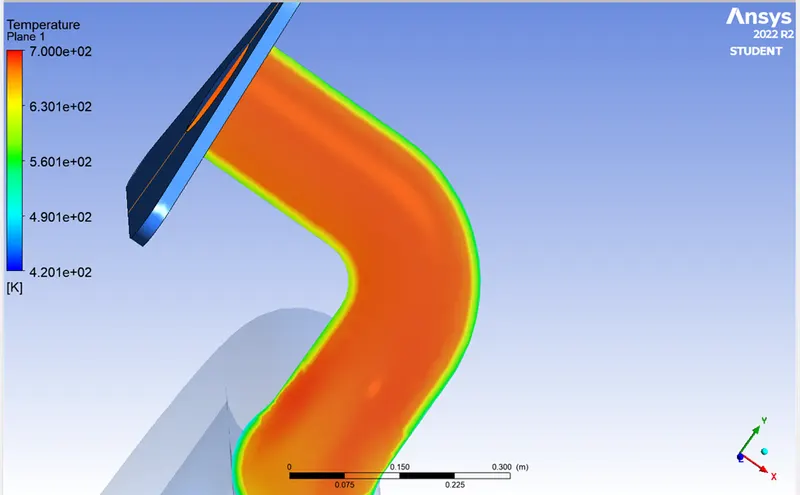
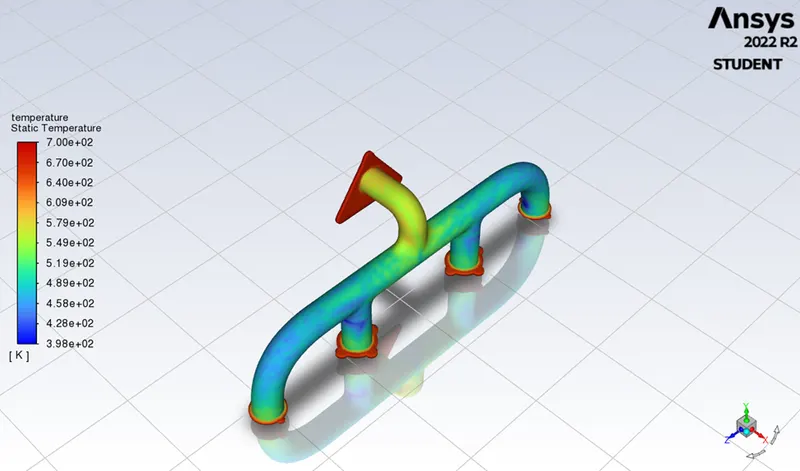
Setting up the model of viscous model as k-omega for a smoother flow by sub-viscous layer region in the exhaust port, applying velocity as 5 m/s and temperature as 700k for inlet port and for outlet putting 0 as gauge pressure.
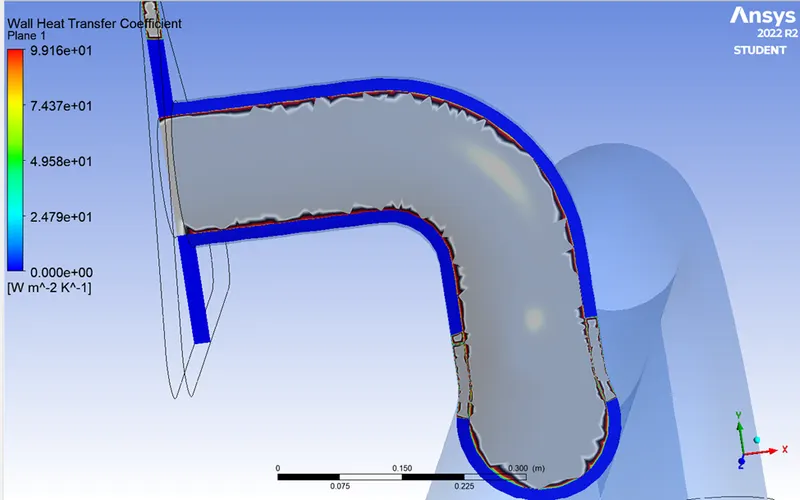
Applying the convection heat coefficient as 20 k-W/k for convection wall of model, and putting the heat flux as 0 for solid body.
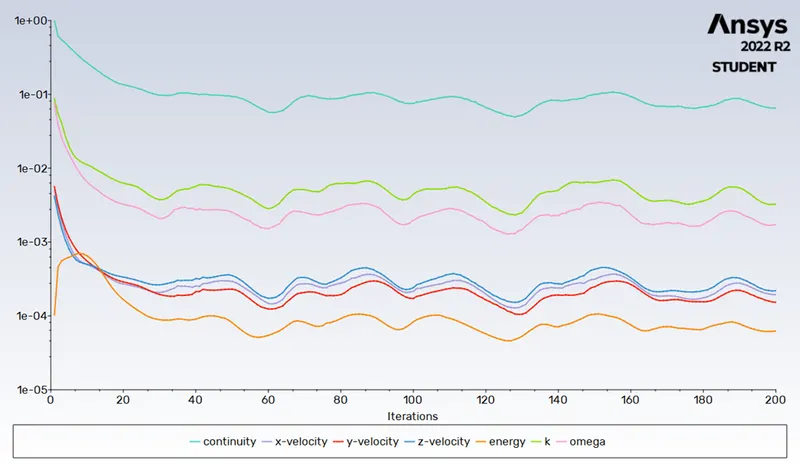
RESIDUAL PLOT:
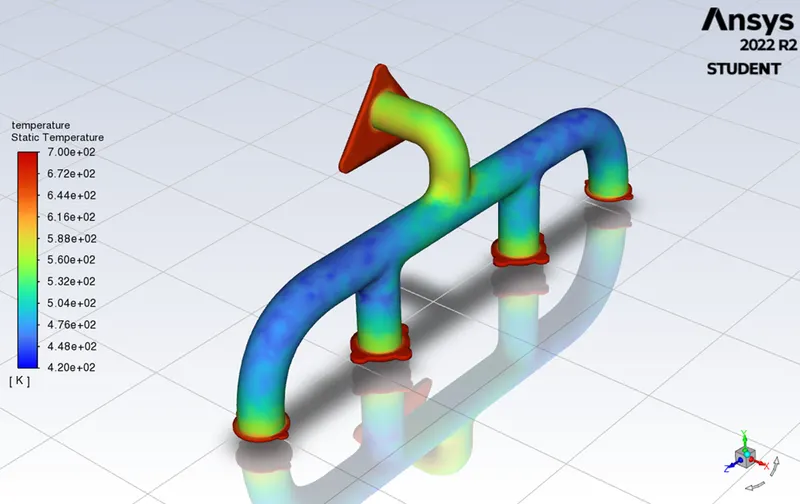
STATIC TEMPERATURE:
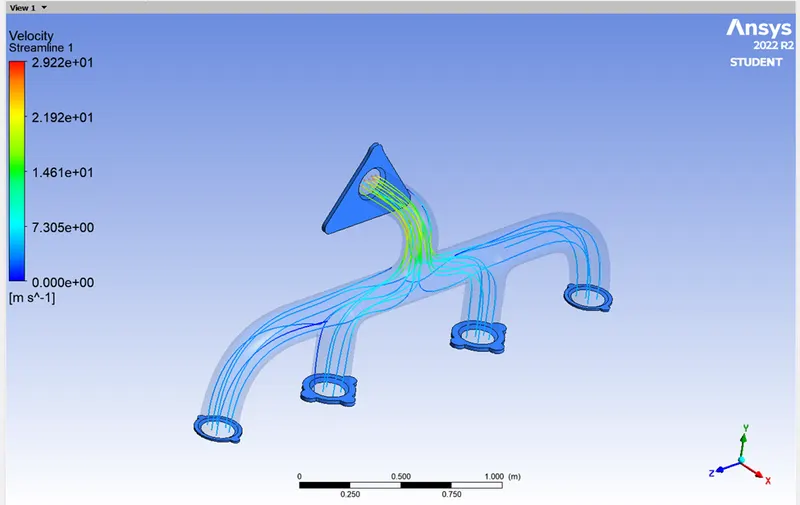
4. Post-Processing of Exhaust Port:
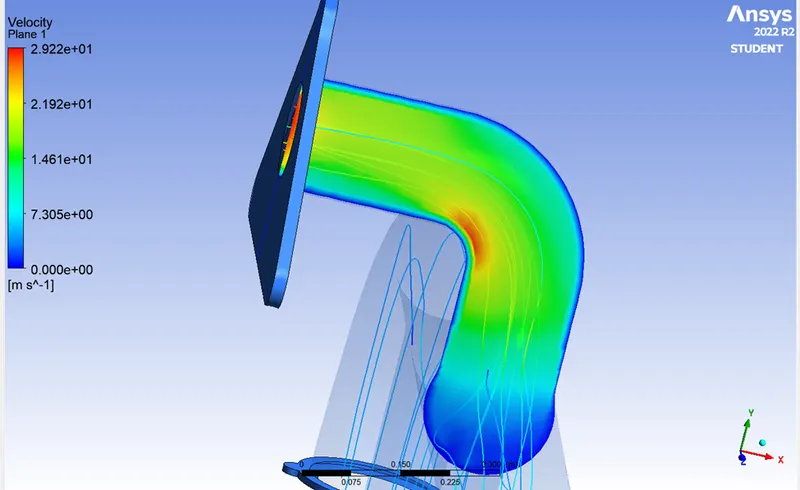
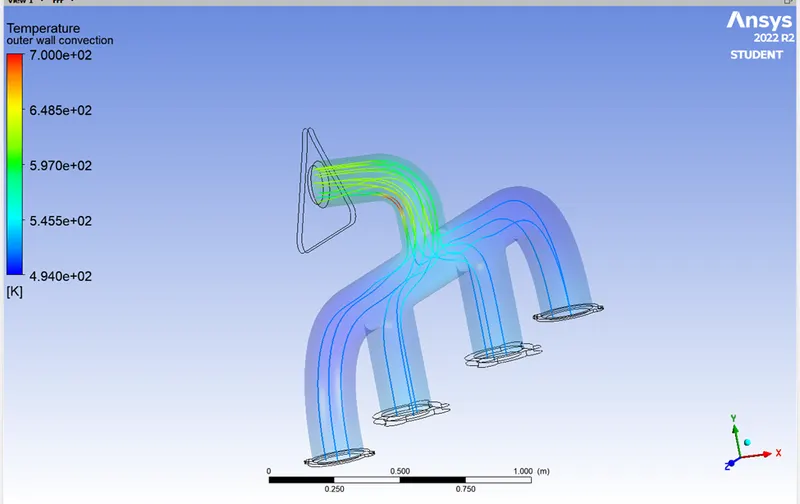
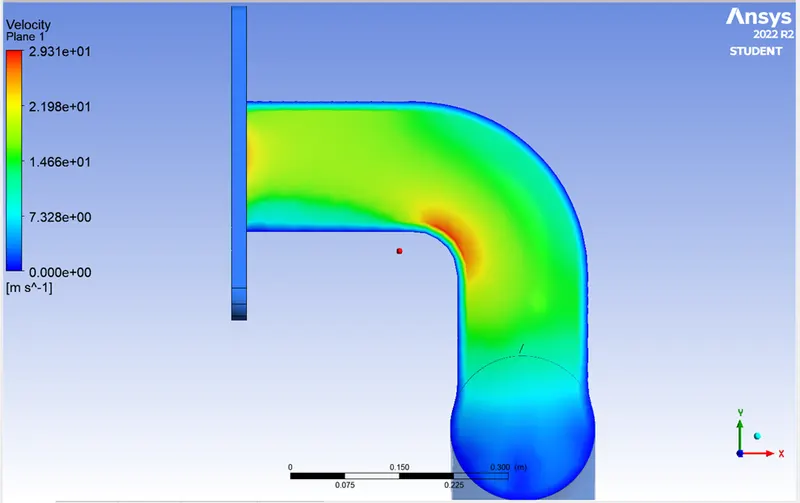
Velocity streamline acting in exhaust port with lower velocity at inlet ang higher at outlet.
VELOCITY CONTOUR:
WALL HEAT TRANSFER COEFFICIENT:
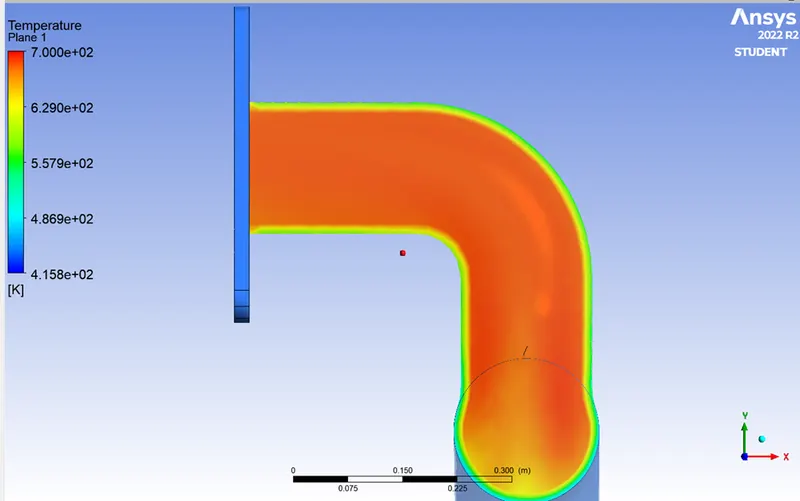
TEMPERATURE PLANE:
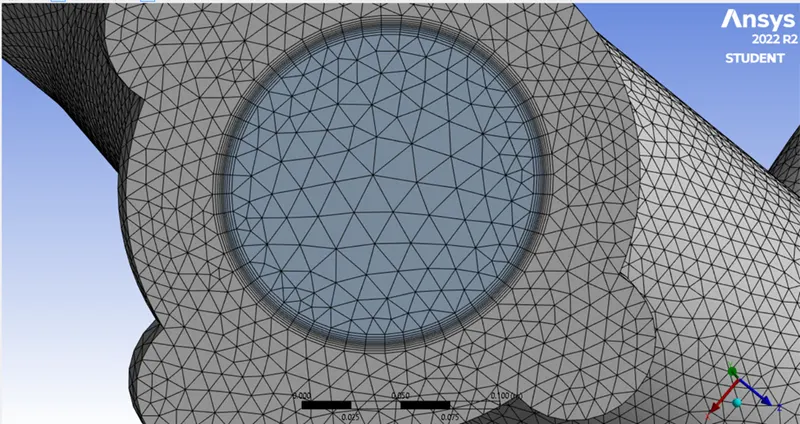
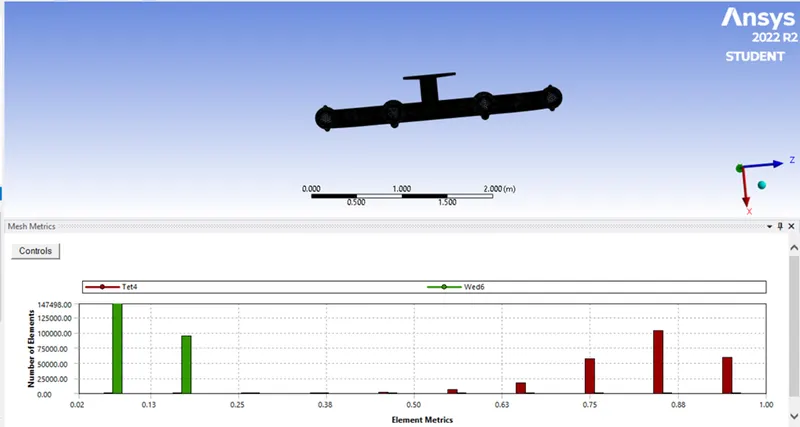
Refined exhaust port meshed model i.e., added inflation layer with 419826 elements.
2.Y+ value helps to understand how the coarse or fine the generated mesh for particular method. The Y+ for the viscous sublayer would be less than 5 and if were modelling for turbulent region Y+ would be greater than 30 from boundary layer theory.
In turbulent flows the flow nearer the wall is laminar for every small region if the wall has no-slip condition has been given,
Y^+= (y*u^*)/v
Where,
Y – distance from wall in meter
u^* - friction velocity m/s
V – kinematic viscosity kg/m-s
(u^* )^2= τ/ρ
τ – shear stress in m/s
– 0.5 * (cf* ρ * u^2)
u - free stream velocity
cf – skin friction co-efficient
The value of y+ is considered on the basis of y+ boundary layer theory, Therefore considered first layer thickness is considered by sub-viscous layer zone.
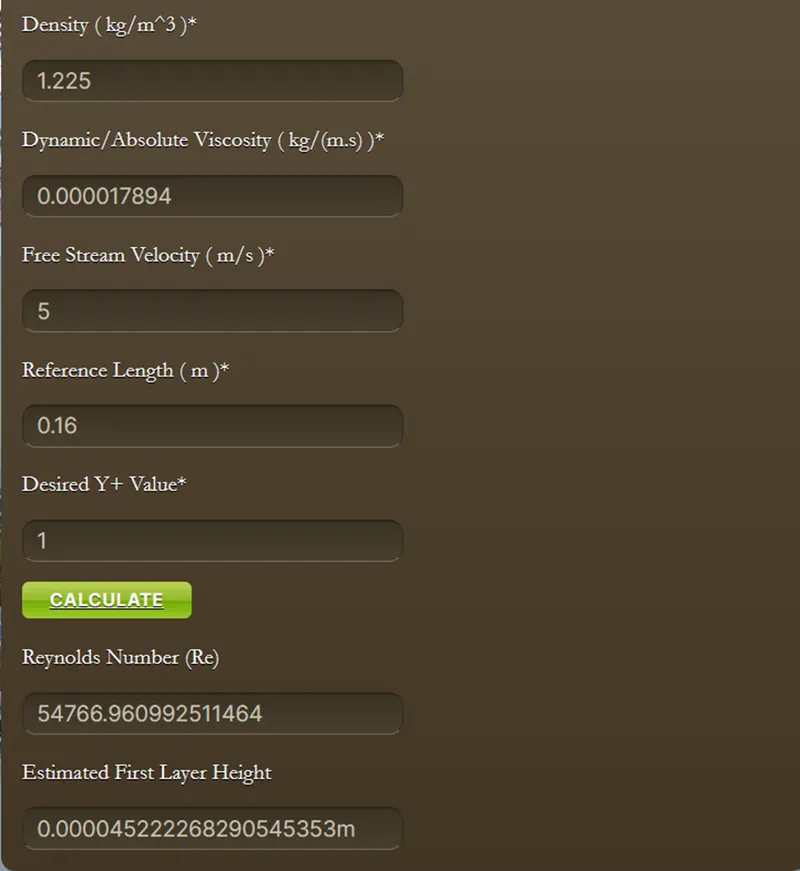
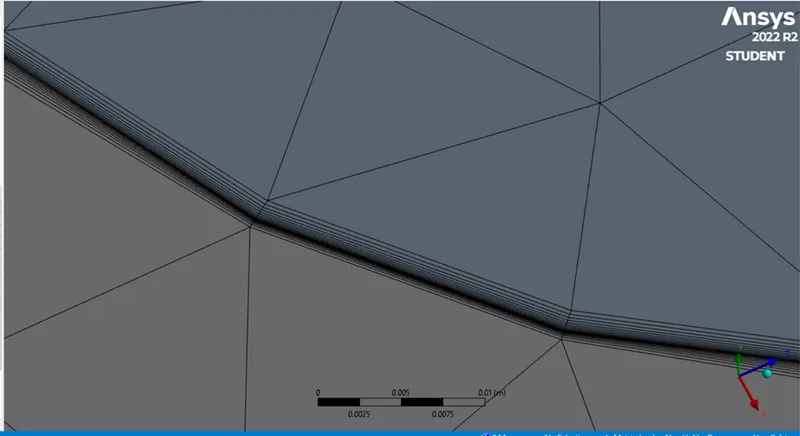
By putting values in online calculator y+ = 1 then we get the y value as 0.00004522m.
CALCULATION:
Refined Mesh Body with 419826 elements.
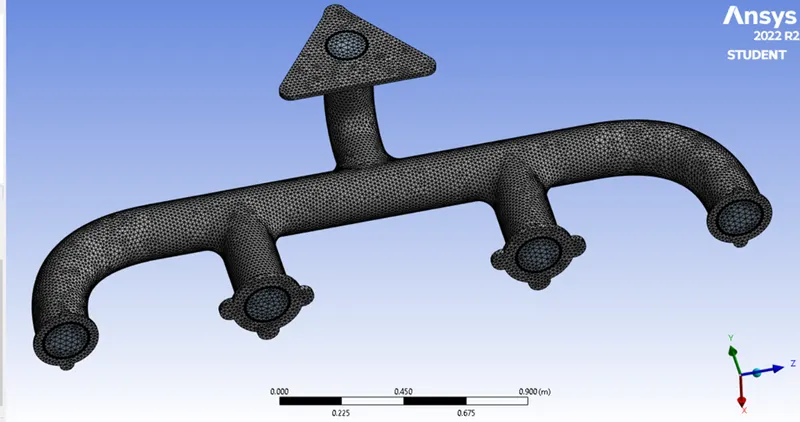
Added inflation layer and first layer thickness as 0.00004522 for 10 layers.
ELEMENT QUALITY FOR EXHAUST PORT:
RESIDUAL PLOT:
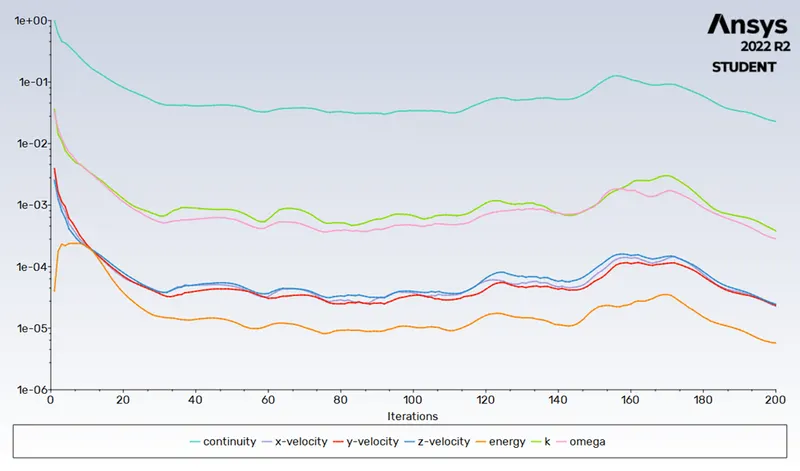
STATIC TEMPERATURE:
TEMPERATURE STREAMLINE:
TEMPERATUTRE CONTOUR:
VELOCITY CONTOUR:
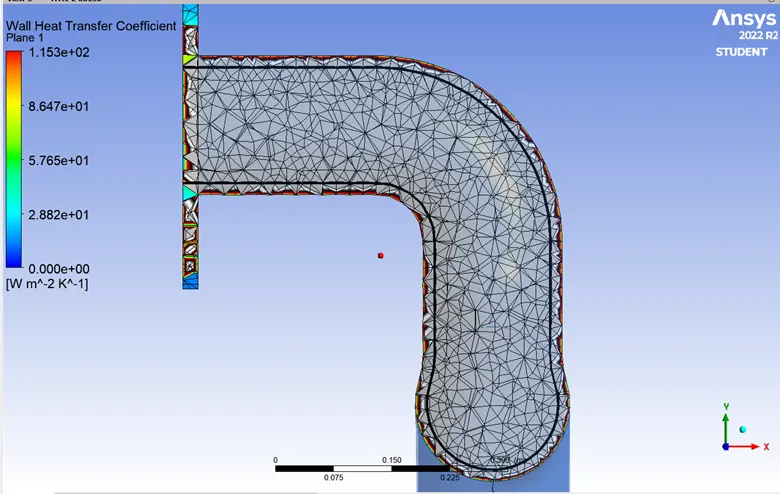
WALL HEAT TRANSFER COEFFICIENT WITH SMOOTH INFLATION LAYER:
4.Heat Transfer coefficient will be determined by Nusselt Number(Nu)
Nu = convective heat transfer/conductive heat transfer
Nu = h*L/k
h – convective heat transfer coefficient in W/m^2 K
L – characteristic length/diameter of inlet port as 0.16m
k – Thermal conductivity 0.0242 W/m K
Cp – specific heat 1006.43 J/Kg K for fluid material
Re – 54767
Pr – Thermal diffusivity/Prandlt Number
Pr = µ*Cp/K
Pr = 0.74
Nu = 0.023*(54767)^0.8*(0.74)^0.4 = 125.96
h = (123.89*0.242)/0.16 = 19.05W/m^2 K
According to calculation comparing analytical and theoretical values of heat transfer coefficient
That we chosen the HTC as 20 W/m^2 K in in simulation and we get the analytical HTC as 19.05W/m^2 K i.e., The analytical and simulative HTC value are approximately same at end.
The factors of accuracy of the prediction depend on
- Mesh Refinement.
- The number of inflation layers.
- Number of Elements.
- Viscous model consideration.
- Number of iterations to reach convergence.
In the above cases by adding the inflation layer to the exhaust port the wall heat transfer coefficient (HTC) will be smother comparing to case 1 i.e., baseline method.
Conclusion:
According to above results and simulations the HTC is approximately same for analytical and simulation HTC value. With this we conclude that the refined mesh more smoother/accurate than baseline exhaust port and we have use the viscous model as k-omega as of the flow in in sub-viscous region to select y+ value to find the first layer thickness of inflation layer for exhaust port.