Week 4 - CHT Analysis on Exhaust port
OBJECTIVE: To perform CHT analysis on an Exhaust port of 4 in-line cylinder engine.
THEORY:
Conjugate Heat Transfer (CHT) refers to the coupling of conduction in solids with the convective or radiative heat transfer in the surrounding fluids. In simpler words CHT is combination of heat transfer in solids and fluids.
CHT analysis is required for the understanding of complex heat transfer mechanisms and the interactions between those mechanism to improve the performance and increase the lifespan of the component being analyzed. It also helps to get clear insights on velocity distribution and mechanism of heat transfer of fluids in engines, it also provides temperature distribution in solids and fluids.
CHT is used in analysis of heat transfer mechanism in turbochargers, engines and HVAC systems. Also in analysis of heat sinks of power electronic devices and industries like power plants and Automotive.
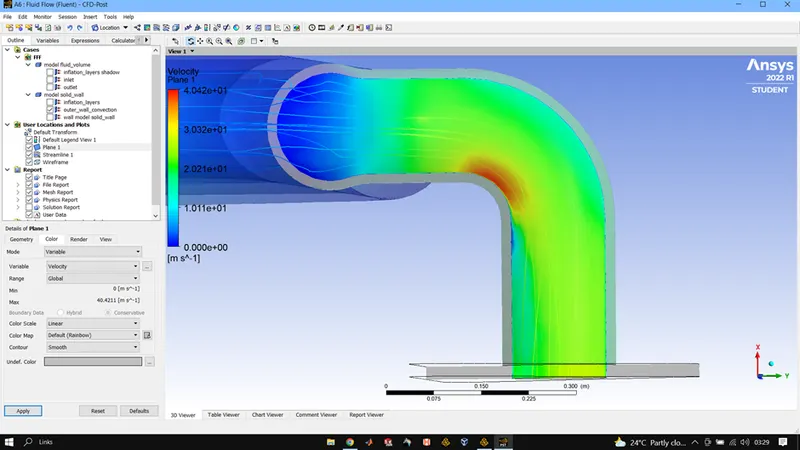
CHT analysis results can be verified using the Nusselt’s number which is a function of Reynolds number which is related to velocity of flow. Thus the Heat transfer co-efficient from CHT analysis should be directly proportional to velocity and we can see that velocity is maximum at outlet due to conservation of mass flow rate and at the same place the heat transfer co-efficient has the maximum values thus we can say that our CHT analysis results are valid.
Though the results depend on factors like number of elements and their quality in the mesh grid, presence of inflation layer in the mesh as it helps to capture accurate results near the boundaries thus giving smooth analysis plots and also on the interaction between Solid mesh and flow volume mesh, it should be conformal in order to have accurate heat transfer between the two.
PROCEDURE:
GEOMETRY
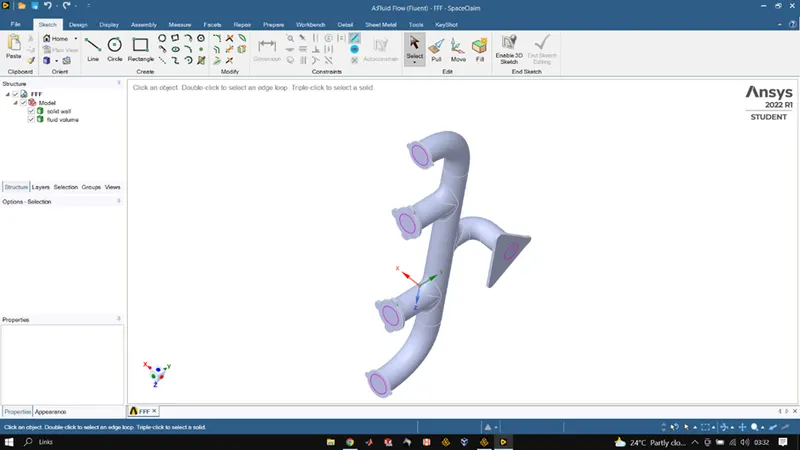
We initialize by starting space claim and converting the units to meters, after that we open the exhaust port CAD file. Once the file is loaded, we use the edge selection tool to select all the 4 inlets and outlet edges to extract the flow volume. If there is any issue then the geometry has extra edges which could be removed using the extra edge tool in the repair section. After that we rename both the parts as solid wall and fluid volume and bring them to one component and then we share the topology in the new component once share topology is enabled, we go to Workbench section to use the share tool for having smooth sharing of properties between the two interacting bodies. Once all the steps are done we close Space-claim.
MESHING:
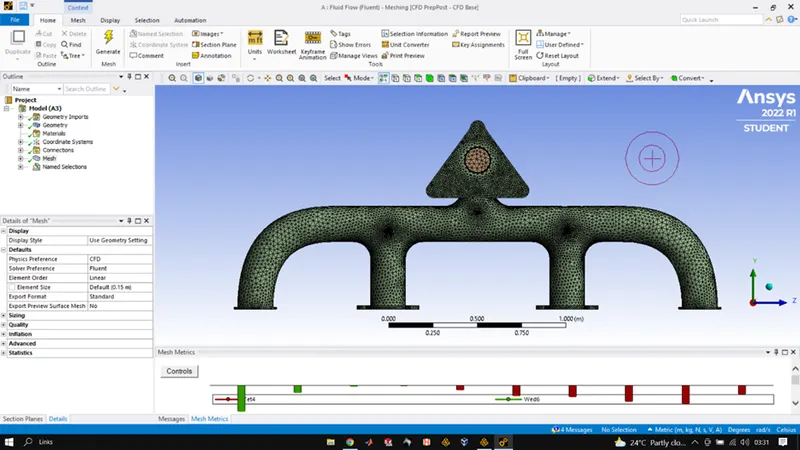
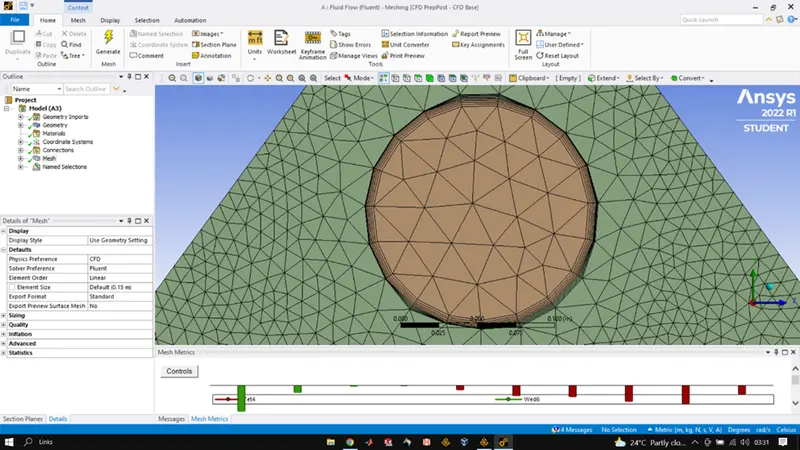
After the geometry is setup we open the Ansys Mesher and once the geometry is loaded we name our boundary edges and faces. All the four inlets are named vel-inlets and the outlet is named vel-outlet. The outer wall is selected by double clicking and is named outer wall convection. After that we uncheck the solid body and select the inner walls and name them inflation layers. After this we generate the baseline mesh and then refine it using sizing to control the size of elements in fluid volume and inflation layer is also added. Body sizing element size were 0.005m and total thickness for inflation layer with 5 layers was 5mm. which generated roughly around 375K elements,. Once meshing was finalized the GUI was closed.
FLUENT SETUP:
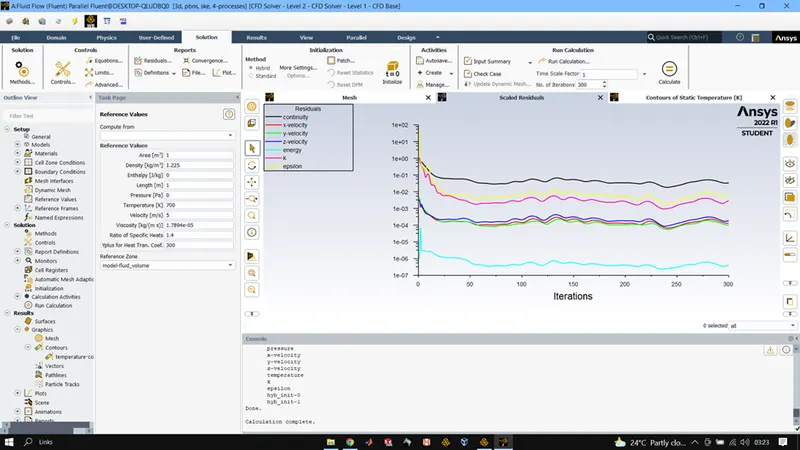
We launched Ansys fluent and performed a mesh check after it was ok, we went to setup physics and selected pressure-based solver and time was selected to be steady and the velocity was absolute. Once done we checked our material for fluid the material of choice was air and for solid the material of choice was aluminum. After this we created boundary conditions where the inlet velocity was set to 5m/s and thermals were at 700k where as the outer convection wall type was selected as convection and the co-efficient value for the same was 20. We checked in for the energy as we were calculating for the temperature and then the viscous model was selected as k-epsilon. After this we initialized the solution using the hybrid solver and used the contour tool in the result section to plot the temperature contour on the outer convection wall. And run the simulation for 300 iterations. Once completed Fluent was closed.
POST-PROCESSING:
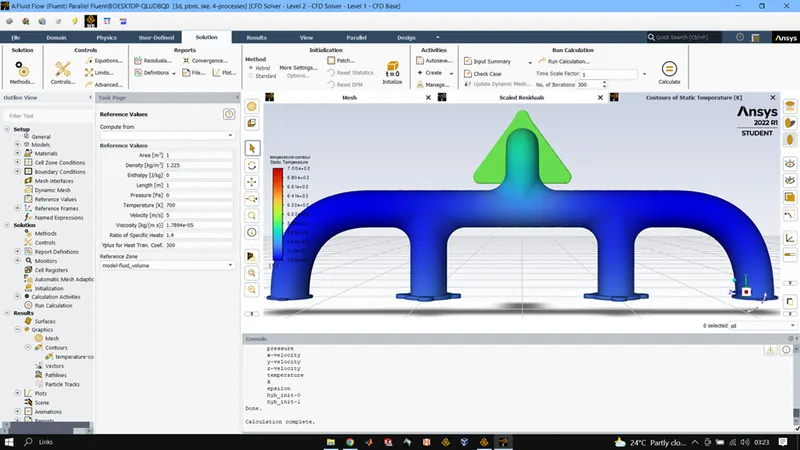
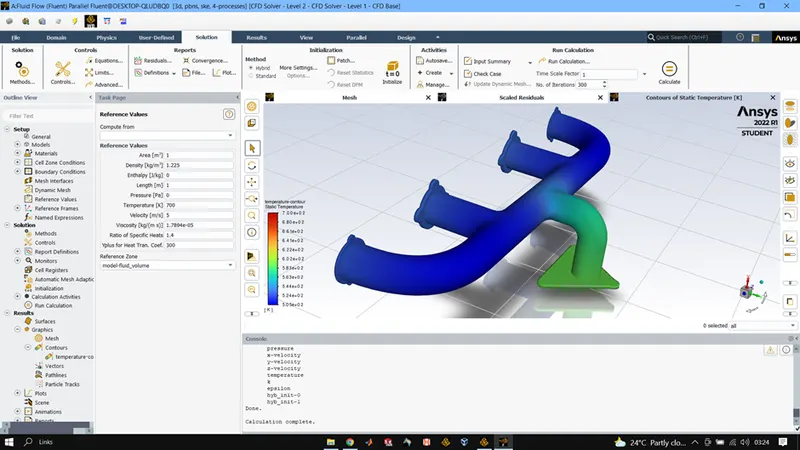
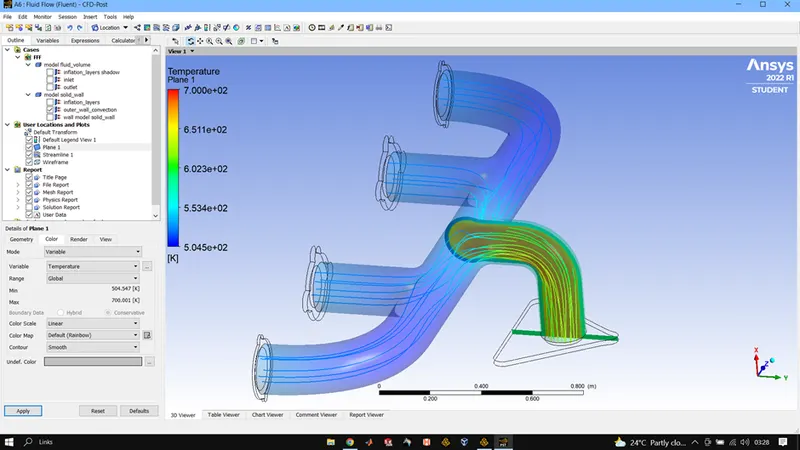
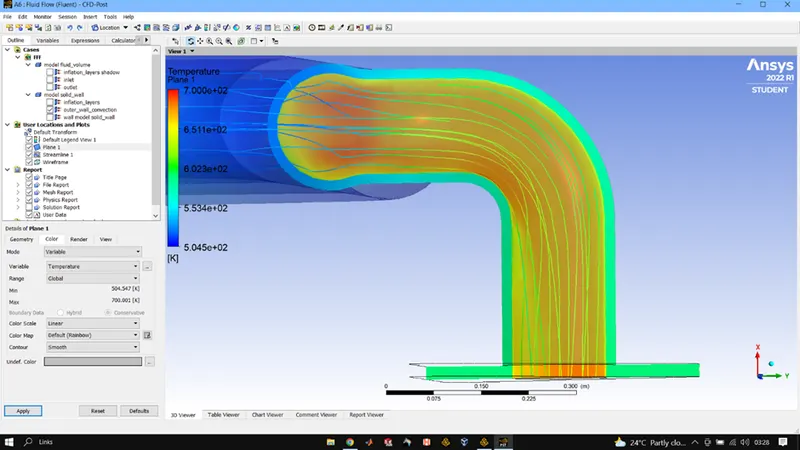
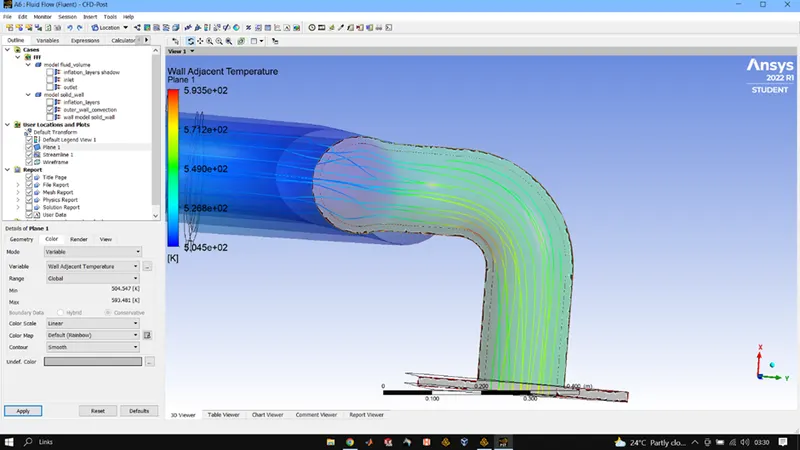
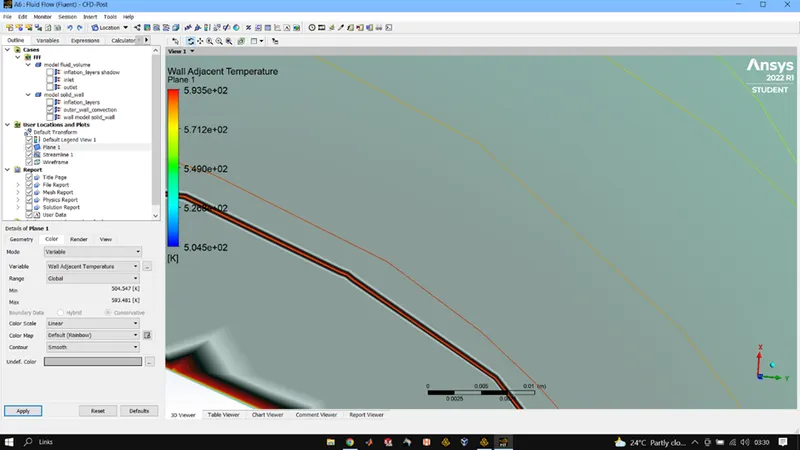
After the simulation was completed, we used the Ansys postprocessor to plot the temperature on the surface of the outer convection wall. Similarly streamlines were plotted of velocity and then we inserted a XY plane and colored it with heat transfer coefficient, then temperature and then velocity.
RESULTS:
CONCLUSIONS:
Increasing the refinement and inflation layer to the mesh increases the accuracy of the results.
As we have 4 inlet ports and only one outlet port and all have the same cross-sectional area the velocity increases in order to conserve the mass flow rate, effect of this can be seen on the temperature of the exhaust port outer surface one might assume the inlets to be hot but in reality, the outlet is hotter compared to inlets. And as the speed is high at outlet hence near the bent turbulence is generated which increases the heat transfer co-efficient value and this bent region having the highest transfer co-efficient value becomes the hottest region in the outer surface of exhaust port.
Y+ is the normal distance between the wall and first cell of the fluid volume and it is non-dimensional value which basically tells how refine a mesh is. Acceptable Y+ value depend upon the type of model used here we have used RANS k-epsilon model for which accepted values of Y+ is 1-5 for near wall approach and 30-300 for wall function approach.
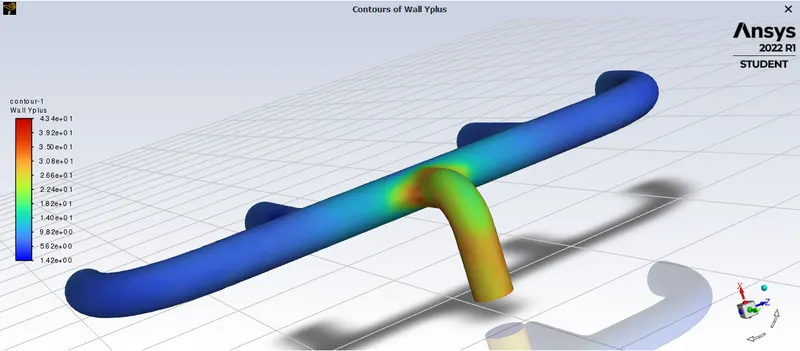
For our model we have Y+ value of 1.42 near the low velocity and temp regions and around 43 in high velocity and temperature region which seems to be in the acceptable range.