Week 4 - CHT Analysis on Exhaust port
Objective: To simulate Conjugate Heat Transfer (CHT) analysis on an exhaust port using Ansys Fluent.
- Give a brief description of why and where a CHT analysis is used.
- Maintain the y+ value according to the turbulence model and justify the results.
- Calculate the wall/surface heat transfer coefficient on the internal solid surface & show the velocity & temperature contours in appropriate areas.
- How would you verify if the HTC predictions from the simulations are right? On what factors does the accuracy of the prediction depend
Conjugate Heat Transfer (CHT) refers to the coupling of conduction in solids with the convective and radiative heat transfer in the surrounding fluids. In other words, CHT corresponds with the combination of heat transfer in solids and heat transfer in fluids. In solids, conduction often dominates whereas, in fluids, convection usually dominates. Efficiently combining heat transfer in fluids and solids is the key to designing effective heaters, coolers, or heat exchangers. Heat transfer in solids and heat transfer in fluids are combined in the majority of applications. This is because fluids flow around the solids, or between solid walls, and because solids are usually immersed in a fluid.
Why is CHT used?
Understanding the complex heat transfer mechanisms and the interactions between those mechanisms to improve the performance and increase the lifespan of the components to be analyzed. Conjugate Heat Transfer analysis provides the temperature distribution in solids and fluids, and clear insight on velocity distribution and mechanism of heat transfer of fluid, like in engines. It is more accurate and fast to simulate the problem. Can be used in complex scenarios like in automotive components or in power plant components. Multiple numbers of regions can be simulated. All types of region combinations can be simulated like solid-fluid, fluid-fluid, etc.
Where is CHT used?
Analysis of Heat transfer mechanism in the turbocharger. HVAC systems. Burners, combusters. Automotive (IC Engines), power plants, and various other applications. Heat transfer in ribbed passages. Heat transfer in micro-channels. Heat transfer in fin arrays. Heat transfer in mobile phones.
How would you verify if the HTC predictions from the simulations are right? On what factors does the accuracy of the prediction depend?
Nusselt's number is in the form: `h= (Nu*K)/L` where h= heat transfer coefficient, Nu= Nusselt's number, K= coefficient of thermal conductivity, and L= length characteristic. Nusselt's number is proportional to Reynolds's number and Re is, in turn, a function of flow velocity. Hence heat transfer coefficient is directly proportional to velocity. Results from this conclusion will later be shown below.
Geometry:
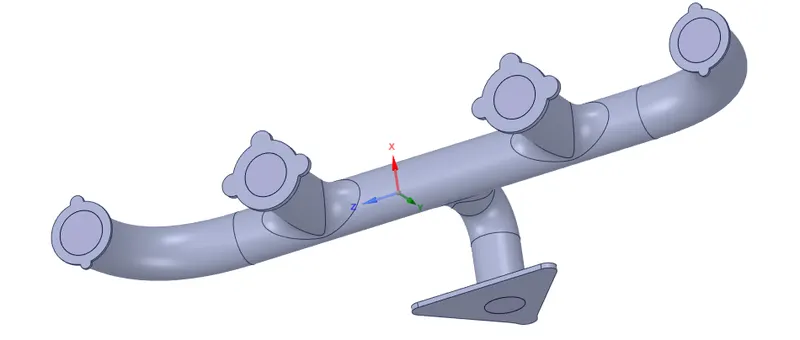
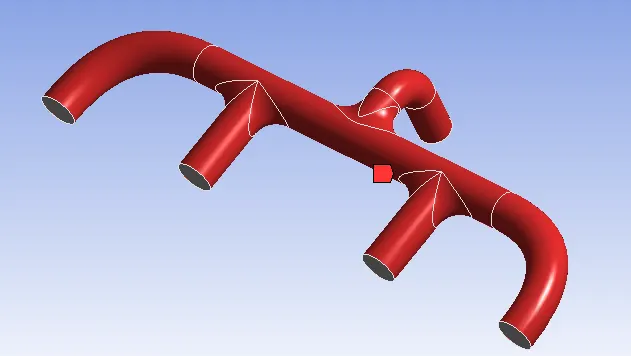
In this project, we discuss the CHT analysis of the exhaust port by the following steps. Our base geometry is given, to which we change it according to our requirements. First, we check for any duplicate edges and clear them. Then we extract the fluid volume by the volume extract option. Then we enable the sharing and share the topology which is used for a perfect intersection between solid volume and fluid volume.
Meshing:
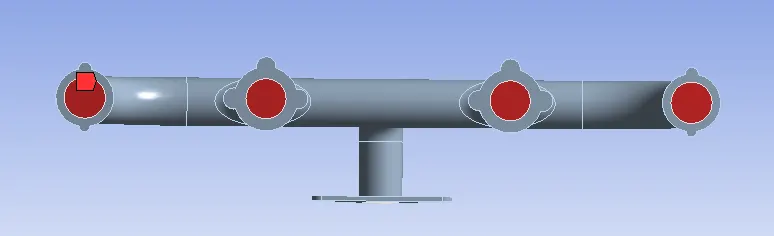
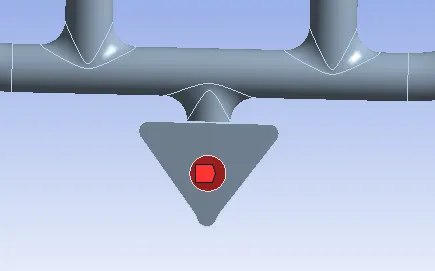
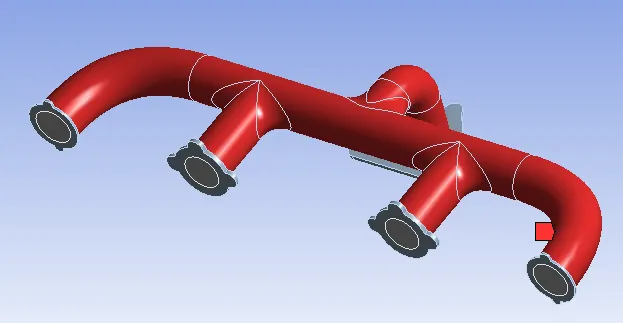
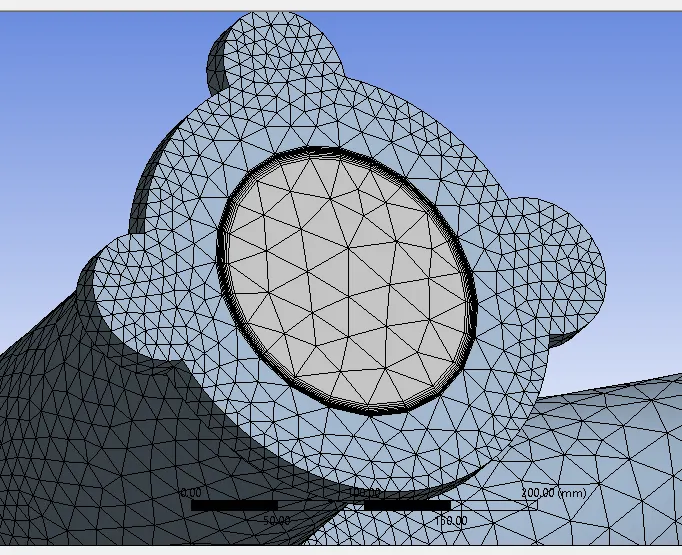
We start the meshing by naming all the outer surfaces, inlets, outlet, outer-wall-convection, and the inflation layer (shown in figures below respectively). Then for the inflation layer, we select the named selection 'inflation layer' and the total thickness of 0.005 mm for 5 layers and a 1.2 growth rate, activating the mesh through curvature.
Setup:
Solver Type: pressure-based and Steady-state
Viscous Model: K-epsilon
Fluid type: Air and Solid-type: Aluminium
Boundaries:
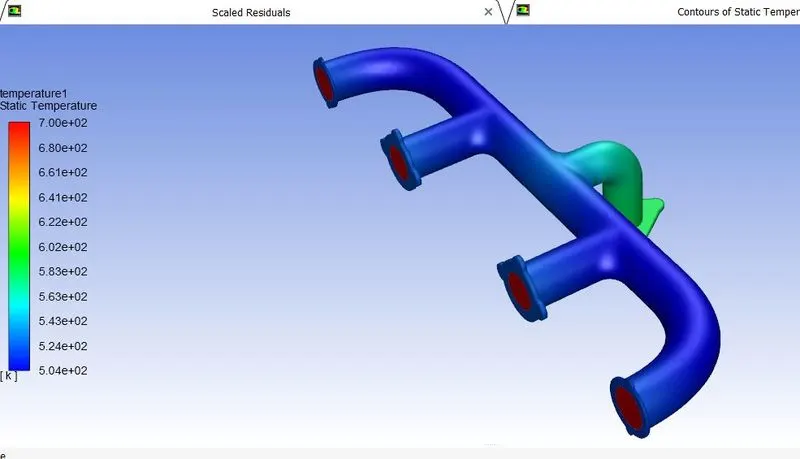
Inlet: Velocity type, velocity magnitude= 5 m/s, Temperature= 700k.
Outlet: Pressure outlet.
Outer-wall-convection is wall type with the thermal condition being convection and heat transfer coefficient and all other walls being adiabatic.
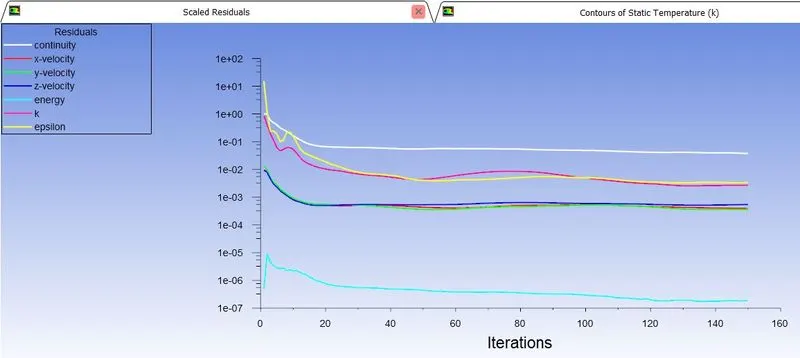
Hybrid initialization is done and the simulation is run for 150 iterations and converged solution is obtained.
Plots:
Scaled Residuals:
Temperature contour:
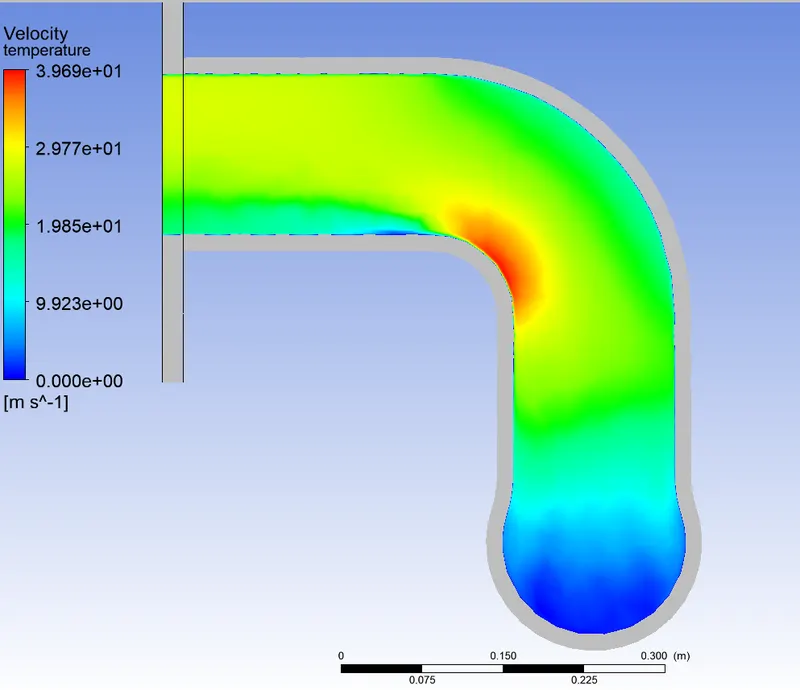
Velocity contour:
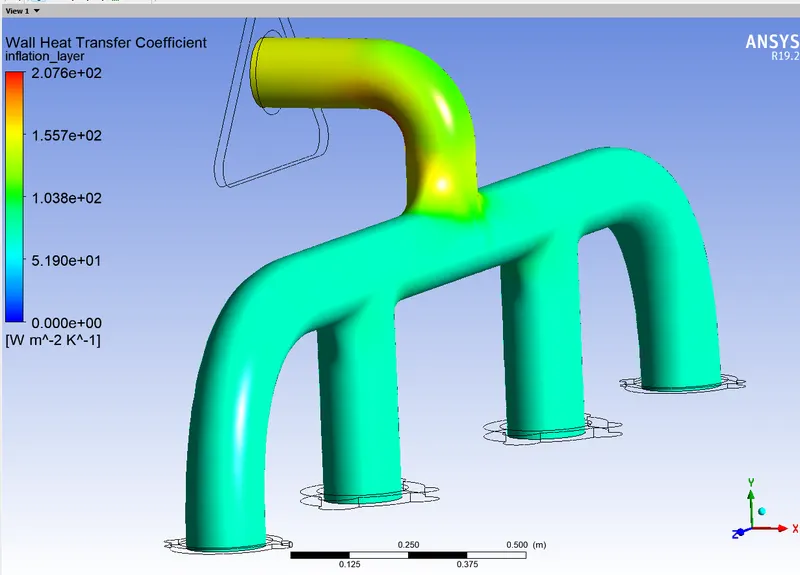
Heat Transfer Coefficient contour:
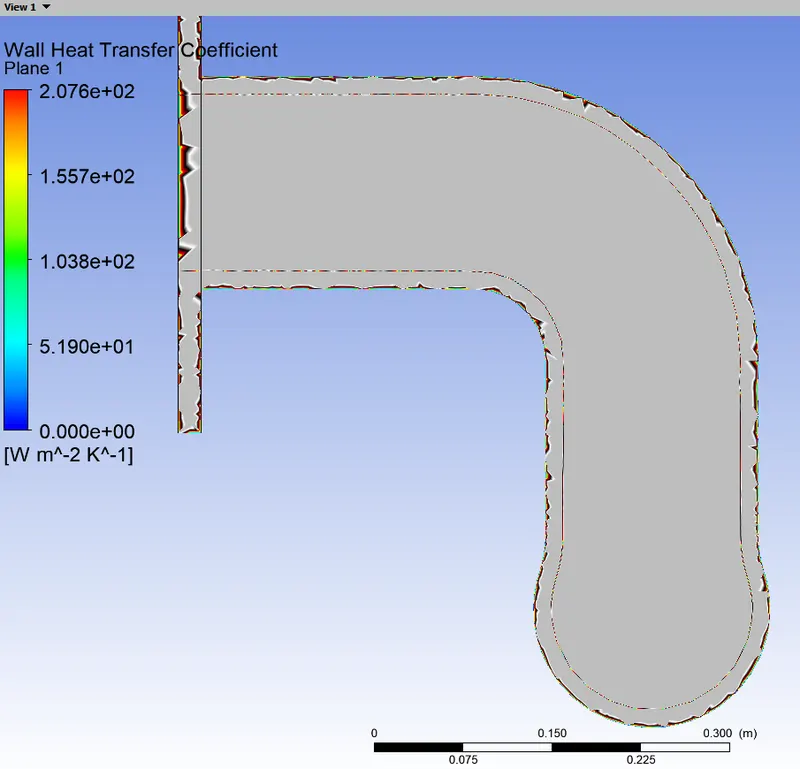
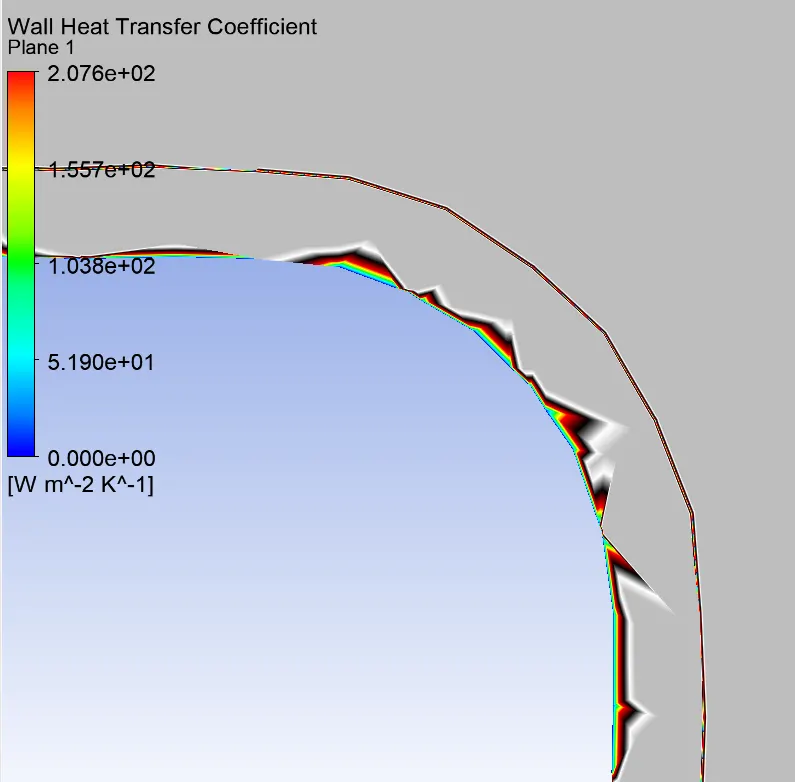
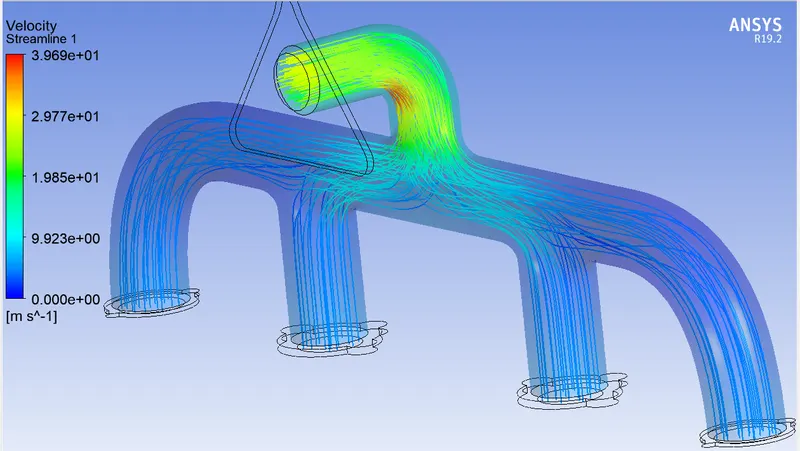
Velocity is maximum at the bent portion near the outlet. Hence higher Re. From our above discussion, Nusselt's number is proportional to Reynolds's number and Re is, in turn, a function of flow velocity. Hence heat transfer coefficient is also maximum where velocity is maximum.
Velocity Streamlines:
Animation:
Conclusions:
Factors affecting the prediction are as follows: Element Size and Quality = The finer the mesh, the accurate the results. Inflation Layer = It increases the quality of mesh near the boundary interface and helps to capture smooth plots of different quantities. Mesh at the solid-fluid interface = The mesh at the solid-fluid interface must be conformal. Correct choosing the value y+ which satisfies the turbulent model, by effectively capturing the velocity and temperature at the boundary wall interface.
Two factors influence the performance simultaneously one being the flow is developing along the length and the heat transfer coefficients tend to decrease along with the flow and the second one being turbulence. At the same time, turbulence is developing with tube rows at the bent, which would increase heat transfer coefficients. The maximum heat transfer results at the bent of the exit port. It is because to ensure the conservation of mass at the exit port, the velocity should more, which results in higher velocity and increase in velocity attains a Reynolds number that is sufficient to make flow turbulent and higher Nusselt's number at pipe bent at the exit, which increases Heat transfer co-efficient at that location.