Week-4 Challenge WOT Condition Part-2
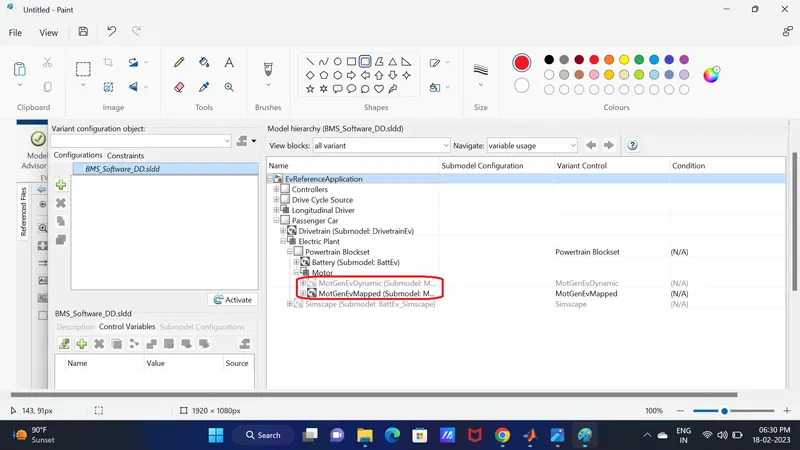
1) What is the difference between mapped and dynamic model of engine, motor and generator? How can you change model type?
Ans :
1. In Mapped Model all the parameters are predefined or set as their configuration, we can not make changes in it. These all parameters are included in lookup table.
Lookup table = It is the repository of the all parameters which are included in it.
2. In Dynamic Model we can change the parameters within the certain limits as required. In the case of vehicle driver can set or change the parameters data or values.
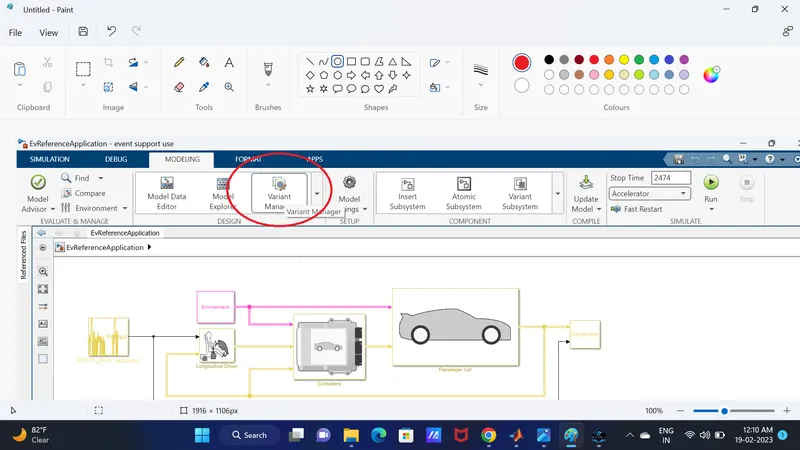
( Steps to change the Mapped Model and Dynamic Model setting )
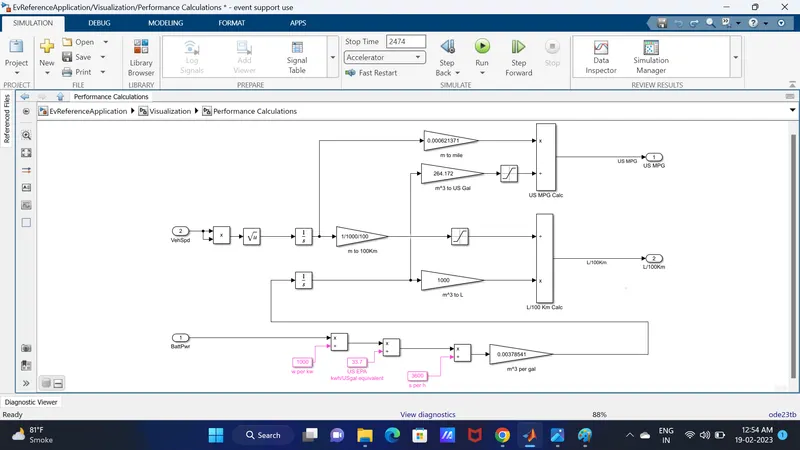
2. How does the model calculate miles per gallon? Which factors are considered to model fuel flow?
Ans : 1. In India vehicle mileage is calculated as per distance ie. Kilometer covered by particular vehicle per litre but in other foreign country mileage is calculated as distance covered ie. Miles per Gallons.
2. In given model calculation of miles per gallon is happen by using different blocks like
1) Integrator Blocks : In this case integrator block is gives its output signals to other blocks for converting the meter to miles.
2) Gain Blocks :
The Gain block multiplies the input by a constant value (gain). The input and the gain can each be a scalar, vector, or matrix.You specify the value of gain in the Gain parameter. The Multiplication parameter lets you specify element-wise or matrix multiplication
3) Saturation Blocks :
The Saturation block produces an output signal that is the value of the input signal bounded to the upper and lower saturation values. The upper and lower limits are specified by the parameters Upper limit and Lower limit.
4) product Blocks
5) Input Blocks ( Vehicle Speed ) or ( Battery Power )
6) Output Blocks ( Km per Litre ) or ( Miles per Gallons )
Factors which are considered to calculate the model fuel flow is Vehicle speed or Battery Power.
3.Run the HEV ReferenceApplication with WOT drive cycle. Change the grade and wind velocity in the environment block. Comment on the results.
Ans : Steps to open and Run the HEV Reference Application
1) Go to the search box which is at right corner.
2) Open th HEV reference application and select the Multimode reference application.
3) Open the Drive Cycle source Block and select the Drive Cycle source as WOT.
4) Open the Environment Block and change Wind Velocity and Grade angle.
5) Run the whole model with change in sec as 30 and see all the plots in visualization block.
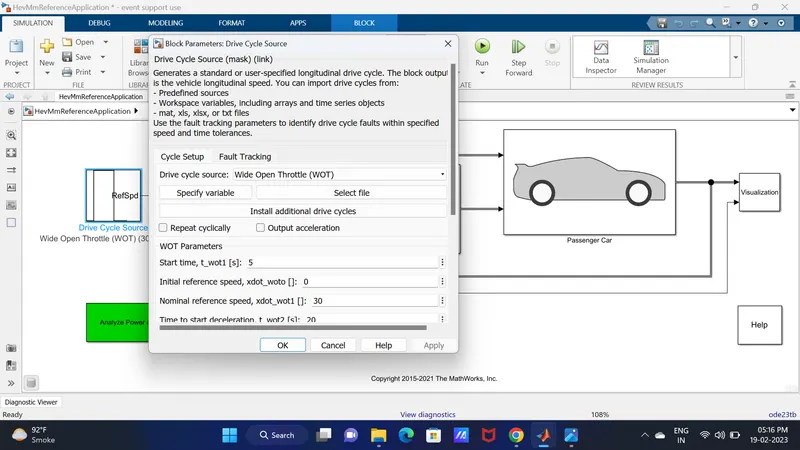 ( Select Drive cycle as WOT )
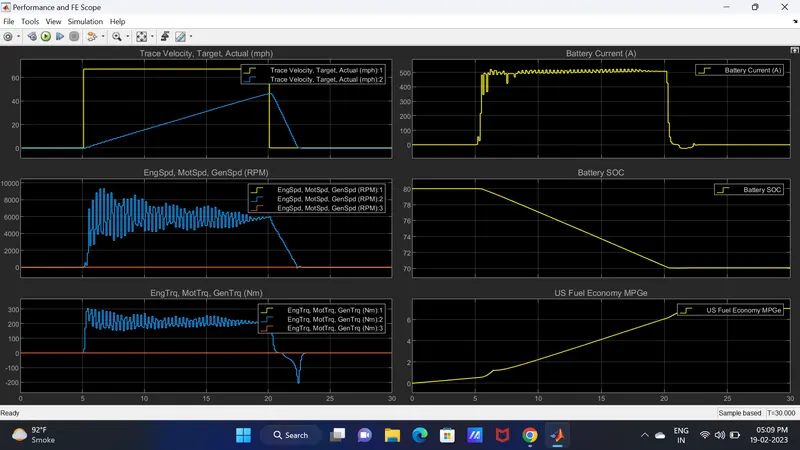 ( At 10 m/s Wind Velocity and 10 % Grade )
Explaination :
For considering the Gradeability and Wind velocity as 10
1. Trace Velocity is at 70 m/s after change the parameters it will only reach upto 48 m/s.
2. When vehicle starts to moving, battery is supply the stored power to the motor and current is increasing gradually and reach upto 500 A in the above case.
3. After a certain time battery SOC is reduced and comes to 70.
4. At 21 miles US fuel economy is 6 gallons.
4.Keeping all other parameters same, compare the simulated results of hybrid and pure electric powertrains.
Ans :
( HEV Model at 10 wind velocity and 10% Gradeability)
( EV Model at 10 wind velocity and 10% Gradeability)
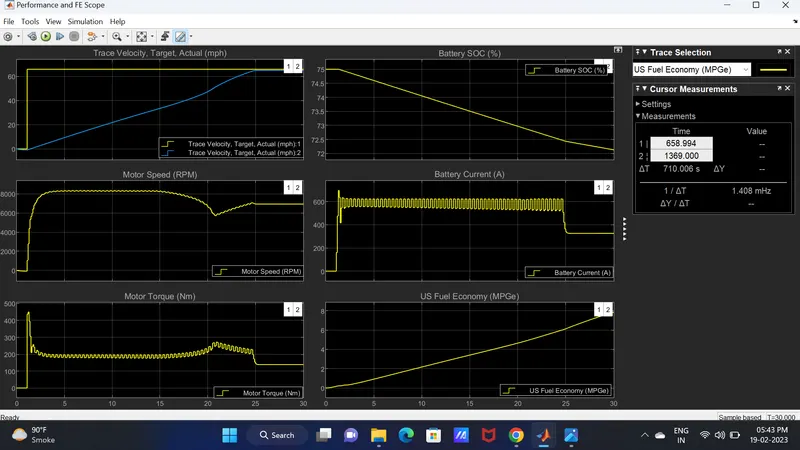
Comparison :
With keeping the same parameter for HEV and EV Model following are the some observations :
1. In HEV model trace velocity is not much more match with actual velocity but in pure EV trace velocity and actual velocity is slighly matching.
2. SOC in EV is more in the sense battery can able to provide more power as compare to HEV to vehicle.
3. In EV US fuel economy is more than HEV i.e 30 miles per 8 gallons.
4. In EV vehicle battery current is more by 100 A.
5. Motor torque and Motor speed are inversely proportional to each other.