Week-4 Challenge WOT Condition Part-2
1) What is the difference between the mapped and dynamic models of the engine, motor and generator? How can you change the model type?
a) Difference between mapped model and dynamic model
Mapped model:
- This type of model uses lookup tables instead of the actual model which contains the behaviour of an actual engine, motor and generator in order to reduce the simulation time.
- The tables provide the overall characteristics engine, motor and generator.
- It is used for quasi-steady-state engine simulations.
Dynamic model:
- This model decomposes the engine behaviour into engine characteristics separated into lower-level components. By combining elements the dynamic behaviour is analysed.
-
The impact of individual engine components on the overall performance can be analysed
- Simulation time is high as compared to the mapped model.
b) In order to change the model type
Select the Component(motor) -> Right click-> Variant-> label model active choice ->then select the required model.

2) How does the model calculate miles per gallon? Which factors are considered to model fuel flow?
a) Calculation of Miles per gallon:
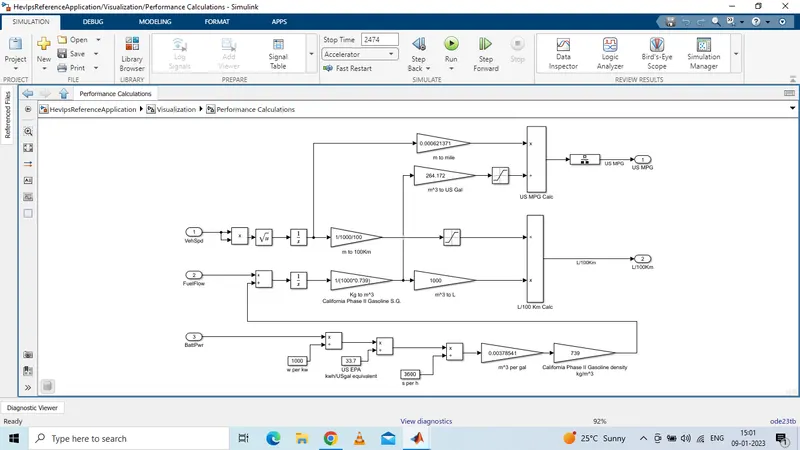
- Miles per gallon (mpg) is a calculation of a motor vehicle's fuel economy. The simple formula is miles travelled divided by gallons of fuel consumed to travel the same distance.
-
The above MPG calculation is for HEV which means it contains both fuel and battery energy.
-
First, we convert the battery power from watts to kilo-watt and then converted it into kw/h.
-
Then it is converted into US gallon equivalent energy by dividing it by the standard value of 33.7.
-
Then converted into US gallons per second.
-
Then, it is multiplied by the standard value 0.00378541 to get volume in meter cube per gallon and it is added to the fuel flow for total value as it is an HEV.
-
Further meter Cube is converted into US gallon.
-
On the other hand, the speed of the vehicle is integrated to get distance and the distance which is in the meter is converted into mile by multiplying the standard value 0.000621371.
b) factors considered for modelling fuel flow.
- Vehicle Speed
- Battery Capacity
- Fuel flow
3) HEV Refrence Application model with WOT drive cycle. Change the grade and wind velocity in the environment block. Comment on the results.
Model:
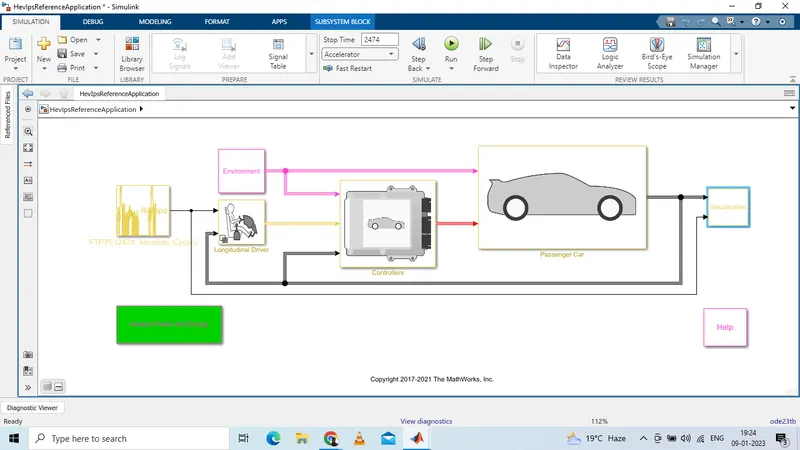
Changing the drive cycle to WOT:
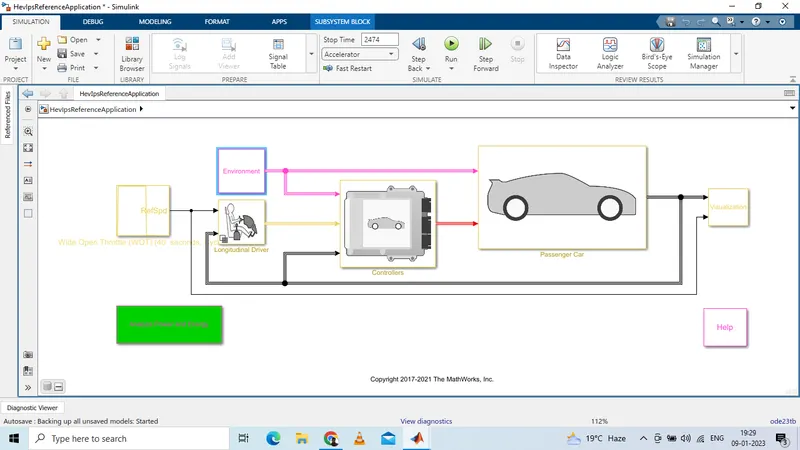
Simulation results:
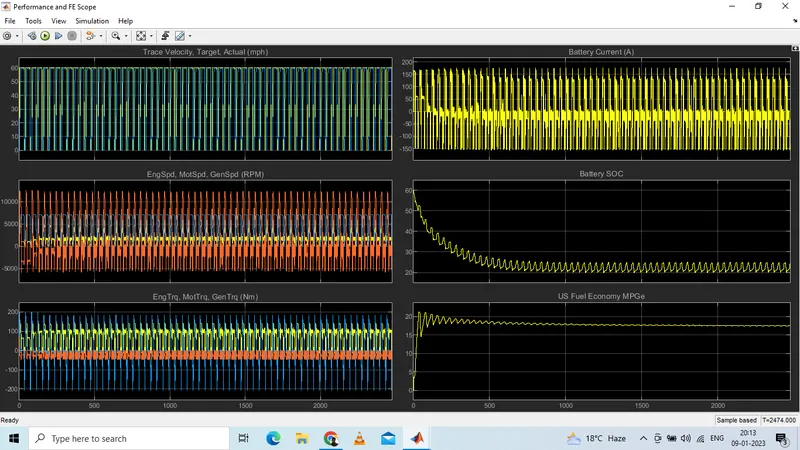
With,
- Nominal speed = 50 mph
- Gradability =0 %
- wind velocity =0 m/sec
Output:
The below figure shows the output results of the HEV model under WOT conditions.
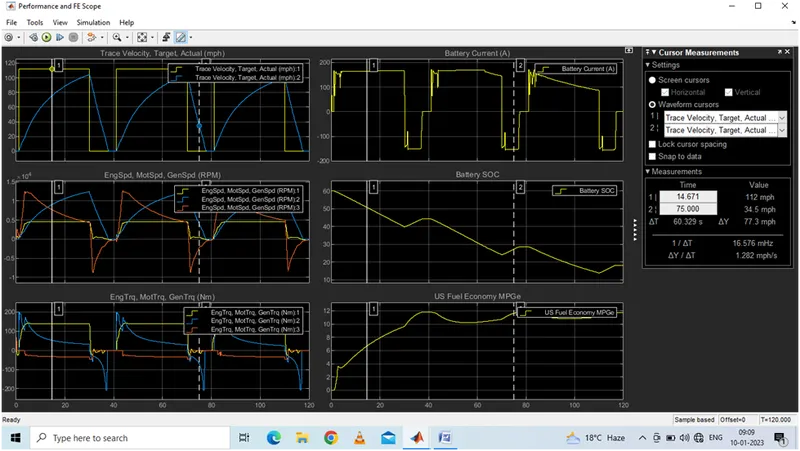
- From the figure, it is clear that the actual speed doesn’t match the desired speed due to limited instantaneous current.
- Maximum speed is 104 mph.
- The vehicle required 30 sec to accelerate from zero speed to top speed.
- The vehicle required 10 sec to decelerate from 104 mph to zero mph.
- The maximum battery current is 167.45 Amp after reaching this value the battery current is constant.
- When the engine and generator is started the battery current is reduced and during regenerative breaking the battery current becomes negative
With,
- Nominal speed= 50 mph
- Gradability =7 %
- wind velocity = 10 m/sec
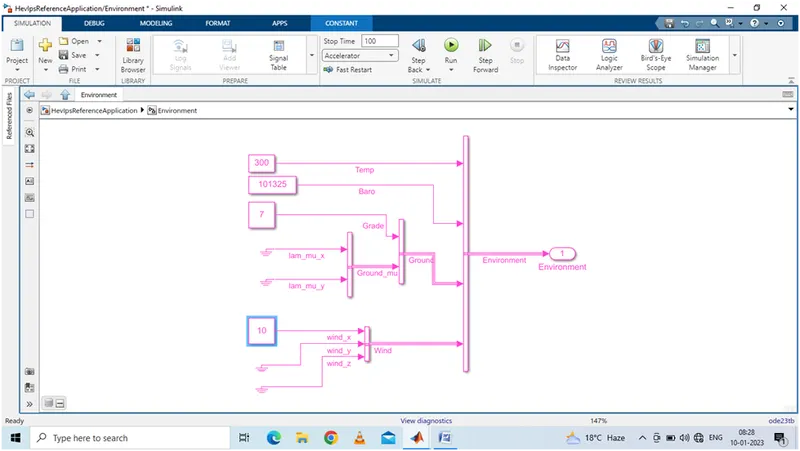
Output:
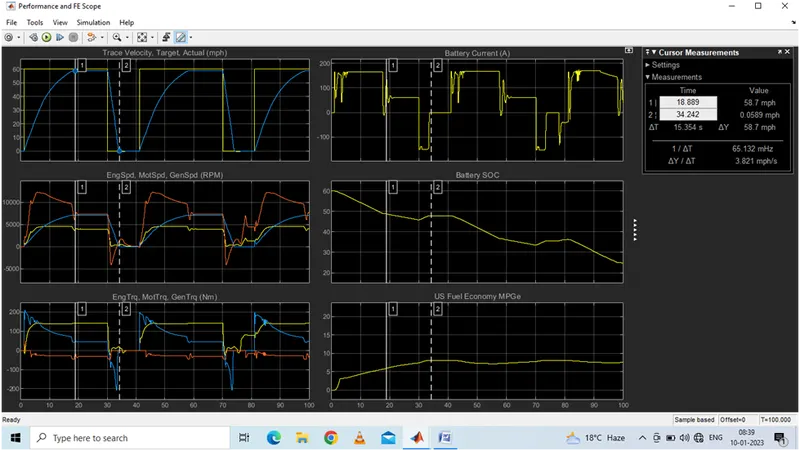
- From the figure, it is clear that the actual speed doesn’t match the desired speed due to limited instantaneous current.
- Maximum speed is 58.7 mph.
- The vehicle required 19 sec to accelerate from zero speed to top speed.
- The vehicle required 4.44 sec to decelerate from 57.8 mph to zero mph.
- The maximum battery current is 165.35 Amp after reaching this value the battery current is constant.
- When the engine and generator is started the battery current is reduced and during regenerative breaking the battery current becomes negative.
4) Keeping all the other parameters the same compare the simulated results of hybrid and pure electric powertrains.
- We already have the data for HEV considering the same values.
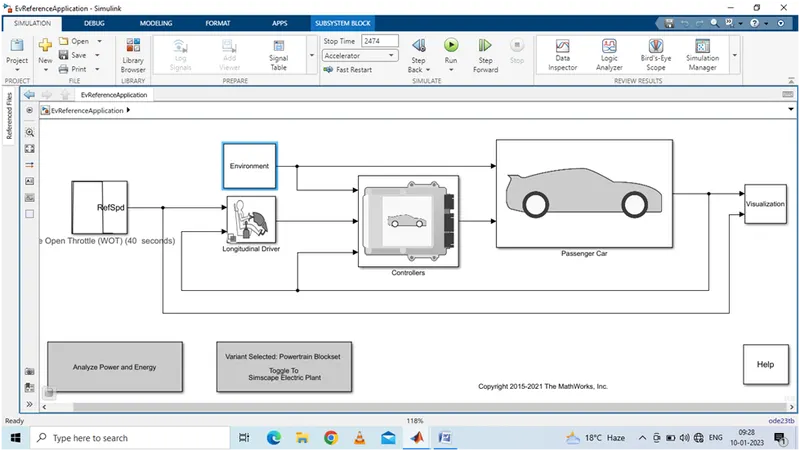
For EV
Reference model of EV.
- Nominal speed =50 mph
- Gradability = 7%
- Wind velocity= 10 m/sec.
Output:
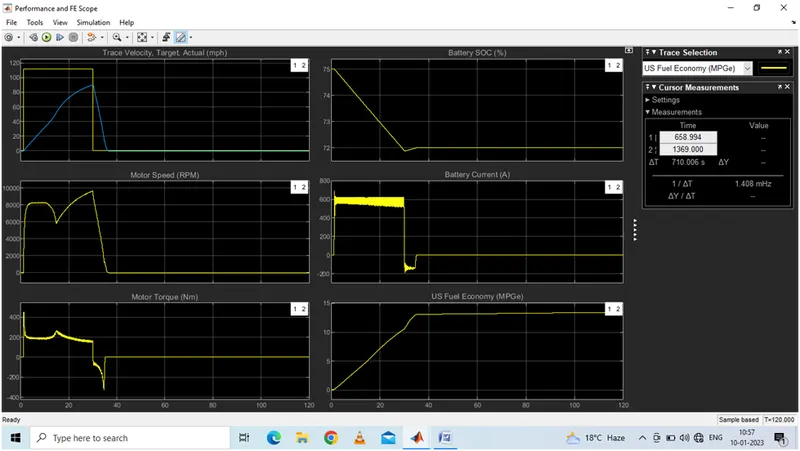
- From the figure, it is clear that the actual speed doesn’t match the desired speed due to limited instantaneous current.
- Maximum speed is 89.74 mph.
- The vehicle required 30 sec to accelerate from zero speed to top speed.
- The vehicle required 6.8 sec to decelerate from 89.74 mph to zero mph.
- The maximum battery current is 620 Amp after reaching this value the battery current is constant.
- During regenerative breaking both motor torque and battery current becomes negative and SOC comes back to 72% and is fixed at 72%.
Comparison:
- In HEV due to the presence of an Engine and generator along with the motor, the required propulsion power is shared between the Engine and motor, therefore, the maximum current requirement by the motor is less whereas in the case of pure EV due to the motor alone, the maximum current requirement is very high as compared to HEV for the same operating condition.
- With EVs for the same operating conditions, we can able to achieve higher speed as compared to HEV.
- In the case of HEV the SOC of the battery falls down to a very low value whereas in EV SOC is maintained at a very good value.
- In the case of HEV time required to reach the maximum speed is less whereas in EV it is higher.
Conclusion:
All the changes are completed successfully and the results are shown for your reference.