Week-4 Challenge WOT Condition Part-2
1)
Powertrain Blockset offers both mapping and dynamic engine models.
- Mapping engines use a series of lookup tables to depict macro engine behaviour as a function of programmed load and measured engine speed. These lookup tables include braking torque, fuel flow, air mass flow, exhaust temperature, efficiency, and emissions.
- Dynamic engines break down the behaviour of the engine into separate component models that take into consideration the dynamics of the engine, particularly the dynamics of the turbocharger and intake airflow.
Depending on your application, you can change between different engine model kinds. For example, in the development of closed-loop AFR control algorithms, dynamic engine models are appropriate for constructing control, estimator, and diagnostic algorithms that depend on dynamic subsystem conditions.
For changing model type consider the EV Reference application example as shown below
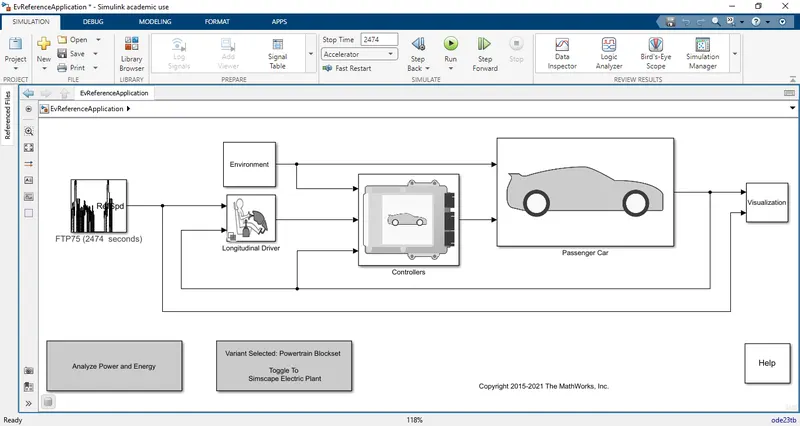
Now, to go the path
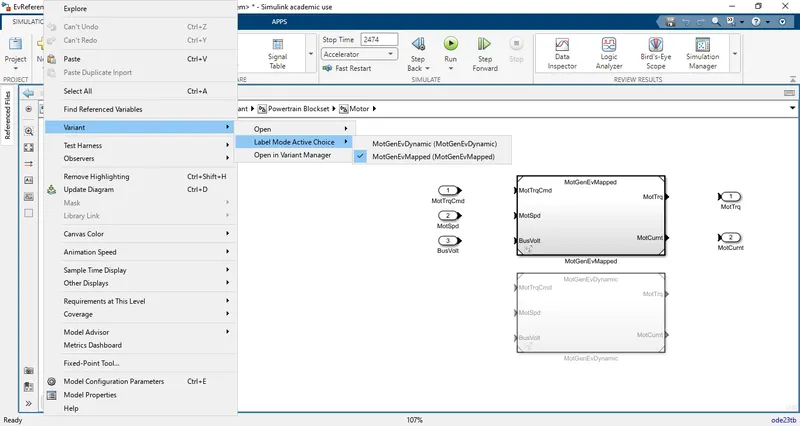
EvReferenceApplication/Passenger Car/Electric Plant/Powertrain Blockset/Motor
We can see the window as shown below. Now we can toggle between modes as shown below.
2)
The number of miles an automobile can go on one gallon of fuel is known as MPG, or miles per gallon. A car's fuel efficiency is mostly measured by its MPG; the greater the MPG, the more efficient the vehicle is.
Now, for the MPG calculation, go to the directory
EvReferenceApplication/Visualization/Performance Calculations
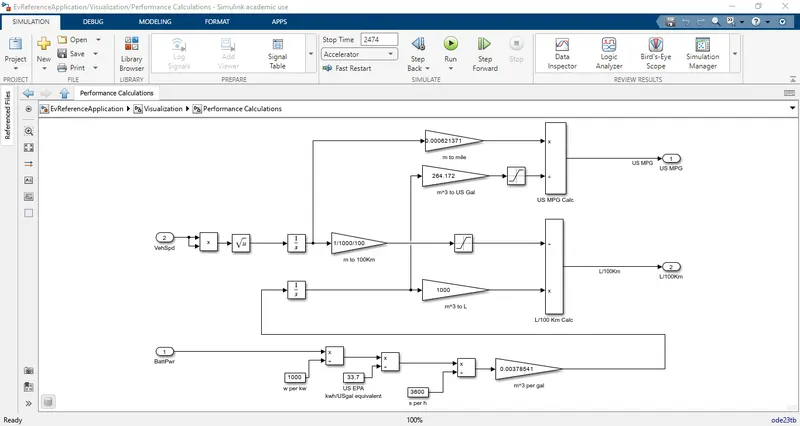
Here, there MPG is calculated as Miles/Gallon. The velocity is first integrated to get distance and obtained distance is converted to miles. Battery power utilized is converted to corresponding US gallons. Now, miles is divided by gallons to get MPG.
3)
The HEV Reference application is taken and Driving Cycle is changed to WOT as shown below.
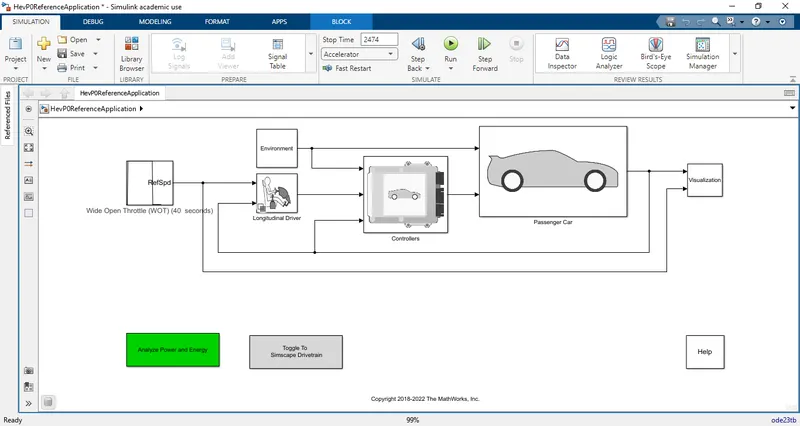
The grade is set as 13 and wind is set to 10.
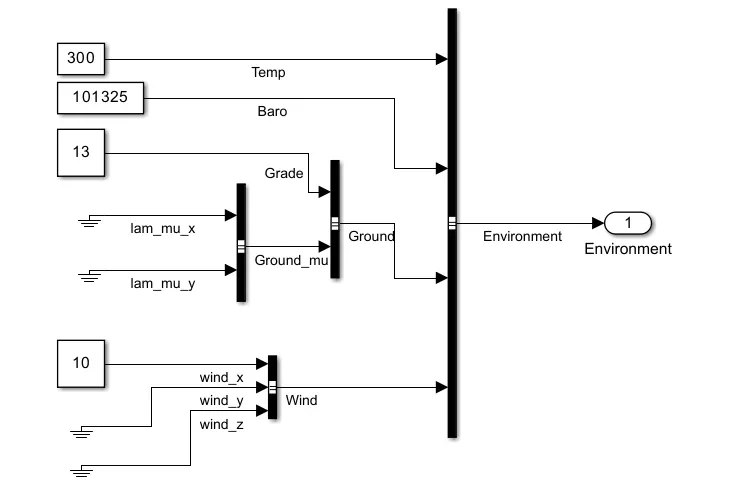
For this configuration, we obtained simulation result as shown below
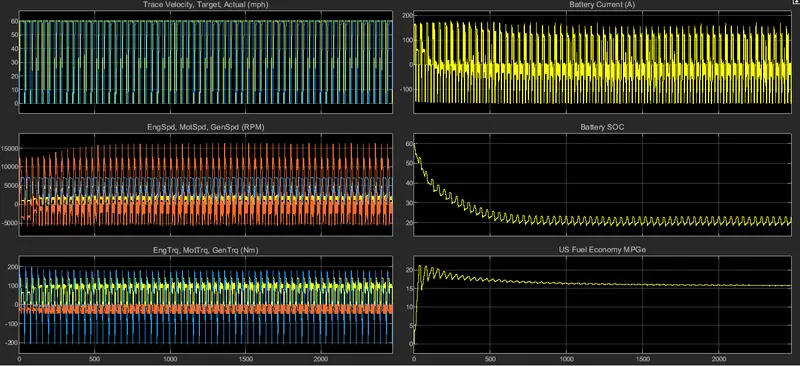
Here, the vehicle is initially run with more power drawing from motor and remaining from engine. Later on, as SOC of battery gets decreased, the power sharing is shifted more towards engine and less towards motor as evident from the result of SOC, engine and motor torque.
4)
Pure EV is set with same parameter as HEV.
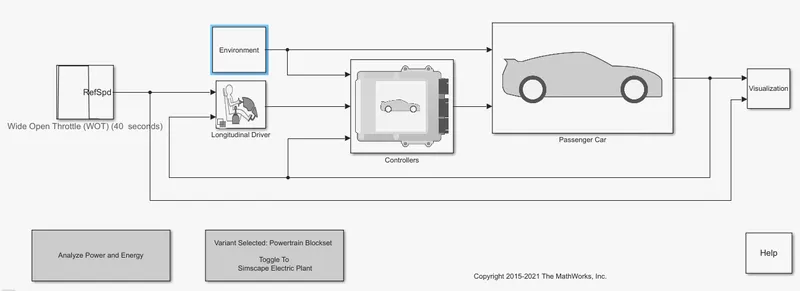
The simulation results are
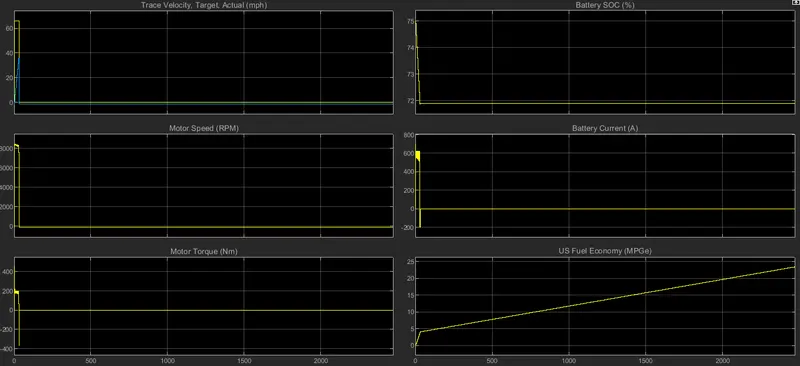
It can be seen that the motor stopped running after SOC dropped near 72%. Torque and Speed immediately falled down to zero. But in case of HEV, this isn't the case. Vehicle ran throughout the simulation duration for HEV model.