Week-4 Challenge WOT Condition Part-2
AIM:
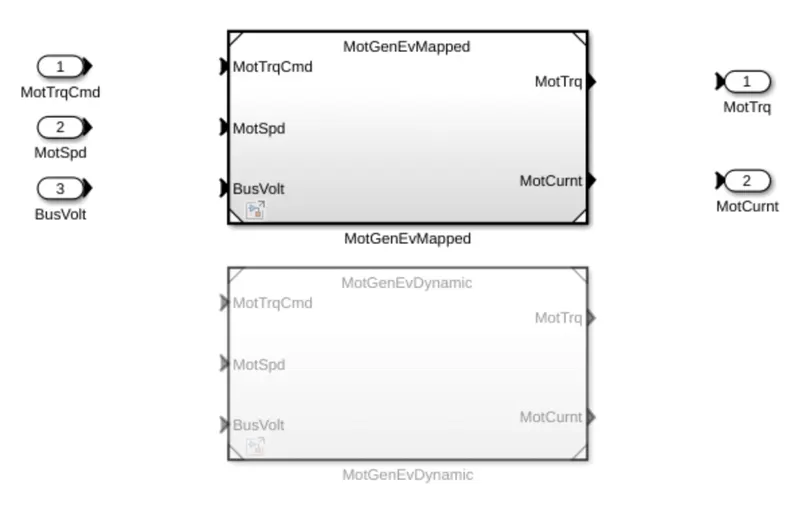
*The difference between mapped and dynamic model of engine, motor and generator.
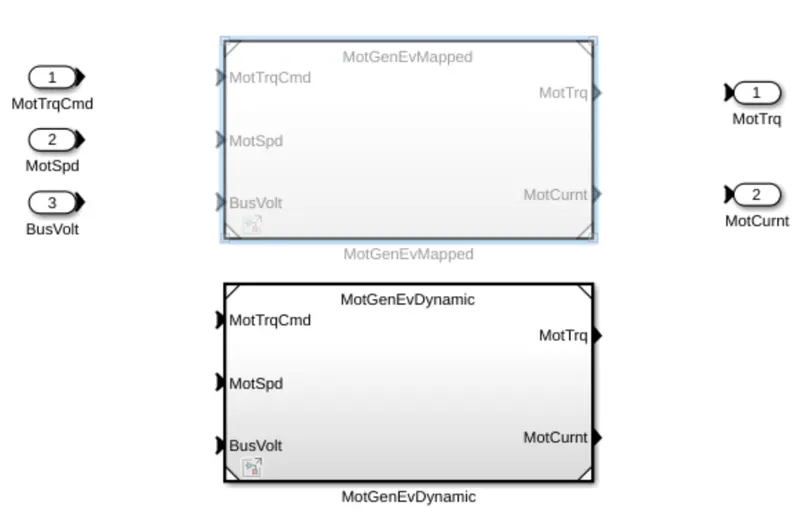
How can you change model type.
*Calculate miles per gallon. Which factors are considered to model fuel flow.Run the HEV.
*With Reference Application of WOT drive cycle. Change the grade and wind velocity in the environment block.
*Keeping all other parameters same, compare the simulated results of hybrid and pure electric powertrains.
1.The difference between "mapped and dynamic" model of engine, "motor and generator".How can you change model type.
Mapped Model:
Mapped models are basically models which has a dataset of outputs mapped corresponding to the given inputs. These data sets or lookup tables are mapped or generated in real world experiments whose outputs are calculated and stored to form these datasets corresponding to different inputs given during the experiments.
Mapped Engine:
Mapped Engine is the default settings in powertrain blockset. It is used to measure to measure performance parameters of the vehicle by using standard lookup tables which are prefed to the system. This type of modelling is less accurate. The lookup tables value are based on the values of brake torque, commanded torque and engine speed. If any other parameter like Input engine temperature is selected then lookup table values are also a function of the temperature parameter. The data extracted from lookup tables are: air mass flow, fuel flow, emission data, exhaust temperature and efficiency. This data is used to find out other parameters which are needed by the end user.
Dynamic model
Dynamic model on the other hand are real-time simulation models and does not have datasets of outputs stored corresponding to the given inputs. Random inputs are fed and model simulates to give results based on the inputs. It simulates using real world scenarios in form of subsystems and blocks to give the output.
Dynamic engines decompose engine behavior into individual component(various subsystems) models that account for engine dynamics. It will take too mant time for the simulation and the result cameout is very accurate and realistic in nature.It is an example of quansi and dynamic state vehicle models. Dynamic engine models are suitable for designing control, estimator, and diagnostic algorithms that depend on dynamic subsystem states.
To Change the model type:
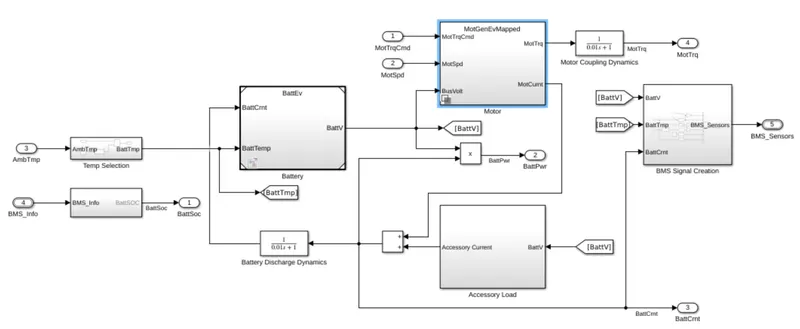
Open the powertrain module blockset for the required vehicle.
Click on passenger car
Vehicle block and select electric plant or engine.
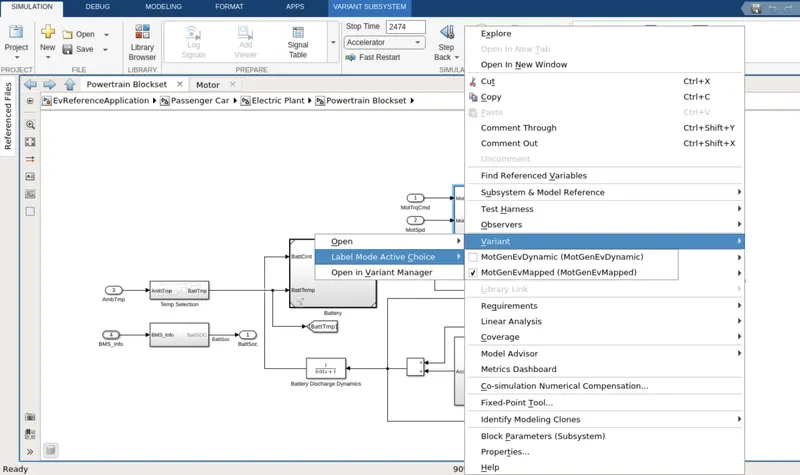
Right click on Engine.
EV motor/generator based on vehicle model and select variant.
Under variant, scroll to label model active choice and choose mapped or dynamic for the require calculation.
2. How does the model calculate miles per gallon? Which factors are considered to model fuel flow.
Miles per gallon (MPG) is a fuel economy rating determined by how far a car can travel on a gallon of gasoline or diesel for a conventional IC Engine vehicle. In the case of an electric vehicle, this is a measure how much electrical energy is consumed by the battery pack to travel a fixed distance.For solving this problem i have taken model "Hybrid Electric Vehicle Input Power Split Reference" and to understand how model calculates miles per gallon follow the path
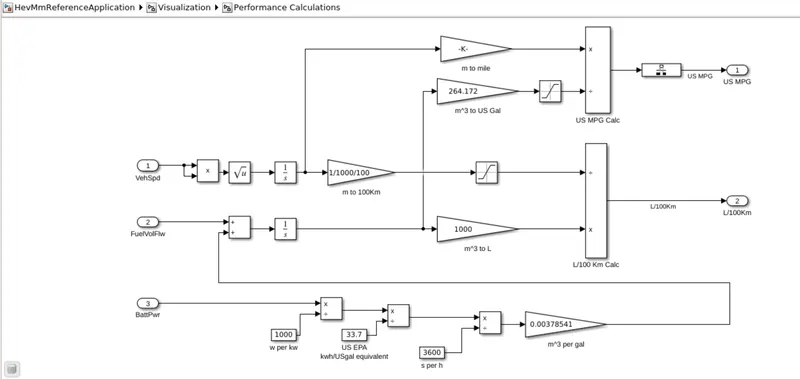
Here the given input is about;
- Vehicle speed.
- Fuel flow.
- Battery power.
The kilogram of fuel is converted into cubic meter by multiplying by1/1000/100
this cubic meter value is then converted into gallons by multiplying it with 264.172.the mile value and gallon value is used to find mpg of the vehicle. Now the battery value is initially converted from watts to kwh by dividing with 1000 and then to gallon equivalent by again dividing it with 33.7(sincw 33.7 kwh=1 gallon). Then divide the value by 3600 to get in per seconds and multiply by 0.00378541nto get the value in cubic meter per gallons.
3. Run the HEV ReferenceApplication with WOT drive cycle. Change the grade and wind velocity in the environment block. Comment on the results.
Here the Rreference is taken from the HEV Reference application with WOT drive cycle
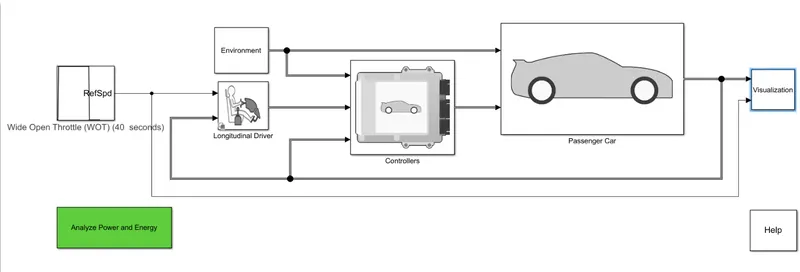
Change the block parameter FTP to Wide open throttle
The default case it shows that;
grade=0 degrees and wind velocity =0 m/s.
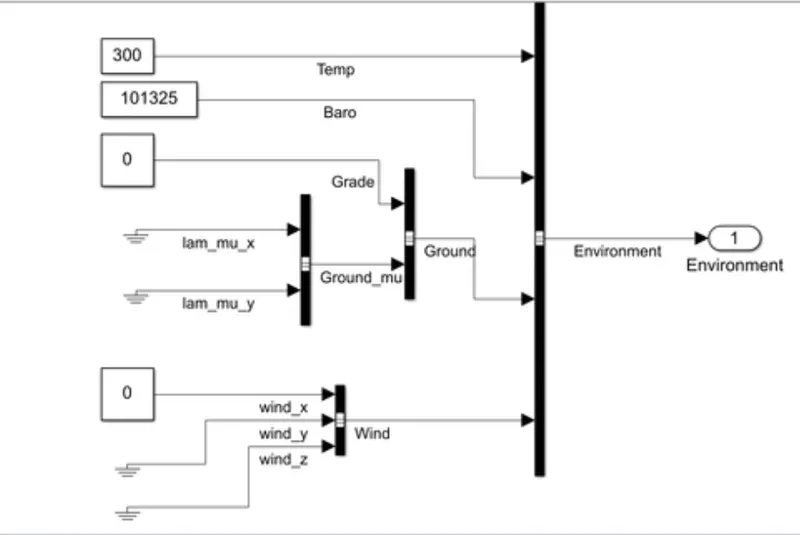
Result
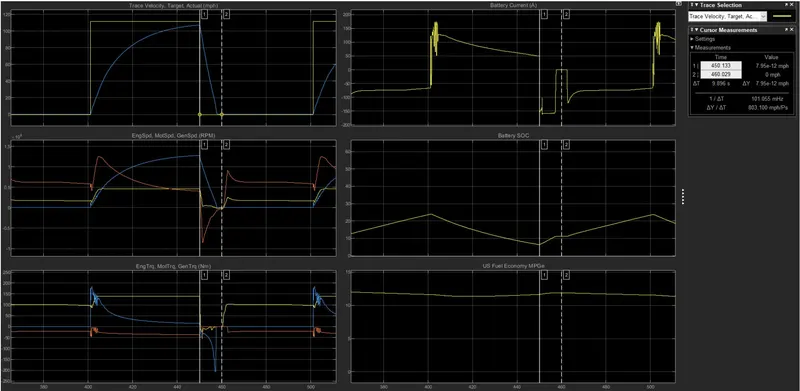
When it changes, Grade = 5 degrees, wind velocity = 10m/s
Result
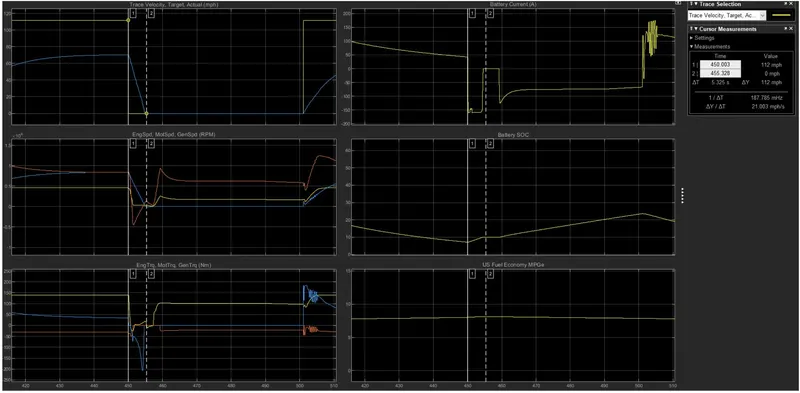
A visible difference is observed between the actual trace velocity curve and input trace velocity curve due to the limitation of power available from the energy source.The maximum speed achieved is lower in case 2 because of the gradient slope considered and also the wind resistance. Since more power from the energy source is required to overcome these resistances, the battery SOC and the fuel economy is decreased.
| case-1 | case-2 | |
| Grade | 0 | 5 |
| Wind velocity | 0 | 10 |
| Max speed | 112 | 86.5 |
| Retardation time | 8.76 | 5.45 |
| Motor torque | 140 | 140 |
| Peak torque | 200 | 200 |
| Battery SOC | (60-30)% | (60-25)% |
| Fuel economy | 13.5 | 9.2 |
4. Keeping all other parameters same, compare the simulated results of hybrid andpure electric powertrains.
* Change the block parameter Wide open throttle to WOT (100 seconds)
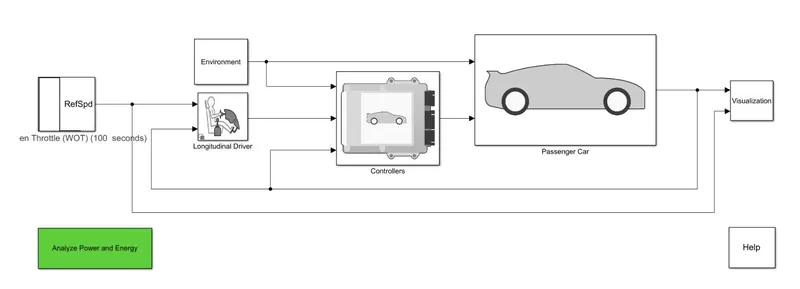
with out changing the parameter
Grade = 5 degrees, wind velocity = 10m/s
Result
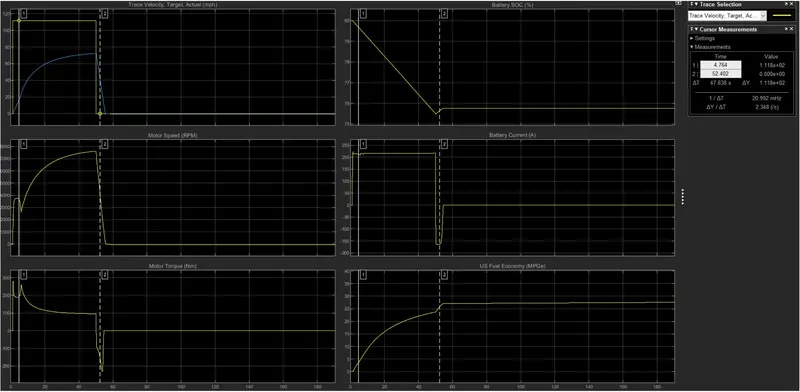
Comparing The both result:
| HEV | EV | |
| Grade | 5 | 5 |
| Wind velocity | 10 | 10 |
| Max speed | 86.5 | 72 |
| Retardation time | 5.45 | 5.8 |
| Motor torque | 140 | - |
| Peak torque | 200 | 280 |
| Battery SOC | (60-25)% | (80-75)% |
| Fuel economy | 9.2 | 27 |
The electric powertrain achieves a lower top speed when compared to a HEV powertrain. Since the motor is the only propulsion source in an EV powertrain, the motor needs higher rated power and generate the instantaneous start up torque to propel the vehicle.The conventional HEV's use lead acid battery whereas the EV's use lithium-ion cells which have more energy density.
From the above comparison we have understand that EV has a superior fuel economy than a conventional HEV.