Week-4 Challenge WOT Condition Part-2
AIM:
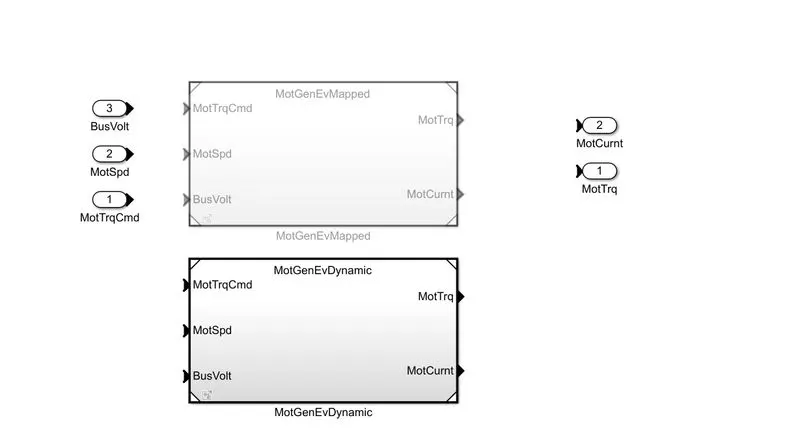
- What is the difference between the mapped and dynamic models of engine, motor, and generator? How can you change the model type?
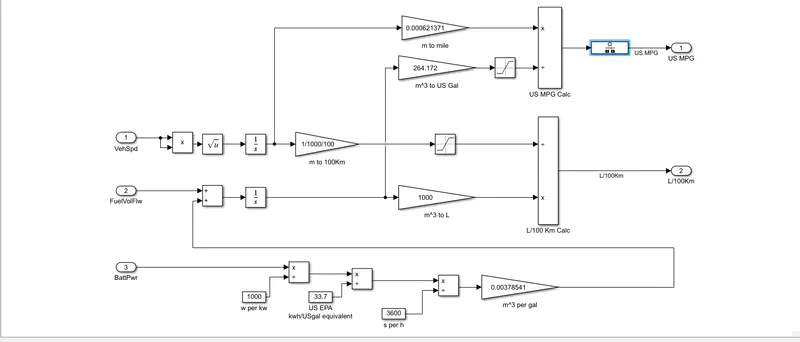
- How does the model calculate miles per gallon? Which factors are considered to model fuel flow?
- Run the HEV ReferenceApplication with WOT drive cycle. Change the grade and wind velocity in the environment block. Comment on the results.
- Keeping all other parameters the same, compare the simulated results of hybrid and pure electric powertrains.
- What is the difference between the mapped and dynamic models of engine, motor, and generator? How can you change the model type?
The mapped and dynamic models of the engine:
| Type | Implementation | when to use | |
| Mapped |
CI mapped engine SI mapped engine |
The model uses a set of steady-state lookup tables to characterize engine performance. The tables provide overall engine characteristics, including actual torque, fuel flow rate, BSFC (Brake specific fuel consumption, and engine-out exhaust emissions. |
|
| Dynamic |
CI mapped engine SI mapped engine |
The model decomposes the engine behavior into engine characteristics that are separated into lower-level components. By combining components in this way, the models capture the dynamic effects. |
|
The mapped and dynamic models of the Motor and Generator :
| Type | Implementation | when to use |
| Mapped |
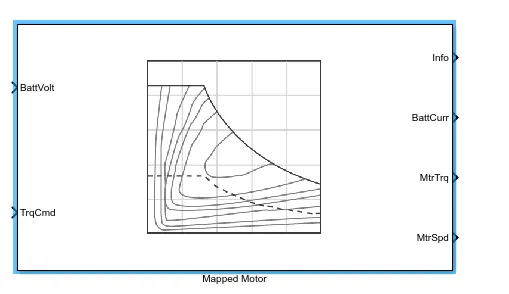
The Mapped Motor implements a mapped motor and drive electronics operating in torque control mode. The output torque tracks the torque reference demand and includes a motor-response and drive-response time constant. The mapped model of the generator also used the lookup table for the inputs the output values are stored in the lookup table as well which has to make as a result of an output |
|
| Dynamic |
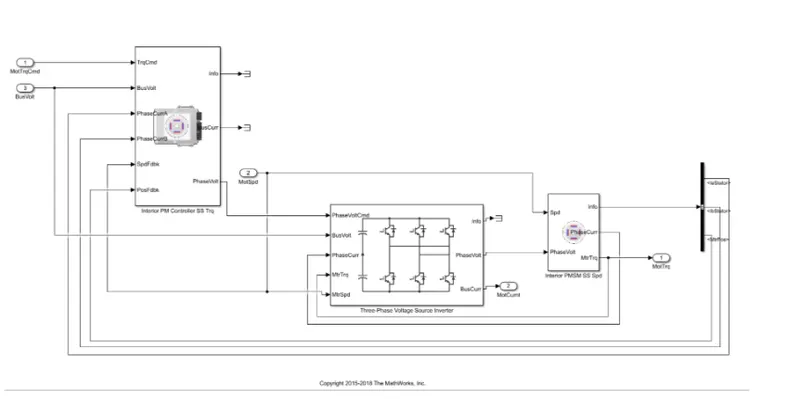
The dynamic model of the motor and generator is driven by a constant input signal that is approximated by a pulse width modulated signal and looks at the current and rotational motion at the motor output. It is a real-time simulation model which provides more accuracy and the inputs and outputs of each component are integrated into the model. |
|
mapped model :
Dynamic Model :
How can you change the model type
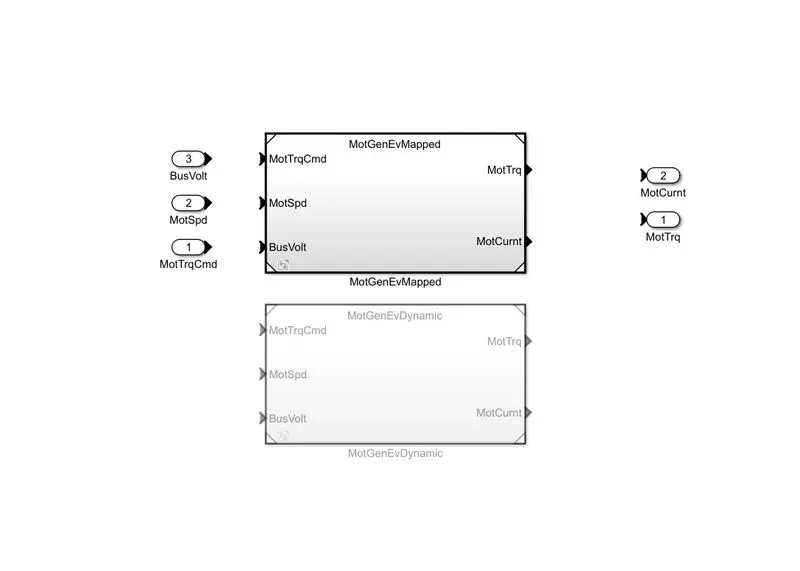
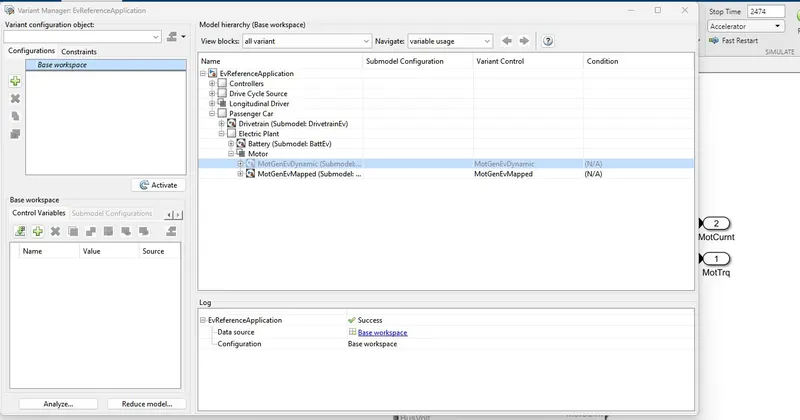
The model is changed by the following process:
taking reference of the EV model
- Open the model and double click on the Passenger car system
- Inside that double click on the electric plant after that again double click on the MOTOR model
- Inside the MOTOR model, there are two base systems one is mapped, and the other one dynamic
- Go to the Modeling window from the tool strip. Select design and click on the variant manager.
- Right-click on the Dynamic model and then click on the set as label model active choice
How does the model calculate miles per gallon? Which factors are considered to model fuel flow?
The HEV model calculates the miles per gallon by following processes:
- The battery power is converted into Watt from KW after which it is divided by the 33.7 kilowatt-hours (121 megajoules) of electricity is equivalent to one (U.S.) gallon of gasoline, which is introduced by the US EPA.
- After which the hour consumption is converted into seconds.
- the Element wise gain multiplies the value by 0.00378541 m^3/gallon.
- After which the values are added to the fuel flow, the sum is integrated by the integrator block, which is then converted from m^3 to Litre.
- Then the value is multiplied and divided by the input speed to calculate the L/100 km.
- Before the conversion of the m^3 to L, one more element-wise gainer block is used to convert the fuel flow from m^3 to US gallon by multiplying it by the factor 264.172.
- the saturator is used after the element-wise gainer to Limit the input and output value. the output value is taken as infinite and the input value is 0.001/
- Then the vehicle speed and the converted value are divided and multiplied to calculate the US miles per gallon, the rate transition is used to handle data transfer between different rates and tasks. the vehicle speed is multiplied by 0.000621371 to convert it from meter to miles
The factors are considered to model fuel flow are as follows :
- The vehicle speed
- Battery power
- Fuel volume flow
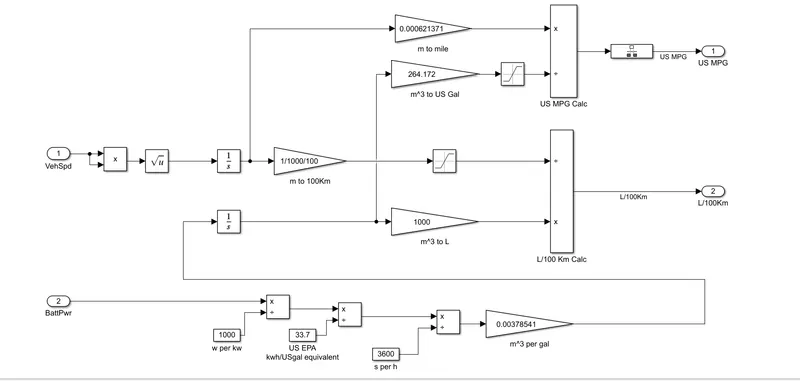
The EV model calculates the miles per gallon by following processes:
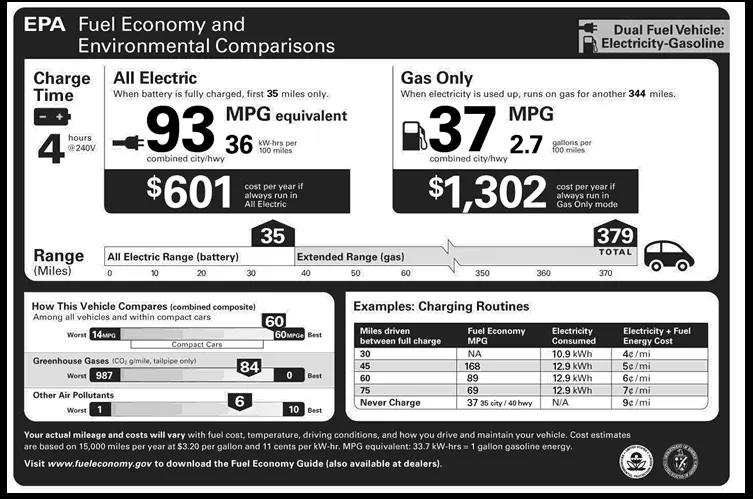
Miles per gallon gasoline-equivalent (MPGe or MPGge) is a measure of the average distance traveled per unit of energy consumed. MPGe is used by the United States Environmental Protection Agency (EPA) to compare the energy consumption of alternative fuel vehicles, plug-in electric vehicles, and other advanced technology vehicles with the energy consumption of conventional internal combustion vehicles rated in miles per U.S. gallon.
The unit of energy consumed is deemed to be 33.7-kilowatt-hours without regard to the efficiency of conversion of heat energy into electrical energy, also measured in kilowatt-hours. The equivalence of this unit to energy in a gallon of gasoline is true if and only if the heat engine, generating equipment, and power delivery to the car battery are 100% efficient. Actual heat engines differ vastly from this assumption.
MPGe does not necessarily represent an equivalency in the operating costs between alternative fuel vehicles and the MPG rating of internal combustion engine vehicles due to the wide variation in costs for the fuel sources regionally since the EPA assumes prices that represent the national averages. Miles per gallon equivalent cost for alternate fuel can be calculated with a simple conversion to the conventional MPG.
The MPGe metric was introduced in November 2010 by EPA in the Monroney sticker of the Nissan Leaf electric car and the Chevrolet Volt plug-in hybrid. The ratings are based on EPA's formula, in which 33.7 kilowatt-hours (121 megajoules) of electricity is equivalent to one (U.S.) gallon of gasoline, and the energy consumption of each vehicle during EPA's five standard drive cycle tests simulating varying driving conditions.
Run the HEV ReferenceApplication with WOT drive cycle. Change the grade and wind velocity in the environment block. Comment on the results.
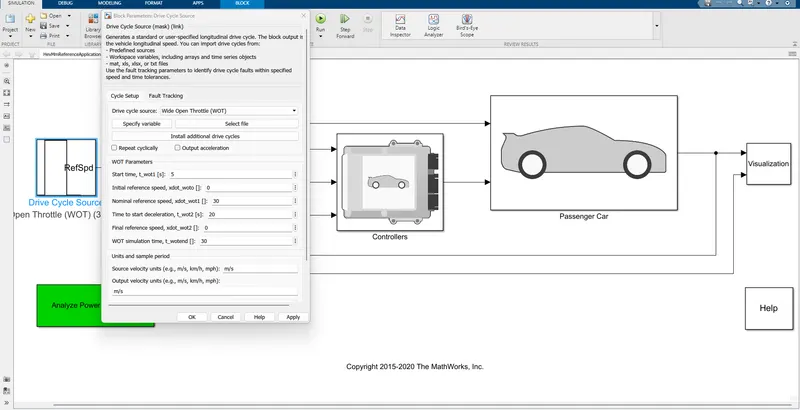
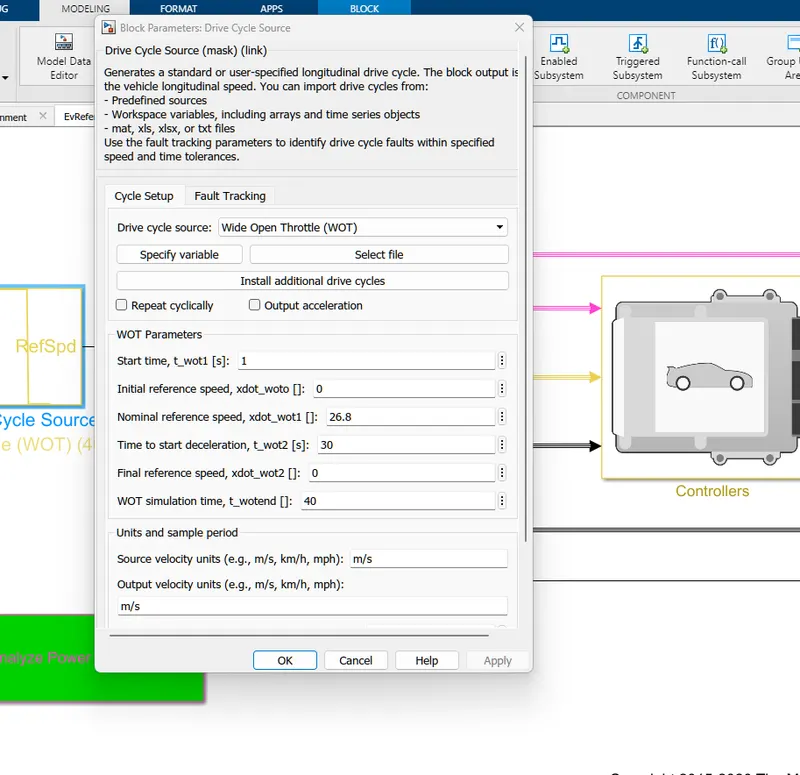
Changing the Drive cycle of HEV reference application from FTP to WOT.
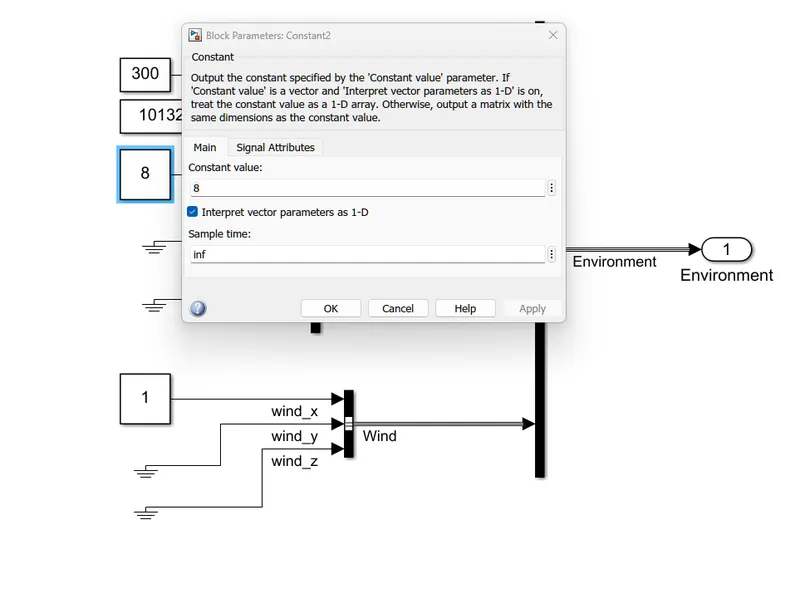
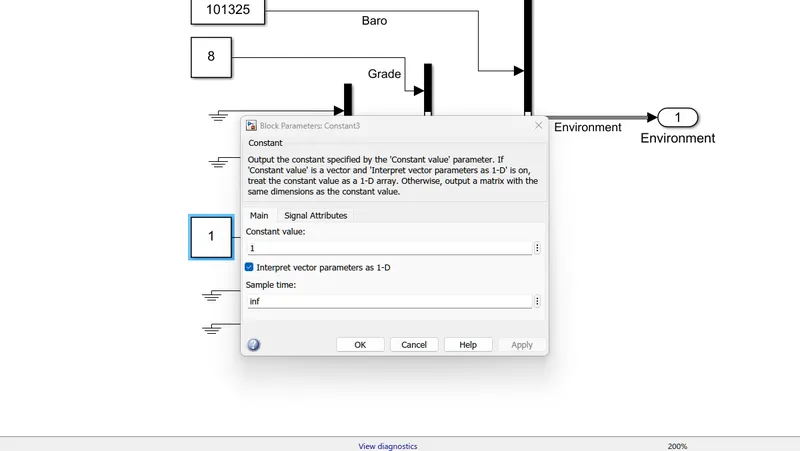
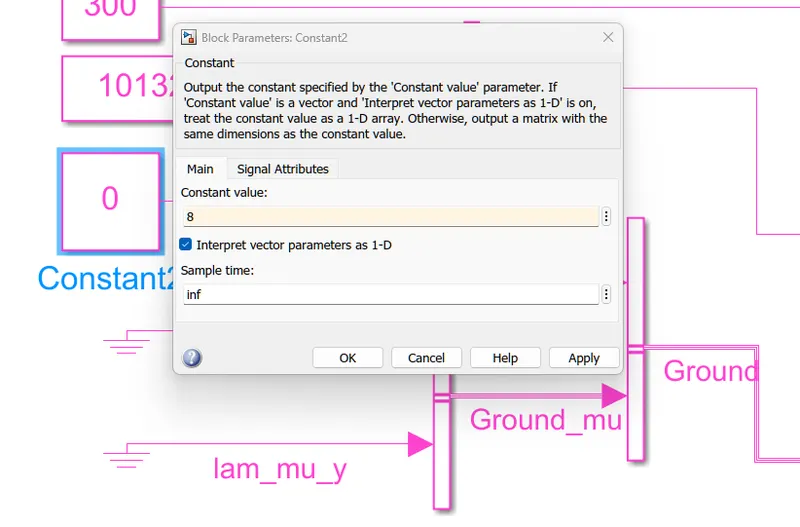
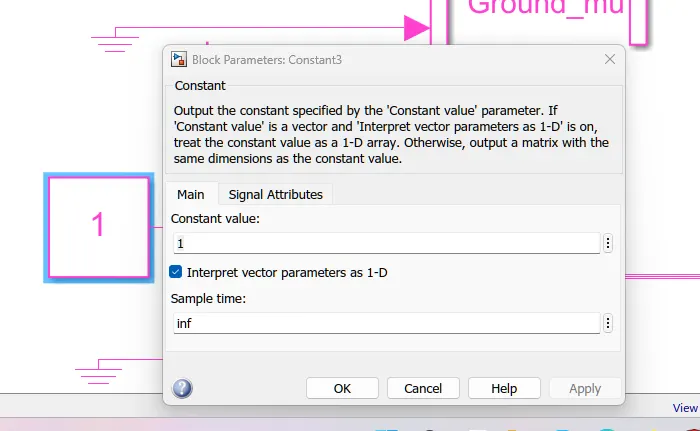
Changing Grade and wind velocity
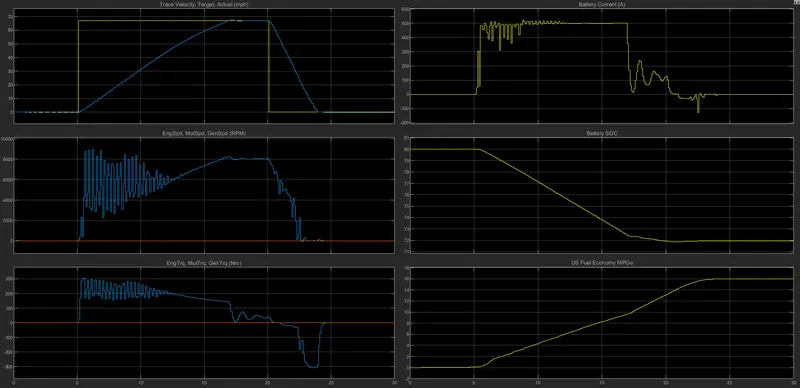
Result
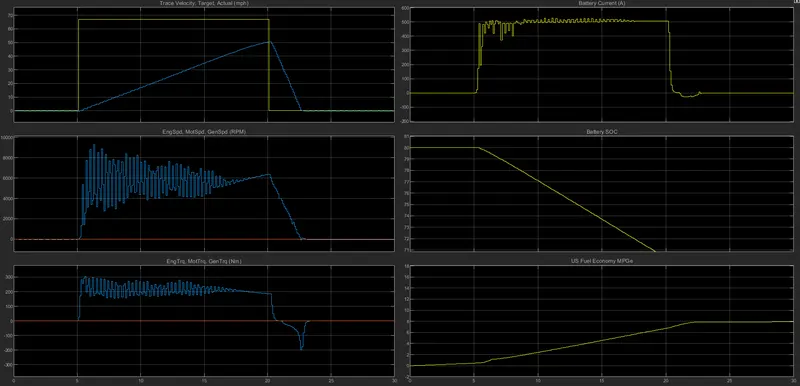
Observation:
- Without changing the grade and wind velocity the Vehicle's actual velocity is climbed to the top 70mph after changing the velocity the vehicle climbed up to 50 mph.
- The battery SOC is dropped to 70% after changing the grade and wind vel. it dropped further.
- US MPEG economy is also dropped to 8 miles per gallon which increased to 16 mpg without changing grade and wind velocity
Comments:
on changing the grade and wind velocity the overall performance of the vehicle is dropped.
the speed of the vehicle is also affected by the changes and the fuel economy also decreased.
Keeping all other parameters the same, compare the simulated results of hybrid and pure electric powertrains.
Results of HEV
Changing the drive cycle and grade and wind velocity
Result of EV:
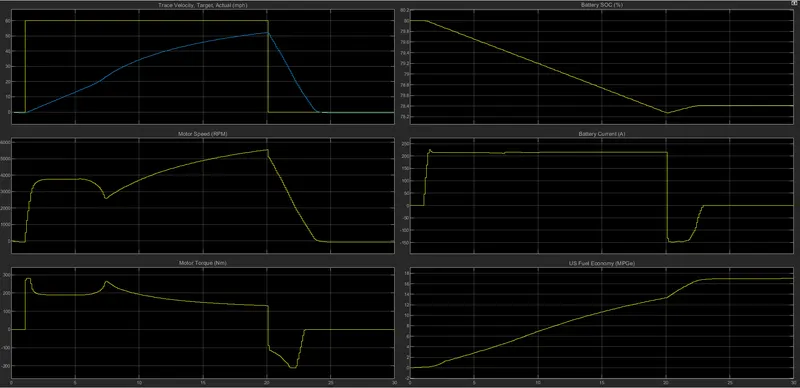
Comparison :
- The vehicle speed of the EV is slightly high as compared to the HEV
- the Battery SOC of the EV is dropped to 78% while the SOC of the HEV is further dropped below 70%
- The MPEG fuel economy is also high for EV vehicles as compared to HEV
References: