Week-4 Challenge WOT Condition Part-2
MODULE1#
What is the difference between the mapped and dynamic model of engine, motor and generator? How can you change the model type?
MAPPED MODELS:
in mapped models the data used for the operation and simulation are to be entered in a form of lookup table which would be then configured with the operational parts and the analysis would be formed.
advantages of mapped models:
if the detailed specification/lookup table data is available with us the simulation becomes easier and it gives the result on the basis of data interpreted.it is also called global-based models.
DYNAMIC MODELS:
it understands the behaviour of the parts /elements and then it behaves accordingly .it gives detailed analysis for the variations
entered by us in the specification whereas it simulates according to real and dynamic operation
Adventages of dynamic models:
it operates dynamically depending on situtation of operation ,detailed data and specification are not required and simulation gives the detailed analysis of the components simulated.
MODULE 1# B
how to change model type ?
steps to be followed while changing the model from mapped to dynamic or vice versa
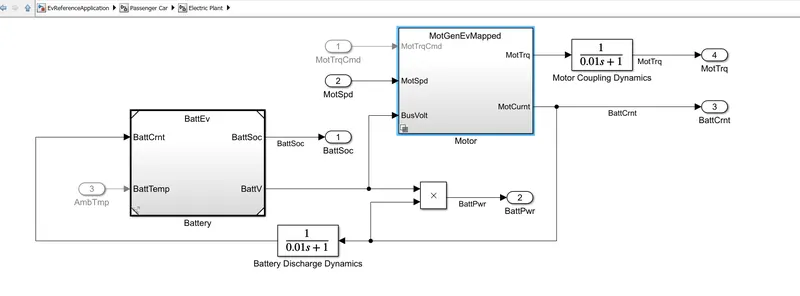
step 1:go to the EV reference application,double click on the passenger car, and click on the electric plant a window will open that will be shown in image below
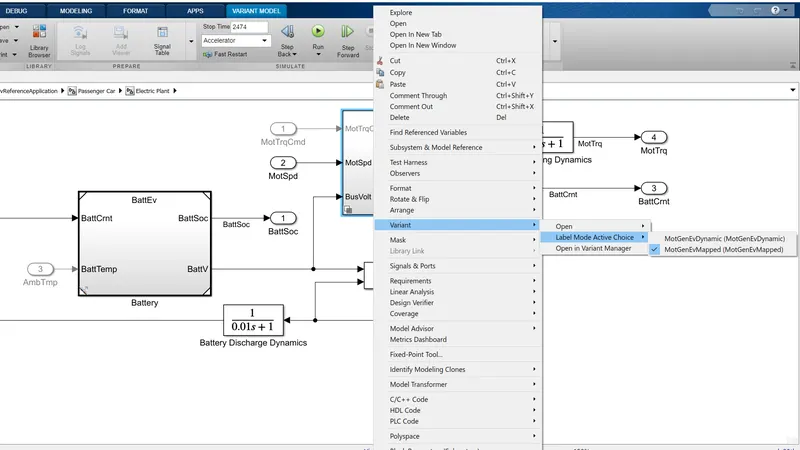
step 2: right-click on the MotGenEVmapped,and a window will open in which variant option is available to take the curser to the variant and it will show two more options (open,lable mode active choice ) we have to click on label mode active choice and select the model either dynamic or mapped.bellow is the image of this process.\
MODULE2#
- How does the model calculate miles per gallon? Which factors are considered to model fuel flow?
It is a fuel economy rating that how far a vehicle can travel per gallon of gasoline /diesel. the case for EV it is different where it is how much electricity is consumed from the battery pack to travel a certain distance.
one gallon produces 121.3MJ of electricity. the corresponding gallon equivalent to electricity is 33.7kwh or 121.3mega joul=33.7kwh
so if a vehicle consumes one gallon of gasoline it will travel 80 miles and in case ev travels 80 miles it has to consume 33.7kwh of electricity.
in this model the fuel consumption is calculated in miles per gallon through a performance calculation block in visuliation
the performance calculation block will be shown in the snap below.
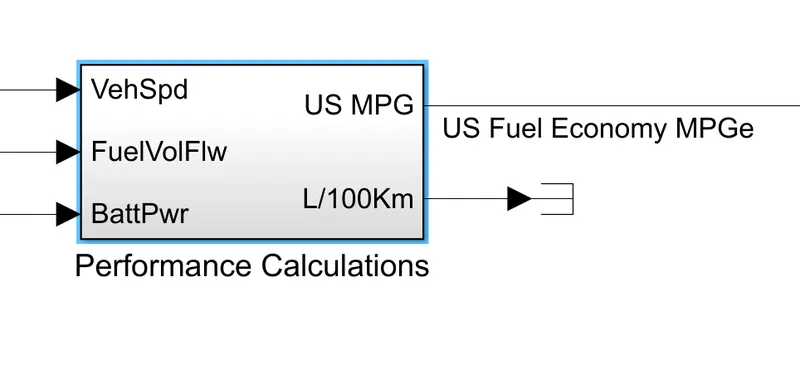
the performance calculation block calculates fuel consumption /battery power consumption and milage .
BATTERY:
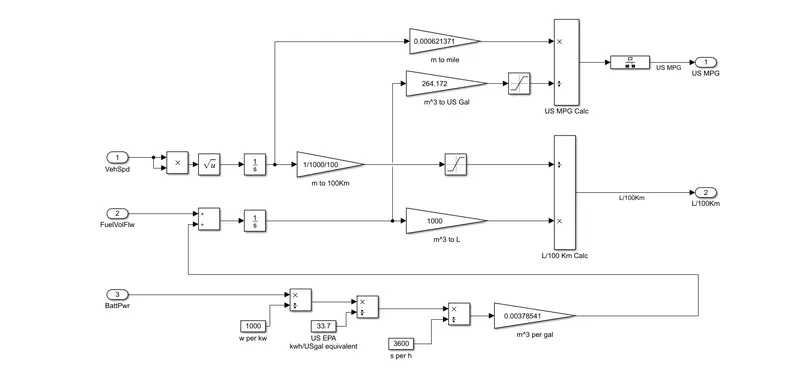
as we know that 1 gallon of gasoline =33.7kwh of battery power in order to convert the the battery power from watt hour to kwh we have to divide the battery power by 1000 after converting w to kwh now convert this into us gallon by dividing 33.7 it will convert it into kwh/us gallon, now the battery power is converted in us gallon after that we are going to convert hour to sec by dividing 3600sec(1hr=60x60sec) after that we are going to multiply it by a factor of 0.00378541 to convert it into m^3/us gallon. the output term will be going added to fuel flow further.
fuel flow:in this case the battery output is taken and added with the fuel flow now both the parameters has been added aftyer adding we are going to do the integration to convert the volume into mass flow rate after that we are going to convert the mass flow rate into liters by just doing multiple from gain block by 1000 or converting m^3 to us gallon so we have to multiply by 264.172
now we have to calculate how much fuel is consumed in 100 km or we can say how many liters has consumed in travelling a distance of 100 km .both the fuel flow and velocity output has to be taken into consideration to get the output.
vehicle speed :the vehicle speed is an important factor while considering the fuel consumption at a particular time.
from the vehicle speed ,the vehicle speed is divided in two (two inpuit value of speed) taking square root of thes terms and then intergate the two speed once integration is done we will get distance to convert this distance into km w ehave to divide the term by 1000 and also to convert it into miles we have to multiply the distance output by a factor of 0.000621371.
under the consideration of us gallon and mile we will get output in US MPG
and if we are going to consider the km and liter our output will be in the ltr/km.
below is the snape for the performance calculation.
- Run the HEV ReferenceApplication with WOT drive cycle. Change the grade and wind velocity in the environment block. Comment on the results.
the HEV refrance model is shown below :
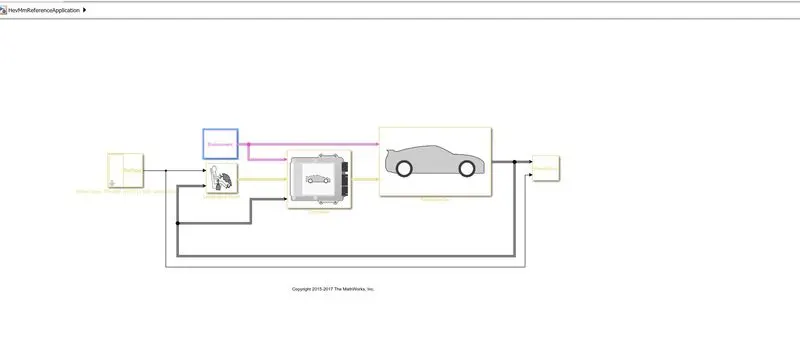
run the simulation on default parameters under WOT:
RESULTS
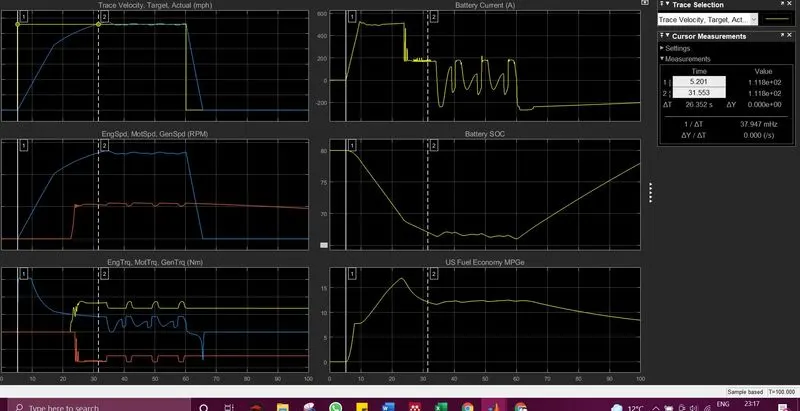
wind velocity=0m/sec
grade angle=0
under these two condtions we are going to run the simulation.
from the plot its clear under default parameters the top velocity is achived in just 31 sec and remains almost constant upto 60 sec after that deceleration starst when brake is applied,the top velocity attained is almost 110mph.
battery SOC:
FROM THIS PLOT the battery remains charged for 5 sec as the throttel is started after 5 sec , intially battery is charged upto 80% when the throttel is pushed down the battery starts discharging and goes upto 67% aftyer that it remains constant for some time .
CHANGE THE WIND VELOCITY AND GRADE FROM THE ENVIRONMENT BLOCK AND LETS SEE THE EFFECT OF GRADE AND WIND VELOCITY TO THE PERFORMANCE OF VEHICLE
wind velocity=3mph
grade=1
results
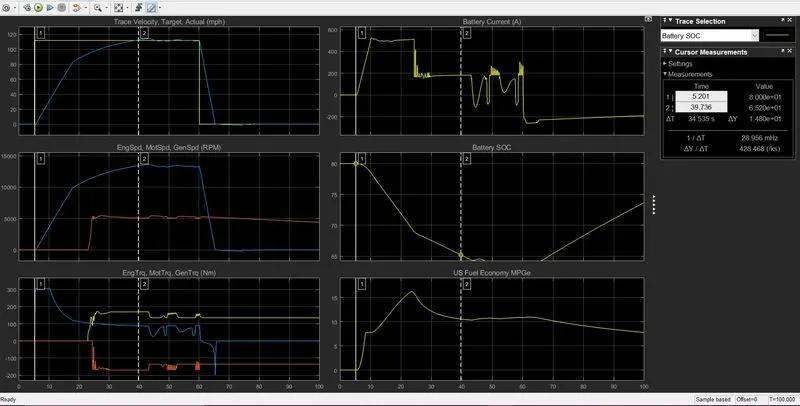
from the above snape it is clear that after changing some parameters to a small level,the top velocity is now attained after 39 sec
from the battery SOC its clear that only 65% of battery remains charged in the first case where wind and grade was 0 and battery remains 67% .in this case it goes down by 2% after changing the grade and wind velocity.
MODULE 4#
Keeping all other parameters same, compare the simulated results of hybrid and pure electric powertrains.
output results of pure electric and hybrid electric vehicle are shown below
HEV
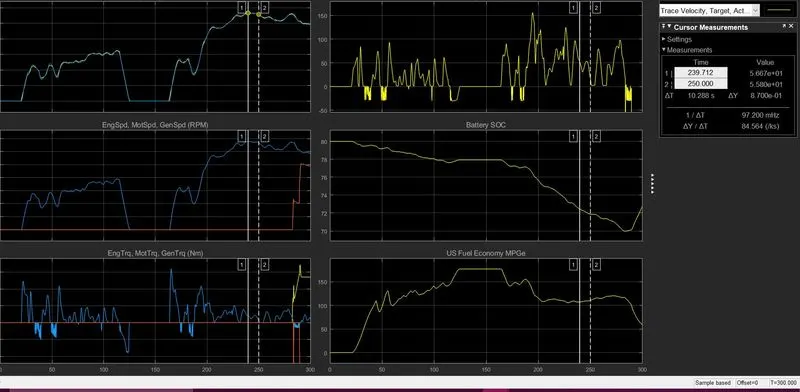
PURE ELECTRIC VEHICLE
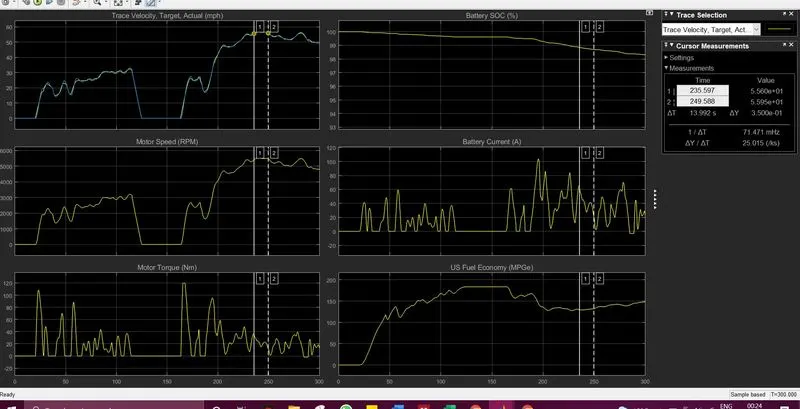
COMPARING THE RESULTS
top velocity 56mph is attained after 235sec for both ev and hev
battery SOC in hev intially battery was 80% charge and at the end of simulatin it remains 73 %
in case of pure electric vehicle intially the battery is 100% after end of simulation it remains 97 %
the battery charge remains more in pure a it uses lithium ion battery and in case of hev where the rate of discharge is more than that of pure ev,in hevs the battery used are nickel metel battery.