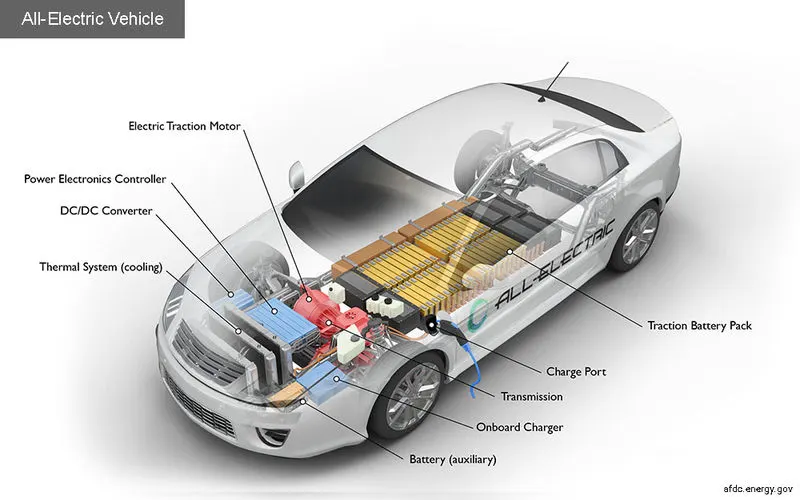
Week-4 Challenge WOT Condition Part-2
Question 1.
| MAPPED MODEL OF ENGINE | DYNAMIC MODEL OF ENGINE |
| The mapped model uses lookup table to get the output of any block.The lookup table is prepared of data, which are oucomes of experiments tried out in laboratory. These experiment cover a vast portion of practical situation and conditions. | The dynamic model calculates the value using the physical model and the inputs provided and runs equations in the background. These calculations are carried out whenever the model is simulated. The data calculated acts as output to the model. |
| The simulation does not require any calculation | The simulation requires solving of equations and calculation of data. |
| Simulation time is less | Simulation time is comparitively more |
| Many practical conditions are taken care of | The mathematical calculations are limited to assumptions |
| They are experimented value, so they are more accurate | They are calculated value, so they are less accurate |
| They are easy to construct and implement | They are more complicated to constructed and implement. |
| Memory is not required in mapped models | To speeden up the simulation, memory element is required, which remembers output at certain input and if same situation are met,uses memory to get the output. |
| Modification of the model is easy. | Modification of the model is comparitively tough |
| They are practically more in use worldwide. | In terms of usage, they are not given the first preference. The decision depends on the requirement. |
| Practical example is preparing lookup table for experimented values of speed - torque charecterstick |
Example is Simulating the model containing equation of torque vs speed i.e. N=V/(Kn* `phi`)- T*`pi`/(Kn*`phi`)^2 Where N is speed in rpm,V is the voltage, `phi` is the flux, Kn is a constant ana T is torque required to run the dc motor with N rpm speed. |
How to convert model type
Lets take an example, lets go to engine block of passenger car.

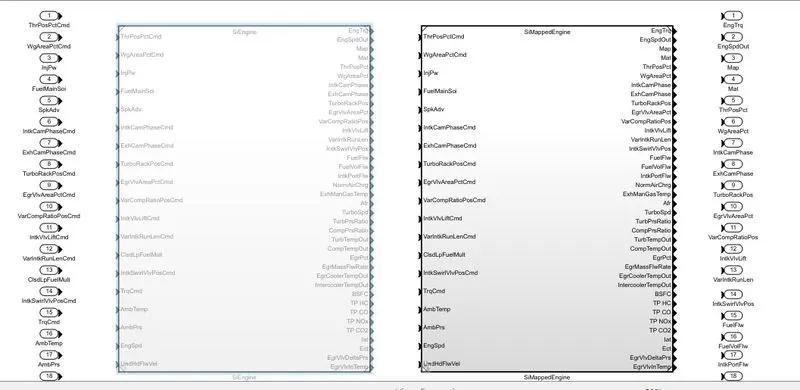
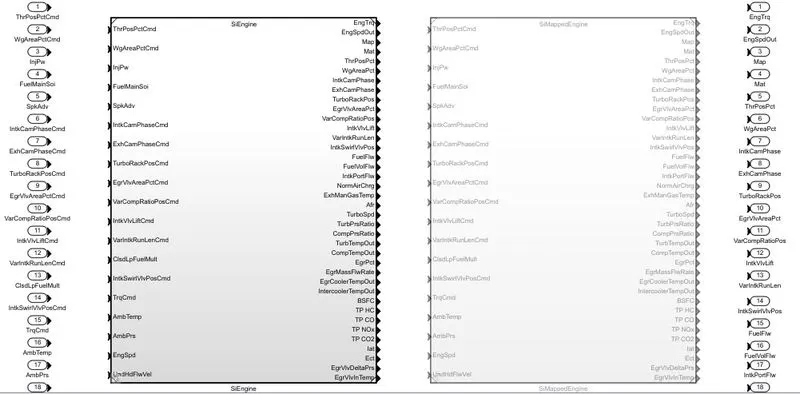
As seen above here are six models of engine out of which one is chosen. The Si Mappen Engine block is chosen. We have to convert the selection to dynamic model and choose Si engine
Steps
1. Inside the engine block right click on any blank space.
2. Some options will pop up. click on variant. Go to label mode active choice.
3. We will get different model types available. Select SEngine
We have successfully changedthe model type.
Question 2.
The miles per gallon or the millage of the vehicle is the distance covered by the vehicle with one gallon of fuel. The fuel considered here is gasoline. In powertrain blockset it is calculated in in a seperate block "Performance calculation". Here the inputs are vehicle speed, volumetric fuel flow and battery power.
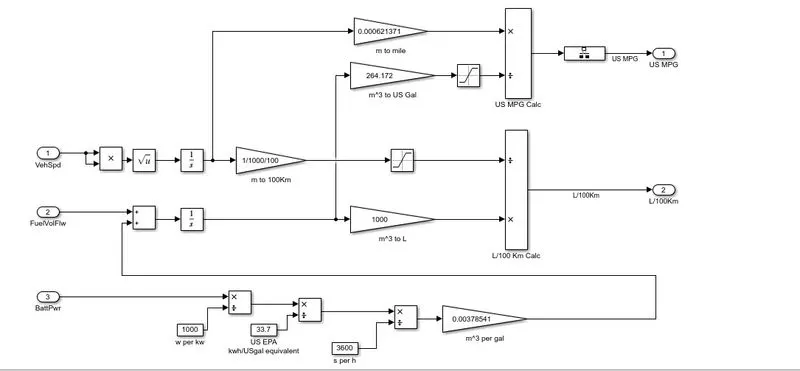
Steps involved in the calculation of miles per gallon
1. Lets start with battery power, whose unit is watts. It is converted into KW by dividing by 1000. When divided by 3600 (1 hr=3600 sec.), It becomes KWh.
2. 1 US gallon equivalent is equal to 33.7 Kw. Hence dy dividing KWh by 33.7 it converts to US gallon equivalent.
3.Multiplying US gallon with 0.00378541 converts it into cubic metre (volume)
4. This volume adds with another input, volumetric fuel flow. The addition is then integrated or added over the entire range, to get the equivalent volume of fuel (cubic metre).
5. The equivalent volume is converted to us gallon by multiplying with 264.172 . It is passed through saturation block, to keep the the value in range.
6. The vehicle speed is integrated to get the distance covered (metres) and multiplied by 0.000621371 to convert it into miles.
7. This distance in miles is divided by equivalent volume (result of step 5) in gallons to get miles per gallon.
From the above model and basic knowledge of fuel flow, battery power, throttle position,battery state of charge, motor power control strategy drive cycle, grade, wind speed, torque requirement etc affects the fuel flow. This can be seen easily through the example in Question 3. The increase in grade or the wind velocity, increases the torque required to run the vehicle, as a result of which the volumetric fuel flow increases.
Question 3.
Aim: To analyse the hybrid electric powertrain blockset result at a given gradient and wind speed.
Working formula
Traction Force= Friction force + Aerodynamic drag force + Hill climbing force + acceleration force.
In the above formula, the traction force is the amount of force required to drive the vehicle. This force will be provided by the engine/ motor in the hybrid electric vehicle. The energy produced by the motor / engine will be used against the constant forces i.e friction force, aerodynamic drag force and hill climbing force (in case of presence of grade). The remaining force will meet the acceleration force demand and increase the speed of vehicle.
In case of a steeper slope, the hill climbing force increases. To provide enough energy to combat the hill climbing force, the acceleration force reduces, and hence the vehicles moves with a very slow speed. Similarly in case of driving on a windy day against the direction of wind, the Aerodynamic drag force increases as the relative speed between the vehicle and the wind increases. This increases the traction force. In order to combat this force, the motor/ engine produces more energy.
Observations.
Here we will discuss the changes in the simulation output at different wind speed.
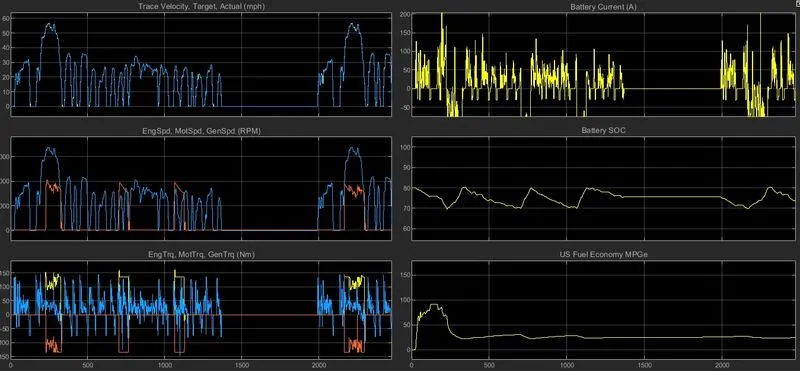
CASE 1 WIND SPEED =0
1. The battery state of charge is maintained between 0.7 and 0.8
2. Charging of battery takes place when the battery state of charge goes to 0.7, and then it charges to 0.8.
3. The battery contribution in the drive is limited and can be seen through the motor torque produced.
4. The fuel consumption is taken as standard (to compare it with other cases).
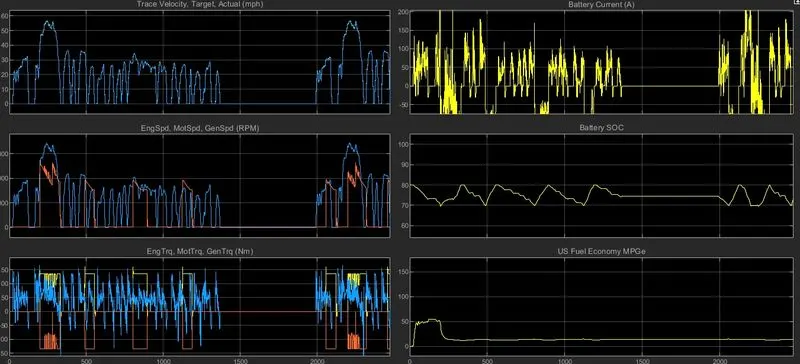
Case 2 wind speed =25
1.To drive the vehicle on the same drive cycle, the engine mechanism has to produce more torque which is provided by the motor.
2. Hence the battery charges more frequently.
3. Battery discharge current increases due to meet the extra torque load.
4. Because the opposing force(aerodynamic force) the fuel consumption increases or distance covered per gallon of fuel reduces.
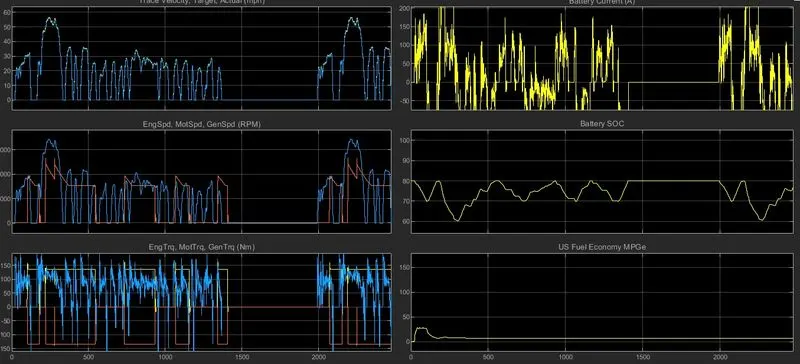
CASE 3. wind speed =50
1. The battery state of charge lies between 0.8 and 0.6.
2. Both engine and motor torque increases to meet the load.
3. The time span for motor producing torque increases.
4. The charging operation takes more frequently.
5. The fuel consumption increases or the distance covered per gallon of fuel reduces.
Case 4 grade =5 and wind speed is 0
1. The battery state of charge is between 0.68 and 0.8
2. The motor operation duration increases.
3. The battery charging operation takes place more frequently and for a longer duration.
4 The engine torque increases to meet the load demand.
5. The motor torque remains same as it depends upon the battery discharge current.
6. The fuel consumption increases or the distance covered per gallon of fuel increases.
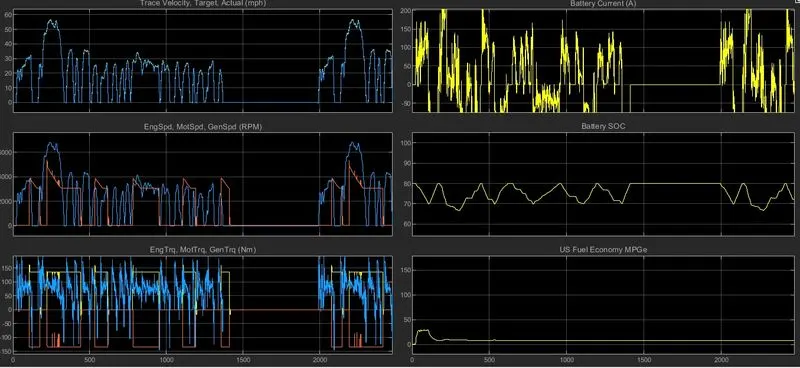
From the above cases we see that if the vehicle drives in steep slope or against the direction of blowing wind, the vehicle tends to gets slower to maximize efficiency. If the vehicle is driven in the same driving cycle, then high torque values are required to drive the vehicle, which is drawn primitively from engine and secondarily from the motor. This will furthur reduce the fuel efficiency.
Question 4.
Based on the simulation of powertrain blockset of Pure electric vehicles and hybrid electric vehicles, the two can be differentiated in the following ways.
| Electric Vehicle | Hybrid electric vehicle |
| 1. Only the motor runs to achieve the required speed and torque. | Both engine and motor runs to achieve the required speed and torque |
| 2. There is no generator in pure electric vehicle. | The negative generator speed indicates charging of battery from the running engine. |
| 3. The achieved motor torque is more. | The achieved motor torque is comparitively lesser as it is accompanied by engine torque. |
| 4. Oher than external charging, battery is charged only through regenerative charging. | The battery charges through engine, regenerative charging and external(In case of plug in hybrid electric vehicle). |
| 5. The maximum battery current is 100 amp depending on the torque required. | Depending upon the torque requirement and state of charge, the maximum battery current is limited to 50 amps. |
| 6. The power train blockset of pure Electric vehicle is comparatively easier. | The power train block of HEV is very complex. |
| 7. The simulation of electric vehicle does'nt take much time | The simulation of HEV takes comparitively longer time. |
| 8. Efficiency is more. | Efficiency is comparitively less. |
Hybrid Electric Vehicle
A hybrid type vehicle that makes use of both electrical populsion and Internal combustion engines. The main idea is to yield better output in terms of efficiency, fuel economy compared to conventional internal combustion engines. There is a variety of HEV types and the degree to which each function as an electric vehicle (EV) also varies. The most common form of HEV is the hybrid electric car, although hybrid electric trucks (pickups and tractors), buses, boats and aircraft also exist.Modern HEVs make use of efficiency-improving technologies such as Regenerative braking which convert the vehicle's kinetic enerfgy to electric energy, which is stored in a battery. Some varieties of HEV use an internal combustion engine to turn an electrical generator, which either recharges the vehicle's batteries or directly powers its electric drive motors; this combination is known as a motor-generator. Many HEVs reduce idle emission by shutting down the engine at idle and restarting it when needed; this is known as a Start Stop system.
Based on the degree of hybridization, the hybrid electric vehicles can be divided as mild, and full hybrid. A full hybrid vehicle can run on engine alone mode, electric alone mode and in hybrid mode. A mild hybrid vehicle can not be driven solely by electric motor, as its motor does not have enough power to facilitate vehicle propulsion. They can just contribute to benifits like fuel consumption over a certain range. The battery in hybrid vehicles can be charged by the combustion engine or external charger. Such hybrid vehicles with external battery charging facility are called PLUG IN HYBRID VEHICLE. The commertial hybrid vehicles are Toyota prius,Saturn vue green line, Chevrolet silverado.
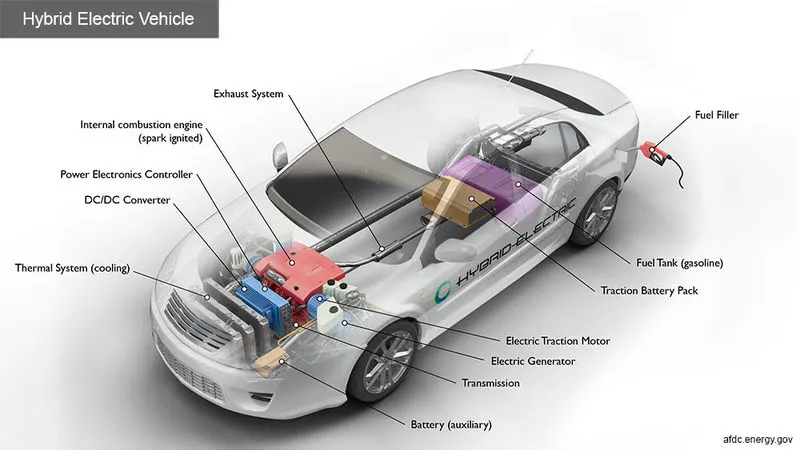
Based on how the power is supplied to the powertrain, the hybrid vehicle can be divided as
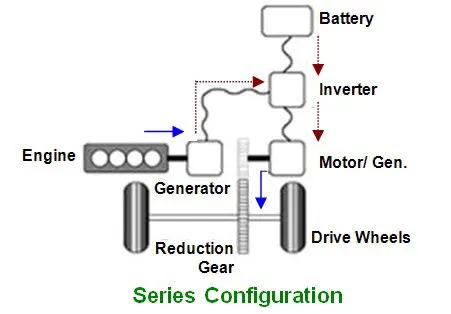
SERIES HYBRID In series hybrid, the vehicle runs only by the motor. The internal combustion engine is used to run the generator which feeds the motor, to which axle and differential system is connected. The motor can also be fed by the battery. This switching action is performed by the controller based on control strategy.
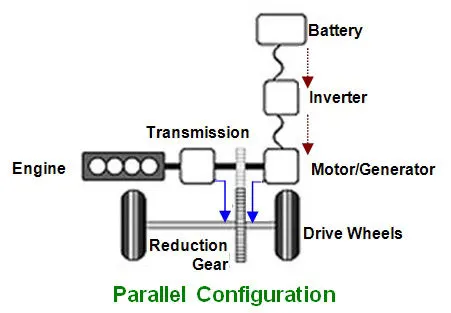
PARALLEL HYBRID The parallel hybrid vehicle runs by both motor and internal combustion engine. Here there is no generator. The motor runs solely by battery. Both the motor and engine blocks are connected in parallel to the transmission and differential block. The motor can also act as a generator and charge the battery through IC engine.
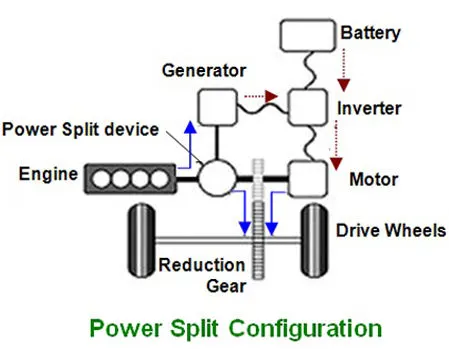
POWER-SPLIT HYBRID These type of vehicles have the advantages of both series and hybrid type. The series hybrid vehicles have maximum efficiency at low spped and parallel hybrid vehicles, at high speed. Here the engine block is connected to gear system which is connected to the differential and transmission system. The engine is also conected to a generator that feeds the battery through inverter (charging). The inverter is also connected to the motor, which is connected to the differential system.
Electric vehicles
Vehicles that uses one or more electric motors for propulsion. It can be powered by a collector system, with electricity from extravehicular sources, or it can be powered autonomously by a battery (sometimes charged by solar panels, or by converting fuel to electricity using fuel cells or a generator). EVs include, but are not limited to, road and rail vehicles, surface and underwater vessels, electric aircraft and electric spacecraft.