Week-4 Challenge WOT Condition Part-2
Here i have considered HEV Multimodal reference application model from the MATLAB Help documentation for below analysis :-
1.
1. Mapped model: A mapped engine model uses a set of steady-state lookup tables to characterize engine performance.The tables provide overall engine characteristics, including actual torque, fuel flow rate, Brake specific fuel consumption, and engine-out exhaust emissions.
The mapped model is used mainly for quasi steady-state simulations.It is used when we already have the engine/motor/generator data from dynamometer or other tools.
Dynamic model: The dynamic Model on the other hand decomposes the engine/motor/generator behavior into the characteristics that are separated into lower-level components. By combining components in this way, the models capture the dynamic effects.
It is used in dynamic real time simulation & analysis of engine/motor parameters. It is used to analyze the impact of individual engine/motor components on the overall performance of engine/motor.
It is used when we have the individual component level data for an engine/motor
Mapped motor model: The Mapped Motor block implements a mapped motor and drive electronics operating in torque-control mode. The output torque tracks the torque reference demand and includes a motor-response and drive-response time constant. Use the block for fast system-level simulations when you do not know detailed motor parameters, for example, for motor power and torque tradeoff studies. The block assumes that the speed fluctuations due to mechanical load do not affect the motor torque tracking.
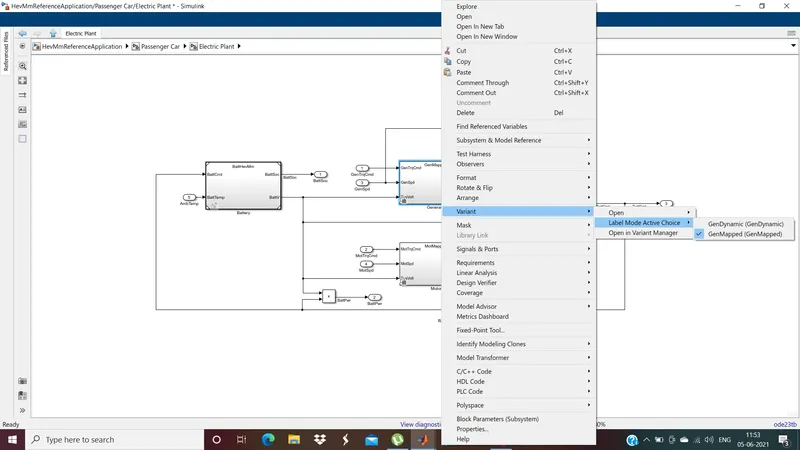
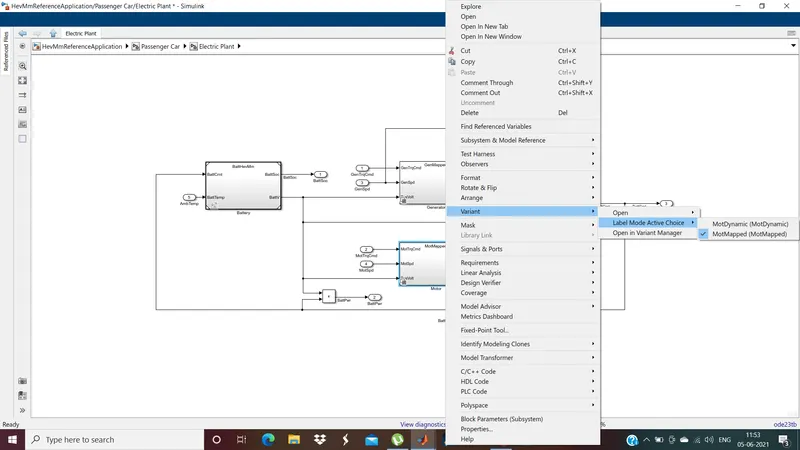
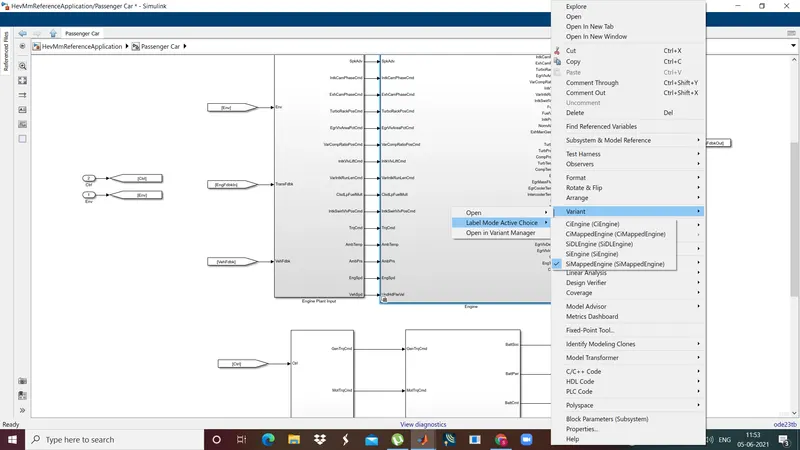
The motor/engine variant can be changed from mapped to dynamic & vice versa by: right click mapped/dynamic engine/motor model -> select Variant -> select label mode active choice option -> Motdynamic/Motmapped or Ci dynamic engine/Ci engine or GenMapped/Gendynamic
2. Miles per Gallon is a method of comparing the energy consumption & fuel economy of Vehicles running on Alternative fuels,Electric & hybrid electric vehicles with that of the conventional vehicles running on Petrol or diesel.
miles per gallon gives the average distance covered by consuming a unit of energy(Miles covered by consuming 1 gallon of fuel , 1 Gallon = 3.7854Lts of fuel & 1 Mile = 1.6093 kms. The electrical energy equivalent for 1 gallon fuel is 33.7 KWh.
The model calculates Miles per Gallon using the performance calculation sub-block under Visualization block in the HEV Multimodal reference application model.
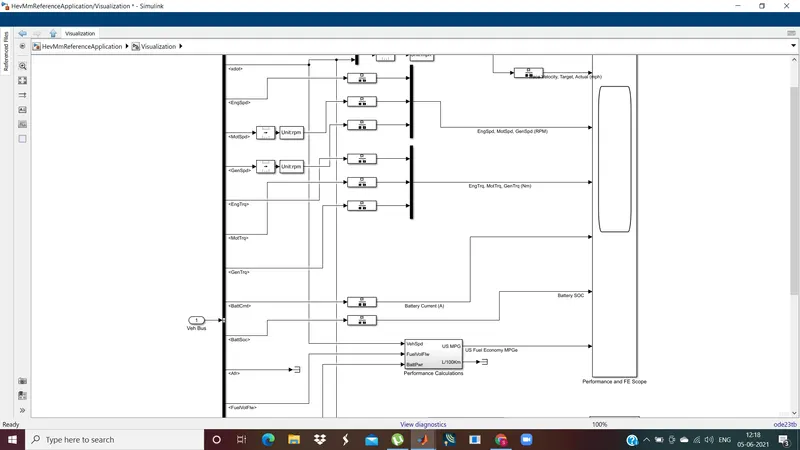
In order to calculate miles per gallon the inputs to the performance calculations block are Vehicle speed , Fuel volume flow & battery power.
i. Vehicle speed is integrated over time to find distance covered.For this the speed is given as an input to integrator block.Output is distance covered .
ii. Fuel flow volume in m^3 & that is converted to Litres.
iii.Battery power in converted to KWh & that is converted to equivalent Gallons of fuel.That gallon is converted to m^3 & it is added with actual fuel volume & then m^3 to Litre conversion is done
Thus using different conversion blocks the Miles per gallon(MPG) & Litres of fuel consumed is calculated for given vehicle & thus fuel consumption & fuel efficiency is decided.
The different unit conversions that are implemented in this model are based on simple unit conversions as below:
1 Litre = 1000 m^3
1 Mile = 1.6093 km
1 Gallon = 3.7854 Litres
1 Gallon = 33.7 KWh
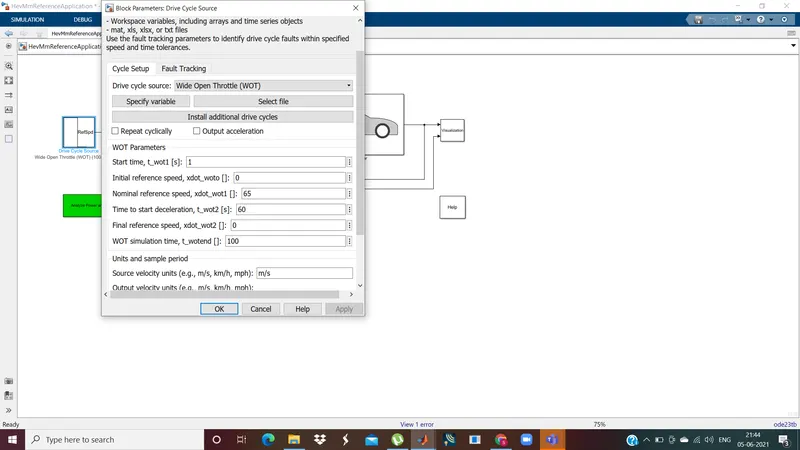
3. For the HEV ReferenceApplication WOT drive cycle is selected & the wind velocity is set as 20 kmph , grade angle as 10 degrees. The parameters in WOT drive cycle is set as follows:
The output characteristics for the HEV after changing the above parameters(keeping all other parameters unchanged) is shown below(simulation run for 100 sec):
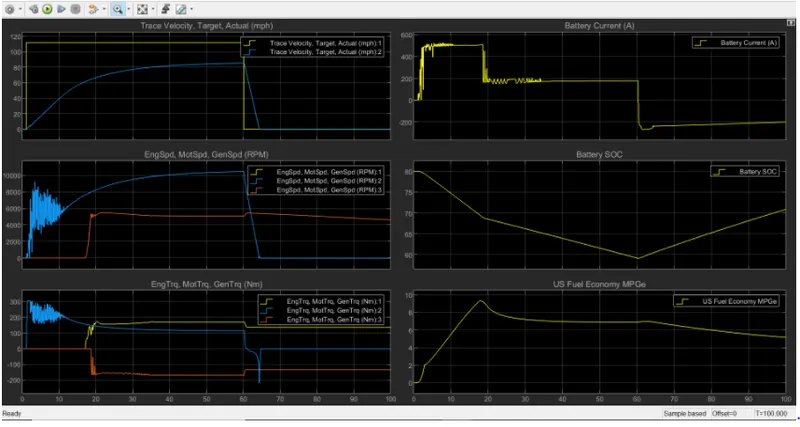
As we can see the observations drawn are:
i. With the selected grade angle & wind velocity the actual velocity of the vehicle is unable to catch up with the Trace velocity(obtained from the selected WOT drive cycle).
ii. During starting due to the full throttle the battery current consumption is high then for constant velocity period the current consumption is constant & during deceleration the motor is in regenerative mode so the current is shown as negative in the current plot.
iii. Battery SOC: During initial starting of the vehicle & high speed course the battery discharge is high(steep slope) the rate of discharge is a bit slow.During deceleration the regenerative power of motor charges the battery.
iv. Engine,motor & generator speed : here the blue(motor speed),yellow(engine speed),red(generator speed).Initially due to high torque & speed requirement the motor speed is high(sudden spikes).The engine & generator are not operating.
Once the SOC drops below 65% the engine & generator is functioning & generator speed increases.During deceleration the generator speed reduces due to regeneration by the motor.Yellow line is not visible because it may coincide with the generator plot(engine & connected generator having same speed) during this simulation.
v. During start the vehicle requires high starting torque so the motor torque is high, after the starting is successful the engine takes over powering the vehicle for high speed throttle so engine torque increases, becomes constant & finally decreases.
vi. Fuel economy: Finally from the MPG plot , the maximum fuel economy for this case of simulation turns out to be 9 MPG.
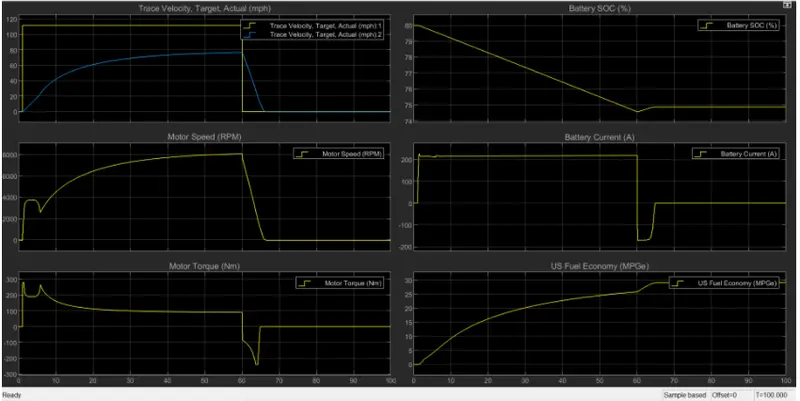
4. Now we keep the parameters the same as in the 3rd challenge for a pure EV vehicle & simulate the results:
So the observations are:
i. The top speed for EV vehicle is less than that of HEV.(because in HEV engine is there to assist for high speed throttle)
ii. The battery current provided in case of EV is larger that of in the case of HEV,because in EV the battery is the sole source of energy for vehicle propulsion.
iii. The overall energy efficiency of EV is higher than HEV.This is because the electric motor is more efficient machine than the engine.