Week-4 Challenge WOT Condition Part-2
Ans1.
Mapped model
To run the simulation with predefined commands and set of look up tables, mapped model is selected.
Mapped model simulation takes less time to simulate.
Mapped model simulation can also be known as static model simulation since, it does not involve the real-time outputs from the subsystems.
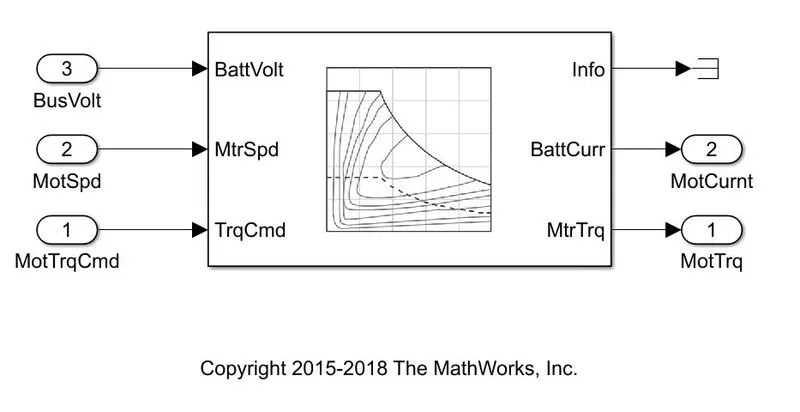
Dynamic model
To run the simulation with the actual model, dynamic model is selected.
Dynamic model involves the real-time outputs from all the subsystems to simulate
Since considering all the subsystems, the accuracy of this model is better than the mapped model simulation
Dynamic model simulation takes more time to simulate than the mapped model simulation.
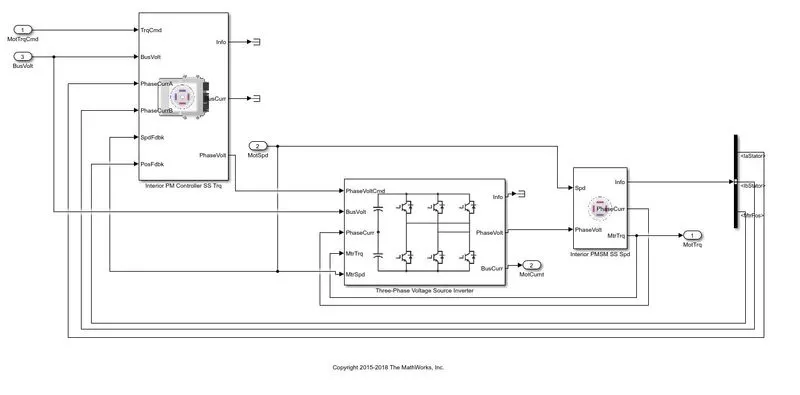
To change between mapped & dynamic model:
- Open the powertrain module blockset for the required vehicle.
- Click on passenger car/vehicle block and select electric plant or engine.
- Right click on Engine/EV motor/generator based on vehicle model and select variant.
- Under variant, scroll to label model active choice and choose mapped or dynamic for the required calculation.
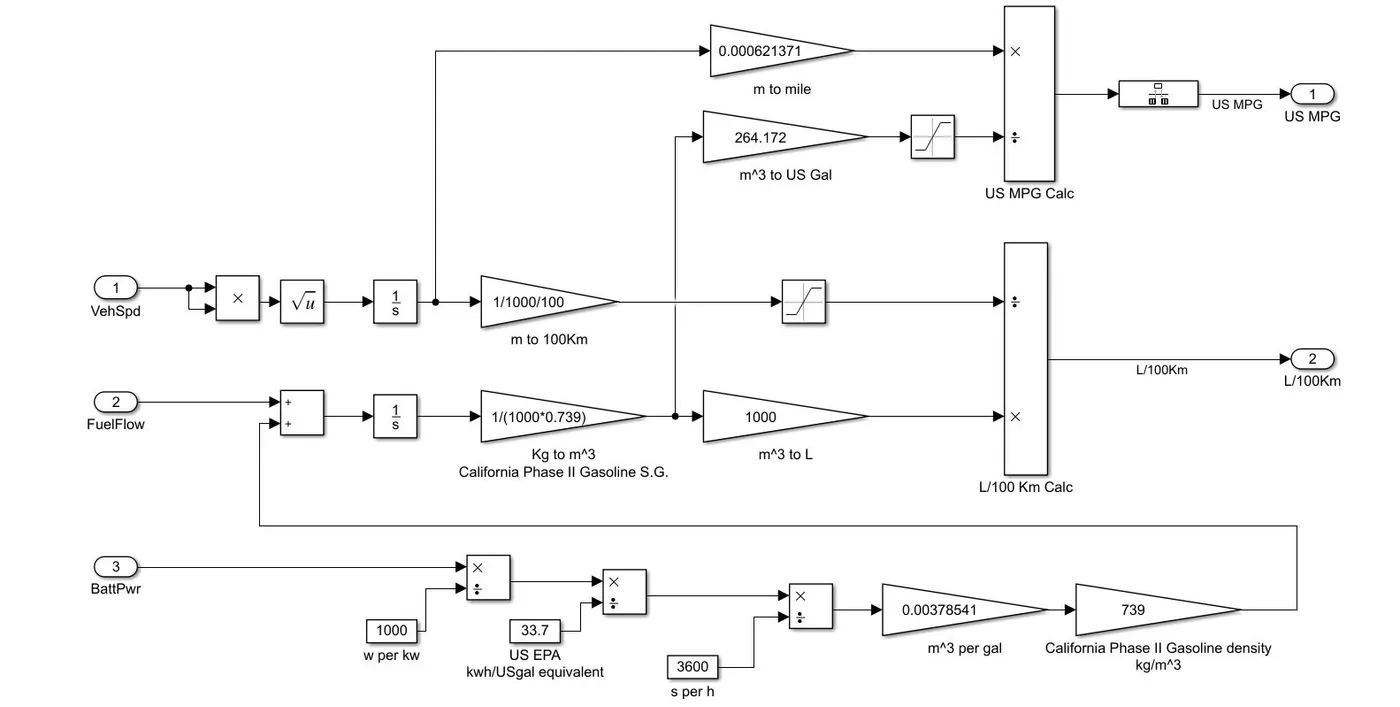
The powertrain block has an inbuilt model for this which can be found inside the visualization block.
Simulation of HEV with WOT condition without any change
The simulink window of the HEV reference application and the modified drive cycle source window is show below.
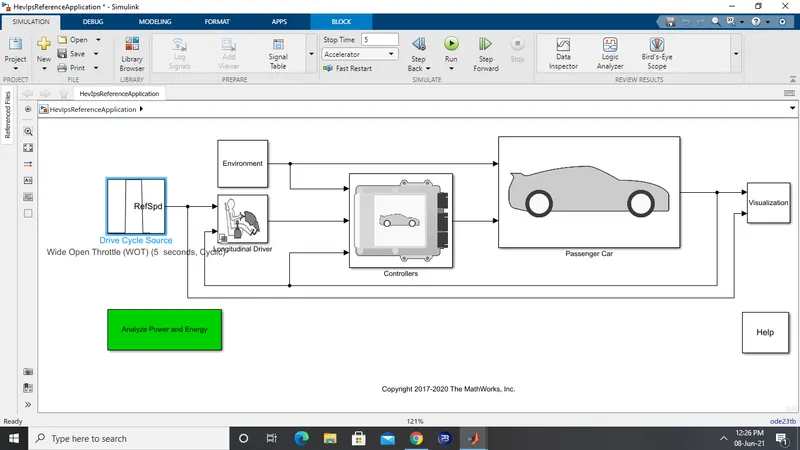
The drive cycle source is modified in such a manner to simulate the vehicle in wide open throttle condition.The time duration is set to 5 sec.
The result of the simulation
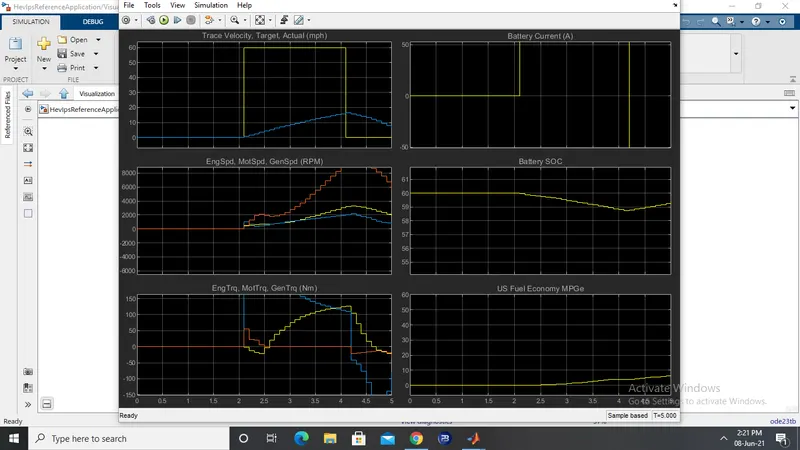
Simulation of HEV with WOT condition with changes in environment block
The parameters of the drive cycle source block is kept the same.
The parameters such as grade and wind velocity in the environment block is changed
>The Grade value is set to 5 degrees
>The wind velocity is set to 5 m/s in x axis direction
>Other parameters remains unchanged
The result of simulation
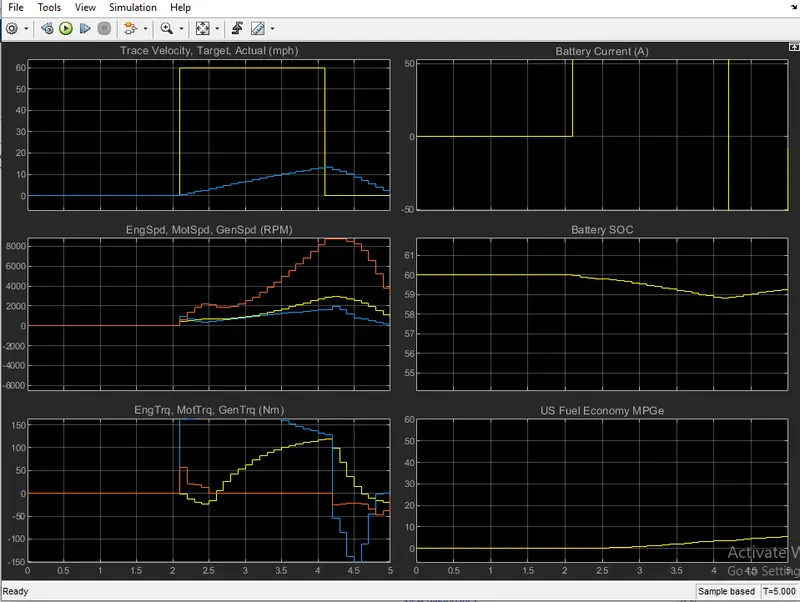
Ans4. Simulation of Pure EV with WOT condition with changes in environment block
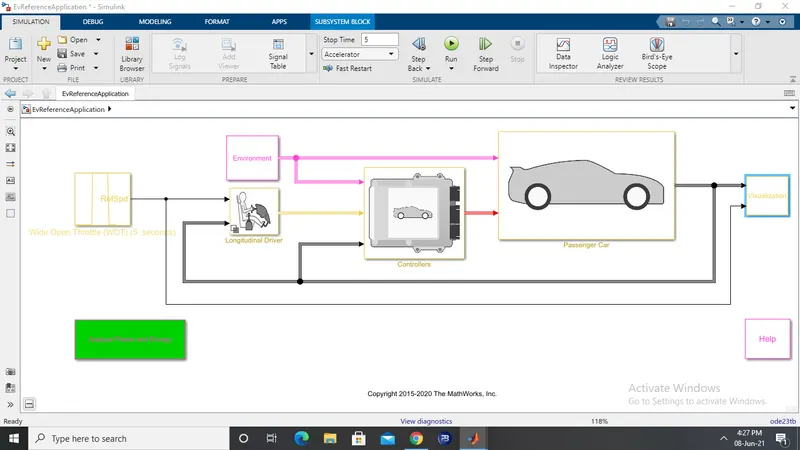
>The drive cycle source window parameters are kept similar to the HEV simulation.
>The Grade value is set to 5 degrees
>The wind velocity is set to 5 m/s in x axis direction
>Other parameters remains unchanged
The simulation is made to run with the above changes
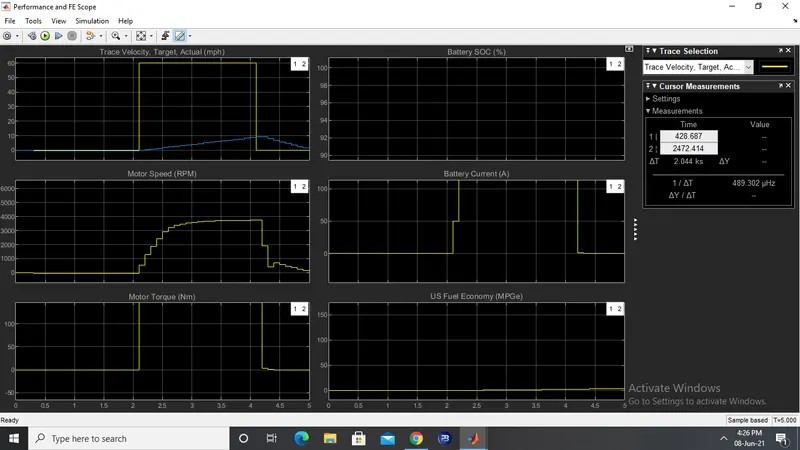
The result of the simulation
Observations:
- The electric powertrain achieves a lower top speed when compared to a HEV powertrain.
- Since the motor is the only propulsion source in an EV powertrain, the motor needs higher rated power and generate the instantaneous start up torque to propel the vehicle.
- The conventional HEV's use lead acid battery whereas the EV's use lithium-ion cells which have more energy density.
- EV has a superior fuel economy than a conventional HEV.