Week -2
To Make a Simulink model of Doorbell using solenoid block.
- Working of Model
- Pulse Generator creates an input signal of pulse with 1 unit amplitude, 4 sec period, having 50% pulse width with 2-sec delay for the model.
- Then we attach the scope to it get so that we can compare the inputs and outputs of the model.
- Now the input signal is connected to the Simulink-PS Converter which converts the Simulink signal to a physical signal which is then sent towards the SPST switch.
- After receiving the physical signal, the SPST switch compares it with its threshold value if it's greater than it, then it closes the electric circuit, or else it is open.
- After the electric circuit is closed the current is flown from the circuit and then it energies the solenoid connected to the battery.
- As the solenoid is charged it pulls the Port R towards port C (which refers to us as the ringing of a bell).
- A Mechanical Translation Reference is attached to the port R of the Solenoid to understand the position and velocity of the plunger of the solenoid.
- To record its position and velocity PS-Converter converts the physical signal to a Simulink signal and then using the scope block we record it for the simulation duration.
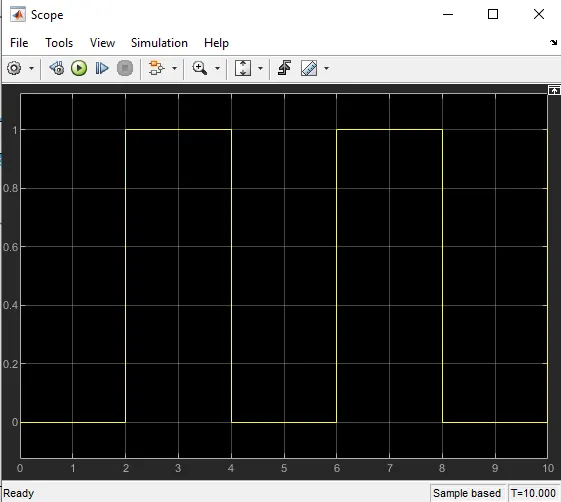
- Above imageis the input signal given
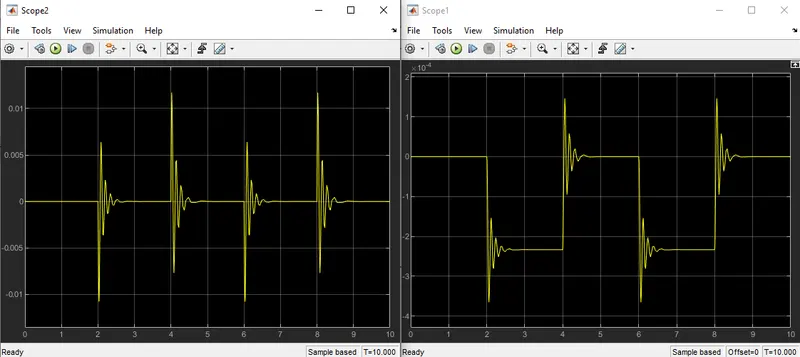
- This is the output that we get.
Simulink model is attcahed.
Q2. Use a thermistor to sense the temperature of a heater & turn on or turn off the fan as per the below conditions:
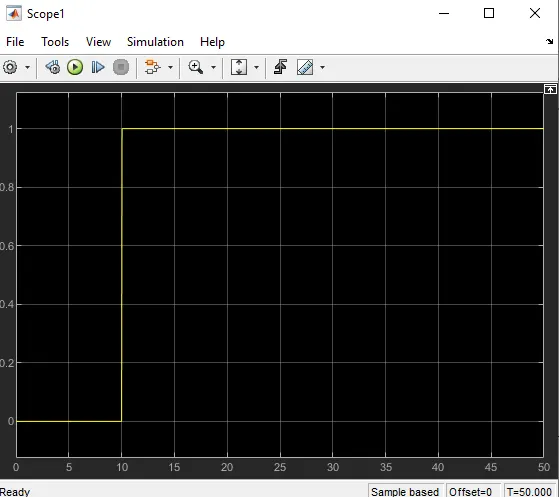
- Temperature source: 20 °C from 0 to 10 seconds, 27 °C from 10 to 30 seconds, 23 °C from 30 to 50 seconds.
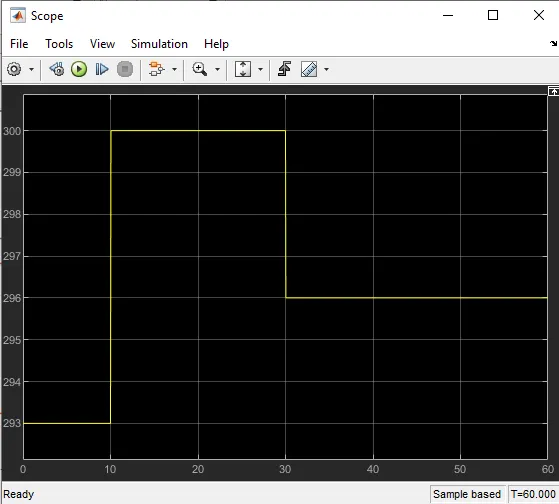
Above is the input signal given as seen from scope.
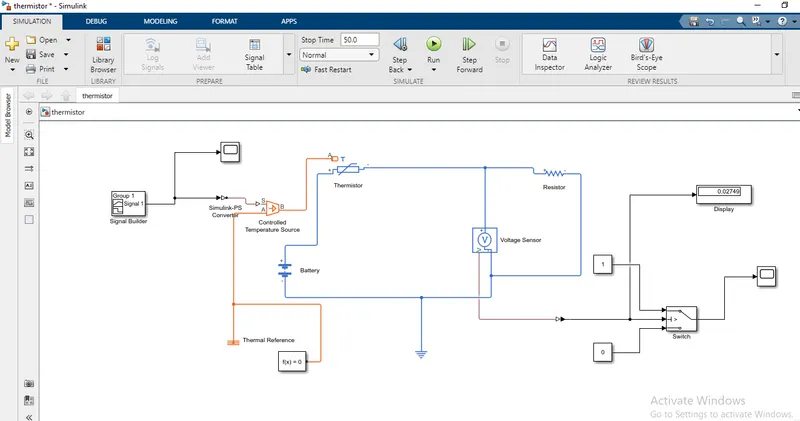
Simulink model is also attached.
Theory
- A thermistor is a type of resistor whose resistance is strongly dependent on temperature, more so than in standard resistors. The word is a combination of thermal and resistor. Thermistors are widely used as inrush current limiters, temperature sensors (negative temperature coefficient or NTC type typically), self-resetting overcurrent protectors, and self-regulating heating elements (positive temperature coefficient or PTC type typically).
- Thermistors are of two opposite fundamental types:
- With NTC thermistors, resistance decreases as temperature rises usually due to an increase in conduction electrons bumped up by thermal agitation from the valency band. An NTC is commonly used as a temperature sensor, or in series with a circuit as an inrush current limiter.
- With PTC thermistors, resistance increases as temperature rises usually due to increased thermal lattice agitations particularly those of impurities and imperfections. PTC thermistors are commonly installed in series with a circuit and used to protect against overcurrent conditions, as resettable fuses.