Week-4 Challenge WOT Condition Part-2
Wide open throttle of HEV and EV
Aim: To simulate and analysis Power train block set and comment on various results
Objective:
- What is the difference between mapped and unmapped model of engine, motor and generator? How can you change model type?
- How does model calculate miles per gallon? Which factors are considered to model flow?
- Run the HEV reference application with WOT drive cycle. Change the Grade and wind velocity in the environment block. Comment on the results
- Keeping all other parameters same, compare the simulated results of hybrid and pure electric powertrains.
Platform Used
- Matlab
- What is the difference between mapped and unmapped model of engine, motor and generator? How can you change model type?
Mapped model
Mapped engines has macro engine behavior as lookup table as functions as load and measured engine speed. It is suitable analysing and designing activities doesn’t require engine subsystem dynamic characteristics such as in emissions and fuel economy are matched while calculations of engine performance and transmission. Also mapped model works with a specific set of lookup table values or a steady state lookup table to determine the engine performance.
Dynamic Model
Dynamic model are more individual component model that take into account of different engine dynamics such as turbocharger dynamics, intake of airflow etc. For characterizing dynamic engine states, dynamic mapping is suitable.
Switching between Dynamic and mapped models
To switch the model type,
- Open HEV model, navigate into passenger car
- Right click on engine subsystem and then switch over
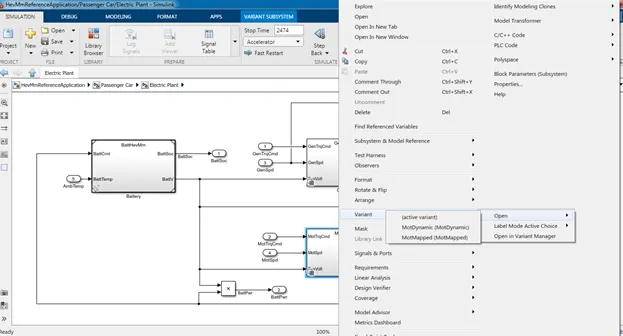
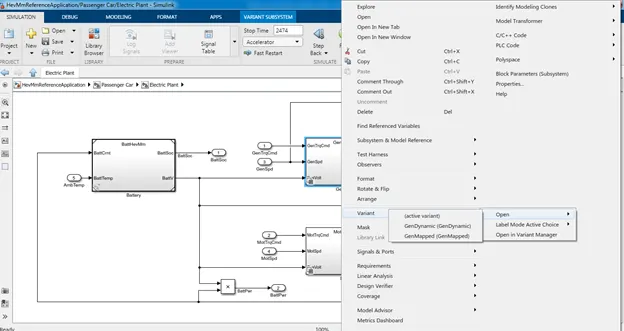
For Motor and generator in electric plant, right click on motor and generator block and select variant to switch over
Motor
Generator
2.How does model calculate miles per gallon? Which factors are considered to model flow?
Miles per gallon (MPG) is the fuel economy rating of a car where distance is measured in miles, that a car can travel per gallon of fuel.
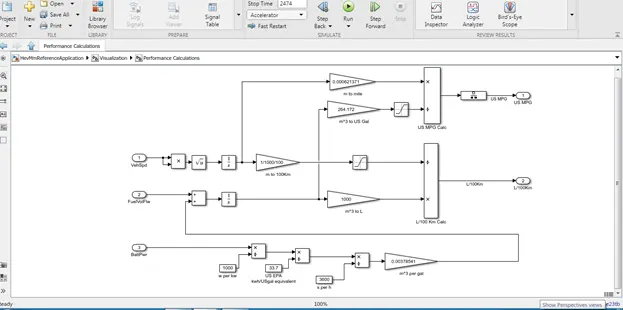
- Battery power (watt) is converted to Kilowatt by dividing by 1000
- Then power KW is divided by 33.7 (KWh/US gal).
- Then Usgal/h is converted to USgal/sec by dividing 3600
- Then the value is multiplied by 0.00378541 to convert m^3.
- To remove negatives values and convert vehicle speed into (m), vehicle speed is squared and square rooted and then integrated.
- Then the vehicle speed is divided with (m^3) to obtain speed in miles per gallon MPG
Factors considered to model fuel flow
- Braking
- Rapid acceleration
- Weight
- Environment and weather conditions
3.Run the HEV reference application with WOT drive cycle. Change the Grade and wind velocity in the environment block. Comment on the results
Model
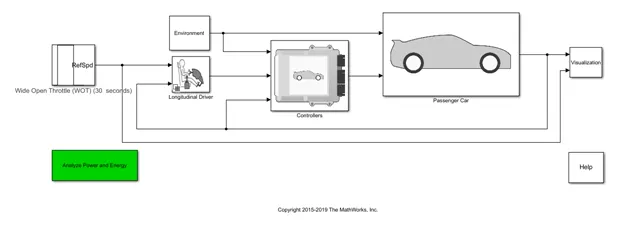
Environment Block
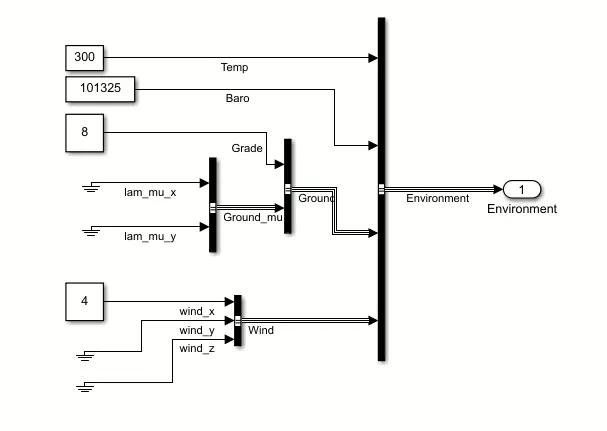
wind velocity and gradeability is given to check the performance in WOT.
Simulation result
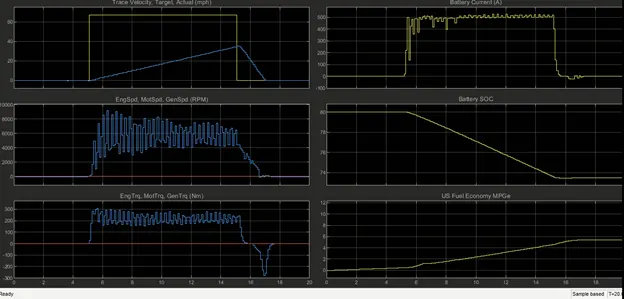
By analyzing , We can conclude
- Vehicle is at rest from 0-5sec and the starts accelerating till 20 sec
- After 20 sec, the vehicles decelerates, on that time, Motor act as generator and the battery gets charged through regenerative breaking.
- While decelerating (regeneration) SOC is being increased
- While acceleration, SOC is reduced from 80 to 70 percentage
- The maximum current being used is near 500amps and during deceleration negative 20 Amps, that concludes battery is being consumed and charged respectively.
5.Keeping all other parameters same, complete the simulated results of hybrid and pure electric powertrains.
EV SIMULATION MODEL
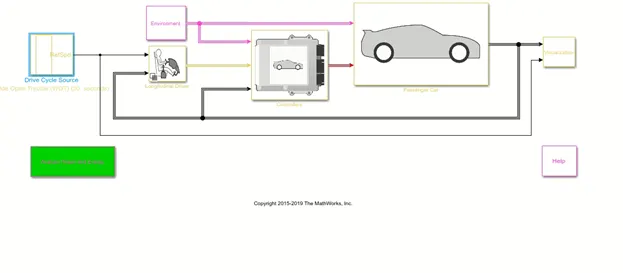
Environment Block
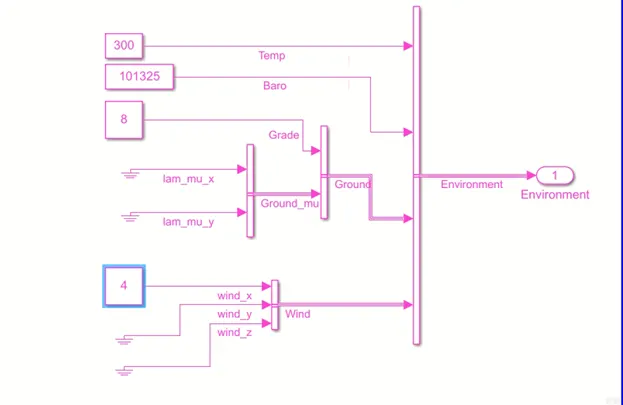
Greadiability and wind velocity is set same as of HEV reference model
Simulation Result
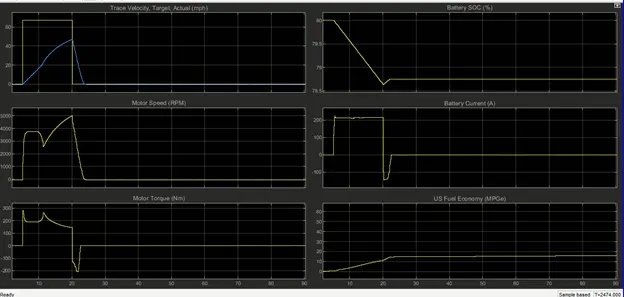
1.Vehicle is at rest from 0-5sec and the starts accelerating till 20 sec
2.After 20 sec, the vehicles decelerates, on that time, Motor act as generator and the battery gets charged through regenerative breaking.
3.While decelerating (regeneration) SOC is being increased
4.While acceleration, SOC is reduced from 80 to 78.7 percentage
5.The maximum current being used is near 200amps and during decelarion negative 150 Amps, that concludes battery is being consumed and charged respectively.
Compairing the results, EV has greater efficiency, Fuel economy.