Week-4 Challenge WOT Condition Part-2
1. What is the difference between mapped and dynamic model of engine, motor and generator? How can you change model type?
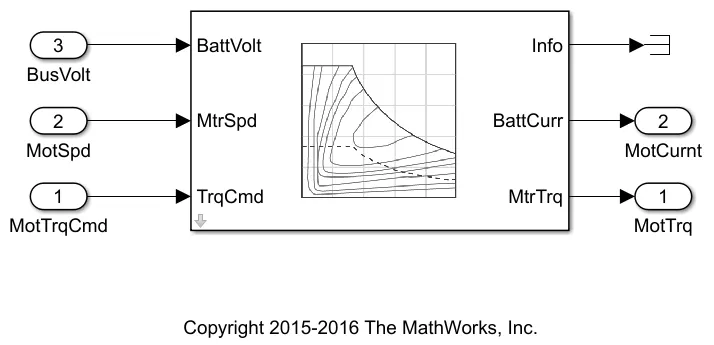
Mapped model:It uses a set of steady-state lookup tables to characterize engine performance.
The tables provide overall engine characteristics, including actual torque, fuel flow rate, BSFC, and engine-out exhaust emissions.
When to use,
- If we have engine data from a dynamometer or a design tool like GT-POWER.
- For quasi steady-state engine simulations.
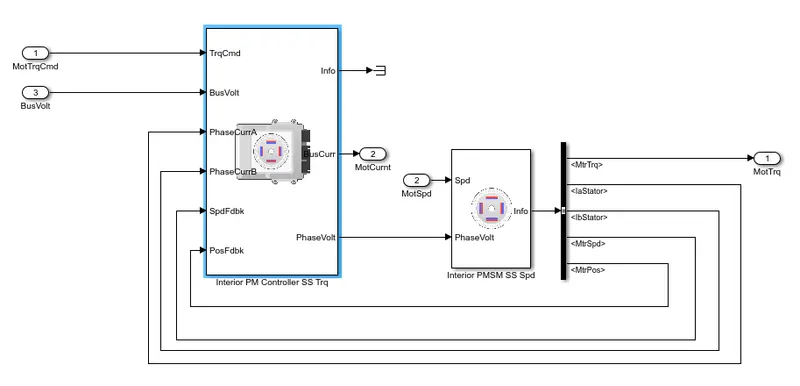
Dynamic model: It decomposes the engine behavior into engine characteristics that are separated into lower-level components. By combining components in this way, the models capture the dynamic effects.
When to use,
- If we need a more detailed dynamic model and have component-level data.
- To analyze the impact of individual engine components on the overall performance
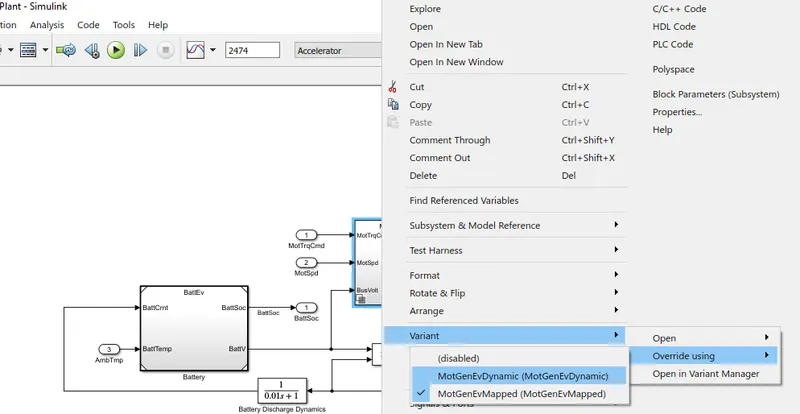
To change model type follow below steps:
- Open the EV model in simulink.
- Double click on the passenger block.
- Then double click on electric plant sub model block.
- After entering into the electric plant sub model, right click on the motor block and select varaint from the list as shown below.
- Under variant, select override using, and then select the required model.
2. How does the model calculate miles per gallon? Which factors are considered to model fuel flow?
Miles per gallon (MPG) is a fuel economy rating determined by how far a car can travel on a gallon a deisel or petrol (gasoline) for convention IC engine vehicle. However fuel economy for EV or hybrid vehicles via miles per gallon equivalent.
In order to create the MPG equivalent, the Environmental Protection Agency (EPA) uses an established energy standard of 115,000 BTUs (British thermal units) per gallon of gasoline. Simplified, this means that if you ignited 1 U.S. gallon of unleaded gasoline, it would generate that much heat. To create that same amount of heat, 33.7 kilowatt-hours of electricity would be required. Thus, 1 gallon of gasoline generates the same ‘heat energy’ as 33.7 kilowatt-hours of electricity.
If an electric vehicle is able to travel 100 miles on 33.7 kWh of electricity (the energy equivalent of 1 gallon of gasoline), it would be rated with an MPG equivalency of 100 MPGe.
In case of EV matlab model, inside the visualization block there is a block named performance calculations as shown below.
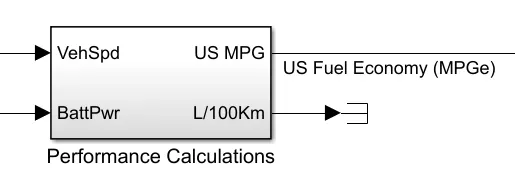
Double click on the above block we would be able to see the caluclations for the MPGe.
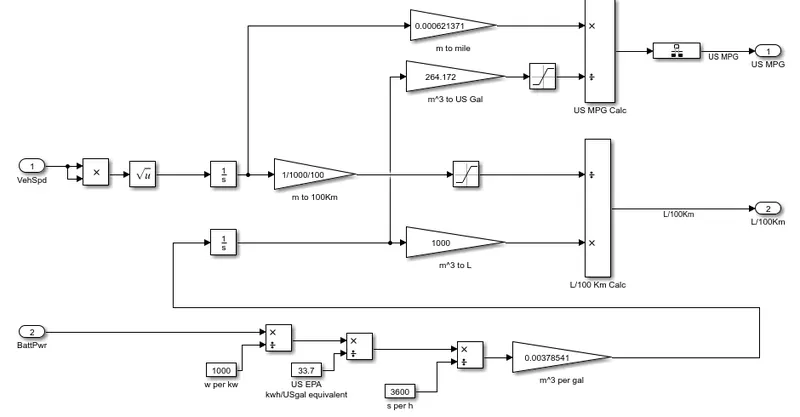
The MPGe calcualtions are based on 2 inputs.
- Vehicle Speed
- Battery power
3. Run the HEV Reference Application with WOT drive cycle. Change the grade and wind velocity in the environment block. Comment on the results.
Simulink model of HEV:
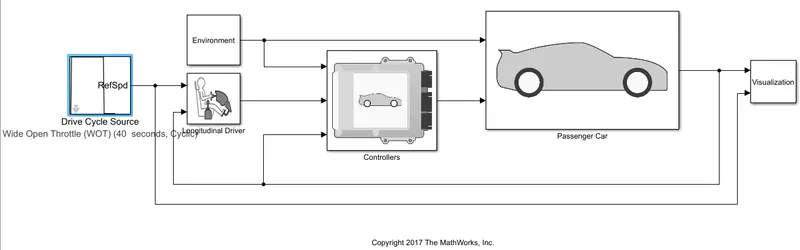
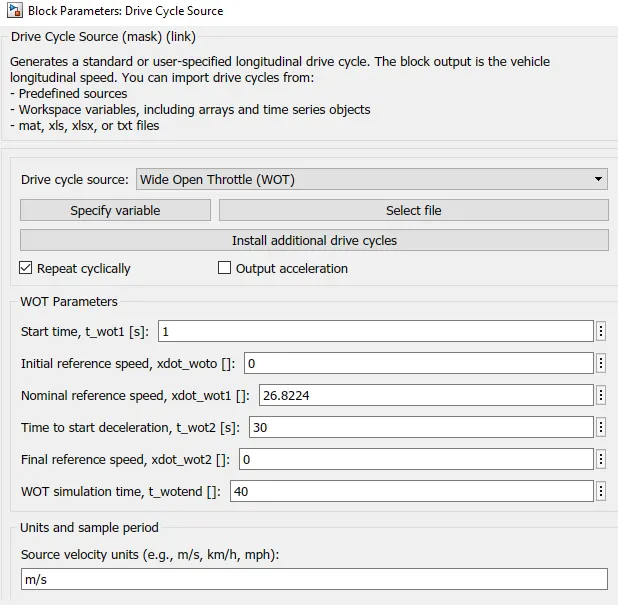
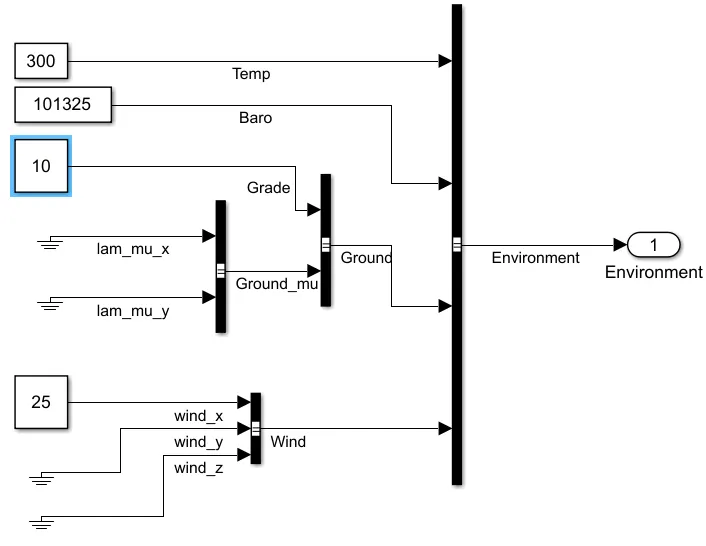
The drive vehicle has been changed to WOT with a sample time of 40 seconds. We have alos changed the wind speed and the grade to 25 m/s and 10 respectively.
Results:
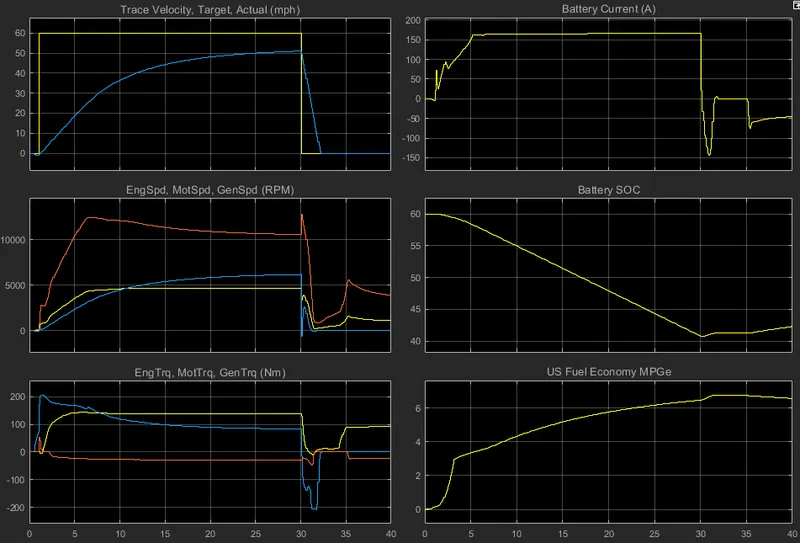
Plot#1: Trace velocity, target, actual (mph)
Top velocity = 51.76 mph
Acceleration time = 28.999 seconds
Deceleration time = 2.1 seconds
Plot#2: Engine speed, motor speed, generator speed.
Max motor rpm = 6175 rpm
Max engine rpm = 46270 rpm
Generator rpm = 12430 rpm
Plot#3: Engine torque, motor torque, genrator torque.
max Engine torque = 138.6 N.m
max Motor Torque (acceleration)= 206.8 N.m
max motor toorque (deceleration) = 206.99 N.m
Plot#4: Battery Current (A)
The battery current is at its maximum 167.3A when full throttle is applied. During deceleration it falls down to negative 144.5A.
Plot#5: Battery SOC
The battery SOC falls from 60% to 40.7% during acceleration. During deceleration the SOC slightily increases to 41.2% due to regenerative braking.
Plot#6: US Fuel economy MPGe.
The max fuel economy achieved is 67.8 mpg.
4. Keeping all other parameters same, compare the simulated results of hybrid and pure electric powertrains.
Results of HEV:
Results of EV:
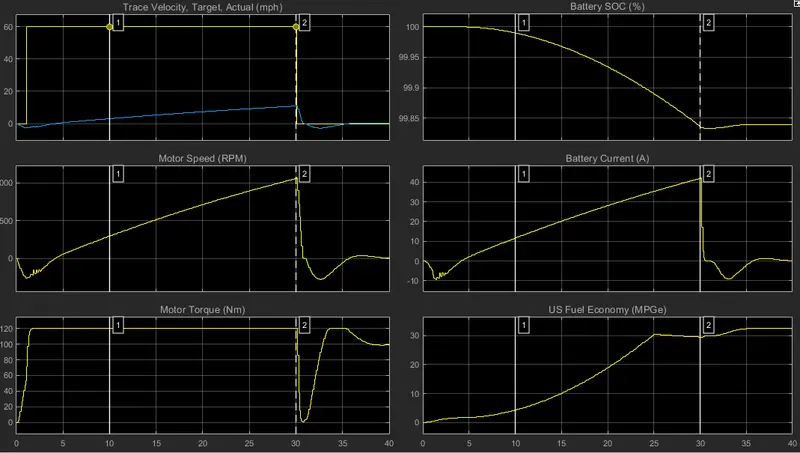
All the parameters are kept same for HEV and EV simulink model.
Results comparison:
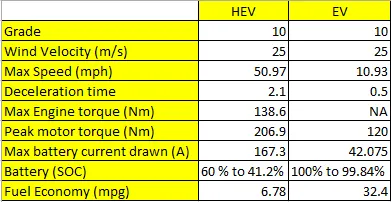
Observations:
- Hybrid vehicle achieved higher speed than EV vehicle.
- The battery capacity of EV is higher than HEV.
- Fuel economy of EV is more than HEV.