Week-4 Challenge WOT Condition Part-2
Q-1) What is the difference between mapped and dynamic model of engine, motor and generator? How can you change model type?
Internal Combustion Mapped and Dynamic Engine Models
When you customize a SI or CI reference application, you can use either a dynamic or mapped engine model. The table provides considerations for using either implementation.
|
Type |
Implementation |
When to Use |
|
|---|---|---|---|
|
Mapped |
|
Model uses a set of steady-state lookup tables to characterize engine performance. The tables provide overall engine characteristics, including actual torque, fuel flow rate, BSFC, and engine-out exhaust emissions. |
|
|
Dynamic |
|
Model decomposes the engine behavior into engine characteristics that are separated into lower-leDifference Between Motor and Generatorvel components. By combining components in this way, the models capture the dynamic effects. |
|
Difference Between Motor and Generator
The Electric Motor and Generator are differentiated on various factors like the main principle of working or function of the motor and generator. Consumption or production of electricity, its driven element, the existence of the current in the winding. Fleming’s rule followed by the motor and generator.
The Difference Between the Motor and the Generator are explained below in the tabulated form.
| BASIS | MOTOR | GENERATOR |
|---|---|---|
| Function | The Motor converts Electrical energy into Mechanical Energy | Generator converts Mechanical energy to Electrical energy. |
| Electricity | It uses electricity. | It generates electricity |
| Driven element | The Shaft of the motor is driven by the magnetic force developed between armature and field. | The Shaft is attached to the rotor and is driven by mechanical force. |
| Current | In a motor the current is to be supplied to the armature windings. | In the generator current is produced in the armature windings. |
| Rule Followed | Motor follows Fleming’s Left hand rule. | Generator follows Fleming’s Right hand rule. |
| Example | An electric car or bike is an example of electric motor. | Energy in the form of electricity is generated at the power stations. |
The motor and the generator are almost similar from the construction point of view, as both have stator and rotor. The main difference between the two is that the Motor is an electric device which converts electrical energy into mechanical energy. The generator is vice versa of that motor. It converts mechanical energy into electrical energy.
Difference between Motor and Generator.
- The Motor converts electric energy into mechanical energy, whereas generator does the opposite.
- Electricity is used in the motor, but the generator produces the electricity.
- The Shaft of the motor is driven by the magnetic force developed between armature and field windings whereas, in the case of the Generator the Shaft is attached to the rotor and is driven by mechanical force.
- The current is to be supplied to the armature windings in case of a Motor, and in Generator, current is produced in the armature windings.
- Motor follows Fleming’s Left hand rule while Generator follows Fleming’s Right hand rule.
- The example of Motor is an electric car or bike where electric current is supplied to the machine or device, and it gets converted into mechanical motion and, as a result, the car or bike moves. The example of Generator is that in power stations the turbine is used as a device which converts mechanical energy of force of water falling from the dam to generate electric energy.
- We can change Model type of our vehicle from Mapped to Dynamics by following Few steps :-
- Go inside the Controllers block from the main Electric Vehicle block diagram
- Go inside the Powertrain Control Module (PCM) (EVPowertrainController) block
- Go inside the Regen Braking Control
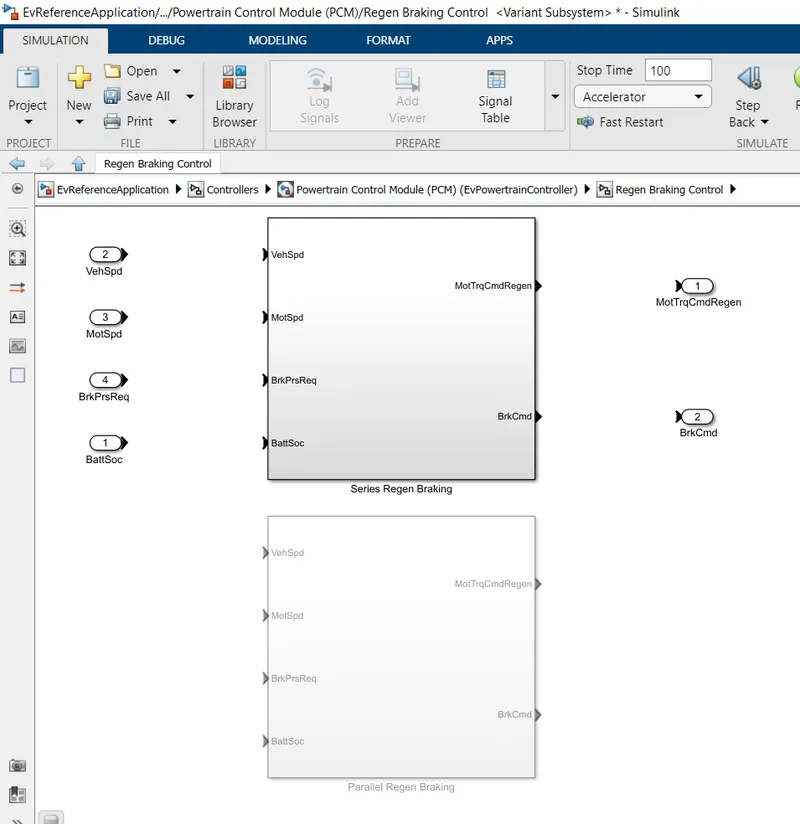
Then Right click and select Variant -> Label Mode Active Choice -> Variant(Series Regen Braking)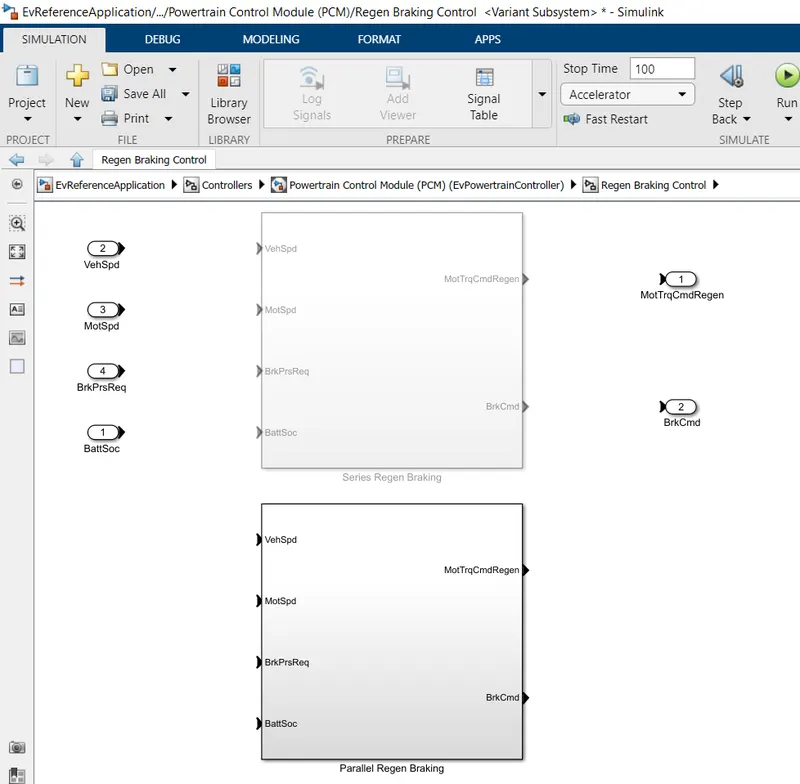
Q-2) How does the model calculate miles per gallon? Which factors are considered to model fuel flow?
There is Performance Calculation block Inside Visualization block, here MPG depend upon:
- Vehicle speed
- Battery power
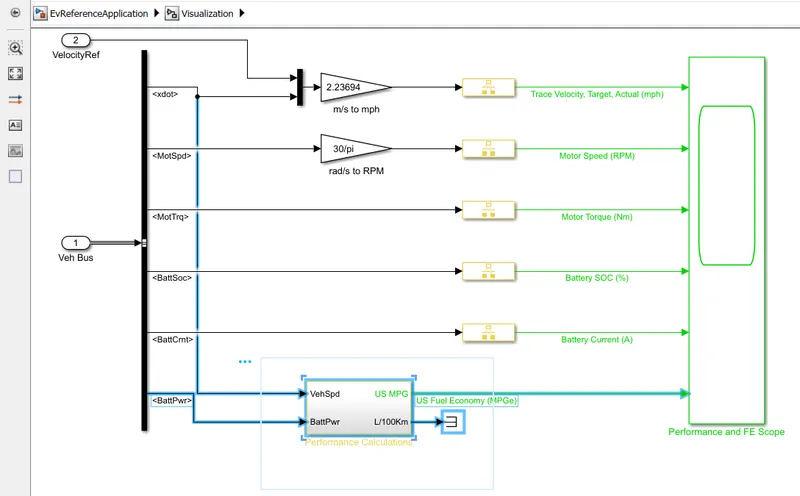
and the conversion for MPG is stated in below picture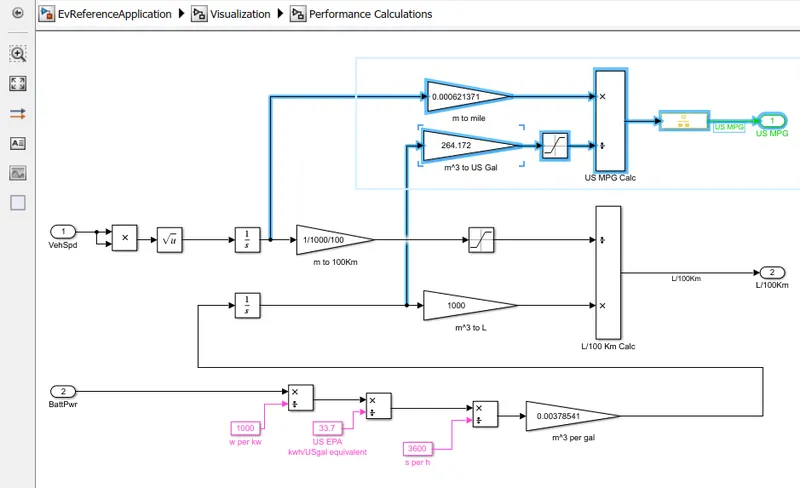
Q-3) Run the HEV ReferenceApplication with WOT drive cycle. Change the grade and wind velocity in the environment block. Comment on the results.
- Running HEV ReferenceApplication with WOT drive cycle for 100 sec with zero Grade and zero Wind Velocity 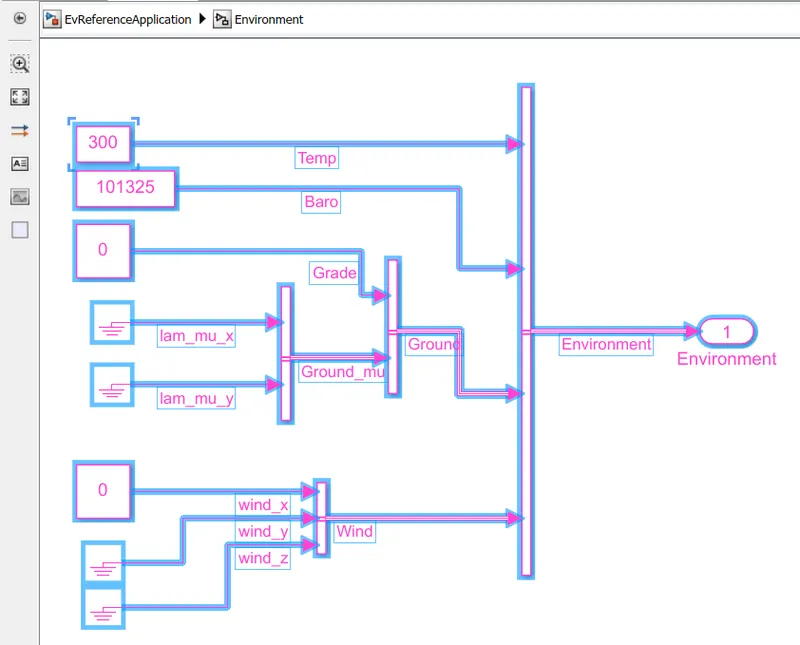
And we get following output :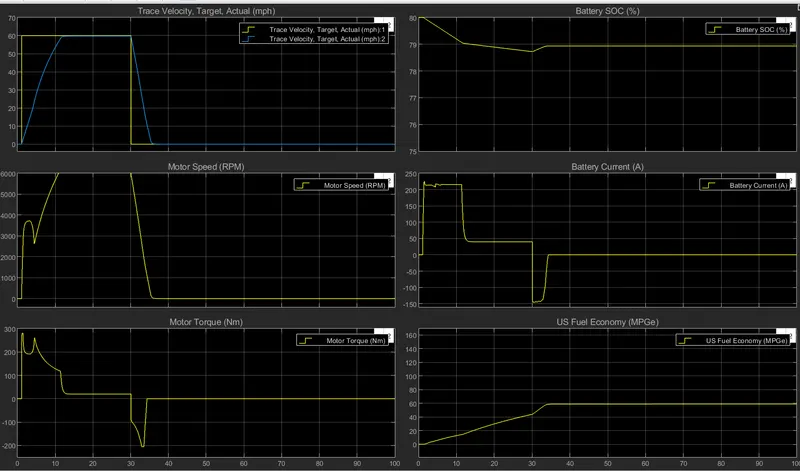
Now we change Grade to 6 and Wind Velocity to 30mph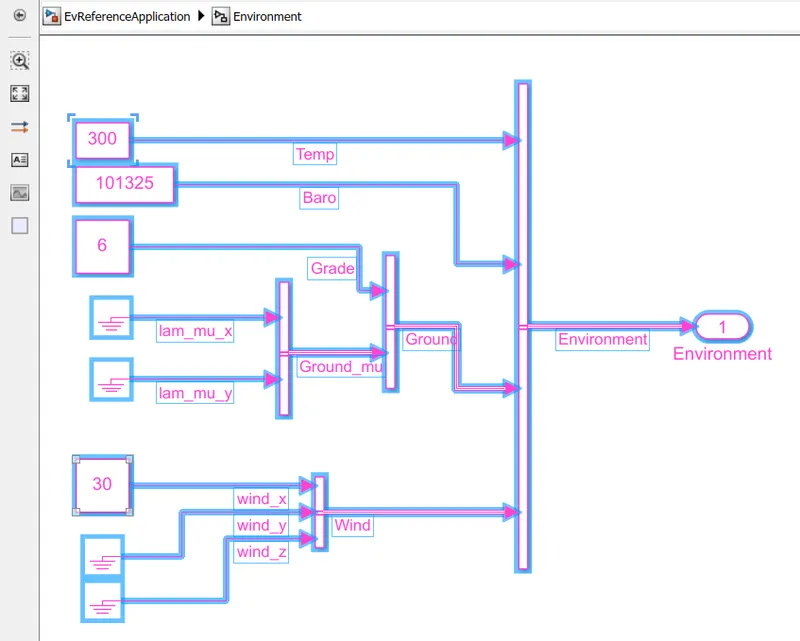
Then we get Following Output: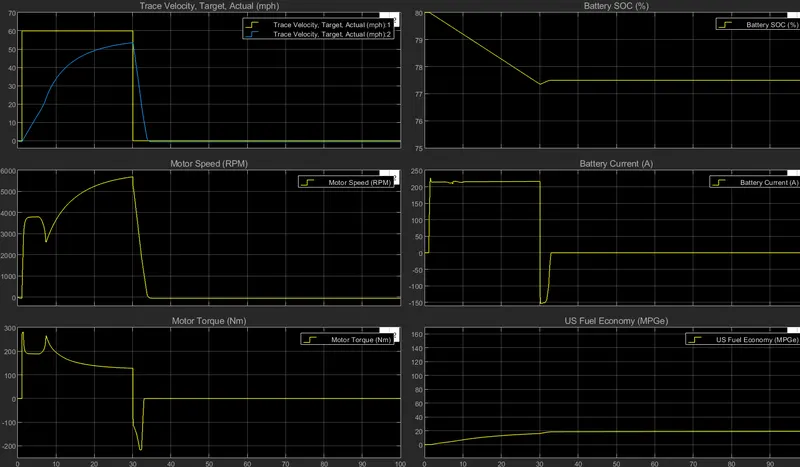
From the obove 2 Outputs we can make following Comments :
- Vehicle accelerate fast and having higher Peak Velocity Without Grade and Wind Velocity,
- Battery SOC decreses fast with Grade and Wind Velocity.
- Moter Torque Output increases with Grade and Wind Velocity.
- Motor Speed output decreases With Grade and Wind Velocity,
- Peak Battery Current for long time With Grade and Wind Velocity,
- Fuel economy decreases i.e MPG decrease With Grade and Wind Velocity,
Q-4) Keeping all other parameters same, compare the simulated results of hybrid and pure electric powertrains.
Running Puew-EV ReferenceApplication with WOT drive cycle for 100 sec with zero Grade and zero Wind Velocity and we get following output :
Running Hybrid-EV ReferenceApplication with WOT drive cycle for 5 sec with zero Grade and zero Wind Velocity and we get following output
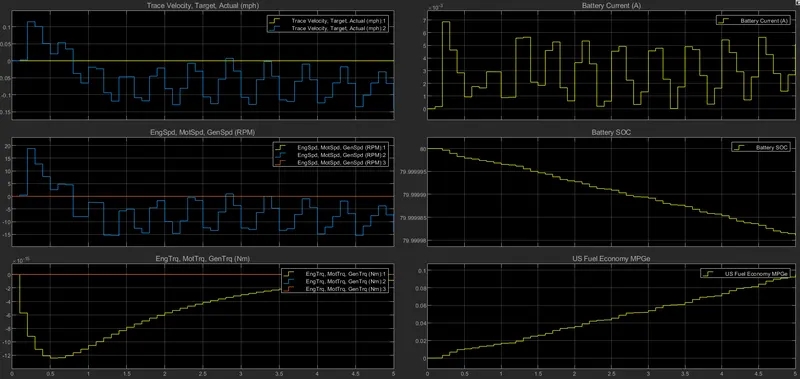
Here Electric vehicle is completely driven off by battery whereas Hybrid vehicle have both battery as well as IC engine so both hai different performace.
REFERENCE : skilllync, google