Week-4 : Basic Calibration of Single cylinder CI-Engine
Aim- The aim of this project is to perform simulation of 1D CI engine and analyse the performance . It is also intended to understand the difference between CI and SI Engine.
Comparison between SI and CI engine
The basic differences between CI and SI engines are listed below
| S.No | SI Engine | CI Engine |
| 1 | SI Engine use a spark Plug for iginition of air fuel mixture | CI engine auto ignites when atomised fuel is injected into compressed air. |
| 2 | SI engine have a low compression ratio, typically in the range of 9 to 11 | CI engine have a high compression ratio, typically in the range 14 to 22 |
| 3 | SI engine require Directed port for tumble fuel injection | CI engine require helical port |
| 4 | Commonly used fuels are Petrol, LPG and CNG | Commonly used fuels are Diesel, Biodiesel |
| 5 | SI engines known for Low NVH, driving comfort | CI engines known for fuel efficiency |
| 6 | Main problem in SI engine is Knocking | Main problem in CI engine is Detonation |
| 7 | High Engine Speed range 1000rpm-8000rpm | Low engine speed range 1000rpm -4000rpm |
| 8 | Emissions include CO,HC and Nox | Emissions include CO,HC ,Nox and soot |
| 9 | 3 way catalytic converter used | Diesel Oxidation Catalyst, Diesel Particulate Filter and Selective Catalytic Reduction are types of aftertreatment methods used |
In the 1D tutorial model of CI and SI engine in GT POST, the following differences were noted.
| Component | Parameter | 1-D Cylinder SI | 1- D Cylinder -DI |
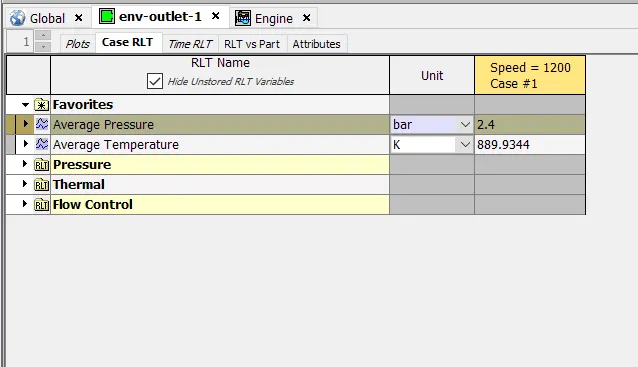
| Env inlet | Pressure (bar) | 1 | 2.4 |
| Temperature (K) | 300 | 350 | |
| Intake Runner | Length(mm) | 350 | 120 |
| Imposed Wall Temperature (K) | 300 | 350 | |
| Fuel | Type | indolene | diesel-vap |
| Fuel Injection | Method | Air fuel mixture injected into intake port. Air Fuel ratio 14.5. Injector delivery rate 6g/s | 80mg of fuel injected at 300 K |
| Cylinder Geometry | Bore (mm) | 86 | 100 |
| Stroke (mm) | 86.07 | 100 | |
| Connecting Rod (mm) | 175 | 220 | |
| Compression Ratio | 9.5 | 16.5 | |
| TDC Clearance Height | 1 | 0.5 | |
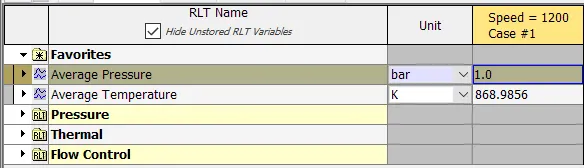
| Env outlet | Pressure (bar) | 1 | 2.4 |
| Temperature (K) | 300 | 350 |
Comparison of Engine Performance Parameters at 1200 RPM
| Parameter | SI | CI | Reason |
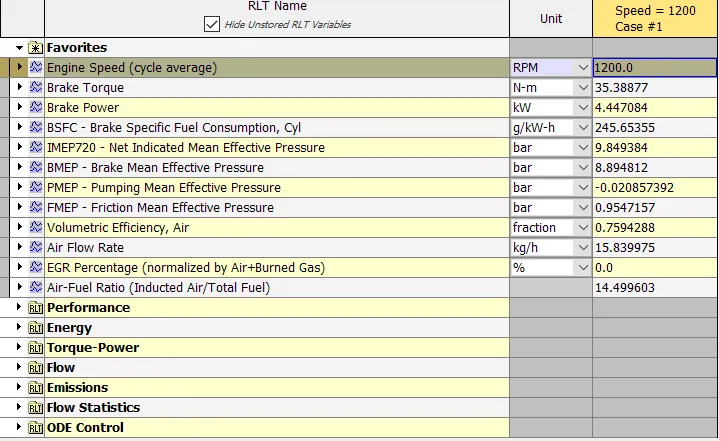
| Brake Specific Fuel Consumption (g/kW-h) | 245.65 | 223 | Power developed in diesel engine is higher than SI engine due to higher compression ratio (12.9 kW in Diesel vs 4.1 in SI at 1200 rpm). Since Power developed is higher in CI therefore BSFC is lower. |
| Exhaust Temperature (K) | 868.98 | 889.93 | Due to higher compression ratio in diesel engine, exhaust temperature is higher |
| Air Fuel Ratio | 14.49 | 18.75 | CI engines typically operate at higher compression ration compared to SI engine. |
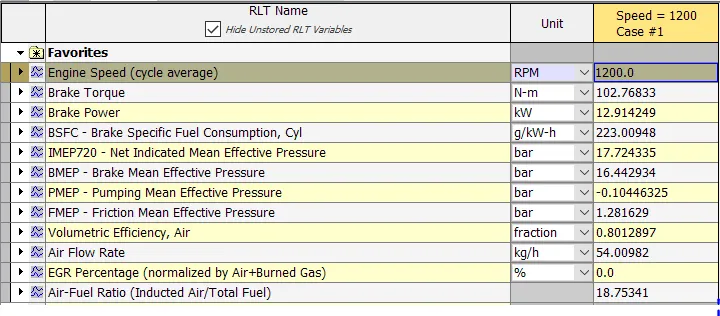
Brake Specific Fuel Consumption , BSFC @ 3600 rpm = 238.2448 g/KW-h-
SI Engine
When MFB =50
Mass fraction burned (MFB) in each individual engine cycle is a normalized quantity with a
scale of 0 to 1, describing the process of chemical energy release as a function of crank angle.
It is noted that by changing the MFB to 50 at 1200 rpm,
- BSFC increases. This is due to lower power output at MFB =50
- Air Fuel Ratio is almost the same
- Brake torque reduces
- Brake Power reduces
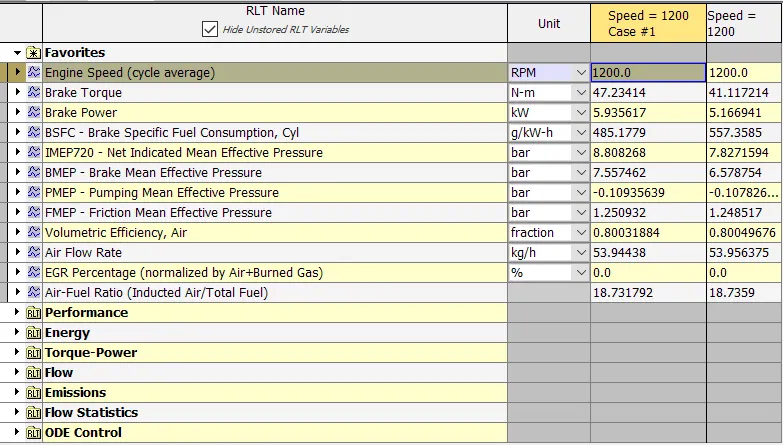
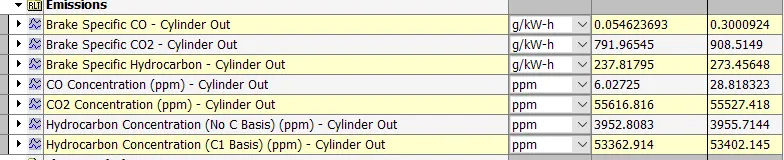
Also when combustion duration increases, the quantum of emissions of various pollutants has also increased.
Conclusion:- In this assignment, the calibration of 1D Diesel engine was performed and results were examined. Comparison were drawn between SI and CI engine, also impact of MFB on performance were analysed.