Week 4.2 - Combustion Efficiency Calculation after Preheating
Combustion Efficiency Calculation after Preheating
AIM:
- Analyze the effect of preheating on the adiabatic flame temperature
- Observe the effect of preheating inlet air on the combustion efficiency.
INTRODUCTION AND THEORY:
Recuperator:
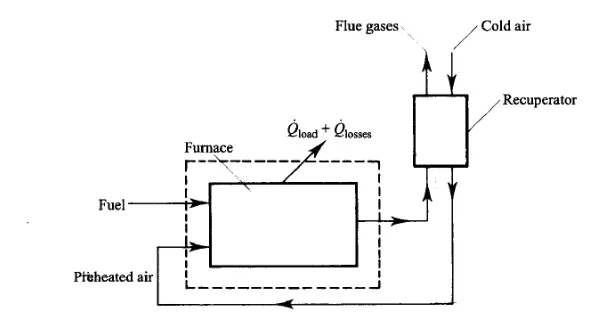
A recuperator is a heat-exchange device which transfers the energy from flue gas to inlet air. During combustion a large amount of energy is released in the form of flue gas and instead of sending it to the open atmosphere, energy can be used to heat the incoming air. Different types of recuperators are plate recuperator, rotary recuperator, water recirculating recuperator and roof recuperator.
The flow diagram of recuperator:
Combustion efficiency:
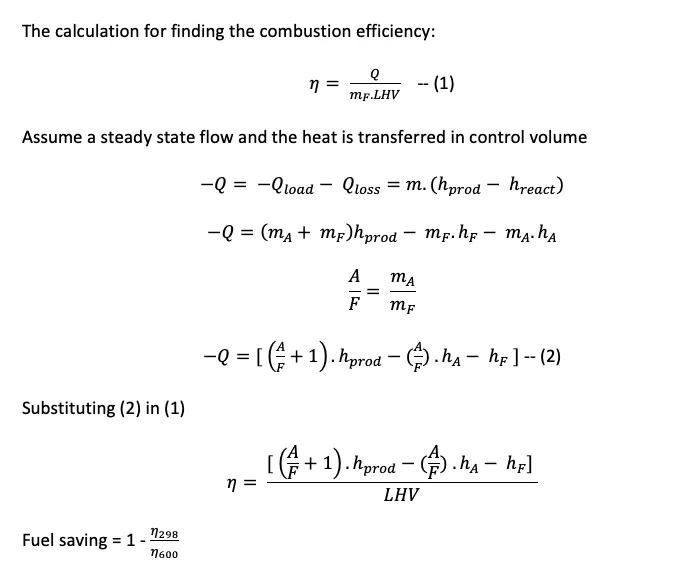
The combustion efficiency is the measure of how well the fuel is combusted into the combustion process. In practical applications, complete combustion is not possible and it leaves with a lot of non combustible products. The efficiency value is higher for gaseous fuels and liquids fuels than the solids.
The combustion efficiency of the recuperator:
CODING APPROACH:
The effect of preheating inlet air temperature on the AFT:
- The gas object is defined using the class Solution
- The air and fuel object is created with the Quantity class
- Assign the inlet Temperature, pressure and mole values.
- The preheating temperature is assigned between 298 - 600 using linspace.
- The preheating values are calculated for air object using the for loop.
- The mixture is added and equilibrated and temperatures are appended in a separate array.
- The graph is plotted for inlet air and Adiabatic flame temperature.
The combustion efficiency calculation:
- Three objects are defined: fuel, air and product.
- The necessary values are assigned eg, T, P, mole fractions, mass and enthalpy
- For calculating the combustion efficiency at STP conditions the air and fuel are at 298.15 K and the product temperature at 1700 K is assigned.
- Using the for loop the inlet air is passed up to 600K.
- The efficiency and the fuel savings is calculated
- The graphs are plotted for efficiency and fuel savings with respect to the inlet air temperature.
CODING AND RESULTS:
The effect of preheating inlet air temperature on the AFT:
import cantera as ctimport numpy as npimport matplotlib.pyplot as plt
gas = ct.Solution('grimech30.cti')
AFT = []
fuel = ct.Quantity(gas)fuel.TPX = 298.15, ct.one_atm, {'CH4':1}fuel.moles = 1
T_pre = np.linspace(298, 600, 100)
for T_p in T_pre: air = ct.Quantity(gas) air.TPX = T_p, ct.one_atm, {'O2':0.21, 'N2':0.79} air.moles = 9.52
M = fuel + air M.equilibrate('HP','auto') AFT.append(M.T)
print(M.T)plt.figure()plt.plot(T_pre, AFT)plt.title('Preheat air effect on AFT ')plt.xlabel('Preheat air temperature (K)')plt.ylabel('Adiabatic flame temperature (K)')plt.grid('on')plt.savefig('A4_Que1.png')plt.show()
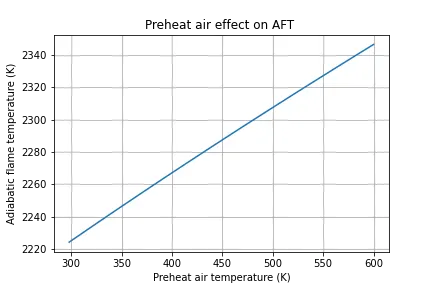
It is evident from the graph that the adiabatic flame temperature increases with increase in inlet air temperature. Both the inlet air temperature and AFT are directly proportional to each other.
The effect of preheating inlet air on the combustion efficiency:
import cantera as ctimport numpy as npimport matplotlib.pyplot as plt
gas = ct.Solution('grimech30.cti')
air = ct.Quantity(gas)air.TPX = 298.15, ct.one_atm, {'O2': 0.21, 'N2': 0.79}air.moles = 9.52air_mass = air.massair_H = air.enthalpy_mass
fuel = ct.Quantity(gas)fuel.TPX = 298.15, ct.one_atm, {'CH4':1}fuel.moles = 1fuel_mass = fuel.massfuel_H = fuel.enthalpy_mass
product = ct.Quantity(gas)product.TPX = 1700, ct.one_atm, {'CO2':1/10.52, 'H2O':2/10.52, 'N2':7.52/10.52}product.moles = 10.52product_mass = product.massproduct_H = product.enthalpy_mass
LHV = 50e+6air_fuel_mass = air_mass / fuel_mass
# Calculating combustion efficiency at STP conditionseff_stp = ((air_fuel_mass)*air_H + fuel_H - (air_fuel_mass + 1)*product_H) / LHV
T_pre = np.linspace(298, 600, 100)Efficiency = []Fuel_saving = []
for T_p in T_pre: air.TPX = T_p, ct.one_atm, {'O2': 0.21, 'N2': 0.79} air.moles = 9.52 air_mass = air.mass air_H = air.enthalpy_mass air_fuel_mass = air_mass / fuel_mass # Calculating combustion efficiency upto 600 K eff = ((air_fuel_mass)*air_H + fuel_H - (air_fuel_mass + 1)*product_H) / LHV Efficiency.append(eff) # Calculating Fuel savings Fuel_savings = abs(1-(eff_stp/eff)) Fuel_saving.append(Fuel_savings)
plt.figure()plt.plot(T_pre,Efficiency)plt.title('Combustion efficiency at various inlet temperature')plt.xlabel('Preheat air temperature (K)')plt.ylabel('Efficiency value')plt.grid('on')print(Fuel_saving)print(air_fuel_mass)plt.savefig('A4_Que2.png')plt.show()
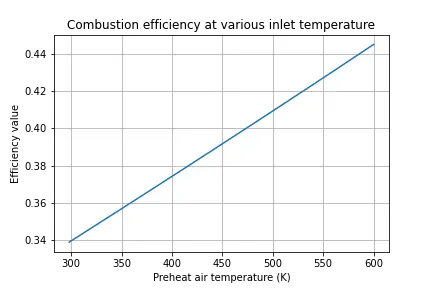
It is shown that with the rise of inlet air temperature the combustion efficiency value is increased which means more fuel is combusted at the preheat of 600K than the 300K.
Fuel saved at 298 K = 0.00015312320408966684 kg
Fuel saved at 600 K = 0.23923117661414817 kg
Larger the preheat temperature, more fuel is saved. As a result, preheating the air helps to save fuel.
It is always not recommended to assume the fixed furnace exit temperature. The exit temperature is a product of the combustion reaction and it involves various factors. Assuming the exit temperature, will not be helpful for practical applications.
CONCLUSION:
The study on the effect of preheating on the adiabatic flame temperature and fuel conversion efficiency is observed. It is concluded that preheating the air will improve the flame temperature and combustion efficiency.