Week 5.1 - Compact Notation Derivation for a simple Mechanism
AIM:
Derive the reaction rate ODEs and production of each species for the simple mechanism mentioned below.
INTRODUCTION and THEORY:
The reaction rate of the reaction is defined as the change in concentration of reactants or products per unit time. In other words, it is the speed at which the reaction takes place. The speed of chemical reaction can vary rapidly in seconds or longer in years and it depends on the species involved and the environment of reaction takes place.
These reaction rates can be determined as an Ordinay Different Equations (ODEs) using the concentration of species with respect to time. Thus the ODEs of all the species of the reaction system is called as the coupled ODEs. This coupled ODEs can be solved numerically by integrating the entire equation system.
Solving integrated systems for practical applications is quite difficult and it involves thousand of reactions and hundreds of species. As a result, it requires a computer program to solve complex equations and derive the concentration of different species with respect to time.
MECHANSIM:
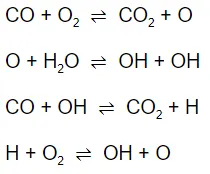
COMPACT NOTATIONS:
Firstly, define the reactions i and the species j involed in the mechanism using an index.
| i | Reaction |
| 1 | R1 |
| 2 | R2 |
| 3 | R3 |
| 4 | R4 |
| j | Species |
| 1 | CO |
| 2 | O2 |
| 3 | CO2 |
| 4 | O |
| 5 | H2O |
| 6 | OH |
| 7 | H |
There are 4 reactions and 7 species involed in this reaction mechanism. Next, for calculating the net reaction rate and production rate, we need the values of `(v_(ji)) , (v_(ji))' and (v_(ji))''`
`(v_(ji))'` is the coefficient matrix of reaction species present in the reactant side,`
`(v_(ji))''` is the coefficient matrix of reaction species present in the product side. `
`(v_(ji)' = [[1,1,0,0,0,0,0],[0,0,0,1,1,0,0],[1,0,0,0,0,1,0],[0,1,0,0,0,0,1]]`
`(v_(ji))'' = [[0,0,1,1,0,0,0],[0,0,0,0,0,2,0],[0,0,1,0,0,0,1],[0,0,0,1,0,1,0]]`
`(v_(ji)) = (v_(ji))'' - (v_(ji))'`
`(v_(ji)) = [[-1,-1,1,1,0,0,0],[0,0,0,-1,-1,2,0],[-1,0,1,0,0,-1,1],[0,-1,0,1,0,1,-1]]`
The net reaction rate is :`w_2 = -q_1 - q_4`
`q_i = k_(fi)prod_(j=1)^N [X_(j)]^(v_(ji)') - k_(ri)prod_(j=1)^(N) [X_j]^(v_(ji)'')`
where N = number of species in reaction mechanism; `k_(fi)` = Forward reaction rate of reactions i; `k_(ri)` = Reverse reaction rate of reactions i
`q_1 = k_(f1)[CO]^1[O_2]^1[CO_2]^0[O]^0[H_2O]^0[OH]^0[H]^0 - k_(r1)[CO]^0[O_2]^0[CO_2]^1[O]^1[H_2O]^0[OH]^0[H]^0`
hence,
`q_1 = k_(f1)[CO][O_2] - k_(r1)[CO_2][O]`
`q_2 = k_(f2)[O][H_2O] - k_(r2)[OH]^2`
`q_3 = k_(f3)[CO][OH] - k_(r3)[CO_2][H]`
`q_4 = k_(f4)[O_2][H] - k_(r4)[O][OH]`
The production rate is:
`w_j = sum_(i =1)^L v_(ji) . q_i`
where L = number of reactions in the mechanism
`w_1 = -q_1 - q_3`
`w_2 = -q_1 - q_4`
`w_3 = q_1 + q_3`
`w_4 = q_1 - q_2 + q_4`
`w_5 = -q_2`
`w_6 = 2q_2 - q_3 + q_4`
`w_7 = q_3 - q_4`
The production rate can also be defined as the rate of change of species concentration with time
`w_j = (d[X_j])/ dt`
The rate od change of species in matrix form
`[[w_1],[w_2],[w_3],[w_4],[w_5],[w_6],[w_7]]=[[ (d[CO])/dt],[(d[O_2])/dt], [(d[CO_2])/dt],[(d[O])/dt], [(d[H_2O])/dt],[(d[OH])/dt],[(d[H])/dt]]`
`(d[CO])/dt = k_(r1)[CO_2][O]-k_(f1)[CO][O_2]+k_(r3)[CO_2][H]-k_(f3)[CO][OH]`
`(d[O_2])/dt = k_(r1)[CO_2][O] - k_(f1)[CO][O_2]+k_(r4)[O][OH]-k_(f4)[O_2][H]`
`(d[CO_2])/dt = k_(f1)[CO][O_2] - k_(r1)[CO_2][O]+ k_(f3)[CO][OH] - k_(r3)[CO_2][H]`
`(d[O])/dt = k_(f1)[CO][O_2] - k_(r1)[CO_2][O]+k_(r2)[OH]^2-k_(f2)[O][H_2O]+k_(f4)[O_2][H]-k_(r4)[O][OH]`
`(d[H_2O])/dt = k_(r2)[OH]^2-k_(f2)[O][H_2O]`
`(d[OH])/dt = 2k_(f2)[O][H_2O]-2k_(r2)[OH]^2+k_(r3)[CO_2][H]-k_(f3)[CO][OH]+k_(f4)[O_2][H] - k_(r4)[O][OH]`
`(d[H])/dt = k_(f3)[CO][OH] - k_(r3)[CO_2][H]+k_(r4)[[O][OH]-k_(f4)[O_2][H]`
Thus, the coupled ODEs are formed for the given mechanism.