Week 4.2 - Combustion Efficiency Calculation after Preheating
Aim: The aim of this study is to understand the effect of preheating temperature of air on the fuel savings.
Introduction: Recuperator is a device which is used to harness the energy of the flue gases coming out of the combustor. The heat energy of the flue gases is given to the incoming air in order to increase its temperature. The energy exchange happens by means of conduction and convection heat transfer between the flue gases and the fresh incoming air. This preheating helps in proper combustion of fuel resulting in the generation of more energy and thus increasing the efficiency of the combustion process. This reduces the amount of fuel required to be burnt for the power generation thus increasing the fuel savings.
Coding Approach:
- Cantera, numpy, and matplotlib.pyplot modules are imported as ct, np, and plt, respectively.
- Using ‘Solutions’ class a ‘gas’ object is created.
- An array containing temperature values is created.
- Empty arrays are created to store the values of adiabatic flame temperature, and the other enthalpy values.
- A ‘for’ loop is created. Its iterator is iterated through the values in the temperature array.
- In the ‘for’ loop, ‘A’ object is created, which is an instance of the ‘Quantity’ class. This class inherits from ‘gas’ object. Using ‘.TPX’ method, temperature, pressure and molar composition is set. Temperature is set at 298.15K, and pressure at 1 atmosphere. Molar composition of oxygen (O2) and nitrogen (N2) is defined.
- Mass of air is calculated using ‘A.mass’ method.
- Similarly, ‘B’ object is created and its temperature, pressure and molar composition is set for methane (CH4). It’s mass is calculated using ‘B.mass’ method.
- Also, ‘C’ object is created to represent the exhaust gases. The exhaust gases contain ‘H2O’, ‘CO2’ and ‘N2’. The exhaust temperature is set as 1700K as per given in the question.
- Using ‘.enthalpy_mass’ method, enthalpy values for ‘A’, ‘B’, and ‘C’ are calculated and those value are stored in the respective arrays (created in the step 4) using ‘.append’ method.
- Using the above values, heat output is calculated using the heat balance equation.
- Using matplotlib.pyplot module, a graph of combustion efficiency and preheating temperature is plotted.
Code:
import cantera as ct
import numpy as np
import matplotlib.pyplot as plt
gas = ct.Solution("gri30.cti")
Temp = [298, 350, 400, 450, 500, 550, 600]
AFT = []
enthalpy_air = []
enthalpy_fuel = []
enthalpy_exhaust = []
for i in Temp:
A = ct.Quantity(gas)
A.TPX = i, ct.one_atm, {'O2':0.21,'N2':0.79}
A.moles = 9.52
mass_air = A.mass
B = ct.Quantity(gas)
B.TPX = 298.15, ct.one_atm, {'CH4':1}
B.moles = 1
mass_fuel = B.mass
Ex = ct.Quantity(gas)
Ex.TPX = 1700, ct.one_atm, {'H2O':2/10.52, 'CO2':1/10.52, 'N2':7.52/10.52}
enthalpy_air.append(round(A.enthalpy_mass,2))
enthalpy_fuel.append(round(B.enthalpy_mass,2))
enthalpy_exhaust.append(round(Ex.enthalpy_mass,2))
print(AFT)
print('Enthalpy of air is', enthalpy_air)
print('Enthalpy of fuel is', enthalpy_fuel)
print('Enthalpy of exhaust is', enthalpy_exhaust)
LHV = 50000000
AF_ratio = mass_air/mass_fuel
Q_out = []
Comb_Efficiency = []
for c in np.arange(0, 7, 1):
Q = -((AF_ratio+1)*enthalpy_exhaust[c] - AF_ratio*enthalpy_air[c] - enthalpy_fuel[c])
Q_out.append(round(Q,2))
efficiency = Q/LHV
Comb_Efficiency.append(round(efficiency,2))
print(Q_out)
print(Comb_Efficiency)
plt.plot(Temp, Comb_Efficiency)
plt.xlabel('Preheating_Temperature')
plt.ylabel('Comb_Efficiency')
plt.grid('on')
plt.show()
Results:
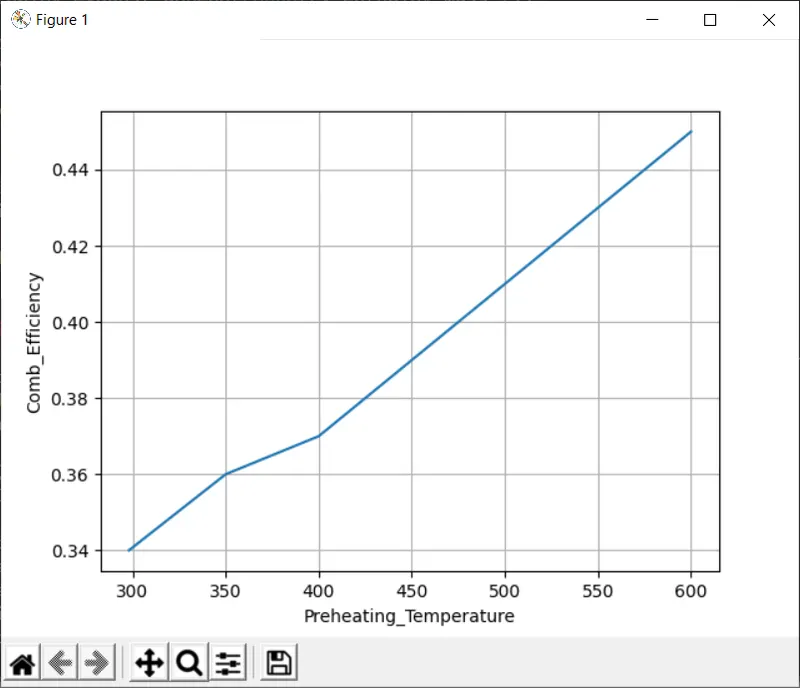
Figure 1: Graph of Combustion Efficiency vs Preheating Temperature
As seen from the figure 1, as the preheating temperature increases, the combustion efficiency also increases. This phenomenon is observed because, as we preheat the incoming air, its temperature increases. This in turn helps in the proper combustion of the fuel. As the fuel is properly burnt, less amount of fuel is required to produce the power. Hence, the combustion efficiency increases.
Answer for Question 4.2.1:
Following is the formula for heat generated (heat output) during the combustion process:
Heat_Out (Q) = mair*hair + mfuel*hfuel – mexhaust*hexhaust
Where,
m = mass flow rate
h = enthalpy
and subscripts to the m and h represent air, fuel, and exhaust gases.
Using the Heat_Out from the above equation, combustion efficiency (efficiency gains due to preheating) is calculated as follows:
Combustion efficiency = Heat_Out (Q)/LHV
Where,
LHV = Lower Heating Value of the Fuel.
Answer for Question 2:
The effect of preheating temperature on combustion efficiency is plotted in the ‘result’ section.
Answer for Question 3:
For the purpose of theoretical calculations, it is considered to assume the furnace exit temperature. But in real-world scenarios, it is incorrect to assume any fixed exit temperature. This is because, although different values (such as air temperature, fuel temperature, air composition, and fuel composition) do not change drastically, they vary continuously and that affects the furnace exit temperature. Hence, in practical applications, the exit temperature of the furnace is always changing and should not be assumed as a fixed value.