Week 4.2 - Combustion Efficiency Calculation after Preheating
Aim- The Aim of this project is undersstand the impact of pre heating on adiabatic flame temperature and combustion efficiency. Also it is intended to compute the potential savings that can be realized by pre heating.
Theory- In order to improve energy utilization, devices such as recuperators and regenerators are used. These are heat exchangers in which hot exhaust gases are used to pre heat the incoming air. Pre heating the air through such an arrangment reduces the amount of fuel to be burned as a result of which savings can be realized.
A schematic of a typical recuperator system is given below
Report
1. Effect of Preheating on Adiabatic Flame temperature.
In this section we examine the impact of preheating on the adiabatic flame temperature. The stoichimetric combustion for methane is expressed below as
`CH_4 +2(O_2 + 3.76N_2) = CO_2 +2H_2O+7.52N_2`
One mole of fuel combines with 2 moles of air to undergo combustion. Air comprises of 21 % Oxygen and 79% Nitrogen. A total of 9.52 moles are involved (1 fuel Methane + 2 Oxygen + 7.52 Nitrogen).
The temperature of inlet air is varied from 298 K to 600 K. Temperature is varied using the Quantity class and TPX method.The equilibrate class is used for performing the combustion and computing the adiabatic flame temperature.
import cantera as ct
import matplotlib.pyplot as plt
gas=ct.Solution('gri30.cti')
B=ct.Quantity(gas)
B.TPX=298.15,ct.one_atm,{'CH4':1} # Defining the fuel composition and temeperature
B.moles=1
phi=1
T_pre=[] # Array for storing the pre mixed temperature
T_aft=[] # Array for storing the adiabatic flame temperature
T_min = 298
T_max=600
for i in range(T_min,T_max):
    A=ct.Quantity(gas)
    A.TPX=i,ct.one_atm,{'O2':0.21,'N2':0.79}# Varying temeperature with every iteration
    A.moles=9.52/phi
    M=A+B
    M.equilibrate('HP','auto') # Equilibrate function for performing combustion
    T_aft.append(M.T) # AFT computed for every temperature using M.T method
    T_pre.append(i) # Temperature values stored in array
plt.plot(T_pre,T_aft,color='blue')
plt.title("Effect of Pre Heating of air on AFT")
plt.xlabel("Pre heated air temperature K ")
plt.ylabel("Adiabatic Flame Temperature K ")
plt.savefig('plot.png', dpi=300, bbox_inches='tight')
plt.show()
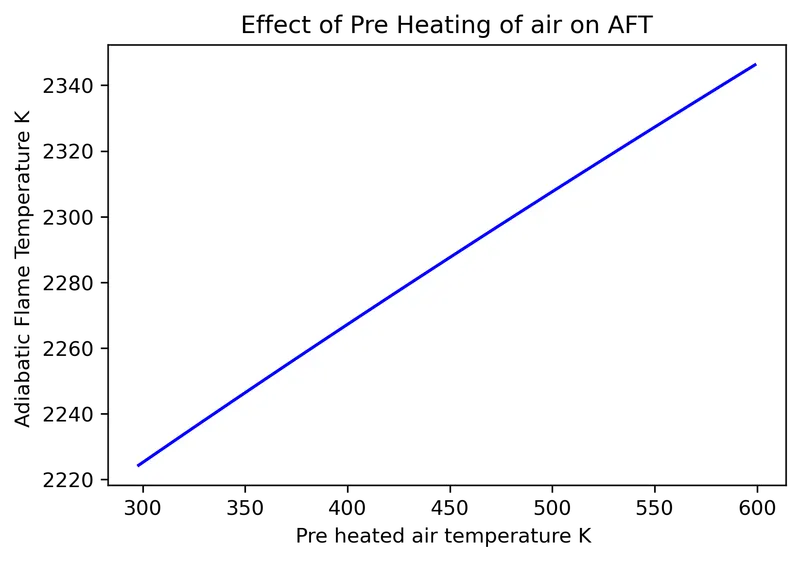
From the above plot we note that by pre heating, the adiabatic flame temperature increases. This can be attributed to dissociation and larger specific heat of product gases compared with air.
2. Impact of Preheating on efficiency and fuel heating
An energy balance of the system would yield
`dotm_(air)h_(air) +dotm_(fuel)h_(fuel) = Q_(output) + dotm_(exhaust)h_(exhaust)`
Solving for Q_output
`Q_(output)= dotm_(air)h_(air) +dotm_(fuel)h_(fuel)- (dotm_(air) +dotm_(fuel))*h_(exhaust)`
Value of Q on a per mass basis
`Q_(specific)= h_(fuel)+h_(air)*(A/F) - (1+(A/F))*h_(exhaust)`
In the above equation the enthalpy of fuel (h_fuel), air (h_air) and exhaust (h_exhaust) need to be determined. This is computed from the the Quantity class. The number of moles on the product side were computed assuming stoichiometric combustion.
Combustion efficiency is defined as
`eta= (Q_(specific)*100)/(LHV)`
Fuel Savings that can be relaized is given by
Savings= (1-(Qspecific, without pre heating)/(Qspecific, with pre heating))*100
Code which was used is given below.
# CH4 +2O2+7.52N2 - CO2 +2H2O +7.52N2 Stoichimetric Equation
import cantera as ct
import matplotlib.pyplot as plt
gas=ct.Solution('gri30.cti')
n_moles = 10.5
n_co2= 1/n_moles    #Computing number of moles of product assuming a stoichiometric combustion
n_h2o= 2/n_moles
n_N2= 7.52/n_moles

B=ct.Quantity(gas) # Mass and Enthalpy of fuel
B.TPX=298.15,ct.one_atm,{'CH4':1}
B.moles=1
fuel_m=B.mass
fuel_h=B.enthalpy_mass

C=ct.Quantity(gas) # Mass and enthaply of exhaust gases
C.TPX=1700,ct.one_atm,{'CO2':n_co2,'H2O':n_h2o, 'N2':n_N2}
C.moles = n_moles
exhaust_h= C.enthalpy_mass

LHV=50e6

T_pre=[]
eff=[]
fuel_save=[]
T_min = 298
T_max=600
for i in range(T_min,T_max,1):
    A=ct.Quantity(gas)     # Mass and enthaply of air at different temperatures
    A.TPX=i,ct.one_atm,{'O2':0.21,'N2':0.79}
    A.moles=9.52
    a_m= A.mass
    air_h= A.enthalpy_mass

    AF= a_m/fuel_m     # Air Fuel Ratio
    Qspec= fuel_h+AF*air_h-(1+AF)*exhaust_h # Computing Q specific
    eff.append((Qspec*100)/LHV)
    if i==298:
        Q_298=Q_spec
    fuel_save.append((1-Q_298/Qspec)*100)
    T_pre.append(i)

print("Efficiency without preheating is (T=298 K)", round(eff[0],4),"")
print("Efficiency with preheating is (T=600 K) ", round(eff[-1],4))
print("Fuel Saving with preheating is (T=600 K) ", round(fuel_save[-1],4))
plt.figure(1)
plt.plot(T_pre,eff,color='blue')
plt.title("Effect of Pre Heating of air on Efficiency")
plt.xlabel("Pre heated air temperature K ")
plt.ylabel("Efficiency % ")
plt.savefig('plot1.png', dpi=300, bbox_inches='tight')
plt.show()

plt.figure(2)
plt.plot(T_pre,fuel_save,color='red')
plt.title("Effect of Pre Heating of air on Fuel Savings")
plt.xlabel("Pre heated air temperature K ")
plt.ylabel("Fuel Savings ")
plt.savefig('plot2.png', dpi=300, bbox_inches='tight')
plt.show()
Impact of pre heating of air on efficiency
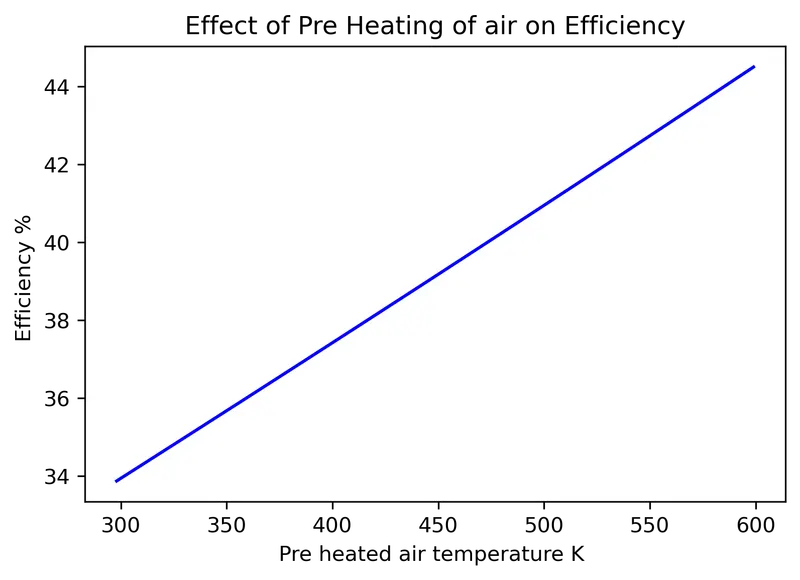
From the above plot we note that by pre heating the air the efficiency of the heat exchanger increases linearly. It is 34 % at 298 K and increases to 44 % at 600 K. Since we have considered a constant heat exhaust (at 1700 K), the work extracted is constant and fuel used to generate reduces. This leads to higher efficiency.
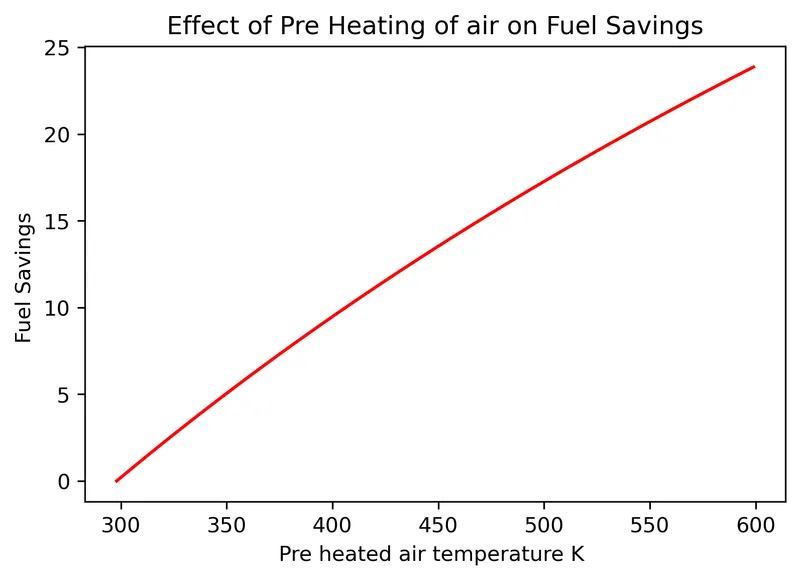
With the increase in efficiency, there is a corresponding increase in savings. The quantum of efficiency and savings are given below.
Efficiency without preheating is (T=298 K)=  33.8728 %
Efficiency with preheating is (T=600 K)=  44.4951 %
Fuel Saving with preheating is (T=600 K)=  23.8729 %

Preheating of air results in fuel savings of 24%, however one must be conscious of the incresed emission of pollutants at higher temperature.

For the purpose of modelling a combustion process it is right to assume a constant exhaust temperature as this would aid in making an optimal design of combustor and recuperator. However in practice, combustion chambers are seldom adiabatic and there is always a heat loss
Conclusion
It is noted that by pre heating, the adiabatic flame temperature and efficiency increase as a result of which fuel savings which are realized also increase.