Week 4.1 - Genetic Algorithm
AIM:
Write a code in MATLAB to optimise the stalagmite function and find the global maxima of the function.
INTRODUCTION:
- Genetic algorithm (GA) is a search based optimization tecqnique based on the principle of Genetic and Natural Selection.
- It is frequently used to find the optimal or near optimal solution for difficult problem.
- It is used to solve optimization problems,in research, and in machine learning.
HOW THE GENETIC ALGORITHM WORKS:
- The algorithm begins by creating a random initial population.
- Then it creates a sequence of new population.
- At each step, the algorithm uses individuals in the current generation creates the next population.
- To create a new population the algorithm performs the following steps.
- Each member in the current population is computed by fitness value. These values are called the raw fitness scores.
- The raw fitness scorss are converted into more usable range of values.These values are called expectional values.
- Some of the current population that have lower fitness are chosen as elite.These elite individuals are passed to the next population.
- Children are produced either by making random changes to a single parent,mutation,or by combinig the vector entries of a pair of parents.
- Replaces the current population with the children to form the next generation.
- The algorithm stops when one of the stopping criteria is complete.
OPERATORS OF GENETIC ALGORITHM:
- Selection Operator
- Crossover Operator
- Mutation Operator
SYNTAX FOR ga:
ga(@stalagmite,2,[],[],[],[],[0;0],[1;1],[],[],option)
ga(fun,nvars,A,b,Aeq,beq,lb,ub,nonlcon,options)
ga- To find the minimum of the function using genetic algorithm.
fun- Find a local minimum of the function
nvars- number of variables
A- linear inequality constraints,specified as real matrix
b- linear inequality constraints,specified as real vector
Aeq- linear equality constraints,specified as real matrix
beq- linear equality constraints,specified as real matrix
lb- lower bound
up- upper bound
nonlcon- nonlinear constraints,specified as function handle
option- optimization option,specified as the output
PROGRAM:
clear all
close all
clc

%defining our search space
x=linspace(0,0.6,150);
y=linspace(0,0.6,150);
num_cases = 50

%creating a 2d mesh
[xx ,yy]= meshgrid(x,y);

%evaluating the stalagmite function
for i=1:length(xx)
    for j=1:length(yy)
        input_vector(1)=xx(i,j);
        input_vector(2)=yy(i,j);
        input_vector=[input_vector(1),input_vector(2)];
        GA(i,j)=stalagmite(input_vector);
    end
end

%study_1 in unbounded condition

tic
for i=1:num_cases
    [input, GA_opt(i)] = ga(@stalagmite,2);
    xopt(i)=input(1);
    yopt(i)=input(2);
end
study_1_time = toc
%plot the graph
figure(1)
subplot(2,1,1)
hold on
surf(x,y,-GA)
shading interp
plot3(xopt,yopt,-GA_opt,'marker','o','markersize',5,'markerfacecolor','r')
title('Unbounded inputs')
subplot(2,1,2)
plot(-GA_opt)
xlabel('Iteration')
ylabel('Function maximum')

%study_2 upper and lower bounds

tic
for i=1:num_cases
    [input, GA_opt(i)]=ga(@stalagmite,2,[],[],[],[],[0;0],[0.6;0.6]);
    xopt(i)=input(1);
    yopt(i)=input(2);
end

study_2_time = toc
%plot the graph
figure(2)
subplot(2,1,1)
hold on
surfc(x,y,-GA)
shading interp
plot3(xopt,yopt,-GA_opt,'marker','o','markersize',5,'markerfacecolor','r')
title('Bounded inputs')
subplot(2,1,2)
plot(-GA_opt)
xlabel('Iteration')
ylabel('Function maximum')

%study_3 increasing GA iterations

options = optimoptions('ga');
options = optimoptions(options,'populationsize',240);
tic
for i=1:num_cases
    [input, GA_opt(i)]=ga(@stalagmite,2,[],[],[],[],[0;0],[0.6;0.6],[],[],options);
    xopt(i)=input(1);
    yopt(i)=input(2);
end

study_3_time = toc
%plot the graph
figure(3)
subplot(2,1,1)
hold on
surfc(x,y,-GA)
shading interp
plot3(xopt,yopt,-GA_opt,'marker','o','markersize',5,'markerfacecolor','r')
title('Bounded inputs')
subplot(2,1,2)
plot(-GA_opt)
xlabel('Iteration')
ylabel('Function maximum')

function[ga] = stalagmite(input_vectors)

x=input_vectors(1);
y=input_vectors(2);

term1 = pi*5.1*x;
term2 = pi*5.1*y;
term3 = ((x-0.0667)^2/0.64);
term4 = ((y-0.0667)^2/0.64);
term5 = (-4)*log(2);

xf1 = (sin(term1+0.5)).^6;
yf1 = (sin(term2+0.5)).^6;
xf2 = exp(term5*term3);
yf2 = exp(term5*term4);

ga=-(xf1*yf1*xf2*yf2);
end
OUTPUT:
EXPLANATION:
- First we initialise the values of x and y by taking 150 values between the interval o f 0 to 0.6.
- Then we consider the no of iterations as 50.
- Then we take a 2d array of x and y using meshgrid and store them in the input_vector array.
- Then another function is created for the stalagmite function.Here the output is taken as -GA since ga gives only the minimum valueof the function.So -GA automatically considered to give the maximum value.
- Using the genetic algorithm function the maxima is calculated and the output is stored in insputs.
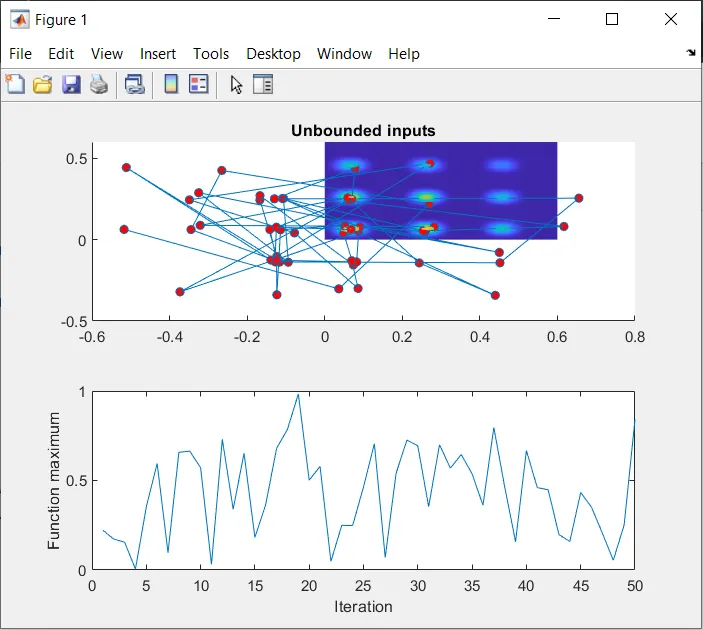
- In study 1 the iteration is done in unbounded conditions
- We use the plot3 command to make a plot of xopt,yopt and -GA_opt.
- To get the time taken for the complete cycle we uae the command tic toc
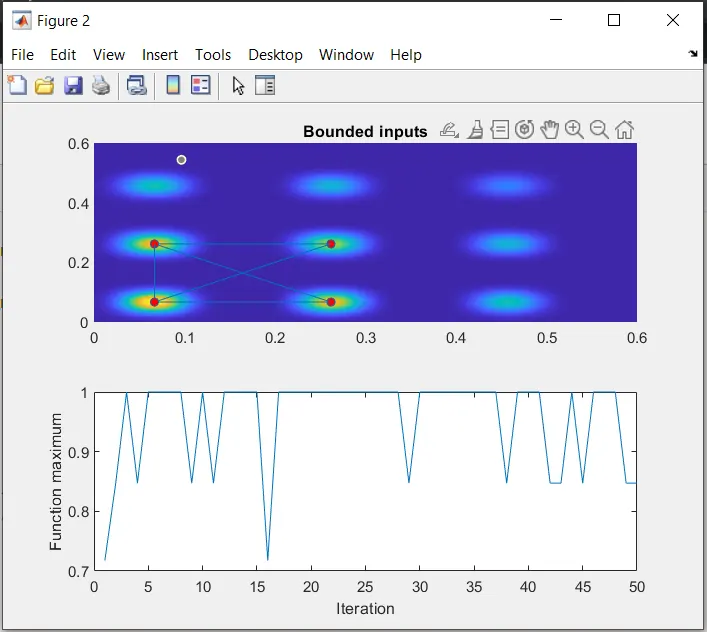
- In study 2 in takes place in bounded values.Here we specify the upper and lower values for x and y, and ga is initoated with random population only.
- Then the same plotting method is done to plot the graph.
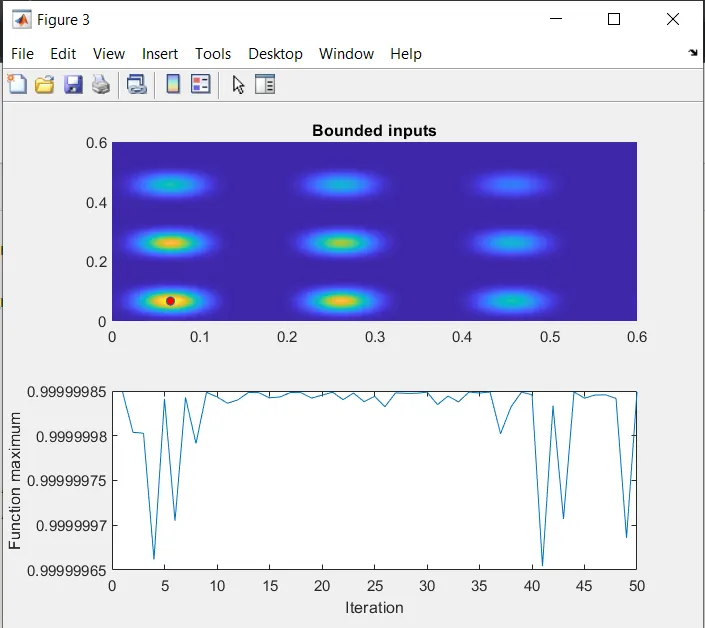
- In study 3 let us increase our initial population which is default as 50 to 250.
- The initial population is set my using the command called optimumopytions and get our value of populationsize to 250.
- Now the results are stored in and the graph is plotted as in the previous study.
ERROR:
Havnt got any error while running the program.
REFERENCES:
- https://in.mathworks.com/discovery/genetic-algorithm.html
- https://skill-lync.com/student-projects/matlab-code-to-optimize-the-stalagmite-function-and-find-the-global-maxima-of-the-function-using-genetic-algorithm
- https://skill-lync.com/student-projects/Matlab-code-to-optimise-the-stalagmite-function-and-find-theglobal-maximaof-the-function-52561