Week 4.1 - Genetic Algorithm
Aim-: Write a matlab code to optimise the stalagmite function and find the global maxima also to understand the concept of Ganetic Algorithm.
Theory & Introduction
Stalagmite Function: What is a Stalagmite? A stalagmite is a type of rock formation that rises from the floor of a cave due to the accumulation of material deposited on the floor from ceiling drippings. Stalagmites may be composed of lava, minerals, mud, peat, pitch, sand, sinter and amber
Ganetical Algorithm: In my word in Algorithm taking so many Random values like a ganes in body
that values undergo in algorithm that gives the global minima like best mutation of chromsome.Algorithm made by Dr. charles Darwin . Ganectical algorithm generate the population of a each point. Best point of the population aproches the best optimal solution for next generation
- They need the given components: A process of coding solutions to solve the problem of chromosomes. ...
- ANNs working principle: The working principle of a standard Genetic Algorithm is illustrated in the given figure. ...
- Difference between traditional and genetic approach: An algorithm is a progression of steps for solving a problem
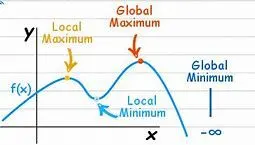
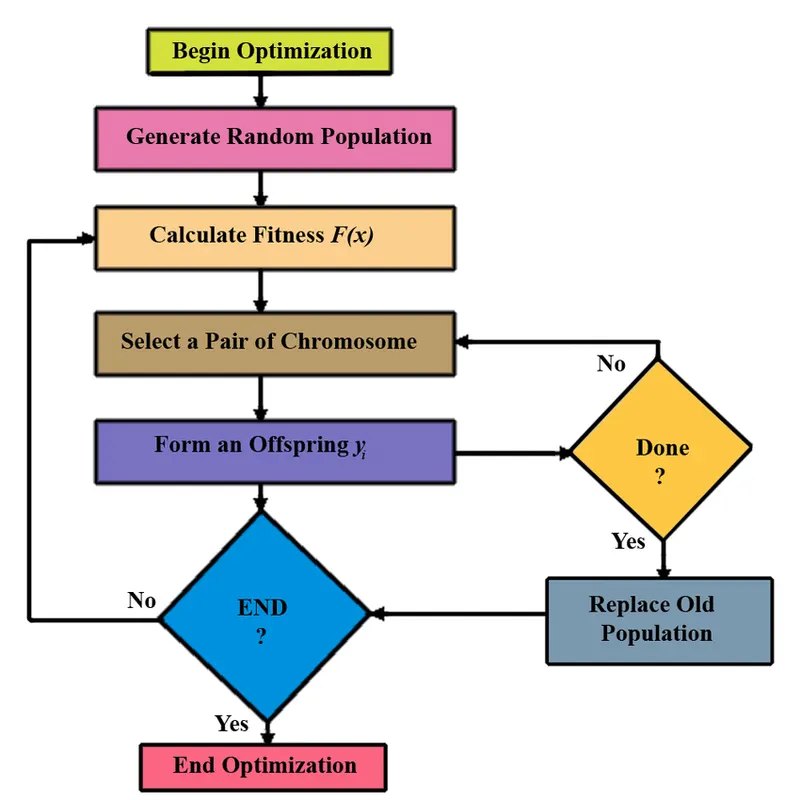
Genetic operators:-
- Selection – selection of random values to check global minimas & maximas,
--Crossover- combine two good value and compare values between both to check minimas & maximas
---Mutation – probability of selection of values to be low for good result
Method of mutation-
1. Bitwise method
2.Swap method
3.Inversion mutation
Syntax for GA-
x=ga(function, Nvar);
x=ga(function, Nvar,A,B);
x=ga(function, Nvar,A,B,Aeq,Beq,lb,ub);
x=ga(function, Nvar,A,B,Aeq,Beq,lb,ub,lnconst,nlnconst,options);
[inputs,f3_out(i)]=ga(@stalagmite,2,[],[],[],[],[0;0],[0.6;0.6],[],[],options)Nvar-no.of input variable-2
A- [] A matrix of linear inequlity equation
B- [] B vectors of linear inequlity equation
Aeq-[] linear equality
Beq-[] linear equality
lb- lower bound
ub- upper bound
lnconst-[]linear constraints
nlnconst-[]non-linear constraints
Mathematical Equation of Stalagmite Function
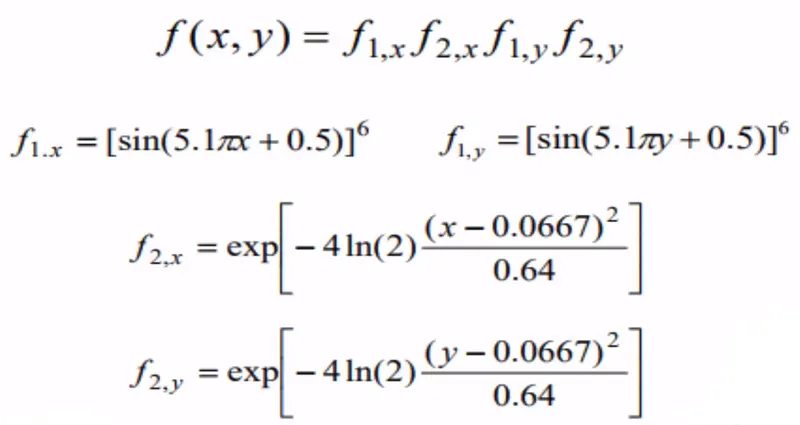
Matlab code for this-:
% program for stalagmite funtion
function solution= stalagmite(input)
 x=input(1);
 y=input(2);
f1x=(sin(((5.1*pi.*x)+0.5))).^6;
f2x= exp((((x-0.0667).^2).*(-4*log(2)))./0.64);
f1y= (sin(((5.1*pi.*y)+0.5))).^6;
f2y= exp((((y-0.0667).^2).*(-4*log(2)))./0.64);
solution=-((f1x)*(f2x)*(f1y)*(f2y));
end
Final matlab code to optimise the global maxima & Three study of graph plot b/w F maximum & no. of iteration--
explanation of case study in matlab program -
close all
clear all
clc
% defining our serach space
x=linspace(0,0.6,150);
y= linspace(0,0.6,150);
% creating 2-dimention data
[xx,yy]=meshgrid(x,y);
 % evaluating the stalagmite function
 for i=1:length(xx)
     for j=1:length(yy)
         input_vector(1)=xx(i,j);
         input_vector(2)=yy(i,j);
         f(i,j)=stalagmite(input_vector);
     end
 end
 [inputs,fval]=ga(@stalagmite,2);
 x_out=inputs(1);
y_out=inputs(2);
xlabel('x axis --')
ylabel('y axis--')

 % case 1 study
 % finding a GA for limited no.of iterations without any specific
 % boundaries , As GA works for random values so itmay consider values
 % which are outside the our concern area and run for many values and
 % slow the compiling of program sp we are constraning the no.of run it as follow.
 Num_itr=40;
 tic % used for calculating the time loop takes complete compiling
 for i=1:Num_itr
     [inputs,f1_out(i)]=ga(@stalagmite,2); % funtion that solve the local mainimas

      x1(i)=inputs(1);
      y1(i)=inputs(2);
 end
 study_time1=toc % calculate compile time
  figure(1)
   subplot(2,1,1) % subplot is used to plot 2 representation in single image
  hold on
  surfc(xx,yy,-f)
  shading interp % create a smooth surface instead of having grid line
  plot3(x1,y1,-f1_out,'marker','o','MarkerSize',5,'MarkerFaceColor','r') % plot3 use for 3 axis point
  title('Unbounded inputs')
  subplot(2,1,2) % ploting 2nd image for same image
  plot(-f1_out)
  xlabel('No.of iteration')
  ylabel('function maximas')

  % case 2 study
 % finding a GA for limited no.of iterations with
 % boundaries , As GA works for random values
 % which are inside the our concern area and run for many values and
 % slow the compiling of program sp we are constraning the no.of run it as follow.
 Num_itr=40;
 tic % used for calculating the time loop takes complete compiling
 for i=1:Num_itr
     [inputs,f2_out(i)]=ga(@stalagmite,2,[],[],[],[],[0;0],[0.6;0.6]); % funtion that solve the local mainimas

      x2(i)=inputs(1);
      y2(i)=inputs(2);
 end
 study_time2=toc % calculate compile time
  figure(2)
  subplot(2,1,1) % subplot is used to plot 2 representation in single image
  hold on
  surfc(xx,yy,-f)
  shading interp % create a smooth surface instead of having grid line
  plot3(x2,y2,-f2_out,'marker','o','MarkerSize',5,'MarkerFaceColor','r') % plot3 use for 3 axis point
  title('bounded inputs')
  subplot(2,1,2) % ploting 2nd image for same image
  plot(-f2_out)
  xlabel('No.of iteration')
  ylabel('function maximas')


   % case 3 study
 % finding a GA for limited no.of iterations with bounded values controlled
 % population size,  As GA works for random values which are inside  the
 % our concern area with controlled size and run for many values and
 % slow the compiling of program sp we are constraning the no.of run it as follow.
 Num_itr=40;
 options=optimoptions('ga');   % read the GA program & gives only optimum values
 options=optimoptions(options,'PopulationSize',200); %optimum values with controlled size
 tic % used for calculating the time loop takes complete compiling
 for i=1:Num_itr
     [inputs,f3_out(i)]=ga(@stalagmite,2,[],[],[],[],[0;0],[0.6;0.6],[],[],options); % funtion that solve the local mainimas

      x3(i)=inputs(1);
      y3(i)=inputs(2);
 end
 study_time3=toc % calculate compile time
  figure(3)
  subplot(2,1,1) % subplot is used to plot 2 representation in single image
  hold on
  surfc(xx,yy,-f)
  shading interp % create a smooth surface instead of having grid line
  plot3(x3,y3,-f3_out,'marker','o','MarkerSize',5,'MarkerFaceColor','r') % plot3 use for 3 axis point
  title('bounded inputs with controlled population size')
  subplot(2,1,2) % ploting 2nd image for same image
  plot(-f3_out)
  xlabel('No.of iteration')
  ylabel('function maximas')
workspace data-
MATLAB Workspace Page 1
May 28, 2022 1:54:17 PM
Name          Value
f            150x150 double
f1_out       1x40 double
f2_out       1x40 double
f3_out       1x40 double
fval         -0.2061
i             40
input_vector [0.6000,0.6000]
inputs       [0.0668,0.0668]
j             150
Num_itr       40
options       1x1 GaOptions
study_time1   9.9324
study_time2   15.1778
study_time3   39.4638
x             1x150 double
x1            1x40 double
x2            1x40 double
x3            1x40 double
x_out        -0.2901
xx            150x150 double
y             1x150 double
y1            1x40 double
y2            1x40 double
y3            1x40 double
y_out          0.0712
yy            150x150 double
output of a code :-
study first - select a random values without a boundries to optimise the data to gain local maxima
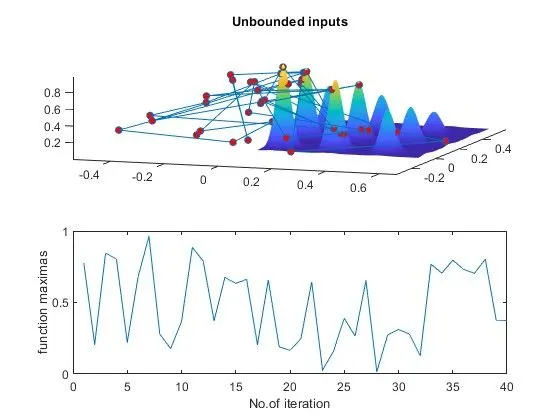
study two- select a values for cross over & mutation with a boundry condition that is inside the stalagmite curve.
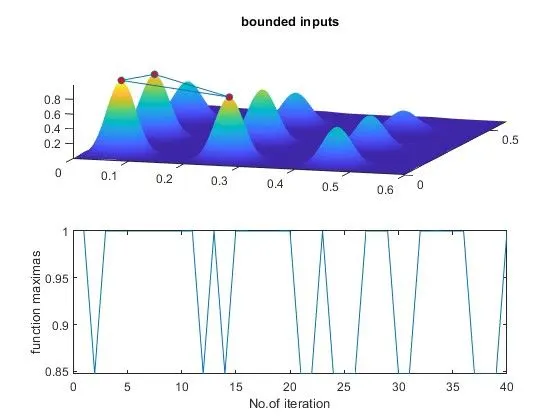
study three- : select a values for crossover & mutation to check global maxima in forty no. of iterations that are controlled
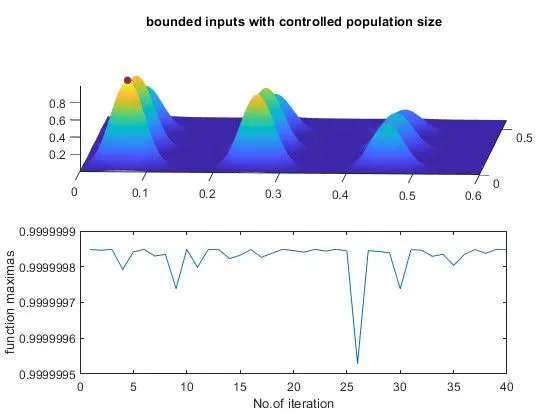
Error comes - becuase of using negative sign in function calling output -f1_out(i)
MATLAB Command Window Page 6
Warning: Unable to copy the figure to the clipboard. Increasing the Java Heap Size
setting in the MATLAB preferences may help;
otherwise try saving to a file or choose a different clipboard format.
Error while evaluating ButtonPushedFcn for axes toolbar.
>> stalagmite_model
Error: File: stalagmite_model.m Line: 31 Column: 14
Assigning the function output to this expression is not supported.
This Error overcome by Replacing negative sign from calling function output
[inputs,f1_out(i)]=ga(@stalagmite,2);
Result- find Global maxima of stalagmite function with use of ganetic Algorithm in matlab
Refrences
www.google com.