Week 4.1 - Genetic Algorithm
AIM:-
To understand the concept of the genetic algorithm by referring to various sources before you attend this challenge. Look out for information regarding the stalagmite function and ways to optimize it.
OBJECTIVES:-
- Write a code in MATLAB to optimize the stalagmite function and find the global maxima of the function.
- Clearly explain the concept of genetic algorithm in your own words and also explain the syntax for ga in MATLAB in your report.
- Make sure that your code gives the same output, even if it is made to run several times.
- Plot graphs for all 3 studies and for F maximum vs no. of iterations. Title and axes labels are a must, legends could be shown if necessary.
THEORY:-
What is a Genetic Algorithm:-
A genetic algorithm (GA) is a method for solving both constrained and unconstrained optimization problems based on a natural selection process that mimics biological evolution. The algorithm repeatedly modifies a population of individual solutions. At each step, the genetic algorithm randomly selects individuals from the current population and uses them as parents to produce the children for the next generation. Over successive generations, the population "evolves" toward an optimal solution.
You can apply the genetic algorithm to solve problems that are not well suited for standard optimization algorithms, including problems in which the objective function is discontinuous, nondifferentiable, stochastic, or highly nonlinear.
The genetic algorithm differs from a classical, derivative-based, optimization algorithm in two main ways, as summarized below.
Classical Algorithm:-
- Generates a single point at each iteration.
- The sequence of points approaches an optimal solution.
- Selects the next point in the sequence by a deterministic computation.
Genetic Algorithm:-
- Generates a population of points at each iteration.
- The best point in the population approaches an optimal solution.
- Selects the next population by computation which uses random number generators.
Stopping Criteria of Genetic Algorithm:-
Proof of convergence of an algorithm to an optimal solution is very important as it assures the optimal solution in infinite iterations. When an algorithm does not assure or guarantee the optimal solution even after running for infinite iterations, its utility is in doubt. Once the convergence of an algorithm is assured, the focus turns into the exploration of the stopping time or stopping criterion of the algorithm. Today, the biggest challenge in the implementation of GAs is to decide when to stop the algorithm keeping in mind that there is no a-prior information regarding the objective function. Attempts have been made to provide stopping criteria of a GA based on the time the algorithm is being executed and obtained objective function values or their distribution [11, 8, 12]. Time-based stopping criteria are mainly of two kinds. The popular one is to decide upfront the number of iterations to be executed. Another is based on the execution time of the algorithm. An algorithm is run for a predetermined period and gets the result. Though these criteria are very simple to implement but determining the time is again a challenge.
The theoretical study brings out a number of limitations in defining a stopping criterion. Some desirable properties of a ”good” stopping criterion are given below.
• Easy to implement.
• Able to provide stopping time automatically for any fitness function.
• Should lead to ’good’ / ’satisfactory’ results.
• Total number of strings searched should not exceed 2L
Where GA is used?
Genetic Algorithms are primarily used in optimization problems of various kinds, but they are frequently used in other application areas as well. The areas in which Genetic Algorithms are frequently used are listed below.
Optimization - Genetic Algorithms are most commonly used in optimization problems wherein we have to maximize or minimize a given objective function value under a given set of constraints.
• Economics - GAs are also used to characterize various economic models like the cobweb model, game theory equilibrium resolution, asset pricing, etc.
• Neural Networks - GAs are also used to train neural networks, particularly recurrent neural networks.
• Image Processing - GAs are used for various digital image processing (DIP) tasks as well as dense pixel matching.
The above are some of the areas where the Genetic Algorithm is extensively used for optimization.
Syntax of Genetic Algorithm:-
x = ga(fun,nvars)finds a local unconstrained minimum,x, to the objective function,fun.nvarsis the dimension (number of design variables) offun.x = ga(fun,nvars,A,b,Aeq,beq)finds a local minimumxtofun, subject to the linear equalitiesAeq*x=beqandA*x≤b. (SetA=[]andb=[]if no linear inequalities exist.)gaevaluates the matrix productAeq*xas ifxis transposed (Aeq*x')x = ga(fun,nvars,A,b,Aeq,beq,lb,ub)defines a set of lower and upper bounds on the design variables,x, so that a solution is found in the rangelb≤x≤ub. (SetAeq=[]andbeq=[]if no linear equalities exist.x = ga(fun,nvars,A,b,Aeq,beq,lb,ub,nonlcon)subjects the minimization to the constraints defined innonlcon. The functionnonlconacceptsxand returns vectorsCandCeq, representing the nonlinear inequalities and equalities respectively.gaminimizes thefunsuch thatC(x)≤0andCeq(x) = 0. (Setlb=[]andub=[]if no bounds exist.)x = ga(fun,nvars,A,b,Aeq,beq,lb,ub,nonlcon,options)minimizes with the default optimization parameters replaced by values inoptions. (Setnonlcon=[]if no nonlinear constraints exist.) Createoptionsusing optimization.x = ga(orfun,nvars,A,b,Aeq,beq,lb,ub,nonlcon,intcon)x= ga(fun,nvars,A,b,Aeq,beq,lb,ub,nonlcon,intcon,options)intcontake integer valuesx = ga(problem)find the minimum for, a structure described in the problem.[x,fval] = ga(___), for any previous input arguments, also returnsfval, the value of the fitness function at x[x,fval,exitflag,output] = ga(___)also returnsexitflag, an integer identifying the reason the algorithm terminated, andoutput, a structure that contains output from each generation and other information about the performance of the algorithm.[x,fval,exitflag,output,population,scores] = ga(___)also returns a matrixpopulation, whose rows are the final population, and a vectorscores, the scores of the final population.
MATLAB PROGRAMMING:-
Function Code:-
- here the stalagmite function consists of 4 different functions which have been calculated separately along with their product as f which we can see in the above code.
- This function helps us to get the values of the global minima and global maxima of a stalagmite function when called upon in the main program as a function code.
- However, with this function, it gives us the global maxima whereas in other cases, when we want to achieve the global minima, there is a slight difference where we remove the -ve sign on the output variable notation.
% function of stalagmite

function  f=stalagmite(input_vector)
x=input_vector(1);
y=input_vector(2);
f1 = (sin(5.1*pi*x+0.5))^6;
f2= (sin(5.1*pi*y+0.5))^6;

f3= exp(-4*log(2)*((x-0.0667)^2)/(0.64));
f4= exp(-4*log(2)*((y-0.0667)^2)/(0.64));

f= -(f1*f2*f3*f4);
end
Main Code:-
- The main program consists of three different studies with these we are able to get the values of global minima and global maxima.
- For the first case, statistical behavior is checked where no values of bounds are provided.
- For the second case, statistical behavior is checked where values of upper and lower bounds are provided.
- And for the third case, the genetic algorithm interactions are increasing to get the values of global minima and global maxima.
- To reduce the run time of the given program it's best to run individual cases at a time with this the output we get is easy to study.
- The main code is given below.
clear all
close all
clc

% Defining our search space
x = linspace(0,0.6,150);
y = linspace(0,0.6,150);
num_cases = 50;

% creating 2D array using meshgrid
[xx,yy] = meshgrid(x,y);

% evaluating the stalagmite function
for i=1:length(xx)
    for j=1:length(yy)
        input_vector(1)=xx(i,j);
        input_vector(2)=yy(i,j);
        f(i,j)=stalagmite(input_vector);
    end
end
tic

% study 1 - satistical behavior
for i=1:num_cases
    [inputs,fopt1(i)] = ga(@stalagmite,2);
    xopt1(i) = inputs(1);
    yopt1(i) = inputs(2);
end

study1_time = toc;

figure(1)
subplot(2,1,1)
hold on
surfc(x,y,f)
shading interp
plot3(xopt1,yopt1,fopt1,'marker','o','markersize',5,'markerfacecolor','r')
title('Unbounded inputs')
subplot(2,1,2)
plot(fopt1)
xlabel('Iterations')
ylabel('Function minimum')

tic

% study 2 - satistical behavior - with upper and lower bounds

for i = 1:num_cases
    [inputs,fopt2(i)] = ga(@stalagmite,2,[],[],[],[],[0;0],[0.6;0.6]);
    xopt2(i) = inputs(1);
    yopt2(i) = inputs(2);
end

study2_time = toc;

figure(2)
subplot(2,1,1)
hold on
surfc(x,y,f)
shading interp
plot3(xopt2,yopt2,fopt2,'marker','o','markersize',5,'markerfacecolor','r')
title('Unbounded inputs')
subplot(2,1,2)
plot(fopt2)
xlabel('Iterations')
ylabel('Function minimum')

% study 3 - increasing GA interactions

options = optimoptions('ga','PopulationSize',150);

tic

for i = 1:num_cases
    [inputs,fopt3(i)] = ga(@stalagmite,2,[],[],[],[],[0;0],[0.6;0.6],[],[],options);
    xopt3(i) = inputs(1);
    yopt3(i) = inputs(2);
end

study3_time = toc;

figure(3)
subplot(2,1,1)
hold on
surfc(x,y,f)
shading interp
plot3(xopt3,yopt3,fopt3,'marker','o','markersize',5,'markerfacecolor','r')
title('Unbounded inputs')
subplot(2,1,2)
plot(fopt3)
xlabel('Iterations')
ylabel('Function minimum')
After running the program we got three outputs for our main programming, the output result is explained below.
RESULTS/OUTPUT:-
1. FOR THE FIRST CASE:-
- For the first case we are going to analysis of genetic algorithm for statistical behaviour.
- Here for loop is used in this for loop we used ga command on stalagmite function to reduce the variation of functions.
- We used tic and tac command to provide time taken on a program to run.
- subplot command is used to display output in one single window.
- Here by providing negative value (-ve) we can get global maxima as we mention early in the theoretical part.
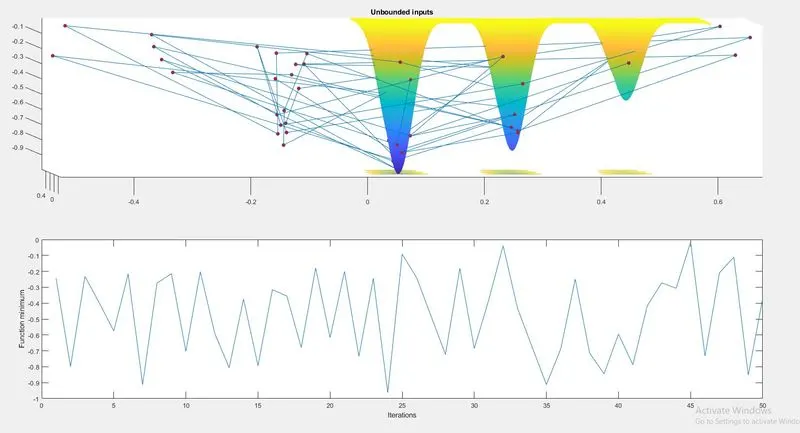
- here as we can see from the above result, the iterations are generating a lots of values causes a variations.
- To get the less iterations values and less variations we need to provide some values at their bounds.
- It is impossible to get the exact global maxima due to lots of values.
2. FOR THE SECOND CASE:-
- For the second case we are going to analysis of genetic algorithm for statistical behaviour with upper bound and lower bound.
- With the help of upper and lower bounds we get the better result as compared to the first case.
- All the process is same as first case except the UB and LB values are provided as [inputs,fopt2(i)] = ga(@stalagmite,2,[],[],[],[],[
0;0],[0.6;0.6]);
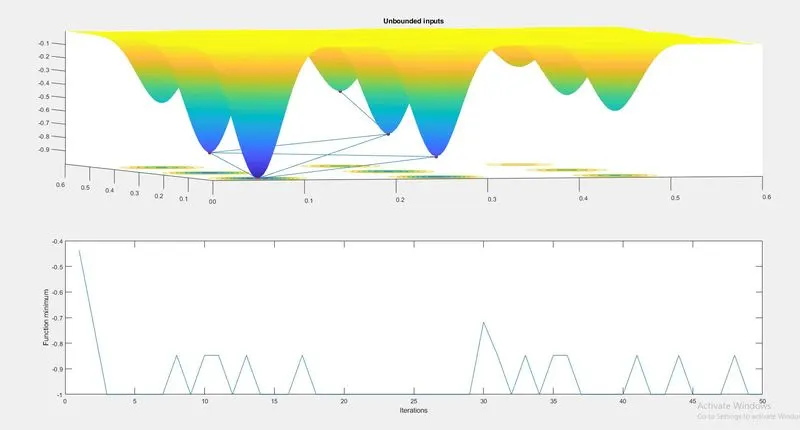
- Here as we can see from the result the iterations are generating less values as compared to the first case
- Becouse of this variations are also less.
- Only five iterations values are generating here because of this it is easy to find local and global maxima.
- just because we provided upper and lower bounds we are able to get this much of less values.
3. FOR THE THIRD CASE:-
- For the third case we are going to analysis of genetic algorithm for increasing genetic iterations.
- All the process is same as second case except the GA iterations are increasing.
- the GA syntax we used is [inputs,fopt3(i)] = ga(@stalagmite,2,[],[],[],[],[
0;0],[0.6;0.6],[],[],options); - Here option is helps us to increase the population to increase the size.
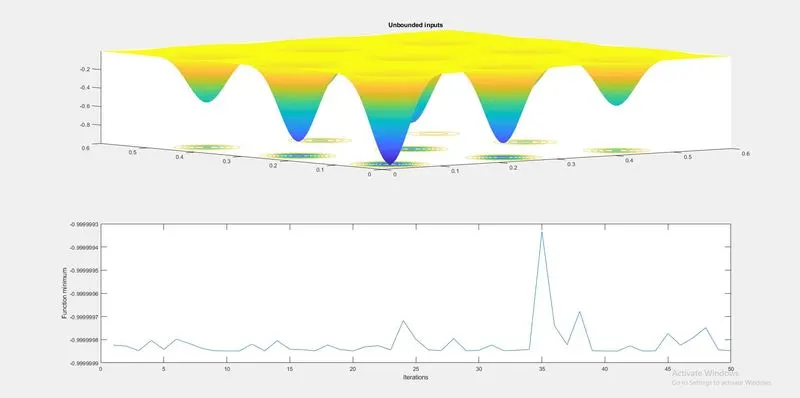
- Here as we can see from the result the iterations are generating only one values compared to the second case.
- here we get the only one global point for global maxima .
- Also the variation is less than second case.
- This is how genetic algorithm is performed on different values to get the exact one global maxima.
CONCLUSION:-
Here with the help of MATLAB we understand the concept of the genetic algorithm by referring to various sources before you attend this challenge and successfully get the value of global maxima.
REFERANCES:-
- Matlab Documantion : https://in.mathworks.com/discovery/genetic-algorithm.html