Week 3 Verification of Weld Joints
Verification of weld joints
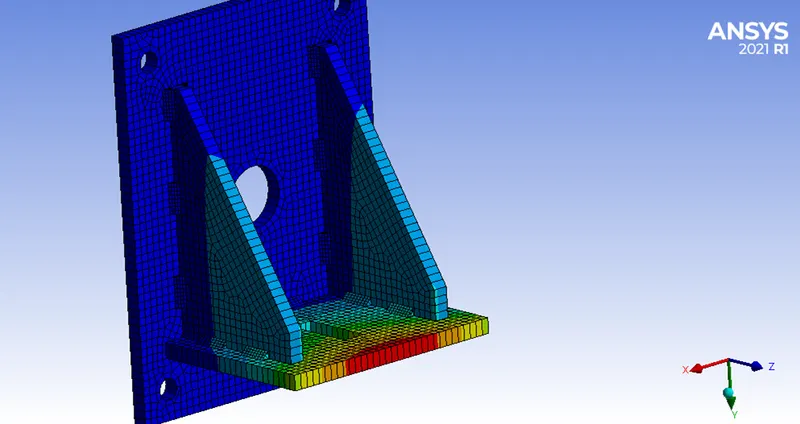
Introduction:
In this paper the structural analysis of the load carrying design is analyzed by varying the materials of the weld. In three different cases, the material properties are varied for base plate and weld joint. From those cases, it is found that case 2 with aluminum alloy steel will experience maximum equivalent stress with maximum directional deformations and equivalent strain.
Model preparation:
Material Assignment:
- Case 1:
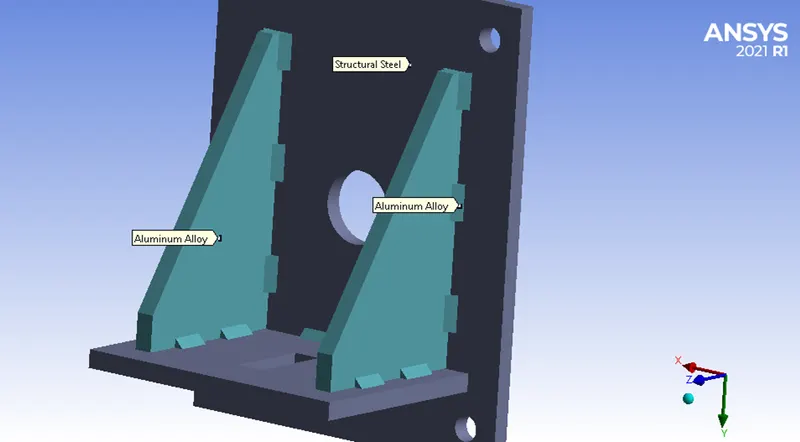
In this case, the plates are assigned the structural steel whereas weldments and ribs are assigned with Aluminum alloy.
- Case 3:
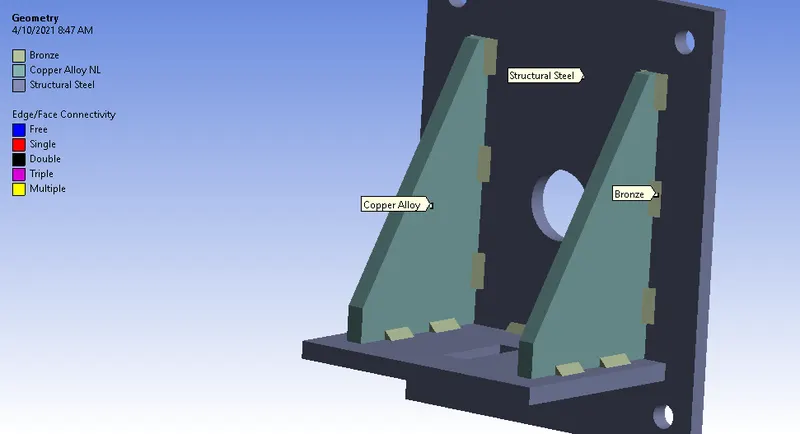
In case 3, the parts are assigned as shown in the above image. The plates are assigned with structural steel, ribs are assigned with copper alloy and weldments are assigned with bronze.
Boundary Conditions:
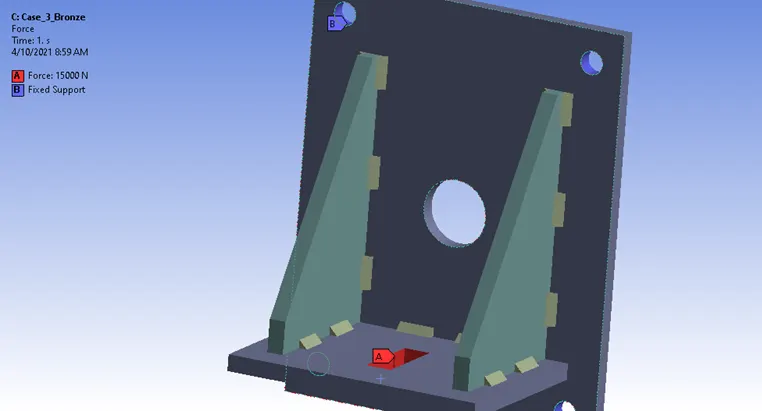
This structure is subjected to the fixed support at the four holes of the plates and force is applied to the rectangular hole of the plate which equals to the 15000 N.
Comparisons:
|
Parameters/ Cases |
Case 1 |
Case 2 |
Case 3 |
|
Directional Deformation (mm) |
0.4025 |
0.5104 |
0.4675 |
|
Equivalent Strain (mm) |
0.00212 |
0.00351 |
0.00319 |
|
Highest equivalent Stress (MPa) |
395.43 |
410.49 |
405.85 |
Case 1 is completely assigned with structural steel which have higher modulus of elasticity. Hence, obviously, it will resist higher force and deform less under the application of external load. Indeed, it is verified in above comparison table. In Case 2, the deformation, equivalent strain and equivalent stress is higher compared to case 1 and case 3 as delineated in the table above. The directional deformation in case 1 is much lower because of the structural steel (welding metal) which have higher capacity to resist deformation. The weld metal assigned with aluminum has higher deformation because it has lower value of stiffness compared to bronze and structural steel and hence less resistant to the deformations.
Positions of maximum stress:
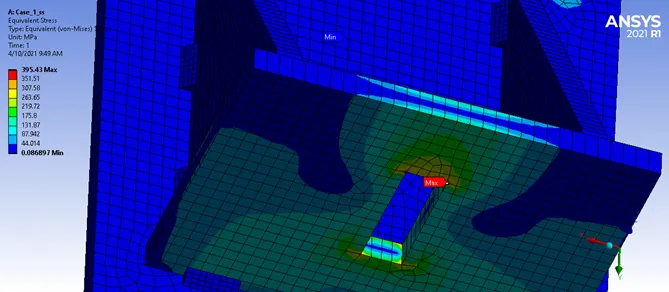
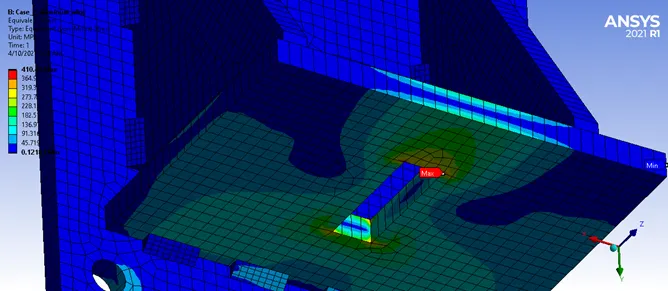
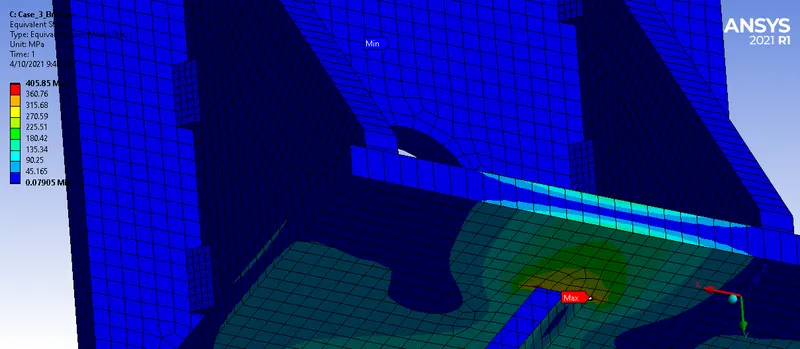
From above picture, we can say that despite the variation in metal of the part of the structure. The maximum stress is acting near the rectangular hole where the force is subjected.
Positions of maximum equivalent strain:
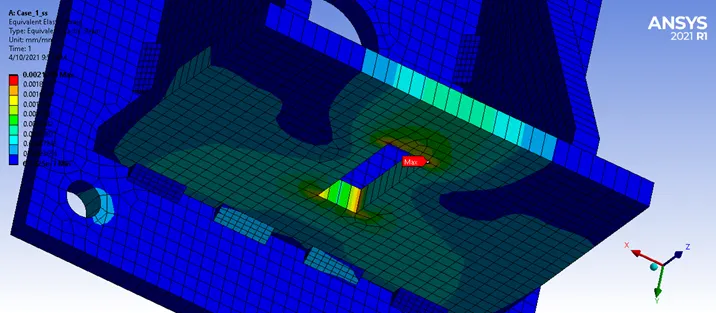
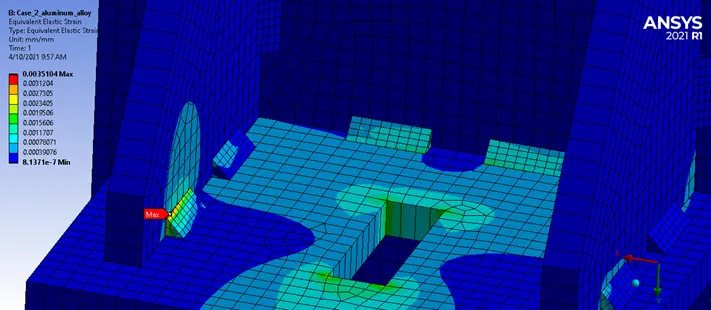
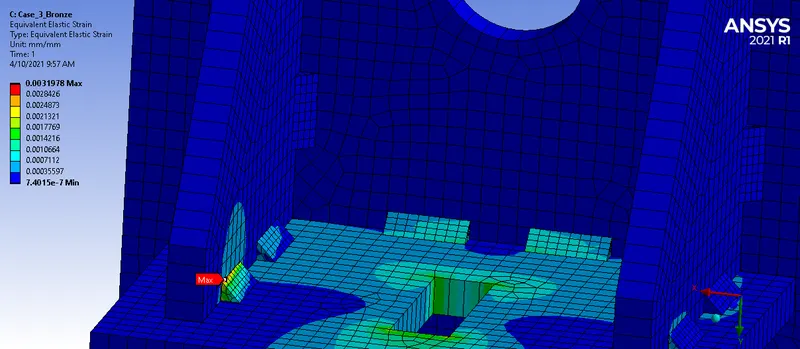
From above picture, we can conclude that the maximum strain is acting on the weld metal in case 2 and case 3 because the metal have lower strength compared to the structural steel. In case 1 as the parts are completely made of structural steel, the maximum strain is occurring where the load is applied.
Learning Outcomes:
- The effect of varying the metal properties on stress and strain
Conclusions:
From above study, we conclude that the structural steel will face the reduced stress and strains on the part due higher stiffness value where the part made of other metal like aluminum and bronze will experience higher stress and strain on the parts.