Week 3 - Solving second order ODEs
function[dtheta_dt]=ode_func(t,theta,b,g,l,mass)

theta1=theta(1);
theta2=theta(2);
dtheta1_dt=theta2;
dtheta2_dt=-(b/mass)*theta2-(g/l)*sin(theta1);
dtheta_dt=[dtheta1_dt;dtheta2_dt];
end
% Second order ODE function
clear all
close all
clc

%inputs
b=0.05;%damping coefficient
g=9.81;%acceleration due to gravity
l=1;%length of the string
mass=0.1;%mass of the pendulum

% Initial condition
theta_0=[0;5];

% time points
t_span=linspace(0,10,800);

% Solve ODE
[t,y]=ode45(@(t,theta)ode_func(t,theta,b,g,l,mass),t_span,theta_0);

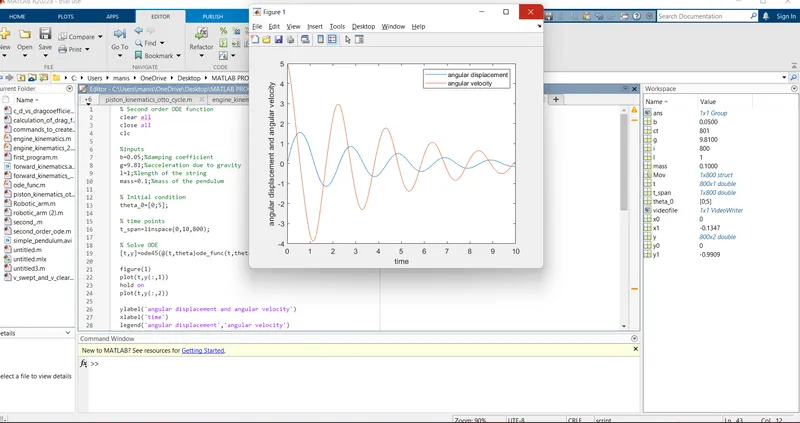
figure(1)
plot(t,y(:,1))
hold on
plot(t,y(:,2))

ylabel('angular displacement and angular velocity')
xlabel('time')
legend('angular displacement','angular velocity')

%% animation
ct=1;
for i=1:length(t_span)
    x0=0;
    y0=0;

    x1=1*sin(y(i,1));
    y1=-1*cos(y(i,1));

    %pendulum motion simulation

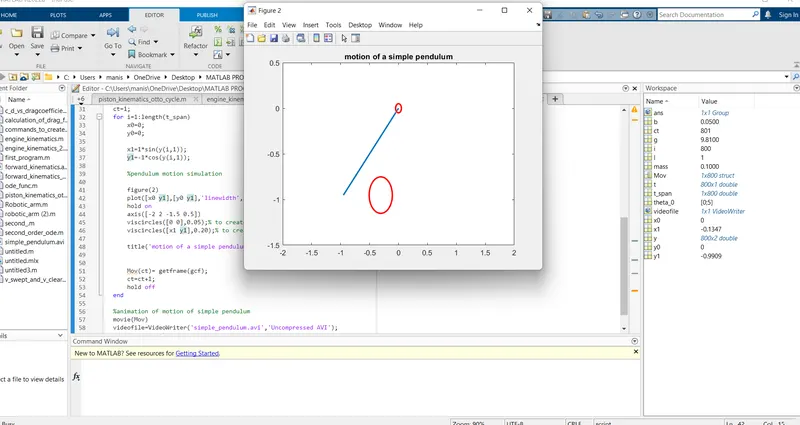
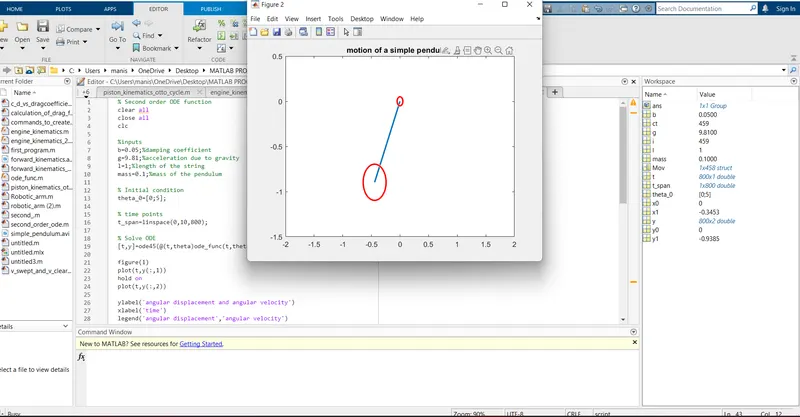
    figure(2)
    plot([x0 x1],[y0 y1],'linewidth',2)
    hold on
    axis([-2 2 -1.5 0.5])
    viscircles([0 0],0.05);% to create a rigid hook
    viscircles([x1 y1],0.20);% to create a pendulum ball

    title('motion of a simple pendulum')


    Mov(ct)= getframe(gcf);
    ct=ct+1;
    hold off
end

%animation of motion of simple pendulum
movie(Mov)
videofile=VideoWriter('simple_pendulum.avi','Uncompressed AVI');
open(videofile)
writeVideo(videofile,Mov)
close(videofile)
YOUTUBE LINK FOR THE VIDEO:
EXPLANATION OF CODE:
1.start the code with clear all,close all,clc
2.the inputs are given as follow
%inputs
b=0.05;%damping coefficient
g=9.81;%acceleration due to gravity
l=1;%length of the string
mass=0.1;%mass of the pendulum
with x0 and y0 being 0,0 and x1,y1 being
3.x1=1*sin(y(i,1));
y1=-1*cos(y(i,1));
4.the initial condition of theta starts from 0 to 5.
5.the timespan is given from 0 to 10 with 800 divisions using linspace.
6.before solving the 2nd order ode we have to declare the function in ode45
7.the function is used to formulate the 2nd order ode formula such as
function[dtheta_dt]=ode_func(t,theta,b,g,l,mass)
theta1=theta(1);
theta2=theta(2);
dtheta1_dt=theta2;
dtheta2_dt=-(b/mass)*theta2-(g/l)*sin(theta1);
dtheta_dt=[dtheta1_dt;dtheta2_dt];
end
8.we know that
d2theta/dt2+b/m(dtheta/dt)+g/l(sin(theta))=0
b=length
m=mass
g=gravity
l=length
theta=theta(1)
dtheta/dt=dtheta1/dt=theta2
d2theta/dt2=d2theta1/dt2=d/dt[dtheta1/dt]=d/dt(theta2)
9.d2theta/dt2+b/m(dtheta/dt)+g/l(sintheta)=0
d2theta1/dt2+b/m(dtheta1/dt)+g/l(sintheta1)=0
dtheta2/dt+b/m(theta2)+g/l(sintheta1)=0
dtheta1/dt=theta2
dtheta2/dt=(-b/m)-(g/l)sintheta1
10. the above formula was formulated in function and was declared in the ode45.
the ode45 function is used to solve the two input arguments such as t and y.
by declaring the function as follows
[t,y]=ode45(@(t,theta)ode_func(t,theta,b,g,l,mass),t_span,theta_0);
11.we now go to plot the ode and animate it
by using the below command
figure(1)
plot(t,y(:,1))
hold on
plot(t,y(:,2))
ylabel('angular displacement and angular velocity')
xlabel('time')
legend('angular displacement','angular velocity')
12.%% animation
ct=1;
for i=1:length(t_span)
x0=0;
y0=0;
x1=1*sin(y(i,1));
y1=-1*cos(y(i,1));
13.%pendulum motion simulation
figure(2)
plot([x0 x1],[y0 y1],'linewidth',2)
hold on
axis([-2 2 -1.5 0.5])
the axis starts from -2 to 0.5
viscircles([0 0],0.05);% to create a rigid hook
viscircles([x1 y1],0.20);% to create a pendulum ball
14.viscircles is used for giving definite radii to a circle and shape
title('motion of a simple pendulum')
15.Mov(ct)= getframe(gcf);
ct=ct+1;
hold off
end
%animation of motion of simple pendulum
movie(Mov)
videofile=VideoWriter('simple_pendulum.avi','Uncompressed AVI');
open(videofile)
writeVideo(videofile,Mov)
close(videofile)
errors i faced:
1.the string was not moving towards x axis but it was only moving in y axis
resolving the error:
1.the points i declared was not correct
such as
plot([x0 y1],[y0 y1],'linewidth',2)
i declared y1 instead of x1
corrected one-
plot([x0 x1],[y0 y1],'linewidth',2)